
Hire a dedicated October CMS developer for a backend your team can trust
Hire a dedicated October CMS developer through Codeblix to implement a defined website or plugin backlog. Start with the installed release, the backend task that needs changing and the result your operators must be able to verify. Commission plugin models, relation editing, components or theme work with agreed allocation and release responsibilities. The consultation establishes project fit, available capacity and a quotation tied to your acceptance cases.
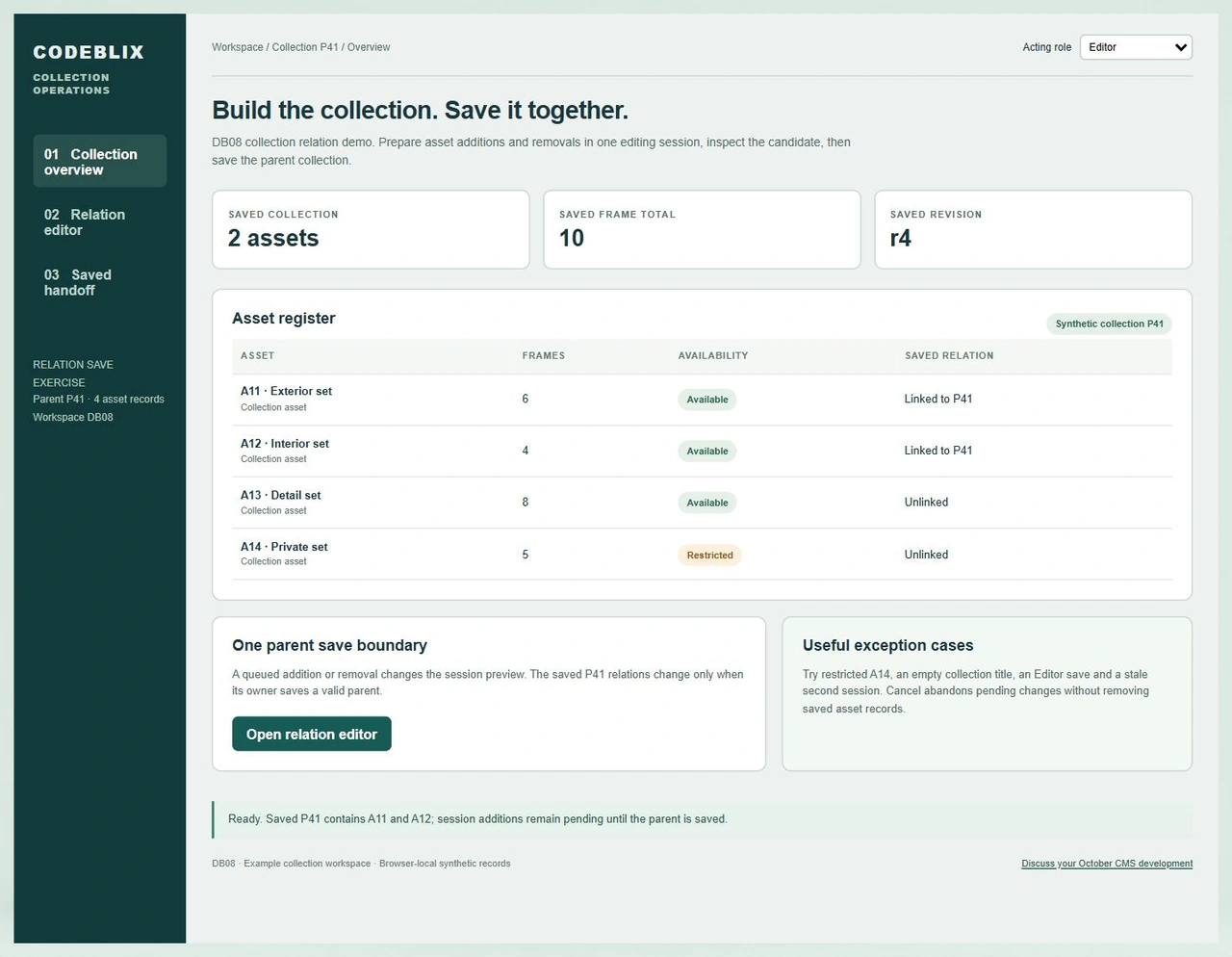
Connect developer time to observable record behaviour.
A useful engagement brief explains what a user can change, when those changes become durable and which failures must leave the existing records intact.
Make the save boundary explicit
Identify the parent record and the relations edited through its form. Decide which operations are immediate and which stay pending until the parent is saved. Include a cancelled form and a failed parent validation in the acceptance examples so a relation preview cannot be mistaken for a completed update.
Distinguish removing a relation from deleting an asset
An operator may need to remove an image set from a collection while keeping the underlying asset available elsewhere. Specify whether the relationship, the related object or both should change. The developer needs the relation type, ownership rules and reuse requirements before implementing the toolbar actions.
Preserve another operator’s completed work
Describe what happens when two forms start from the same saved record. DB08 keeps separate editing sessions and rejects a save based on an older revision. Bring your expected conflict, reload and recovery behaviour to the consultation so the installed implementation has a deliberate concurrency policy.
See what changes now and what waits for the parent save.
DB08 is an interactive collection workspace. Queue a new asset, remove an existing relation and inspect the pending result. A permitted owner saves the parent and its relations together; another session must reload before overwriting that revision.
Try the collection save exercise
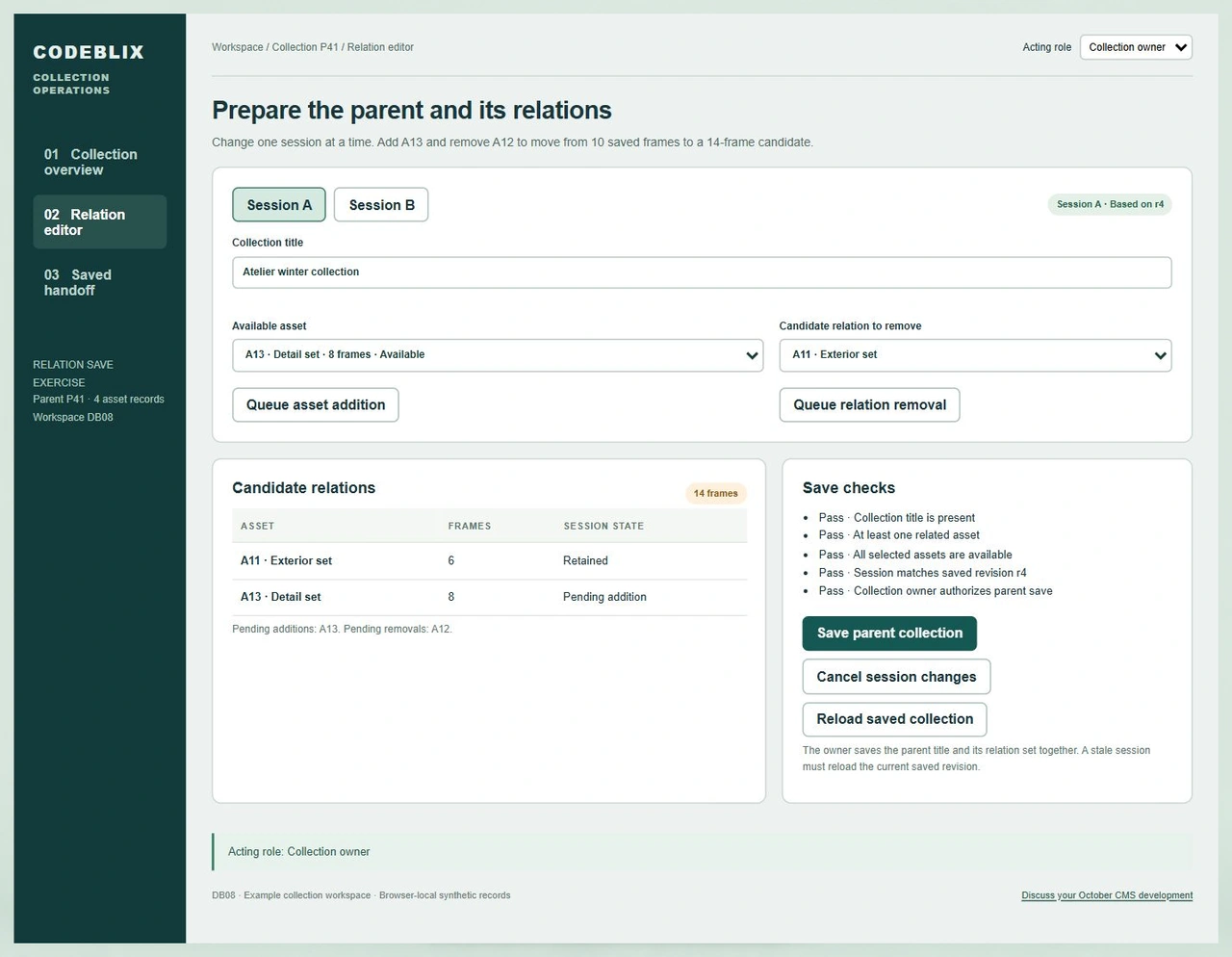
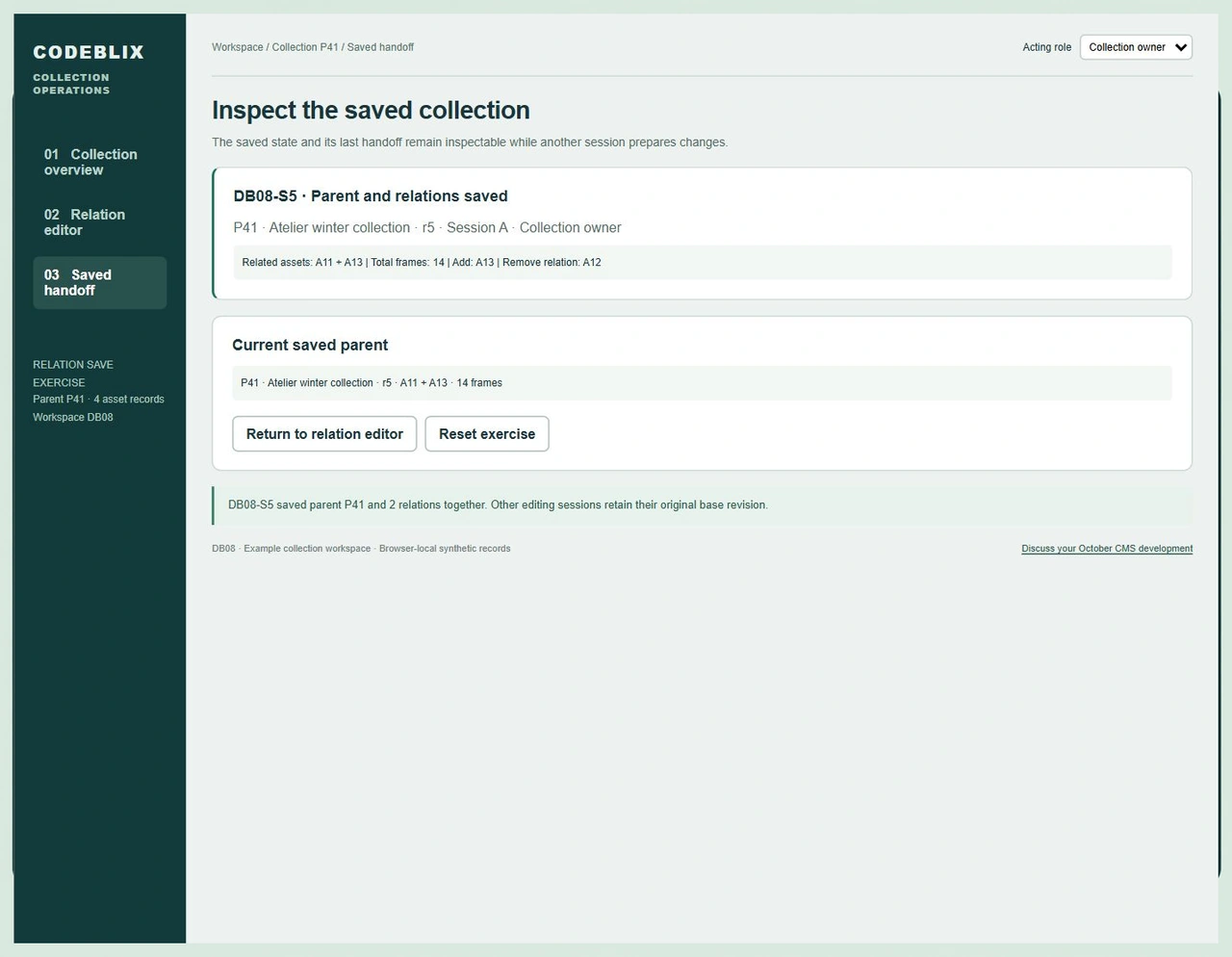
Open DB08, queue A13 and remove A12 from the candidate. Change the title and attempt an Editor save before switching to Collection owner. Inspect the r5 handoff, then try Session B without reloading. These actions expose the difference between pending relations, a saved parent and a stale form.
Open the collection relation demoMatch deferred binding to the installed release
October CMS 4.x documents deferring relation binding through a session key and committing it with the parent save. It also describes cancellation and cleanup. Use the documentation for your project’s actual version when reviewing the plugin; the demo’s owner and revision checks are additional business acceptance rules.
Read the October CMS 4.x relationship referenceSpecify the relation manager actions
The official Relation Controller reference distinguishes relationship types and their configuration, with options for read-only views and deferred binding. Identify the required add, remove, create or delete behaviour separately. Make record reuse and access restrictions part of the form review.
Inspect the primary Relation Controller documentationSeparate another CMS editing backlog
If your organisation also maintains Craft CMS, identify its content models and templates as a separate installation. A nested-entry editing change needs its own version inventory and content-owner acceptance, alongside the allocation being commissioned for October CMS.
Commission a Craft CMS content engagementSix milestones for the October CMS engagement
Use one parent record and its related objects to anchor estimation, implementation and release review.
Define the plugin and website boundary
Supply October CMS, PHP and dependency versions; identify the plugin, controller and theme affected. State the work period, communication overlap and person prioritising the backlog. Agree how estimates, code review and changes to allocation will be handled in the quote.
Map the parent and related records
Name the model keys, relationship types and permitted record sources. DB08 begins with collection P41 at r4, linked to A11 and A12. Their six and four frames total ten. A13 offers eight frames; A14 is restricted by the exercise’s asset-availability rule.
Rehearse pending additions and removals
Queue A13 and remove the A12 relation in Session A. The candidate now contains A11 and A13 with fourteen frames, while saved P41 still has ten. Check duplicate additions and restricted assets without disturbing the existing collection or the other editing session.
Validate the parent and authorise its save
Enter the collection title and check that the candidate retains at least one available asset. An Editor can prepare the relation set; the Collection owner authorises the save. Missing title or insufficient permission blocks the action without changing the saved state.
Exercise cancel, conflict and reload
Save Session A as the owner to produce r5. Session B remains based on r4 and cannot overwrite it. Reload the saved collection before continuing. Queue another change and cancel it: the saved relation set and all four asset records remain available.
Accept and hand over the installed change
Repeat the agreed cases against the actual plugin on staging, including its database and request boundaries. Deliver changed sources, relation and form configuration, deployment instructions and recovery steps. Record the receiving owner’s approval and the support arrangement for subsequent fixes or enhancements.
Include the information that changes the estimate
- Describe a reproducible backend task using synthetic records and a before-and-after result. Include relation definitions, custom validation, permissions and the action labels operators use. Provide the plugin inventory and explain which source files your team controls.
- State whether you need a continuing allocation or a bounded implementation milestone. Identify expected review availability, preferred start window and the person approving additional work. Have the quote distinguish development, acceptance support and deployment assistance.
- List environments, hosting constraints and the release procedure. Identify commercial CMS or plugin licences and who maintains them. Arrange appropriate access after technical scoping; keep passwords and private content exports out of the initial consultation message.
- For data migration, specify stable parent and related-record keys, reused assets and required identifiers. Agree a mapping sample, validation totals, rejected-record treatment and recovery from a partially completed import before the full transfer.
Set integration and ongoing-operation boundaries
- For an external media store or product API, establish which system owns the records and how the relationship keys are mapped. Inspect authentication, permitted operations and failure responses before quoting a connector. Include retry, reconciliation and vendor-side work in the scope.
- For upgrades, check the installed October CMS release, plugins and framework dependencies against the intended target. Rehearse relation editing, existing content and rollback on staging. A successful page render alone does not establish that deferred operations and cancelled forms behave correctly.
- Confirm that permissions are enforced by the installed application at the request and record levels. Include direct requests, restricted related records and separate users in acceptance. The browser exercise provides an operational model for that review.
- Agree who owns backups, deployment credentials, security updates and post-release monitoring. Define the support contact, response arrangement and billing basis for future changes. Keep configuration, code and operating instructions in the project handover.
Six records for a parent-and-relation acceptance brief
Use these example identities to describe an editing session that can be checked independently of visual design.
| Record | Example inputs | Required output and control |
|---|---|---|
| Parent collection | P41 · Atelier collection · r4 | Save its title and accepted relation set at the agreed commit boundary. |
| Saved relations | A11 exterior: 6 frames / A12 interior: 4 frames | Start with two linked assets and ten saved frames. |
| Available candidate | A13 detail: 8 frames | Queue an addition without mutating the saved relation set. |
| Restricted asset | A14 private: 5 frames | Reject selection without changing either candidate or saved data. |
| Editing sessions | A and B each begin from r4 | Keep pending operations isolated and block a stale save after another session commits. |
| Saved handoff | DB08-S5 · r5 · A11 + A13 · 14 frames | Record the saved parent, acting session and relation additions/removals. |
From r4, Session A queues A13 and removes the A12 relation: 6 + 8 = 14 candidate frames, while the saved collection remains at 6 + 4 = 10. Name it Atelier winter collection. An Editor save is blocked. The Collection owner saves P41 as r5, producing DB08-S5 with A11 and A13. Session B still starts from r4, so its save fails until it reloads. Adding A12 in that session and cancelling leaves r5 and all four asset records intact.
Request equivalent implementation boundaries from each provider.
Use the same parent, relations and failure cases when discussing the engagement so allocation and deliverables can be compared fairly.
| Option | Published focus | Ask in your demo |
|---|---|---|
| AddWeb Solution | Dedicated, hourly and time-bucket hiring alongside October CMS plugin, theme and API work. | Which allocation covers deferred-relation validation, cancellation and installed-site acceptance? |
| FTx Infotech | October CMS customisation and backend plugins, with fixed, time-and-material and dedicated-centre engagement models. | How are parent-save failure cases, relation reuse and source handover included in the milestone? |
| ProtonBits | Custom development, migrations and maintenance through project, team-augmentation and hourly arrangements. | Who defines record-level permissions, stale-form recovery and deployment support for this change? |
Ask the provider to replay the ten-to-fourteen-frame change, then cancel it and repeat it through a stale second session. DB08 supplies one reproducible decision asset; extend the cases to your plugin’s actual relationships, requests and storage. Confirm scope and availability directly instead of inferring them from a service list.
Category reference: October CMS 4.x primary reference: relation binding, deferred sessions and parent saves. DB08 models a collection business rule in a working browser workspace. Its roles, revision checks and frame totals are acceptance conditions to implement and test within the commissioned project.
Plan the website change alongside your operational software.
Explore connected Codeblix marketplace workflows when the website also needs a business application or a separately scoped integration.
Explore marketplace software engagementsClarify the development allocation and save behaviour
Resolve these project details before agreeing the implementation milestone.
What should an October CMS developer enquiry include?
Identify the installed CMS release and the plugin or website task you want changed. Share a synthetic parent record, its related objects and a reproducible expected result. Add the allocation period, release window and acceptance contact so Codeblix can review technical fit and capacity before quoting.
Can the engagement include a custom backend plugin?
Bring its model relationships, form fields, controller actions and operator roles to the technical review. Explain the records that must remain compatible and the actions that should be permitted. The quoted scope can connect plugin implementation, backend interaction and installation-specific checks.
How does the collection demo help us evaluate the work?
It makes pending and saved relations visible. Queue an eight-frame asset, remove a four-frame relation and inspect the fourteen-frame candidate before saving its parent. Try restricted selection, missing title, Editor permission and stale-session cases. The results give your team concrete conditions to discuss with the developer.
Does removing an asset relation delete its underlying record?
That depends on the project’s model and chosen action. In DB08, removing a relation keeps the asset record. October CMS relation behaviour varies with the relationship type and action, so specify required reuse and deletion behaviour explicitly and test it on staging.
How is the developer allocation charged?
Codeblix prices the reviewed scope and requested allocation rather than publishing a standard rate for every installation. Agree the billing basis, prioritisation process, review time and treatment of added requirements. Include release assistance and continuing support where those responsibilities are needed.
Can existing plugin data be migrated during the engagement?
Provide source and destination versions, relation keys, data volumes and a representative export with private information removed. Scope mapping, validation, content preservation and a recoverable rehearsal. Existing identifiers and shared assets need explicit acceptance conditions before the full migration.
What needs review before connecting an external API?
Identify record ownership, available endpoints and the keys that connect the systems. Inspect authentication and write permissions, then agree direction, frequency, failure handling and reconciliation. Include the actual connector and vendor-side dependencies in the quote rather than assuming compatibility.
What should be included in the technical handover?
Request plugin and theme sources, dependency versions, relation configuration and release instructions. Retain saved/cancelled and conflict cases with their expected results. Name the operational owner and agree backup, patching and support responsibilities for the period after acceptance.