
Hire dedicated Craft CMS developers for content your team can manage
Hire dedicated Craft CMS developers through a Codeblix engagement built around your website backlog. Bring the Craft release, content structure and the editing journey you want improved. Commission content-model changes, template work or a defined extension with agreed development allocation and acceptance milestones. A consultation establishes the technical requirements, available capacity and responsibilities before Codeblix provides the project quotation.
Give the development allocation a content contract.
A reusable page section needs more than a visual design. Define its fields, relationships and editing rules so the delivered website can be accepted by its operators.
Specify what an editor can compose
List the permitted nested entry types, their fields and the combinations your page design supports. Identify required information for each type and any minimum, maximum or ordering rules. This gives the developer concrete conditions for both the editing interface and rendered template.
Control which related content belongs on the page
A product action should resolve to an appropriate product entry, rather than an arbitrary item with a plausible title. Define source sections, status conditions and site context for relationships. Include removed, disabled and wrong-section targets in the acceptance work.
Buy an inspectable implementation handover
Attach a representative content composition and its expected rendering to the milestone. Ask for field configuration, template changes, extension sources and editing instructions together. The receiving content owner should be able to reproduce the agreed allowed and blocked cases.
See the content rules before commissioning the templates.
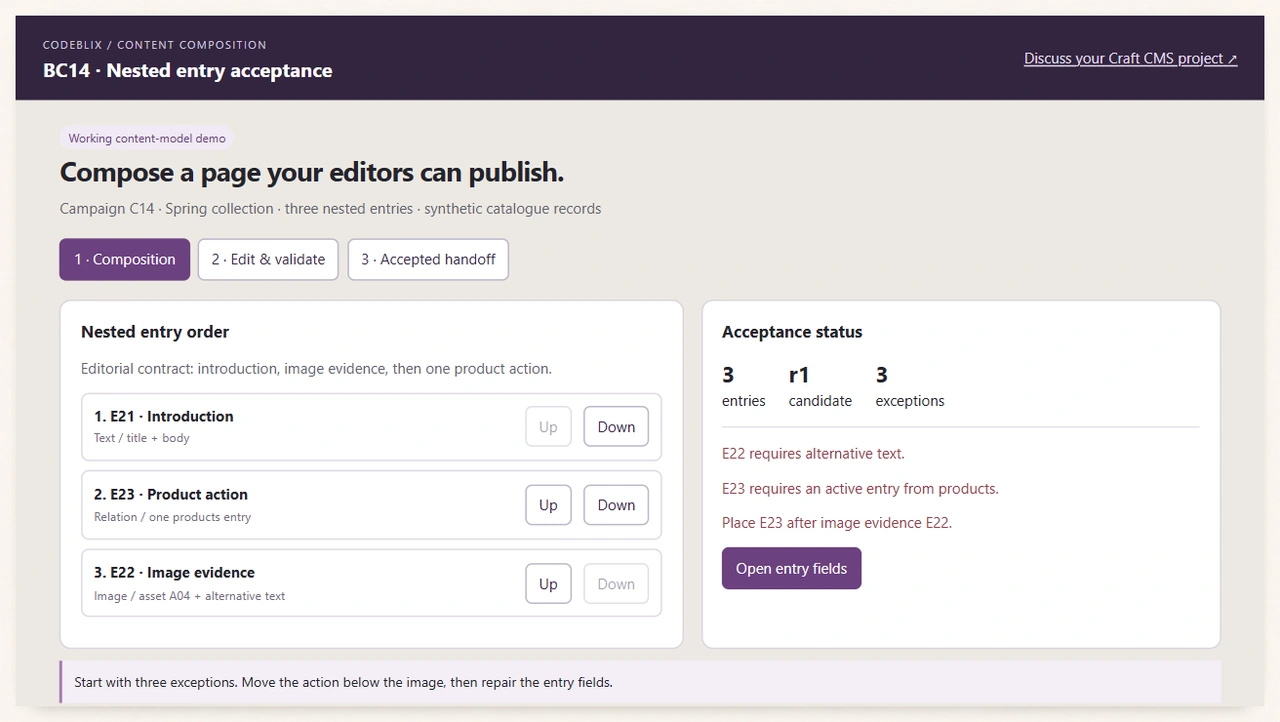
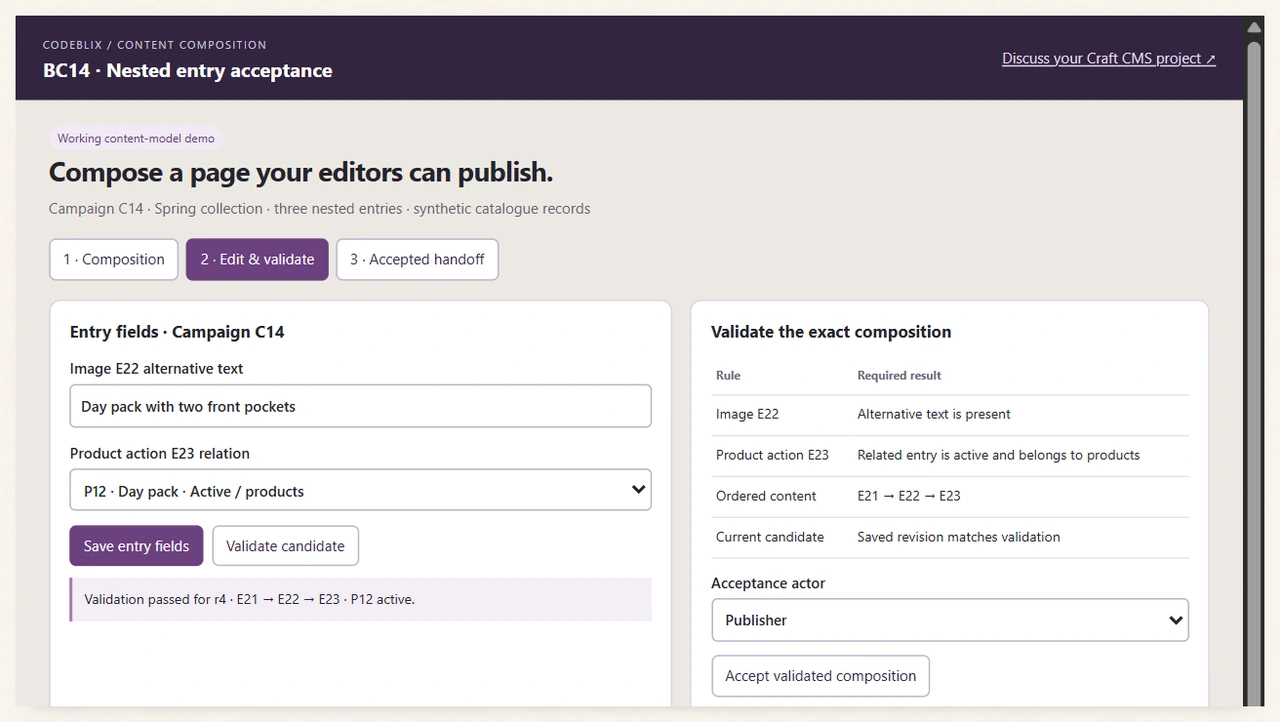
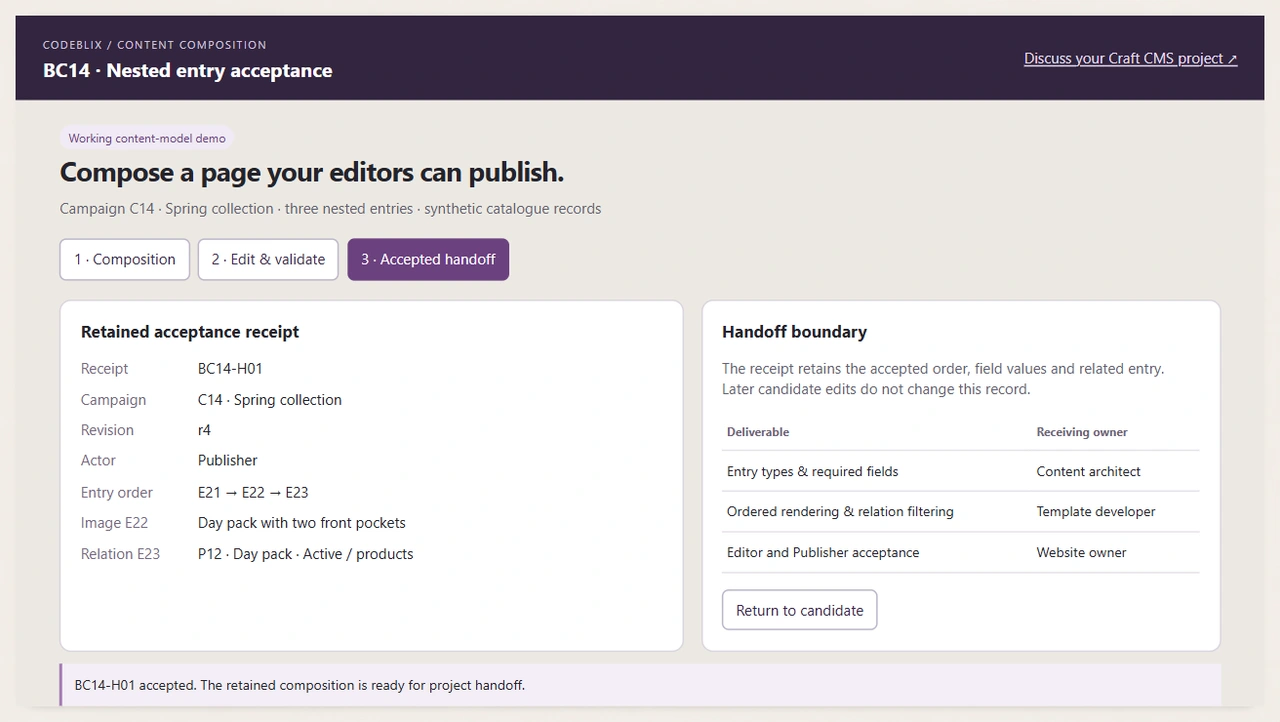
BC14 is a working content composition demo. Reorder three nested entries, complete an image description and choose an active product relation. Validate the saved candidate and let a Publisher retain its accepted composition.
Repair Campaign C14 before acceptance
Open the composition screen and move product action E23 down beneath image evidence E22. Add an image description and select P12, the active products entry. Save, validate and switch to Publisher before accepting the composition. A wrong-section N07 relation provides a useful exception case.
Run the nested-entry composition demoAccount for the installed Matrix model
Craft 5 documents Matrix content as nested entries owned by their parent element, with allowed entry types and minimum or maximum counts. Its documentation also covers ordering and validation errors. Use the reference matching your installed release when estimating a field-model change.
Read the Craft 5 Matrix field referenceSeparate ownership from an entry relationship
Craft’s Entries field relates independently managed entries and offers source and selectable-entry conditions. Bring the intended source section and site behaviour to the scope review. The BC14 active-products condition is the exercise’s business rule to discuss with the developer.
Inspect the official Entries field controlsCoordinate a separate DNN website backlog
Where your organisation also runs a DNN portal, identify that installation and its module changes as a separate workstream. Its portal access cases and deployment responsibilities help keep the development scope clear across independently operated websites.
Discuss a dedicated DNN development engagementSix decisions for the Craft CMS development engagement
Use a representative page to connect the technical scope with the day-to-day editing task.
Inventory the website and development boundary
Record the Craft and PHP versions, installed plugins, hosting environment, source access and release process. Separate Craft CMS work from any Craft Commerce, external API or design scope. Agree the allocation period, working overlap, technical contact and acceptance owner in the engagement.
Model the page composition
Name the parent entry, its nested entry types and their field layouts. Distinguish content owned by the page from references to independently managed entries. BC14 uses C14 with an introduction, image evidence and a product action; the action belongs after the evidence.
Define relations and required fields
Specify the permitted section and status of each linked entry, alongside required text or asset metadata. In the exercise, E22 needs alternative text and E23 needs an active products entry. P09 is archived, while N07 is news content; neither satisfies that product contract.
Rehearse editing and validation
Test reordering, field corrections and failed validation without losing the editor’s current input. Save the visible fields before evaluating the candidate. Repeat the checks after changes to order or relations so the acceptance record describes the composition being delivered.
Accept the composition with the receiving owner
Have the authorized owner review the current fields, order and linked content. BC14 permits editing by an Editor and acceptance by a Publisher after validation. The retained handoff identifies the accepted revision and leaves subsequent candidate edits separately inspectable.
Release the configuration and templates together
Rehearse deployment on staging with a recoverable backup and matching plugin dependencies. Include field configuration, nested-entry rendering, relation handling and permissions in release checks. Hand over the code, editing examples and support responsibilities with the agreed milestone.
Prepare the requirements that affect the quotation
- Supply a version inventory, plugin list and representative entry type or field configuration. Explain the current editing difficulty and show the desired published result using synthetic content. Do not put site credentials or private content exports into the contact form.
- State the allocation you need, preferred start window and expected communication overlap. Agree how backlog prioritisation, estimation, review time and additional requests fit the commercial arrangement. Confirm the named person approving scope changes.
- Identify template ownership, source availability, staging access and any design dependencies. List custom modules and plugin licences that the work relies on. Include build instructions and the current deployment process in the technical review.
- Define editor roles and the paths they should use: entry creation, relation selection, preview, error correction and publishing. Attach a successful composition alongside blocked examples so acceptance does not depend on visual approval alone.
Set migration, integration and support responsibilities
- For a Craft upgrade, inventory deprecated APIs, plugins, custom fields and template dependencies before estimating the migration. Review Matrix representation and existing content against the actual source and target versions. Agree a backed-up staging rehearsal and recovery plan.
- For an external catalogue, DAM or other API, identify which system owns each field and record key. Scope direction, authentication, schedule, retries and invalid-response handling after inspecting the available interface. Include connector implementation and destination testing as distinct deliverables.
- Include site and language propagation, disabled entries, missing assets and deleted relationship targets where they affect the installation. Confirm whether those cases belong to configuration, custom validation, template logic or an integration change.
- Name the team responsible for routine operation after release. Agree plugin and Craft update coverage, incident contact, documentation and support hours. Keep any continuing maintenance commitment explicit in the written quote.
Six records for a content composition that can be accepted
BC14 gives the developer and content owner a small shared model for field rules, ordering and relationships.
| Record | Example inputs | Required output and control |
|---|---|---|
| Parent entry | C14 · Spring collection | Identify the page that owns the nested content and the template receiving it. |
| Nested entries | E21 introduction / E22 image / E23 product action | Preserve stable identities while changing their order. |
| Type-specific field rule | E22 alternative text | Require a useful description before the composition passes. |
| Product relation | P09 archived / P12 active products / N07 active news | Require an active products entry, rejecting both an archive and the wrong section. |
| Candidate validation | r1 initial / r2 reordered / r4 after two field saves | Require saved fields and a passing evaluation for the current revision. |
| Accepted composition | BC14-H01 / Publisher / ordered entry snapshot | Retain the accepted values and return the same handoff on repeat acceptance. |
Start at r1 with three exceptions. Move E23 down to create r2 and order E21 → E22 → E23. Enter “Day pack with two front pockets”, select N07 and save: r3 still fails the products-section rule. Choose P12, save and validate r4. An Editor cannot accept it. Select Publisher and accept BC14-H01, retaining r4, the image description and P12. Change the candidate after acceptance and repeat the action: the original r4 receipt remains. A direct correction from P09 to P12 uses one fewer save and therefore accepts r3.
Ask each provider to quote the same content boundary.
Compare engagement scope using one page composition, its editing exceptions and the handover you require.
| Option | Published focus | Ask in your demo |
|---|---|---|
| UXI360 InfoTech | Dedicated Craft developers with full-time, part-time and hourly engagement options. | How will the quoted allocation cover entry-model configuration, template changes and editor acceptance? |
| Concept Infoway | Craft CMS developer hiring with hourly, monthly and dedicated-team options. | Which deliverables capture relationship filtering and content-order checks alongside the development hours? |
| Latitude Technolabs | Craft CMS developer services covering custom plugins and website development. | Who owns the field configuration, plugin dependency review and staging acceptance at handover? |
Use BC14 to ask for a replay of the wrong-section relation, a reordered page and a candidate edit after acceptance. Its reusable decision asset is the exact content composition and expected exceptions. Confirm how the provider will implement those rules within your Craft release and content architecture.
Category reference: Craft 5 primary reference: Matrix nested entries, ownership and ordering. The exercise’s three-entry composition and Publisher handoff are project acceptance rules. Extend the installed-site rehearsal to the Craft fields, templates, plugins, permissions and propagation behaviour in your quoted scope.
Keep the content platform within the wider project brief.
Connect website changes with the business workflows and integration boundaries your team operates.
Explore Codeblix marketplace development engagementsSettle the developer engagement and content scope
Use these questions to prepare an enquiry with enough detail for a useful technical review.
What should I send when requesting dedicated Craft CMS developers?
Describe the Craft release, installed plugins and highest-priority website change. Include the desired allocation period, content owner and release window. A representative page, its entry types and one editing exception help Codeblix assess the technical scope before confirming capacity and a quotation.
Can the engagement cover changes to Matrix content and Twig templates?
Identify the existing Matrix configuration, relevant entry types and the template output to be changed. Include the content that must be retained and the editor journey affected. The scoped engagement can then cover configuration, rendering work and the installation-specific acceptance checks together.
How is the dedicated development allocation priced?
The quote depends on the reviewed backlog, requested allocation, dependencies and delivery responsibilities. Ask it to state the billing basis, review cadence, start conditions and handling of additional tasks. Include deployment assistance and continuing support explicitly where they are required.
What does the content composition demo let our team test?
It lets you reorder three entries, repair required image text and choose an active product relation. The candidate rejects a news entry even when it is active. Acceptance requires saved, validated content and the Publisher actor; the retained receipt records the accepted composition.
Which content cases should we add beyond the exercise?
Provide cases for your actual nested entry types, field layouts, site and language propagation, asset availability and relationship targets. Include empty and maximum entry counts, validation recovery and disabled content where relevant. Agree the required installed-site results with the developer and content owner.
Can a Craft version upgrade be part of the same engagement?
Provide the current version, intended target and full plugin inventory. Scope compatibility review, data preservation and a recoverable staging rehearsal before the release window. Template and Matrix model changes should be estimated against the specific versions involved.
How will external product data or asset services be scoped?
Identify the source system, receiving fields, record identifiers and ownership of authentication. Review the actual API before agreeing an integration. Specify mapping, rejected values, retry behaviour and which vendor-side work or licences the quotation must cover.
What should our team receive after the development milestone?
Request the changed source and templates, field configuration, dependency notes and deployment instructions. Retain representative editor cases and their acceptance results. Agree the operating contact, update responsibilities and commercial arrangement for subsequent support or backlog work.