
Hire a Zen Cart developer with a monthly scope you can accept.
Hire a Zen Cart developer through Codeblix for a monthly custom development engagement shaped around your store’s backlog. Send the installed version, affected extensions, desired allocation and a clear business task. We assess the technical fit and agree deliverables, review arrangements and commercial terms in your quote. For a gift-certificate change, make the release decision concrete: which purchased value can become account credit, who authorises it and what happens when the entry changes during review.
Make the monthly engagement deliver an observable change.
Agree a prioritised backlog and a named acceptance owner before reserving development time.
Separate purchased value from usable credit
A certificate awaiting approval and a customer’s existing credit are different records. Specify when your business treats the purchase as eligible for release, which account receives the value and how staff reconcile the result. Include held and pending entries alongside the straightforward case.
Make the operator’s authority explicit
A support colleague may need to investigate an order without authorising credit. Identify the permitted release role, the fields that need checking and the evidence retained with the action. A visible button alone cannot define the installed application’s access rules.
Tie allocation to acceptance and handover
Use each review period to accept named changes, inspect unresolved cases and choose the next backlog item. Record the agreed allocation, review availability and release owner. A continuing contract should state how defects, new requests and support time are prioritised.
Follow purchased value into an accepted account balance.
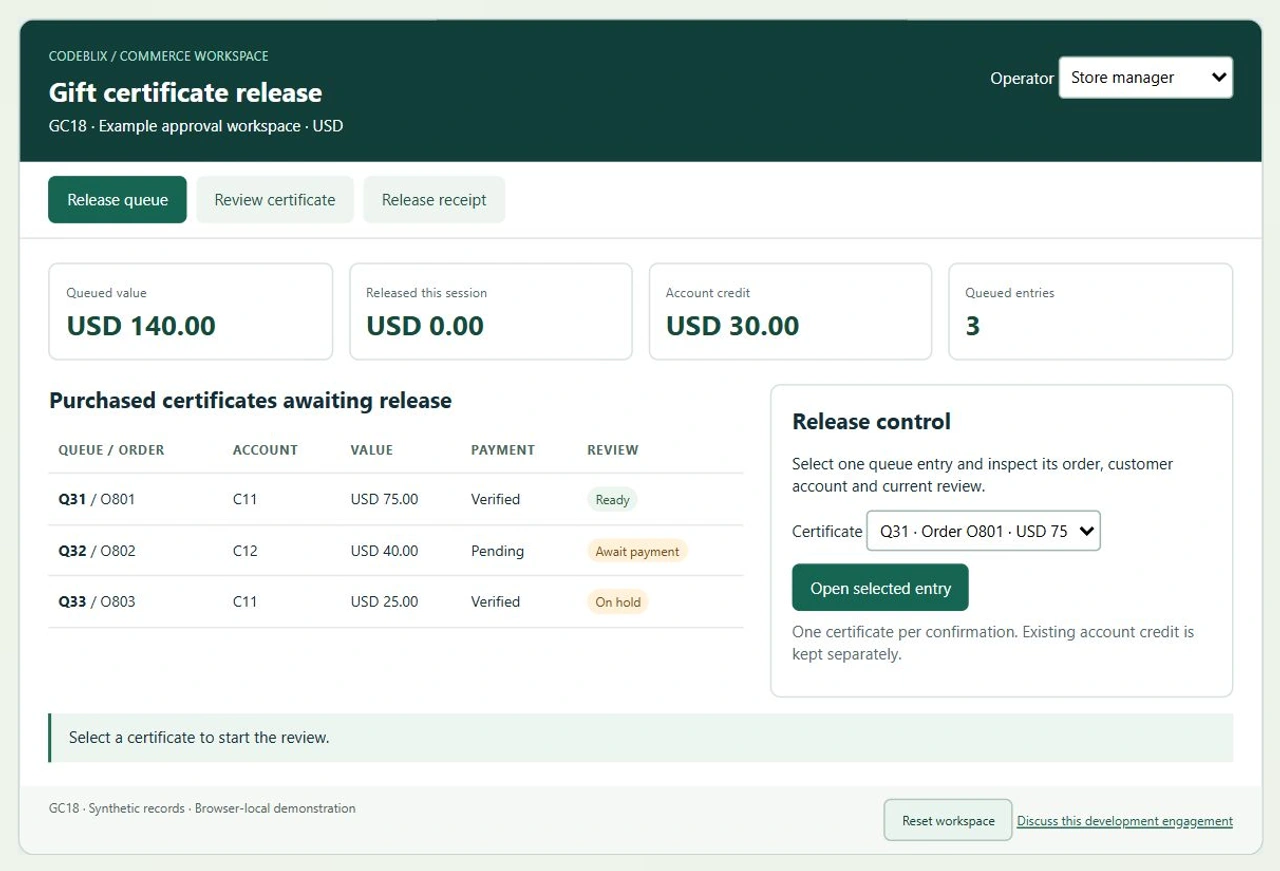
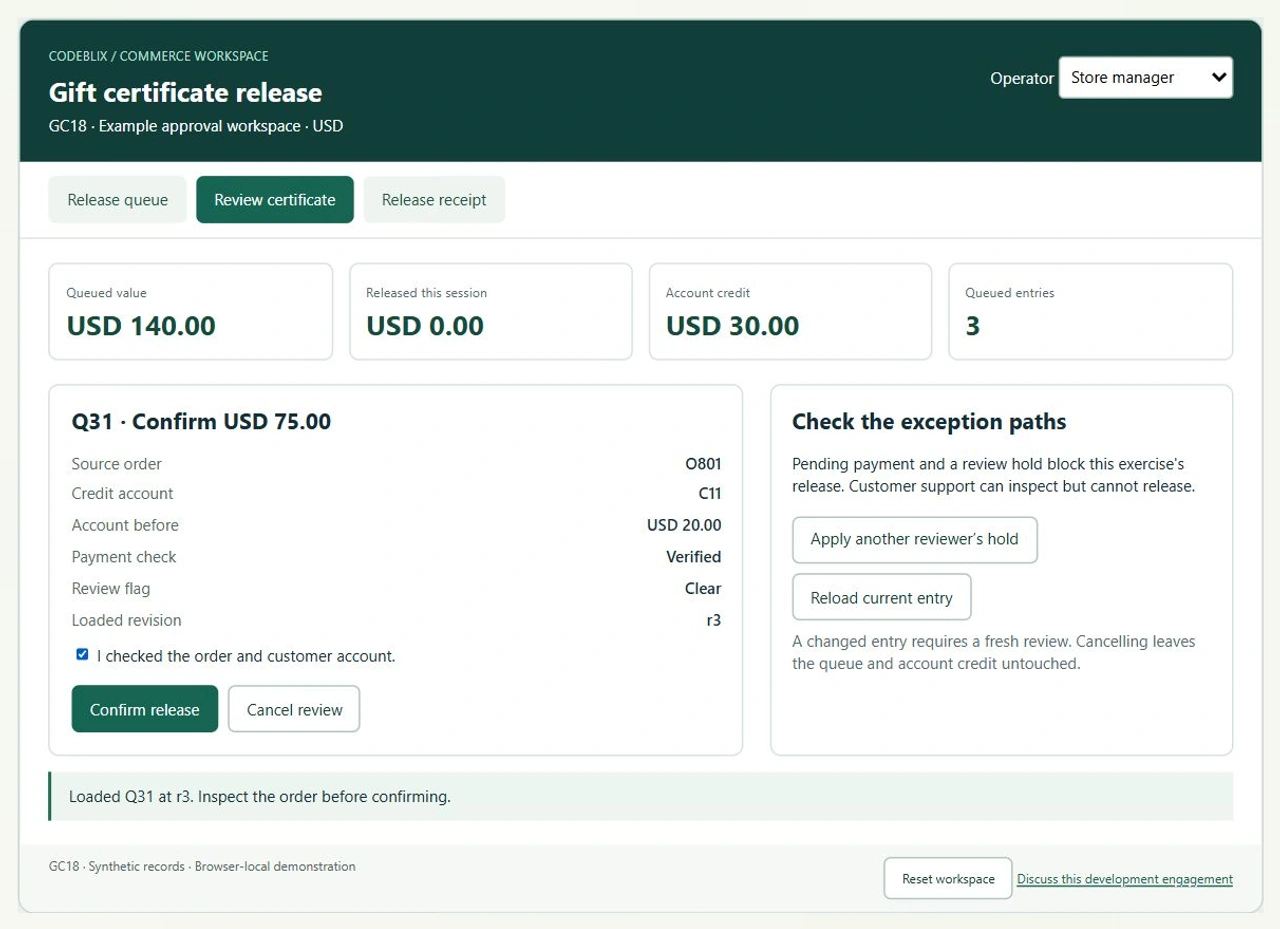
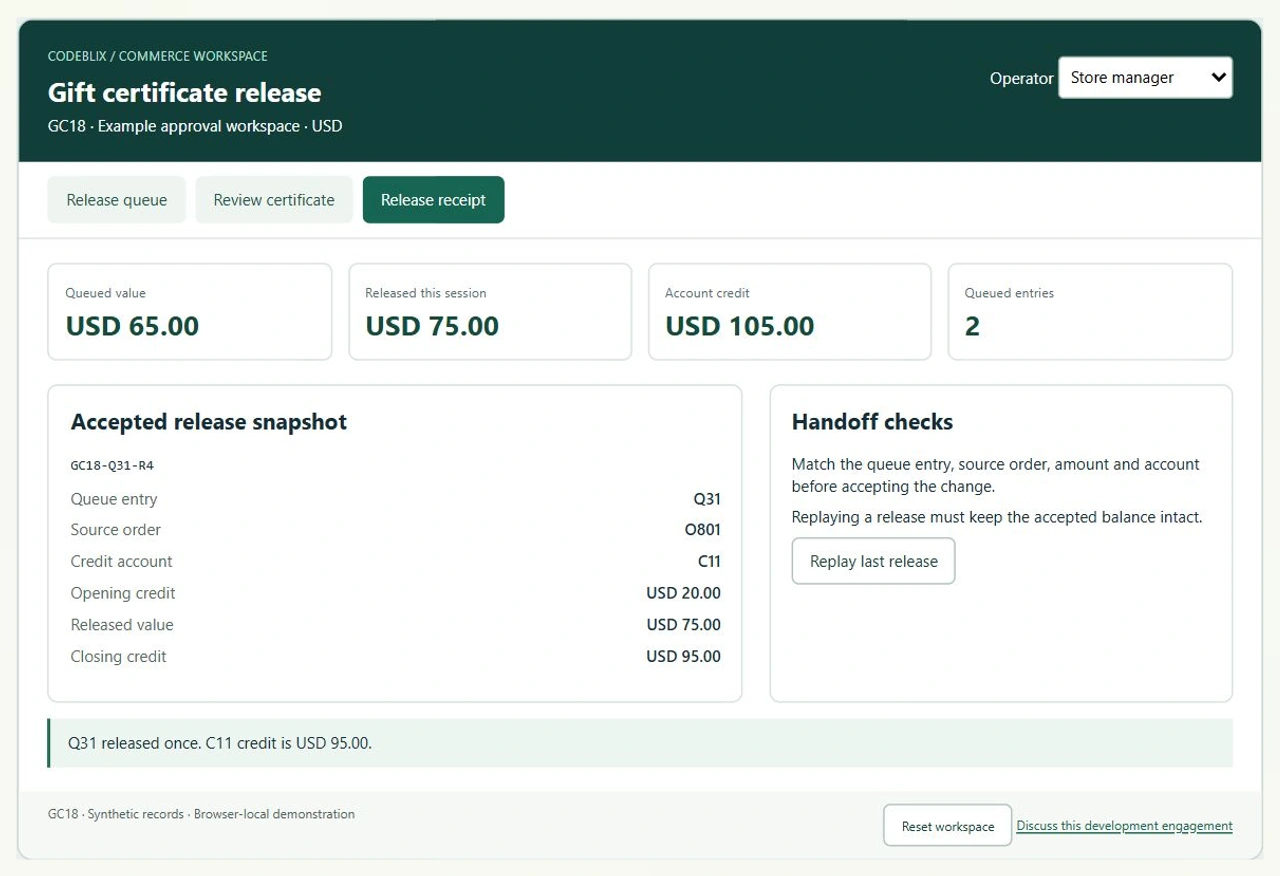
GC18 is an interactive approval workspace using three synthetic certificates. Inspect the opening queue, review Q31 against its order and account, then confirm the USD 75 release. The receipt preserves the opening credit, released amount and closing balance for the handoff.
Try a release and an exception before requesting the quote
Open GC18, inspect Q31 and confirm its release as Store manager. Reset the exercise to check pending Q32 and held Q33. Change the operator to Customer support, cancel a review or place a competing hold to see the acceptance conditions in action.
Open the certificate release demoCheck whether purchased certificates use a queue
Zen Cart’s Gift Certificate Queue reference explains that purchased, unissued certificates appear there when Queue Purchases is enabled in the Gift Certificates order-total module. It describes selecting an entry, opening its order and confirming or cancelling release. Verify that configuration in the store being commissioned.
Read the official Gift Certificate Queue referenceReview the administration profile for added functions
The official Admin Profiles reference describes restricted administration profiles and says new functions may need permission assignment. Include the installed profile mapping and any new release action in the acceptance review, especially when staff responsibilities differ.
Inspect Zen Cart’s Admin Profiles documentationKeep a second commerce platform separately scoped
When your business also runs an X-Cart store, specify its own order and inventory behavior. The certificate approval request and a variant stock reservation use separate account, order and quantity records, so each engagement needs its own accepted cases.
Commission a separate X-Cart development engagementSix stages for a Zen Cart development allocation
Use one purchased certificate as the first acceptance case, then extend the agreed backlog deliberately.
Define the monthly work and store baseline
Provide the Zen Cart and PHP versions, extension list, theme changes and access arrangements. Name the store task you want improved, your preferred allocation and the person who accepts delivery. Agree the billing basis, start window, communication overlap and priority order in the quotation.
Identify the purchased certificate and receiving account
GC18 begins with Q31 for USD 75 on order O801, Q32 for USD 40 on O802 and Q33 for USD 25 on O803. Accounts C11 and C12 start with USD 20 and USD 10 respectively. Queue value is USD 140; existing account credit totals USD 30.
Apply the release conditions to one selected entry
Q31 has verified payment and a clear review flag. Q32 remains pending payment; Q33 carries a review hold. In the exercise, only a Store manager can release a current, eligible entry after checking its order and account. These are concrete business conditions to agree for your implementation.
Confirm the amount and preserve the resulting balance
Release Q31 once: USD 75 moves out of the queue, C11 credit becomes USD 95 and C12 stays at USD 10. The remaining queue is USD 65 across two entries. Receipt GC18-Q31-R4 records the order, account, opening credit, released value and closing credit.
Test cancellation, stale review and repeat actions
Cancel a review and check that neither queue value nor credit changes. Apply another reviewer’s hold while Q31 is open; the old review must be reloaded, and the active hold still prevents release. Replay a completed release and confirm that credit is not added a second time.
Accept the installed change and plan the next period
Run the agreed cases against a staging copy with the installed modules and server permissions. Reconcile the queue, account balances and actual notification behavior. Accept the source changes and deployment instructions, then agree remaining defects, continuing support and the next monthly priorities.
What to include in the monthly quotation request
- List the store release, custom extensions and relevant source ownership. Describe the current certificate process and one desired outcome using made-up order and account references. Supply screenshots or exports with personal information removed.
- Identify the business authority behind payment verification and review holds. Specify the required release role, expected response to a changed entry and the record retained after confirmation. Agree which existing behavior must remain compatible.
- State your desired contract period and working allocation, who prioritises tasks and how often acceptance reviews happen. Ask the quotation to distinguish development, quality checks, deployment assistance and ongoing maintenance.
- Document the receiving account, currency and value rules. GC18 uses one illustrative USD currency; a store with multiple currencies needs an agreed conversion and reconciliation policy based on its installed configuration.
Migration, connections and continuing support
- Before moving an existing store, reconcile purchased certificates still in the queue separately from account credit already released. Preserve stable identifiers and replay a representative migration before approving the cutover.
- For a payment-system connection, supply its current API and callback documentation. Agree the payment state that permits release, authentication, retry identity and reconciliation responsibility. Quote connector development after reviewing those interfaces and installed modules.
- For installation, verify permissions and repeat-action protection on the server with simultaneous requests. The acceptance plan should include transaction boundaries and recovery after an interrupted release, using the actual store database and extension behavior.
- Agree backups, rollback, source delivery, monitoring ownership and how staff report an incorrect release. Define the maintenance window, response arrangements and treatment of later backlog items in the commercial agreement.
Six records that make a certificate change quotable
These identifiers connect the development request, business approval and balance reconciliation.
| Record | Example inputs | Required output and control |
|---|---|---|
| Purchased queue entries | Q31 USD 75 / Q32 USD 40 / Q33 USD 25 | Keep pending purchase value separate from existing account credit. |
| Source orders | O801 / O802 / O803 | Inspect the order behind the selected certificate before authorising release. |
| Receiving accounts | C11 opening USD 20; C12 opening USD 10 | Credit the selected account once and reconcile its resulting balance. |
| Eligibility checks | Verified or Pending payment; Clear or On hold review | Reject Q32 and Q33 under the exercise’s agreed release conditions. |
| Review identity | Q31 loaded r3; another reviewer can advance it to r4 | Reload a changed entry and recheck the current flag before confirming. |
| Accepted receipt | GC18-Q31-R4: USD 20 + USD 75 = USD 95 | Preserve the completed snapshot and reject a second credit of the same entry. |
Opening purchased value is USD 75 + USD 40 + USD 25 = USD 140. Existing account credit is USD 20 + USD 10 = USD 30. Releasing eligible Q31 credits USD 75 to C11, bringing it to USD 95. Total account credit becomes USD 105 and the unreleased queue falls to USD 65. Q32 and Q33 remain untouched. Across this exercise, queued value plus account credit stays at USD 170. Cancelled, denied and repeated actions preserve that reconciliation.
Request a contract with the same acceptance case.
When discussing paid development, ask each provider to connect its engagement terms to your queue, account and release responsibilities.
| Option | Published focus | Ask in your demo |
|---|---|---|
| Concept Infoway | Offers hourly and monthly Zen Cart hiring, developer interviews and store customisation. | Which monthly deliverables include the certificate release cases, permission checks and source handover? |
| Nestack | Publishes monthly developer packages alongside dedicated, time-based and fixed-price engagement models. | How are acceptance ownership, unresolved exceptions and support time assigned within the allocation? |
| iFlair | Describes hourly, monthly and fixed-cost Zen Cart development with ongoing development and support options. | How will the installed queue configuration, balance reconciliation and interrupted release be tested? |
Use GC18’s replay and checklist to describe the work consistently. Ask for explicit deliverables and acceptance responsibility alongside the requested monthly time. A published hiring model does not establish the terms of your individual engagement.
Category reference: Zen Cart primary reference: queue configuration and release confirmation. The payment gate, review hold, record revision and receipt in GC18 are the exercise’s acceptance rules. Map those rules to your installed store during the technical review.
Commission the applications around your commerce operation.
Explore marketplace development engagements for other platforms and business processes that need their own scoped implementation.
Explore Codeblix marketplace engagementsSettle the development agreement before the first month
Connect your request for a developer with the records, responsibilities and acceptance work that determine scope.
What should I include when requesting a monthly Zen Cart contract?
Send the installed platform and PHP versions, affected extensions, a prioritised backlog and your desired allocation. Identify the acceptance owner and review window. A synthetic order, queue entry and expected account balance give Codeblix a concrete starting point for the technical assessment and quote.
Can the contract focus on an existing store’s administration workflow?
Yes. Describe the staff task and the exact change you want commissioned, including permissions and rejected actions. The technical review determines the implementation boundary, installed dependencies and acceptance cases before the engagement terms are agreed.
What does the certificate exercise help us accept?
It lets you inspect purchased value separately from account credit, confirm one eligible release and check the resulting receipt. Pending payment, a review hold, the support role and an outdated review each prevent release. Repeating Q31’s completed action leaves its USD 95 closing credit unchanged.
Will every Zen Cart installation use the same certificate queue?
The official reference ties the queue to the Gift Certificates module’s Queue Purchases setting. Review the actual store configuration and extension changes. State the desired approval behavior in the contract instead of assuming the same controls and business rules across installations.
How will the monthly price and availability be agreed?
Codeblix quotes after reviewing the backlog, technical fit, requested allocation and release responsibilities. Agree the billing basis, capacity, start date and treatment of additional requests in that quote. Include review and maintenance work wherever the engagement needs to cover it.
Can payment callbacks be included in the development request?
Provide the gateway’s documentation and the installed payment module details. Scope the state transition, authentication, duplicate callbacks and reconciliation with the store’s owner. The quote should name the connection work and its dependencies before implementation begins.
What should a store migration preserve for this workflow?
Reconcile queued purchases, released credit and their stable account and order identifiers before transfer. Agree the currency treatment, rehearse sample records and inspect the opening balances. Include a recoverable cutover and the person authorised to accept the reconciled result.
What should we receive at the monthly handoff?
Receive accepted source changes, dependency details, the completed acceptance cases and deployment instructions. Record unresolved items, support ownership and the next backlog priorities. Agree how subsequent requests enter the allocation and who can approve a release to the live store.