

Last updated:
A bill of quantities, commonly called a BOQ, is a structured list of measured construction work. It normally describes work items, gives units and quantities, and provides a place for rates and amounts. Used well, it creates a shared pricing structure for tender comparison, payment valuation, variation control, and cost reporting.
A BOQ does not replace drawings, specifications, contract conditions, site information, or professional judgement. Its meaning depends on the complete project documents and measurement rules.
What a bill of quantities contains
Structure varies, but common parts include preliminaries, measured work by trade or element, provisional items, prime cost items where applicable, dayworks, summaries, and pricing instructions. Each measured item should have an understandable description, unit, and quantity.
Drawings and specifications explain quality and technical requirements. The BOQ provides the measured pricing framework. A contractor should review them together and raise inconsistencies before relying on a quantity or description.
Who prepares and uses it?
A quantity surveyor or other suitably appointed professional commonly prepares or manages the measurement. Designers provide coordinated information. Tenderers apply rates and qualifications. During delivery, the employer’s and contractor’s teams use the structure for valuations, forecasts, and changes according to the contract.
For Mauritius public procurement, the Procurement Policy Office publishes specific directives on bills of quantities in the procurement of works. Check the current PPO directives list and the project’s bidding documents rather than assuming one private-sector practice applies.
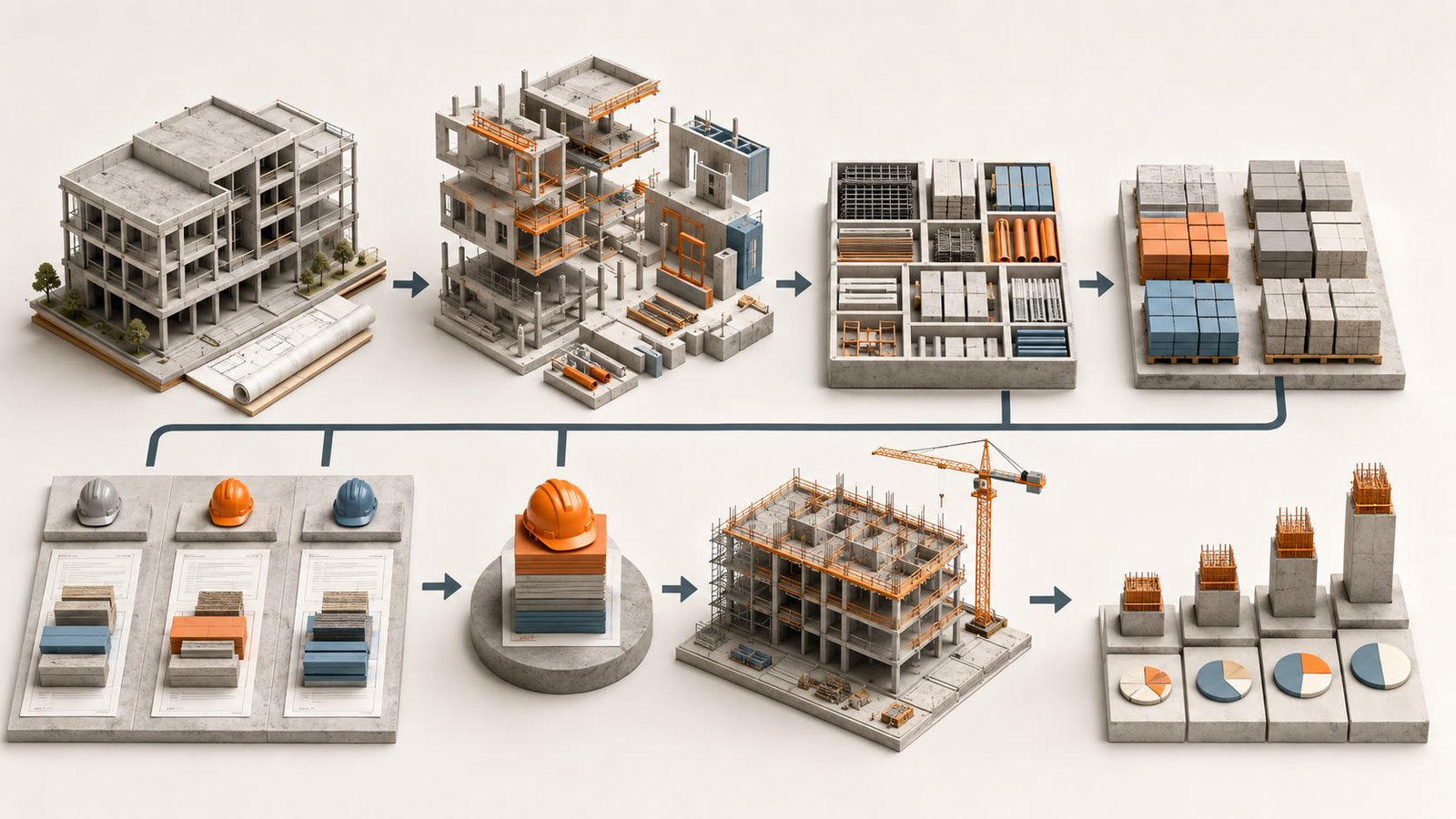
How contractors should review a BOQ
- Confirm the document set: check revisions, drawings, specifications, addenda, contract conditions, and instructions.
- Read measurement rules: understand inclusions, deductions, waste, laps, temporary work, testing, and attendance.
- Walk the scope: compare quantities and descriptions with the design and site information.
- Build rates transparently: include labour, materials, plant, subcontractors, waste, productivity, logistics, overhead, risk, and margin as appropriate.
- Record qualifications: raise ambiguity through the stated tender process instead of burying an assumption.
- Link cost codes: map priced items to the job-cost system before work begins.
BOQ and job costing are related, not identical
The BOQ organises contract pricing and measurement. Job costing organises the contractor’s budget, commitments, actual costs, and forecast. One BOQ item may consume several cost codes, and one cost code may support several billed items.
Create a mapping between them. It lets the team compare value earned and payment status with labour, material, plant, subcontract, and overhead cost. Read the construction job costing guide for that operating layer.
Variations and remeasurement
When scope changes, preserve the instruction, drawing revision, measured quantity, rate basis, programme effect, submission, approval status, and billing status. Do not overwrite the original budget. Keep original, approved change, current forecast, and actual cost separately.
What a BOQ cannot guarantee
Final cost can move because of design change, remeasurement, site conditions, price changes, productivity, waste, delay, provisional work, claims, or contract interpretation. A BOQ improves structure and comparability; it does not eliminate project risk.
Explore the Codeblix construction workspace and the construction job costing guide to see how budgets, commitments, actual costs, and variations can be tracked after tender.
Why this matters for Mauritius businesses
Mauritius is rolling out MRA e-invoicing in phases by taxpayer category. The timetable and status can change, and MRA may separately notify a taxpayer, so businesses should check the current MRA e-invoicing page and their own notices before acting on a deadline.
The Codeblix approach
Codeblix eInvoicing is MRA-listed as an EBS Solution Provider (SN 95, BRN C24214425). The system handles every aspect of MRA compliance automatically - real-time fiscalisation, IRN tracking, QR code generation, hash chain maintenance, and monthly transaction reporting. The local support team in Chamouny is available to help with any MRA query, audit, or transition question.
What to do next
If your present process does not support the fiscal-invoice requirements that apply to your business, document the gap and test an appropriate EBS workflow. Codeblix can review your business requirements and onboarding scope before preparing a proposal; regulatory conclusions remain with the taxpayer and its advisers.
Frequently asked questions
The most common questions about bill of quantities meaning and practical use in mauritius are covered in the FAQ section below. If you have a question that is not covered, the local Codeblix support team is available by phone, WhatsApp, or email.
Related resources
Codeblix publishes a regular blog covering MRA e-invoicing, VAT compliance, payroll, and business management for Mauritius businesses. The blog is updated weekly with new guides, how-tos, and case studies. You can also find detailed product documentation, video tutorials, and a knowledge base in the Help Centre.
Frequently asked questions
What is a bill of quantities?
It is a structured list of measured work items, descriptions, units, and quantities used to price and administer construction work under the project documents.
Does a BOQ guarantee the final project cost?
No. Final cost can change with design revisions, measurement rules, rates, variations, site conditions, provisional items, programme effects, and the contract.