

Last updated:
Construction job costing assigns budget, commitments, actual cost, revenue, and forecast cost to a specific project and cost code. It helps a contractor see not only what has been spent, but what has been ordered, what remains, what has changed, and where the final result may move.
Build a cost-code structure people can use
Start from how the company estimates, buys, supervises, and reports work. Common groups include preliminaries, labour, materials, plant, subcontractors, professional services, and project overhead. Add enough detail to identify action without creating codes that site teams cannot select consistently.
Map the structure to the contract pricing or bill of quantities. The two structures do not have to be identical, but the relationship should be documented.
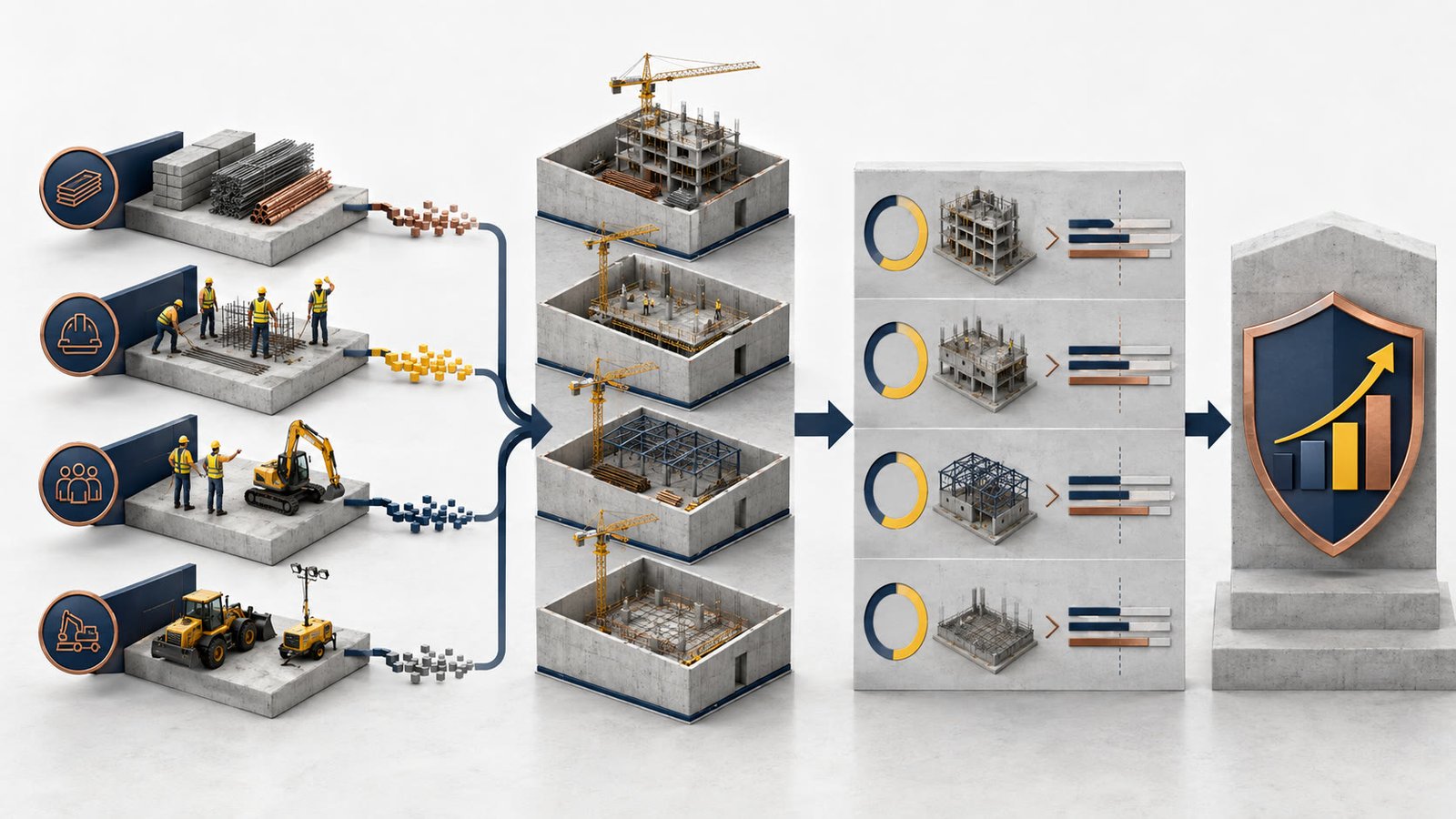
Separate four cost views
- Original budget: the approved baseline at award or project start.
- Approved changes: authorised additions and omissions with a visible history.
- Committed cost: purchase orders, subcontracts, and other obligations not yet fully invoiced.
- Actual cost: approved labour, materials, plant, supplier invoices, and journals posted to the job.
Add a forecast to complete for work not yet committed or posted. The current forecast cost is actual plus open commitments plus forecast remaining cost, adjusted to avoid double counting.
Capture cost close to the work
Labour needs approved time by project and activity. Materials need ordered, received, issued, returned, and transferred records. Plant needs owned or hired time, fuel or operating cost where relevant, and allocation rules. Subcontract cost needs scope, valuation, retention, certification, variation, and payment status.
Use supporting references and dates. A cost posted only to “construction expense” may be correct in total but useless for managing the job.
Control variations from instruction to recovery
Give every potential change a reference. Record instruction source, description, date, drawing revision, estimated cost, submitted value, approval status, programme effect, actual cost, and amount billed or certified. Keep pending changes visible without treating them as approved revenue.
Forecast cost overruns early
Review productivity, quantity growth, price changes, waste, rework, procurement gaps, unresolved design, programme delay, and pending variation exposure. Compare the current forecast with the approved budget by cost code. Assign an owner and action to material movement.
Reconcile the project view
At month end, reconcile job-cost totals to the general ledger, payroll, inventory movements, purchase ledger, subcontract certificates, and billing. Investigate unapproved invoices, duplicate commitments, costs in the wrong project, and work completed but not recorded.
Watch both profit and cash
A project can appear profitable while cash is under pressure because supplier payments occur before customer receipts, retentions remain outstanding, or variations are unfunded. Maintain a project cash forecast alongside cost and value reporting. The cash flow calculator supports a broader business view.
What software should provide
Look for consistent cost codes, budget versions, purchase commitments, time and material capture, subcontract tracking, variation status, permissions, audit history, accounting reconciliation, and forecast reporting. A coloured dashboard is useful only when users can trace a number back to the transaction and evidence.
Explore the Codeblix construction workspace. The objective is a repeatable cost-control process, not a promise that software alone prevents overruns.
Why this matters for Mauritius businesses
Mauritius is rolling out MRA e-invoicing in phases by taxpayer category. The timetable and status can change, and MRA may separately notify a taxpayer, so businesses should check the current MRA e-invoicing page and their own notices before acting on a deadline.
The Codeblix approach
Codeblix eInvoicing is MRA-listed as an EBS Solution Provider (SN 95, BRN C24214425). The system handles every aspect of MRA compliance automatically - real-time fiscalisation, IRN tracking, QR code generation, hash chain maintenance, and monthly transaction reporting. The local support team in Chamouny is available to help with any MRA query, audit, or transition question.
What to do next
If your present process does not support the fiscal-invoice requirements that apply to your business, document the gap and test an appropriate EBS workflow. Codeblix can review your business requirements and onboarding scope before preparing a proposal; regulatory conclusions remain with the taxpayer and its advisers.
Frequently asked questions
The most common questions about construction job costing guide for mauritius contractors are covered in the FAQ section below. If you have a question that is not covered, the local Codeblix support team is available by phone, WhatsApp, or email.
Related resources
Codeblix publishes a regular blog covering MRA e-invoicing, VAT compliance, payroll, and business management for Mauritius businesses. The blog is updated weekly with new guides, how-tos, and case studies. You can also find detailed product documentation, video tutorials, and a knowledge base in the Help Centre.
Frequently asked questions
What is construction job costing?
It assigns budget, commitments, actual costs, revenue, and forecast cost to a specific project and cost code so managers can see where the job is moving.
What costs should a contractor track by job?
Common groups include labour, materials, plant, subcontractors, preliminaries, professional fees, rework, variations, and an agreed allocation of relevant overhead.