
Keep user intent attached to the data.
A successful server response still needs a decision about whether it belongs on the current screen.
Separate arrival order from user intent
A slower first search can finish after a newer search. Tie each response to its request identity and query snapshot, and apply it only while that identity owns the result panel. Retain the ignored response in a diagnostic trace instead of letting it replace newer records.
Make failure and empty data distinct
An empty successful response means no matching records. A failed current request means fresh data could not be loaded. Agree whether the last successful rows remain visible, how their context is labelled and which recovery action the user can take.
Receive an interaction that can be checked
Include keyboard operation, loading announcements, cancelled work and reproducible request sequences in the deliverable. Keep the expected visible rows and the request trace with the source revision so the receiving team can investigate a later regression.
Two searches. Reversed responses. One correct result.
AX23 makes a small asynchronous interaction inspectable. Queue Dock and Bench searches, release the Bench response first, then deliver the older Dock response. The visible records stay with Bench. Use the request trace to agree what your programmer must reproduce in the application.
Make request timing part of the brief.
Use the working replay and primary platform references to define an interaction your receiving team can inspect.
Try the request-order workspace
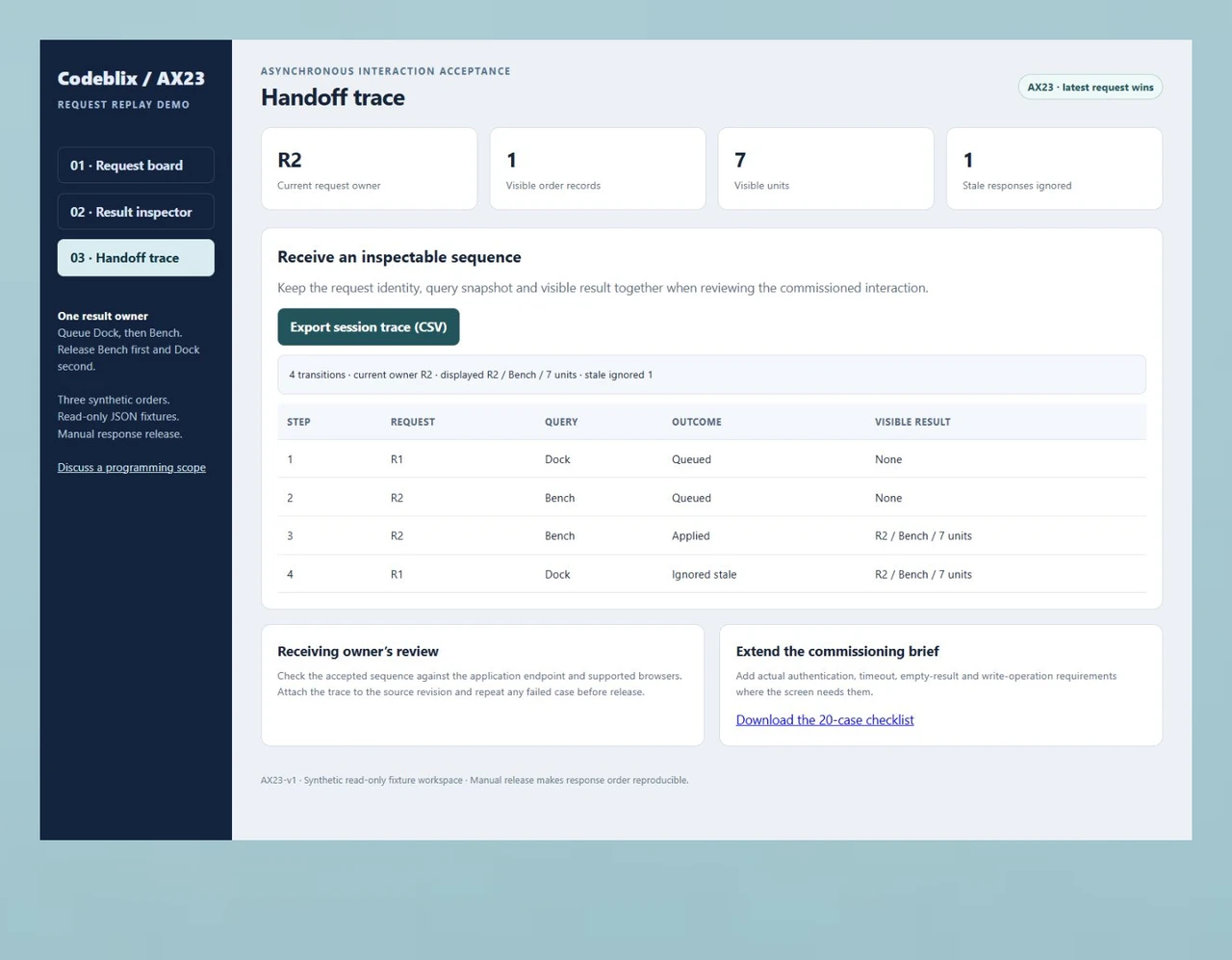
Use AX23 to queue two searches and choose their delivery order. Inspect the current result and trace, then try the failure, retry and cancellation controls. Export the session trace to keep the observed sequence with your development enquiry.
Open the AJAX request replay demoInclude HTTP status in the acceptance contract
MDN’s Fetch reference distinguishes network rejection from an HTTP error response. Ask your programmer to define the accepted status codes, response body and user-facing recovery behavior for the real endpoint.
MDN primary reference: Fetch requests and responsesAgree cancellation and status announcements
The AbortController reference describes cancelling unfinished asynchronous operations. W3C’s status-message guidance supports notifying assistive technology when loading or result status changes without moving keyboard focus unnecessarily.
W3C primary reference: status messagesScope a Laravel endpoint defect separately
When a Laravel backend returns the wrong records or status, attach that server-side reproduction to its own defect-fixing brief. Keep the client request-order rule and the endpoint’s data-selection rule clear so each receiving owner knows what to verify.
Discuss Laravel endpoint defect fixingCommission the interaction from request contract to release evidence
Describe the screen behavior precisely enough for the frontend owner, backend owner and receiving reviewer to agree the same outcome.
Identify the screen, endpoint and receiving owners
Describe the search, dependent field, paginated table or asynchronous form being commissioned. Supply frontend and backend versions, a sanitized request/response example, authentication boundaries and the person who accepts the visible result. Keep account access separate from the public brief.
Agree allocation around a concrete interaction
Request a programming quote for the first reproducible case, its error paths and the required browser checks. Discuss developer allocation, code review, backend changes, release assistance and the handling of additional screens. Confirm the start window and review cadence during scoping.
Record each request before it can update the screen
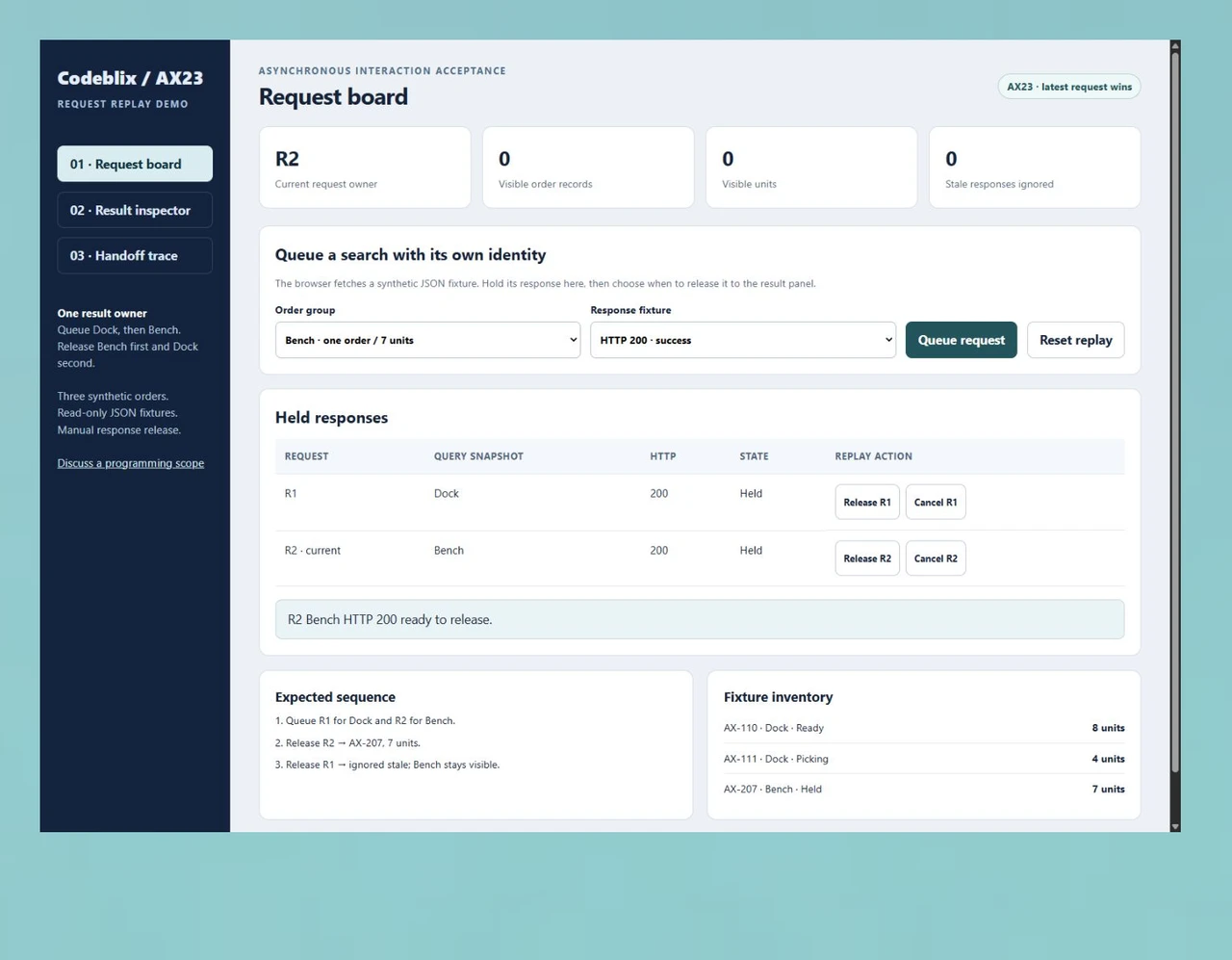
AX23 assigns R1 to Dock and R2 to Bench. Dock has two synthetic records totalling 12 units; Bench has one record containing 7 units. Each request captures its query independently. Editing the selection alone neither queues a request nor changes the displayed result.
Deliver the newer response before the older one
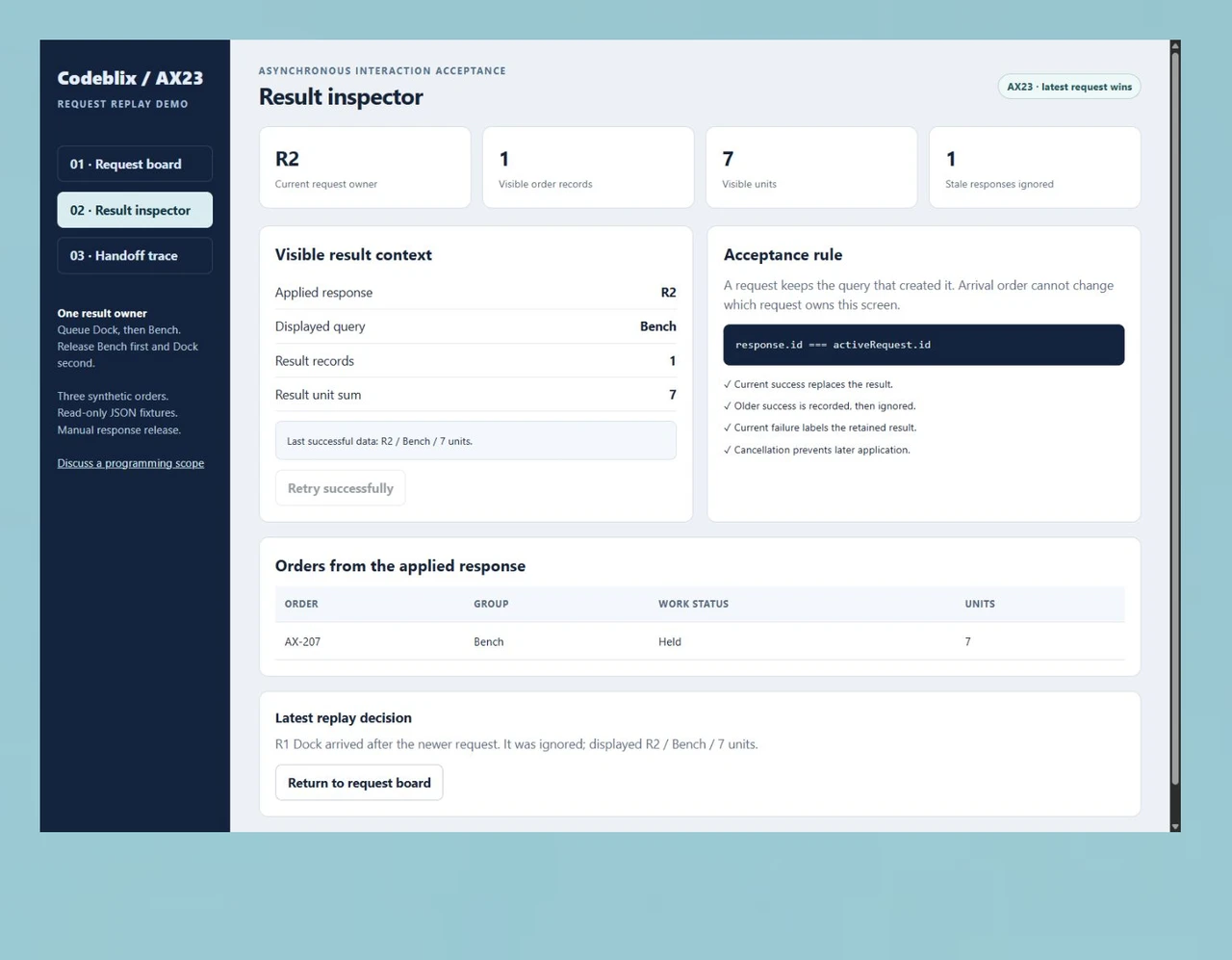
Release R2 to show Bench order AX-207 and 7 units. Deliver R1 afterward: the trace records a successful but ignored stale response, while Bench remains visible. This latest-request rule is an explicit acceptance decision rather than an assumption about server timing.
Exercise the failed current request and recovery
Queue Dock with the HTTP 503 fixture. Releasing it records an error and preserves the last successful Bench rows with their label. Retry creates a new Dock request; a successful delivery then displays AX-110 and AX-111, totalling 12 units. Cancelling a held request prevents it from later applying.
Review the integrated behavior and release handover
Repeat the agreed sequences on staging with the application’s actual endpoint, permissions and records. Receive the changed source, endpoint contract, completed checks and deployment recovery steps. Assign ongoing ownership for API changes, browser compatibility and support requests.
Inputs that make an AJAX quote useful
- Bring the application stack, affected route, supported browsers and sanitized network examples. State which requests read data and which create or update records, including authorization and validation requirements for each operation.
- Define search debounce, pagination and dependent-field behavior where relevant. Name the request identity, query snapshot, displayed-data context and policy for a response that arrives after newer input.
- Assign a product owner for expected behavior, a backend owner for endpoint changes, a programmer for implementation and a reviewer for acceptance. Include the keyboard and assistive-technology checks the receiving team will carry out.
- Request the billing basis, assessment allowance, development allocation and release window. Include source delivery, review access, defect support and the approval process for work beyond the agreed interaction.
Integration, migration and continued operation
- For an existing API, provide its documented methods, status codes, response fields and authentication flow. Agree request limits, caching, timeout handling and diagnostic retention. A read-only search and a record-changing submission need separate acceptance cases.
- For an interface replacement, preserve record identity and map the old screen’s filters, sort order and pagination. Reconcile representative result sets before cutover; retain a rollback route and responsibility for unresolved data differences.
- AX23 uses only synthetic read-only order fixtures and a controlled response-release step. Include actual server latency, session expiry, authorization, cross-origin policy and write-operation duplicate protection in the commissioned application checks when relevant.
- Agree staging access, release approval, backups and recovery instructions with the application team. Specify which monitoring, hosting, ongoing upgrades and later API changes belong to the support arrangement.
Six records for a request-order programming brief
Tie the user action to the request, the response and the screen that is allowed to consume it.
| Record | Example inputs | Required output and control |
|---|---|---|
| User intent | Dock or Bench; Queue request | A changed selector becomes a request only when the user queues it. |
| Request envelope | R1 Dock; R2 Bench; independent query snapshot | Advance the active identity when a new request is queued. |
| JSON response | AX-110 Dock 8; AX-111 Dock 4; AX-207 Bench 7 | Keep record identity and unit counts with the response query. |
| Visible result | R2 Bench; AX-207; 7 units | Apply a completed response only if it still owns the current request identity. |
| Failure and cancellation | HTTP 503 fixture; retry; AbortController | Label retained rows after failure and prevent cancelled work from updating them. |
| Session trace | Queued, applied, ignored stale, failed or cancelled | Export request identity, query, outcome and visible result after each transition. |
Queue R1 for Dock, then R2 for Bench. Release R2: the result is AX-207 with 7 units. Release R1 next: Dock’s 12 units are recorded as an ignored stale response, and the screen still shows Bench. A new Dock request returning HTTP 503 keeps that last successful Bench result labelled. Retry creates a fresh request; release its successful response to show the two Dock records and 12 units.
Ask each provider to quote the same request sequence.
Discuss the engagement terms alongside the exact result, error and receiving evidence your application needs.
| Option | Published focus | Ask in your demo |
|---|---|---|
| YES IT Labs | Offers AJAX development, audits, migration and support with full-time, part-time and hourly engagement options. | Will the scope demonstrate a late first response arriving after a newer successful search? |
| InvoZone | Describes scope calls, developer matching, asynchronous requests, API integration and flexible delivery models. | Which request identity owns the panel, and what remains visible after the current request fails? |
| Programmers.io | Provides consultant profiles, quotation and interview paths with dedicated, augmentation and project engagements. | Will the receiving team get an executable replay and a trace linked to the accepted source revision? |
Compare allocation, code ownership, backend responsibility and acceptance evidence with the price. A defined interaction may suit a bounded delivery; an evolving screen backlog may need an agreed recurring allocation. Resolve both the result behavior and the commercial terms before commissioning.
Category reference: MDN Fetch reference: requests, responses and explicit HTTP status checks. Use the application’s endpoint and permission model to settle its implementation. The replay supplies a concrete request-order case for that discussion.
Connect the interaction to a software development engagement.
Explore Codeblix marketplace development offers and bring a concrete application requirement to the consultation.
Explore marketplace development servicesAgree the programming engagement and its receiving checks
Resolve stack access, asynchronous edge cases and delivery responsibilities before development begins.
What should I bring to an AJAX programming consultation?
Bring the affected screen, stack versions and a sanitized request/response example. Describe the user action, expected records and any observed timing problem. Identify the frontend and backend owners, supported browsers and the reviewer who can accept the final behavior.
Can I request work on an existing JavaScript application?
Yes. Request an assessment of the current code and endpoint contract, then agree the interaction and regression cases to be delivered. Include framework constraints, build access, staging arrangements and the required source handover in the quote.
What does the request replay let me verify?
Queue Dock and Bench searches, then release their responses in either order. The latest queued request owns the result. You can also exercise a current HTTP 503 response, retry it, cancel a held request and export a trace of the transitions.
Does a successful response always replace the displayed rows?
In AX23, a successful response applies only while its request identity is current. An older success is marked ignored stale. Ask the programmer to agree the right policy for your application, including any screens that intentionally display several concurrent results.
What should happen when a request fails or returns no matches?
Specify these separately. AX23 preserves and labels the last successful rows after a failed current request. A successful empty result would represent no matches. Include both cases, their status messages and their recovery actions in your application’s acceptance scope.
How are allocation, cost and start date agreed?
Request a written quote after the first interaction and technical boundaries have been assessed. Discuss development allocation or a bounded deliverable, investigation effort, review cadence, backend changes, release assistance and the arrangement for additional work.
Can the scope include asynchronous record submissions?
Describe each record-changing operation separately from read-only searches. Include server validation, authorization, duplicate submission protection, retry semantics and reconciliation after an uncertain response. Agree which frontend and backend changes are included.
Which evidence should the receiving team get?
Ask for the changed source revision, endpoint contract, completed acceptance cases and release recovery steps. Keep the observed request sequence and expected visible records together. Agree responsibilities for defect support, future API changes and continued browser operation.