
Laravel bug fixing services for existing applications
Codeblix provides Laravel bug fixing services for business applications with a broken action, repeated error or regression after a change. Request corrective development around a reproducible failure and an agreed acceptance result. Bring the affected workflow, application versions and a sanitised error example to a consultation, then approve a repair scope with verification and release responsibilities.
Commission a correction with evidence of what changed.
The application owner needs a reliable business action. The developer needs a precise failure, an inspectable environment and a bounded change to verify.
Turn a symptom into a repairable case
Name the route or screen, the acting role, the input and the action that fails. Record what should happen and what happens instead. Separate one repeated defect from several unrelated failures so the quotation has a clear starting point.
Protect the surrounding workflow
Include the previously working paths that a patch could affect. A repaired submission may also need retry, validation, access and notification checks. Require evidence against the accepted patch revision rather than a screenshot of one successful click.
Receive a usable release handover
Agree who reviews the code, who accepts the business outcome and who releases it. Include the changed files, test results, relevant configuration steps, recovery reference and follow-up coverage in the repair deliverables.
A useful fix has a failure you can repeat and a result you can accept.
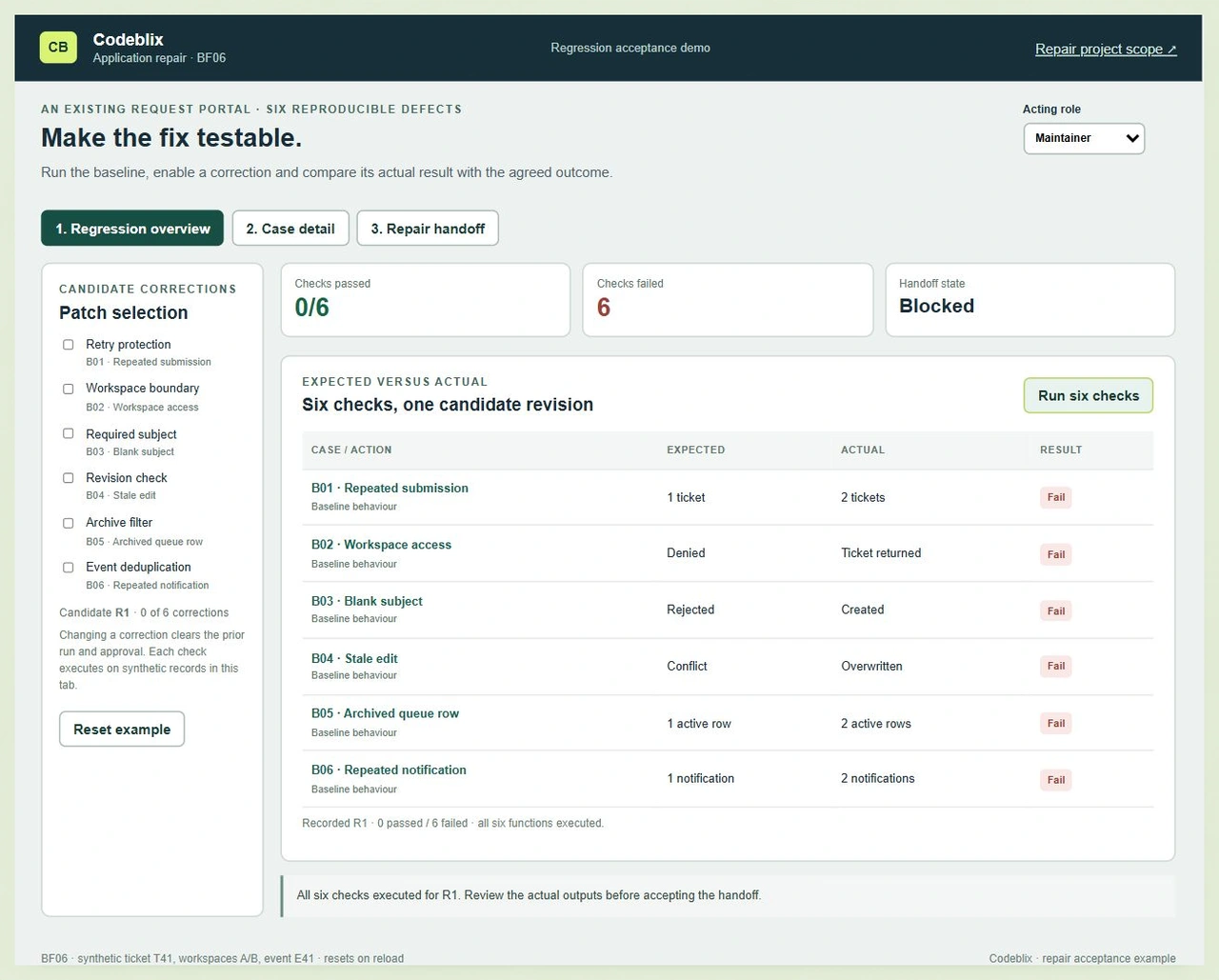
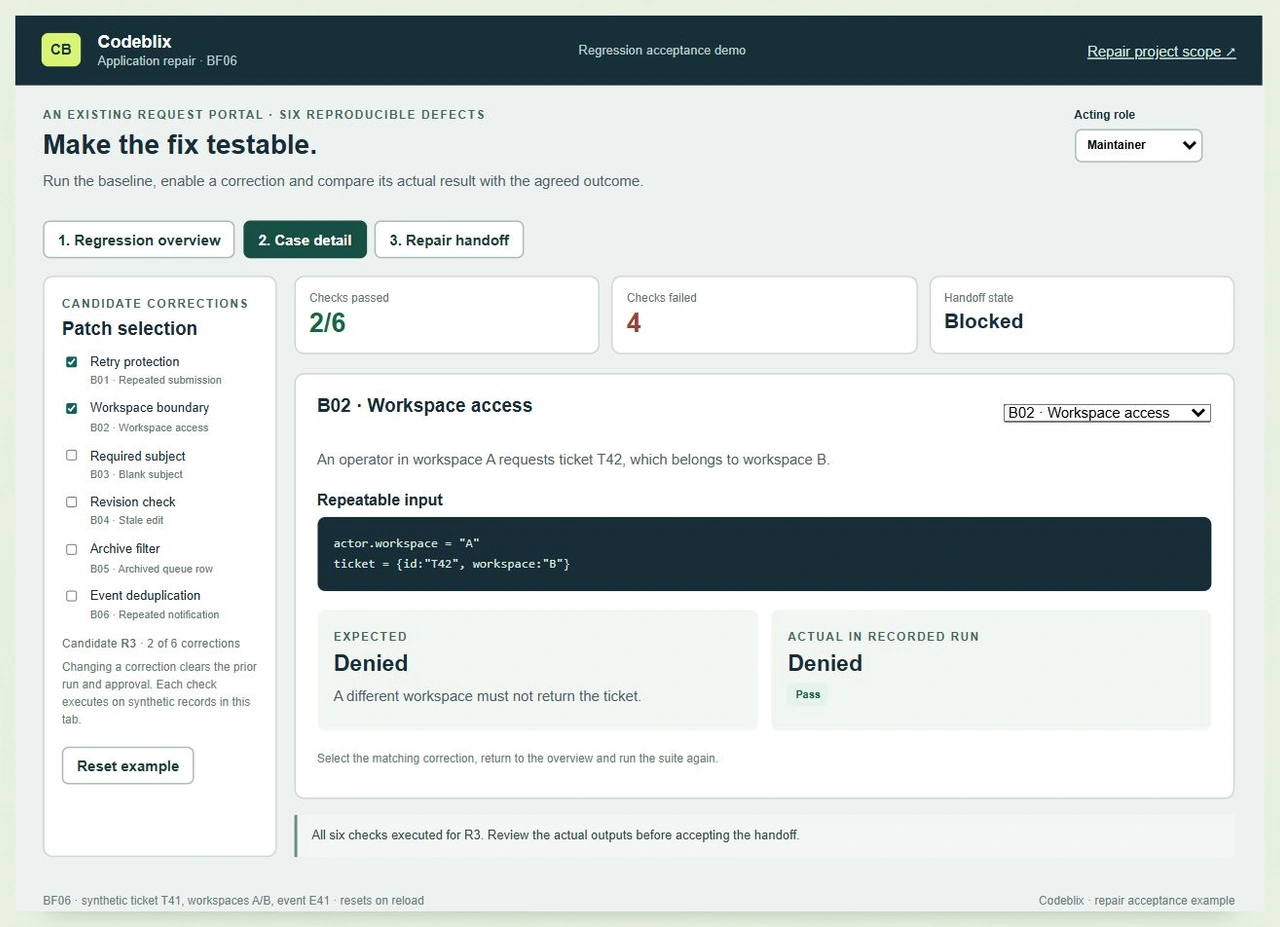
BF06 exercises six defects in a small request-portal model. Inspect the unchanged behaviour, select corrections and record a passing candidate before accepting its example handoff.
Run the six-case repair lab
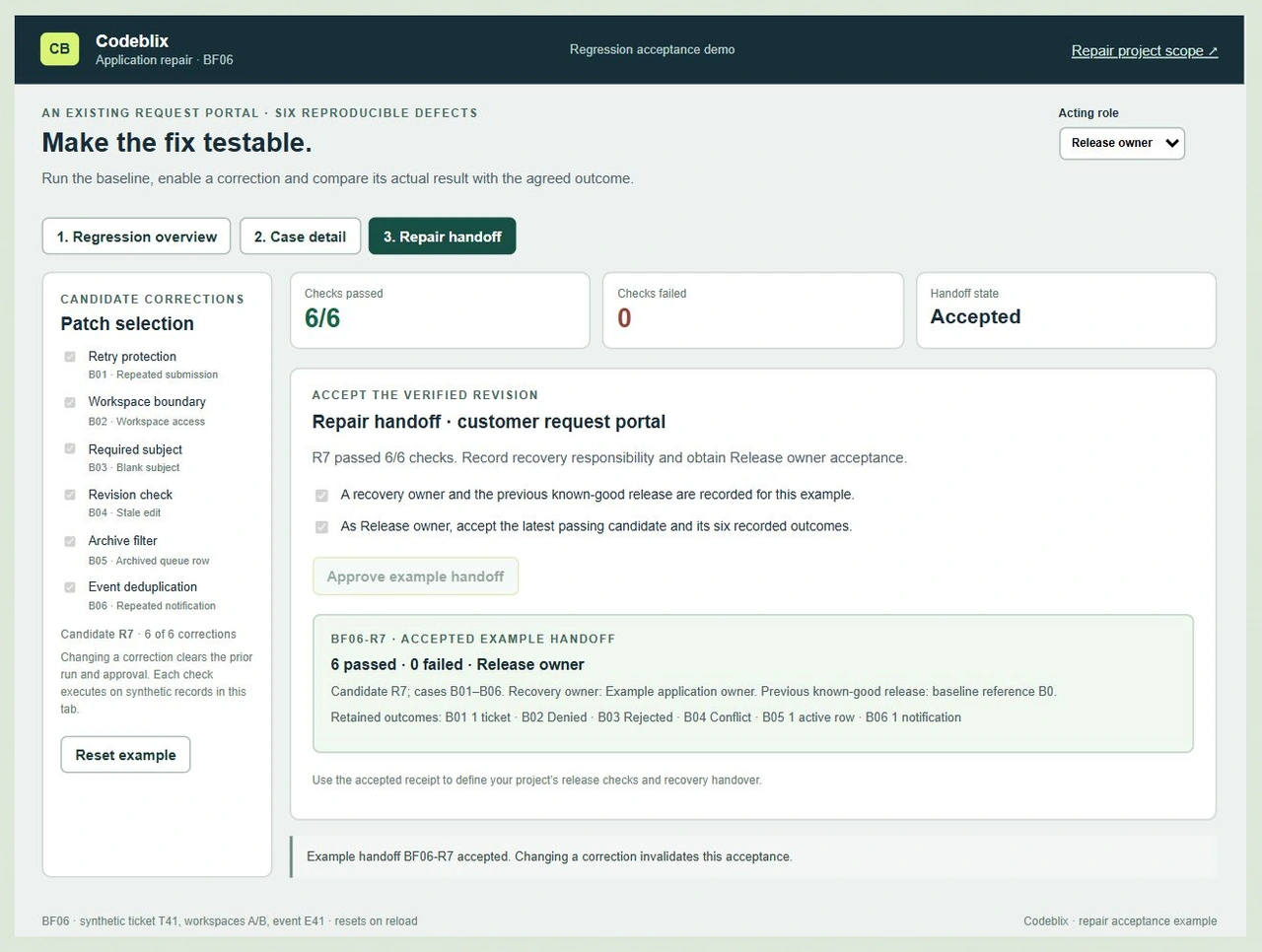
Start with the unchanged candidate: all six checks fail. Select Retry protection and run again to see one passing result. Enable the remaining corrections, re-run the suite and switch to Release owner to accept the current six passing outcomes.
Try the working bug-fix acceptance demoSeparate repair from a new database application
A specific broken write can be repaired within an existing system. Replacing the record model, importing a new dataset or commissioning a new database application is a different scope. Identify that boundary before authorising the work.
Discuss a new database applicationDefine a device-data project separately
A failed integration needs the actual message and error path reviewed. Building a new device-data application also requires asset identities, input contracts and operator decisions. Keep those development deliverables explicit in the project brief.
Explore connected-application developmentMove the defect through six accountable stages
Keep diagnosis, implementation and release approval connected to the same reported business failure.
Describe the broken action
Provide the affected screen or endpoint, a short sequence of actions, expected output and observed output. Add the Laravel and PHP versions, the last known working release and a sanitised exception excerpt where available.
Review the application and agree access
Identify the repository owner, runtime, dependencies and environment differences. Arrange the minimum project access through an agreed channel. Establish a staging or local reproduction and an approved recovery point before changing application behaviour.
Confirm the cause and repair boundary
Trace the failure through the relevant request, validation, authorization, storage or background-work path. Agree the corrective work and its acceptance cases. Separate a defect repair from a feature addition, framework upgrade or wider data correction.
Implement and record the patch
Make the scoped change in version control and identify the candidate revision. Document the reason for the change, affected files and any configuration requirements. Keep unrelated changes out of the repair so the review can assess its actual effect.
Re-run the failure and adjacent cases
Demonstrate the original failure before and after the patch. Check the agreed negative inputs, roles, retries and neighbouring workflows. Re-run the checks whenever the candidate changes; obtain application-owner acceptance against the current results.
Release with a recovery decision
Agree the deployment window, release operator and rollback trigger. Verify the repaired action in the intended environment and retain the patch and acceptance record. Set the follow-up period, support hours and route for reporting a recurring defect.
Supply a useful repair brief
- Describe the business impact and whether the failure affects one user, one role or every request. Include repeatable steps and a small, anonymised input rather than production customer records.
- Record the application, PHP and database versions, dependency lockfile, environment and the most recent change. Identify the correct repository and the person who may authorise access.
- Share a sanitised exception message and relevant log time. Arrange credentials and access grants separately through the agreed project channel; remove secrets from screenshots and error excerpts.
- Agree whether the first engagement covers diagnosis, a defined correction or a larger recovery project. Name what evidence is needed before a repair quotation can be confirmed.
Bound interfaces, data changes and deployment
- For an API or background task, specify request direction, payload example, authentication ownership, retry behaviour and the expected response. Test external services in their approved test environment.
- Review any database correction or schema change as a separate authorised action with backup, reconciliation and recovery arrangements. Include its operator and acceptance steps in the scope.
- Distinguish code defects from hosting, package, configuration and source-system problems. Include the responsible party for changes outside the application repository.
- Agree staging access, deployment responsibility, release timing and the condition that requires rollback. Verify the actual business action after activation, alongside the application health check.
Agree price, ownership and continuing support
- Request a quotation that separates investigation, implementation, regression work and release assistance. Confirm how additional findings or changes to the accepted scope will be estimated.
- Set a response window and support hours appropriate to the application. Define the follow-up period and how a recurrence is reported, reproduced and prioritised.
- Retain the source patch, accepted case list, test evidence and operating notes in the application owner’s project records. Include any revised configuration instructions.
- For continuing maintenance, agree monitoring ownership, dependency review, access renewal and release approval separately from the first repair. Choose that service after the codebase and workload have been reviewed.
Six records that keep a repair verifiable
Use BF06 to distinguish a reported defect from an accepted patch. Its tiny request-portal model makes the repeated action, expected result and current candidate visible.
| Record | Example inputs | Required output and control |
|---|---|---|
| Reported defect | B01–B06; affected action and business impact | Retain the original failing action even when the patch changes its output. |
| Reproduction input | Two K41 submissions; workspace A requesting B; a blank subject | Use the same inputs to distinguish a correction from a different successful scenario. |
| Acceptance outcome | One ticket; Denied; Rejected; Conflict; one active row; one notification | Write the expected result before accepting the implementation. |
| Candidate revision | R1 baseline; R2 after one correction; R7 after all six | Each changed correction invalidates the recorded suite and acceptance. |
| Regression run | Six expected/actual pairs, pass/fail results and candidate reference | Run every case on the current candidate; the handoff stays blocked while a case fails. |
| Accepted handoff | Release owner, passing R7 results and an example recovery reference | Accept the tested revision explicitly and retain its six outcomes with the repair record. |
The unchanged R1 candidate creates two tickets for K41, returns another workspace’s ticket, accepts a blank subject, overwrites a stale edit, lists two active rows and sends two notifications. Its run has 0/6 passing checks. Select Retry protection: R2 creates one ticket and passes 1/6. After all six corrections, R7 produces the six agreed outcomes and passes 6/6. A Release owner can record recovery responsibility and accept BF06-R7. Deselecting any correction clears the run and acceptance; the revised candidate must be tested again.
Ask a repair provider to demonstrate the outcome you need.
These primary service pages describe different repair and maintenance engagements. Use the same failing case, scope boundary and handover questions when requesting a quotation.
| Option | Published focus | Ask in your demo |
|---|---|---|
| StefanMK | Existing Laravel bugs, feature work and integrations, with project review, testing and follow-up. | Which reproduction input, patch reference and neighbouring workflow checks will the repair handover include? |
| PHP Rescue | Laravel route, queue, policy and integration failures, followed through review, tracing, a scoped fix and verification. | Show the reported failure before the patch and the same accepted case after it. |
| Synapse Code | Ongoing Laravel support, bug fixing, queues, database work, integrations and deployment responsibility. | How is a one-off repair separated from continuing maintenance, and who accepts the current patch revision? |
BF06 supplies a repeatable baseline and six exact expected outputs. Carry the same discipline into the project: a named defect, an inspectable change, current regression evidence and a retained acceptance receipt.
Category reference: Laravel HTTP testing documentation. Use the framework documentation for the application’s recorded version when defining request, response and validation assertions.
Connect application repairs to the business workflow.
Include the staff, customer and operational handoffs affected by the defect in the repair brief.
Review service-business application requirementsQuestions to settle when commissioning a Laravel repair
Agree the reported failure, the corrective scope and the evidence that completes the work.
What information should I send for a repair quotation?
Describe the broken action, expected result, actual result and steps to reproduce it. Add the Laravel and PHP versions, environment, last working release and a sanitised error excerpt. Identify the repository owner and business impact. Arrange project access separately after the initial scope discussion.
Can Codeblix review a Laravel application built by another developer?
Start with a review of the available source, dependency versions, runtime, deployment instructions and reproduction evidence. That review establishes the corrective scope, access requirements and acceptance work for the application. Include any missing source or handover material in the consultation.
How is a bug fix separated from a new feature or upgrade?
Define the behaviour the application was already expected to perform and the failing input that demonstrates the defect. A new workflow, expanded interface, framework upgrade or changed data model has additional requirements and should have its own estimate and acceptance criteria.
What does the working demo verify?
BF06 runs six browser-local functions on synthetic request-portal records. It compares expected and actual outputs for retry protection, workspace access, required text, revision conflicts, archive filtering and notification deduplication. Its handoff is bound to a passing candidate revision; use the case structure to define project-specific server and workflow checks.
How do I know the original defect has been fixed?
Agree the reproduction before implementation. Retain its failing result, identify the patch and run the same case again. Include important neighbouring actions and negative inputs in the regression set. Acceptance should name the current patch revision and its recorded results.
Will a repair require database or integration changes?
The review determines whether the cause is in application code, data, configuration, dependencies or an external service. Quote any data repair, schema change or external-system work explicitly. Agree its backup, test environment, authorisation and reconciliation requirements before it is performed.
Who handles deployment and recovery?
Name the release operator and approver in the engagement. Agree the environment, window, health and business-action checks, previous working release and rollback trigger. Keep the patch, verification evidence and recovery instructions with the application owner’s project records.
How are cost, timing and follow-up support agreed?
Confirm them after the failing case, codebase and access requirements have been reviewed. Separate investigation, implementation, regression work and release assistance in the quotation. Agree coverage hours, the follow-up period and how new findings or a recurring defect will be handled.