
Ask for a frontend change with a measurable state transition.
The operator needs to see which values are provisional and which ones another user can rely on.
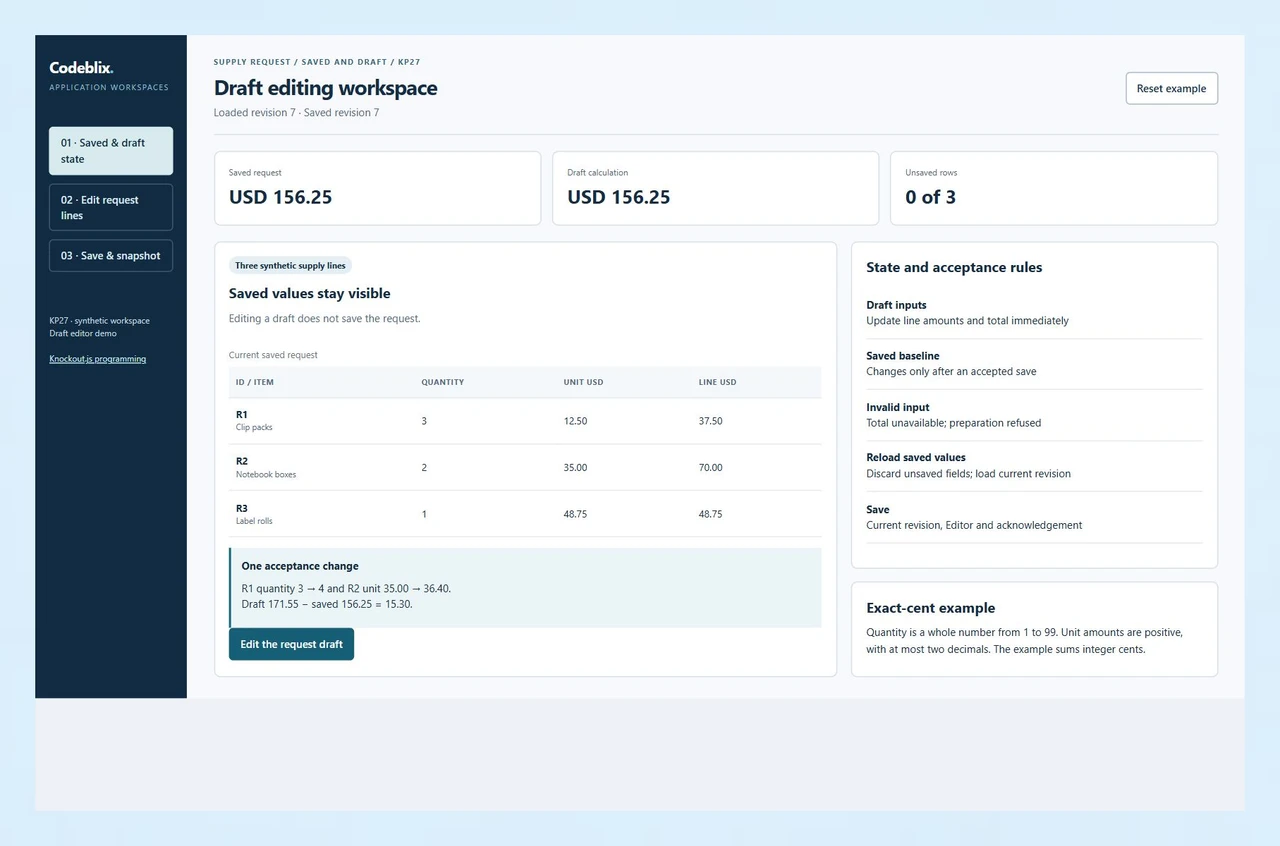
Keep the saved baseline visible while editing
In KP27, the saved request begins at revision 7 and USD 156.25. Editing quantities or unit amounts updates the draft calculation without overwriting that baseline. The change count identifies the affected rows, so the operator can inspect the actual difference before saving.
Calculate valid amounts without concealing invalid fields
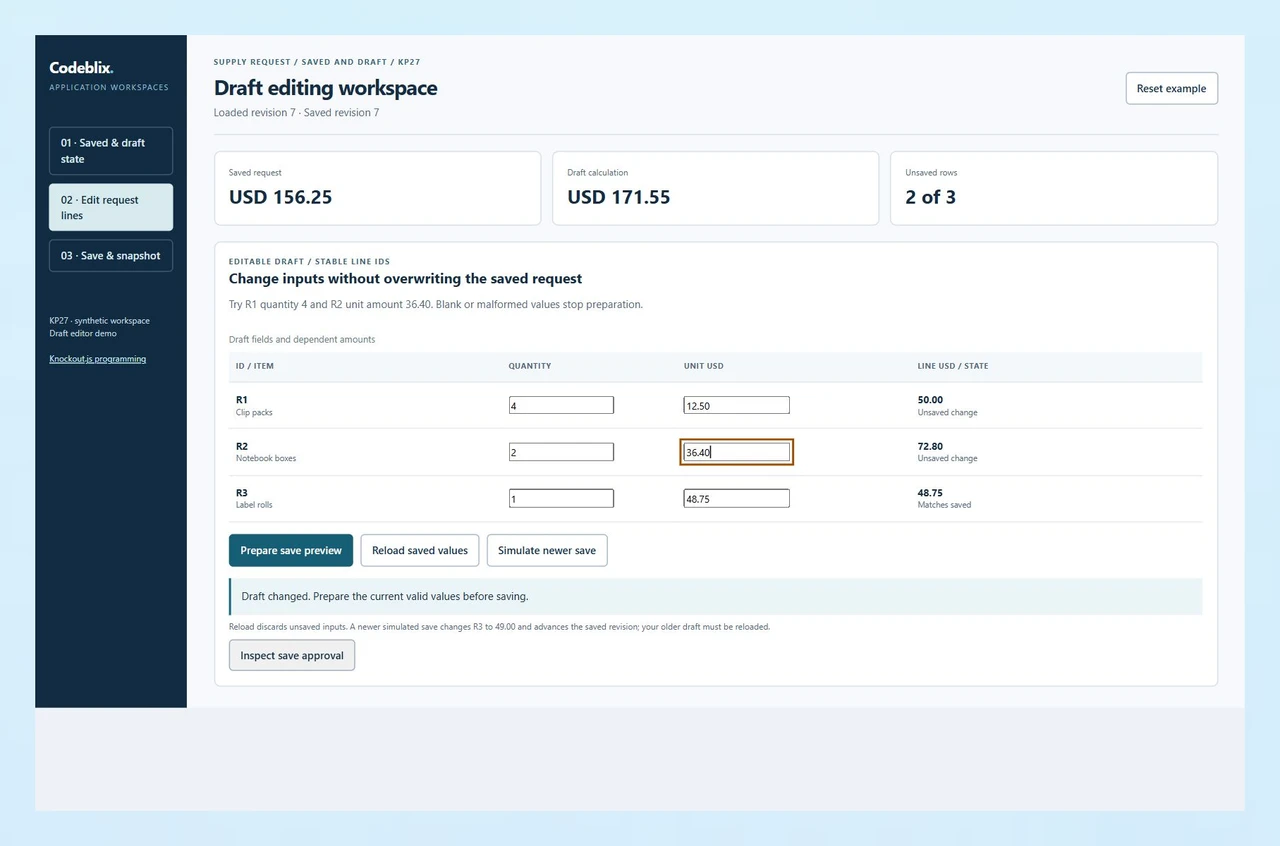
The exercise accepts positive whole quantities and unit amounts with at most two decimal places. Amounts are calculated in integer cents. A blank, fractional quantity or malformed amount makes the draft total unavailable and prevents preparation; it never quietly turns a bad field into zero.
Define reload and concurrent-save behavior explicitly
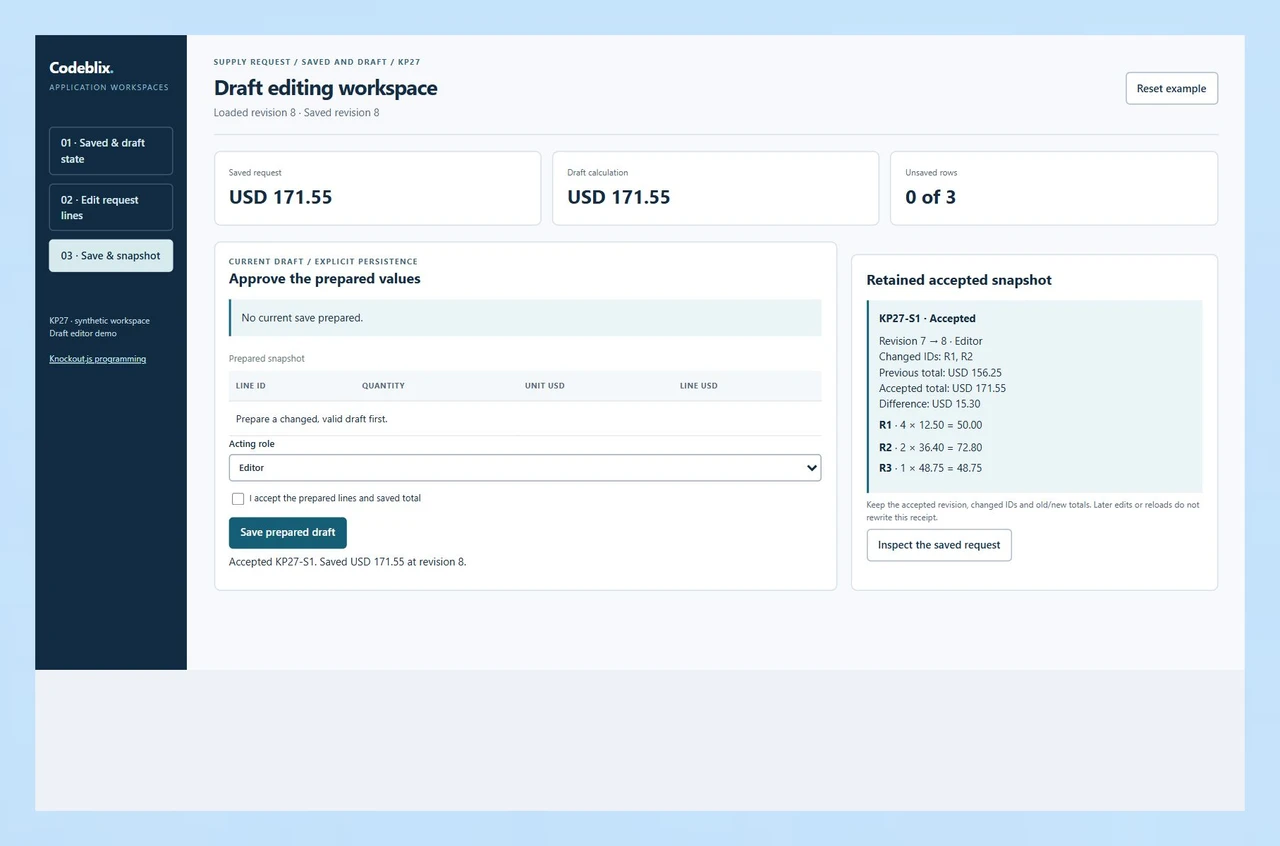
Reloading saved values discards the current draft and restores the saved revision. A simulated save by another operator advances the saved revision and blocks the older draft from being prepared. The accepted snapshot retains the changed IDs and old/new totals for the receiving user.
A changing total should not silently change the saved request.
KP27 starts with three synthetic office-supply lines totaling USD 156.25. Increase R1 to four packs and change R2 to USD 36.40 per box: the draft becomes USD 171.55 while the saved request stays unchanged. Preview the two changed rows, then save the accepted snapshot.
Specify the boundary between a live calculation and a saved change.
Use the working editor and its acceptance cases alongside the official Knockout references when discussing your application.
Operate the saved-versus-draft editor
Enter the two-line change, check the exact total and inspect the prepared snapshot. Try invalid fields and a newer saved revision, then reload the baseline. Use the resulting cases to describe the change you want commissioned.
Open the draft editor demoDiscuss dependent values in the application
Knockout computed observables update when their dependencies change. Identify which displayed amounts depend on each input and which values belong in the saved payload, so a visual recalculation is not mistaken for persistence.
Knockout primary reference: computed observablesChoose when field edits reach the view model
The official field-binding reference distinguishes ordinary value updates from immediate text input updates. Test typing, paste, clearing and mobile entry in the supported browsers, using the behavior your operators actually need.
Knockout primary reference: field value updatesDefine the server action as a separate acceptance boundary
For a CodeIgniter backend, specify how the receiving action rechecks IDs, permissions and current values. Keep the frontend editing request and any server-side bulk action explicit in the programming scope.
Scope the CodeIgniter application actionCommission the input, calculation and save behavior together
A field change affects the display immediately; a saved change needs its own validation and acceptance boundary.
Bring the application screen and its dependency baseline
Identify the installed Knockout.js release, binding or component customizations, supporting libraries, browser requirements and source repository. Show the screen your operators use and the data contract that loads and saves it. Name the person who can authorize development access and accept the finished behavior.
Set the dedicated allocation around a finite first task
Explain the frontend change, the people using it and the intended delivery period. Request an allocation and review arrangement in the quotation, with the developer responsibilities, backend dependencies and acceptance owner identified. Separate the first deliverable from later backlog items so progress has a clear receiving point.
Establish the saved request and editable draft
The three KP27 lines are R1 Clip packs, 3 at USD 12.50; R2 Notebook boxes, 2 at USD 35.00; and R3 Label rolls, 1 at USD 48.75. Their line amounts are USD 37.50, 70.00 and 48.75. Keep the saved revision 7 total of USD 156.25 while constructing a separate editable draft.
Exercise dependent totals and field refusal cases
Change R1 quantity to 4 and R2 unit amount to 36.40. The draft line amounts become USD 50.00, 72.80 and 48.75, totaling USD 171.55. Two rows changed and the difference is USD 15.30. Try an empty quantity, a fractional quantity and an amount with three decimals before restoring valid inputs.
Prepare and save only the current accepted draft
Preview the two changed rows and their totals, then confirm as Editor. KP27-S1 records revision 7 to 8 and the accepted USD 171.55 total. Observer cannot save, and an input edit clears preparation. A newer simulated saved revision requires reloading saved values and preparing a fresh change.
Accept the implementation with its persistence and release evidence
Run the cases against the commissioned application, including the actual save response, authorization and conflicting updates. Receive the source revision, binding changes and verification results. Set the deployment owner, recovery procedure and support terms, including who investigates rejected saves and maintains the remaining frontend backlog.
Prepare access, bindings and integration responsibilities
- Supply a sanitized record set and the observable, component or binding code involved in the change. Identify validation messages, formatting rules and subscriptions that affect adjacent fields. List browser and accessibility requirements with the task.
- Document the existing load/save endpoint, response shape, authentication and expected revision behavior. State which team owns backend changes and error handling. Any new integration or dependency should have a defined interface, access owner and acceptance result.
- Agree the dedicated allocation, communication channel, review frequency and source delivery arrangement in the engagement. A confirmed allocation describes the time and responsibilities reserved; it does not replace a written acceptance result for each delivered change.
Set calculation, migration and support boundaries
- KP27 uses positive whole quantities from 1 to 99 and synthetic USD unit amounts up to two decimals. It keeps calculations in integer cents, separates draft and saved records, and requires explicit acceptance before saving. Specify the actual application’s permitted values, currencies and rounding rules independently.
- The receiving server should validate the payload and operator authority, reject a stale expected revision and return the saved values or a useful error. Confirm how the interface handles network failure, retry and a later load, including which user edits are retained or discarded.
- For modernization, identify the exact Knockout modules and dependencies that will remain, change or migrate. Quote compatibility work and backend adjustments separately where needed. At handover, include the source, deployment instructions, supported browsers, exception handling and agreed defect support window.
Six records that define a reactive draft change
Put the saved baseline, draft inputs and accepted snapshot into the programming request.
| Record | Example inputs | Required output and control |
|---|---|---|
| Application baseline | Knockout.js version, bindings, dependencies, load/save interface and supported browsers | Assess the code and integration responsibilities that the frontend change touches. |
| Saved request | Revision 7; R1 3 × 12.50, R2 2 × 35.00, R3 1 × 48.75; total 156.25 | Keep the baseline unchanged while a separate draft is edited. |
| Draft input | R1 quantity 4; R2 unit 36.40; R3 unchanged | Validate each field and derive the three line amounts in integer cents. |
| Dependent total | 50.00 + 72.80 + 48.75 =171.55; two changed rows; delta 15.30 | Make invalid totals unavailable rather than substituting zero. |
| Prepared save | Current loaded revision; valid changed fields; Editor and acknowledgement | Refuse unchanged, stale, unauthorized or unconfirmed saves; clear preparation after edits. |
| Accepted snapshot | KP27-S1; revision 7 → 8; changedIDs R1/R2; saved 171.55 | Retain the accepted difference; reload later inputs without rewriting the receipt. |
Begin with USD 156.25 saved at revision 7. R1 changes from 3 to 4 packs at USD 12.50, adding USD 12.50. R2 changes from USD 35.00 to 36.40 for two boxes, adding USD 2.80. The draft is USD 171.55 and the increase is USD 15.30. Prepare that change and acknowledge it as Editor. KP27-S1 retains R1 and R2, the previous total and the accepted total at revision 8. Reloading before acceptance instead restores the saved values and discards the draft.
Use the same editing case in each programming enquiry.
Ask about the engagement and the evidence your team will receive, using providers’ published service scope as a starting point.
| Option | Published focus | Ask in your demo |
|---|---|---|
| iFlair | Describes hourly, monthly and fixed-project hiring, custom frontend work, migration and support. | Which draft, save-response and reload cases are included in the programming quotation? |
| Hidden Brains | Offers managed, client-managed and hybrid developer engagements with development, QA and maintenance. | Who will verify invalid fields, dependent totals and concurrent-save handling with the application owner? |
| Logamic | Offers developer matching, contract arrangements, interviews and an expert consultation. | What task-specific acceptance, source delivery and saved-state evidence accompanies the allocation? |
Provide the same dependency inventory, three-line record set and save contract with each request. Confirm the dedicated allocation, the person accepting the work and the boundaries of backend or migration changes. Ask the provider to return reproducible results for the agreed cases, alongside the source and operating handover.
Category reference: Knockout primary reference: observable values. Use the platform references to discuss the installed bindings. Agree draft isolation, validation, revision checks and saved-snapshot handling as explicit application requirements.
Commission application work around a concrete operating result.
Explore Codeblix development services and prepare the records, access and receiving checks your application change needs.
Explore marketplace development servicesClarify the programming allocation and the save contract
Set the first task and its receiving evidence before the development engagement begins.
What information belongs in a dedicated Knockout.js programming request?
Include the library version, relevant dependencies, authorized source arrangements, affected screen and save interface. Provide sample records and the operator’s expected result. Ask Codeblix to assess the programming allocation, review checkpoints, backend dependencies and handover in the quotation.
What does a dedicated allocation need to specify?
Confirm the time reserved, development responsibilities, delivery period and review arrangements with the provider. Give each backlog item an acceptance result and a named business approver. Scope changes, additional dependencies and support responsibilities should be agreed alongside that allocation.
Which values remain saved while the example is edited?
KP27 initially retains revision 7 and USD 156.25 as the saved request. Editing R1 and R2 changes the separate draft to USD 171.55. The saved baseline changes only after a valid prepared save is acknowledged by Editor; the receipt retains the old and accepted totals.
How does the example obtain the USD 15.30 difference?
The extra R1 pack adds USD 12.50. Raising R2’s unit amount from USD 35.00 to 36.40 adds USD 2.80 across two boxes. Together they add USD 15.30 to USD 156.25, producing USD 171.55. The exercise calculates amounts in integer cents.
What happens to empty, fractional or malformed inputs?
A quantity must be a positive whole number from 1 to 99. Unit amounts must be positive and have no more than two decimal places. An invalid field makes the draft total unavailable and stops preparation. Restoring valid input recalculates the draft; it does not automatically save it.
How do reload and a newer saved revision differ from saving this draft?
Reload saved values discards the current unsaved inputs and loads the saved revision. Simulate newer save advances that revision and updates R3’s unit amount to USD 49.00; the older draft cannot be prepared until reloaded. Accepting a current valid draft instead creates a retained save receipt.
Can the engagement include backend changes or frontend migration?
Identify the API contract, authentication, revision behavior and modules involved in the request. Quote backend adjustments, dependency updates and any migration as explicit work with separate checks where needed. The assessment should establish which parts the commissioned programmer owns and which depend on another team.
What evidence should accompany the finished change?
Request the source revision, changed binding or component code, acceptance results and the actual saved response behavior. Include supported-browser and keyboard checks, deployment and recovery instructions, rejected-save handling and the agreed support period. The application owner should be able to reproduce the completed cases.