
Quote the behaviour at the host boundary.
A short script can change application behaviour when a default replaces an intentional value. Put those decisions in the receiving brief.
Preserve an intentional false
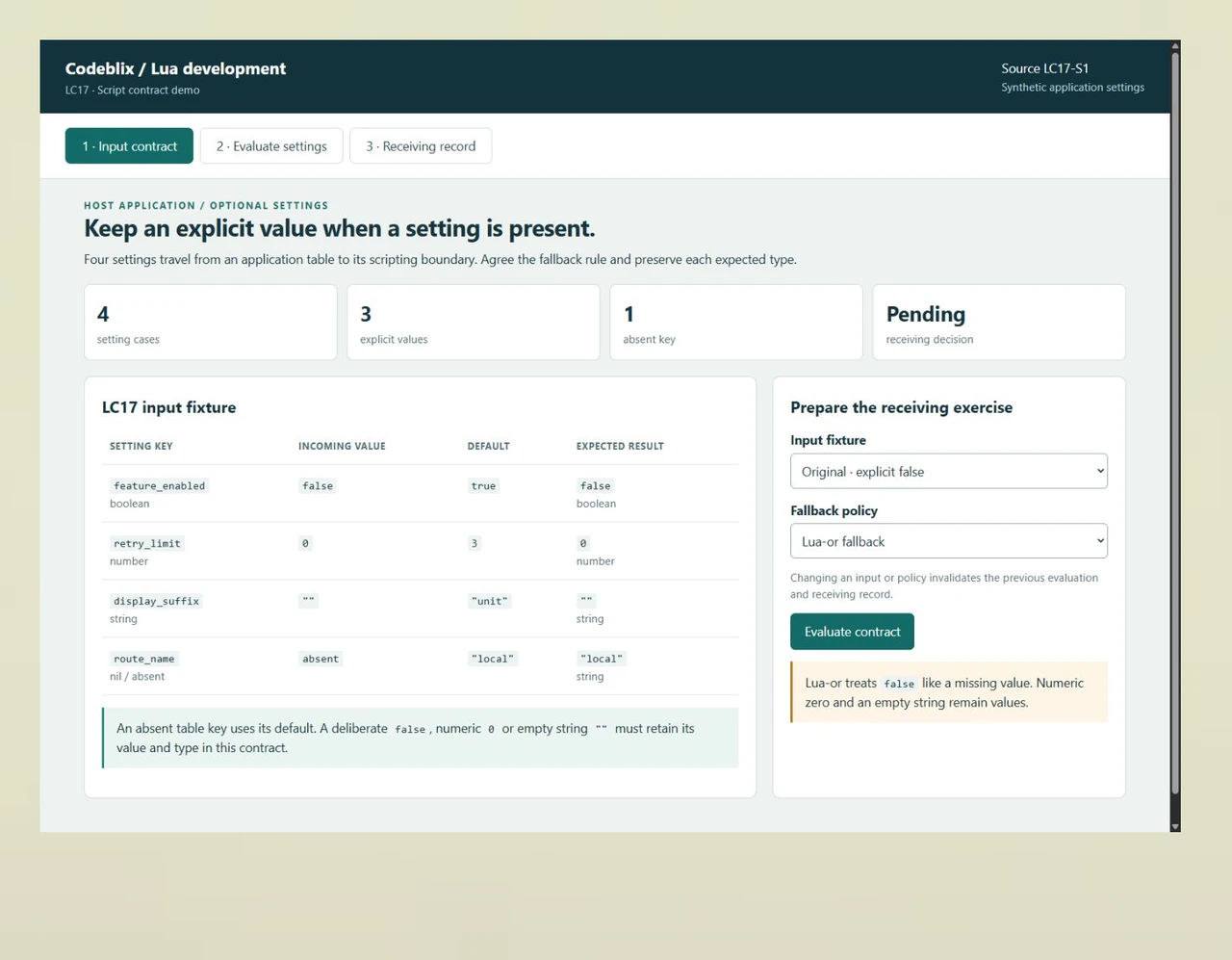
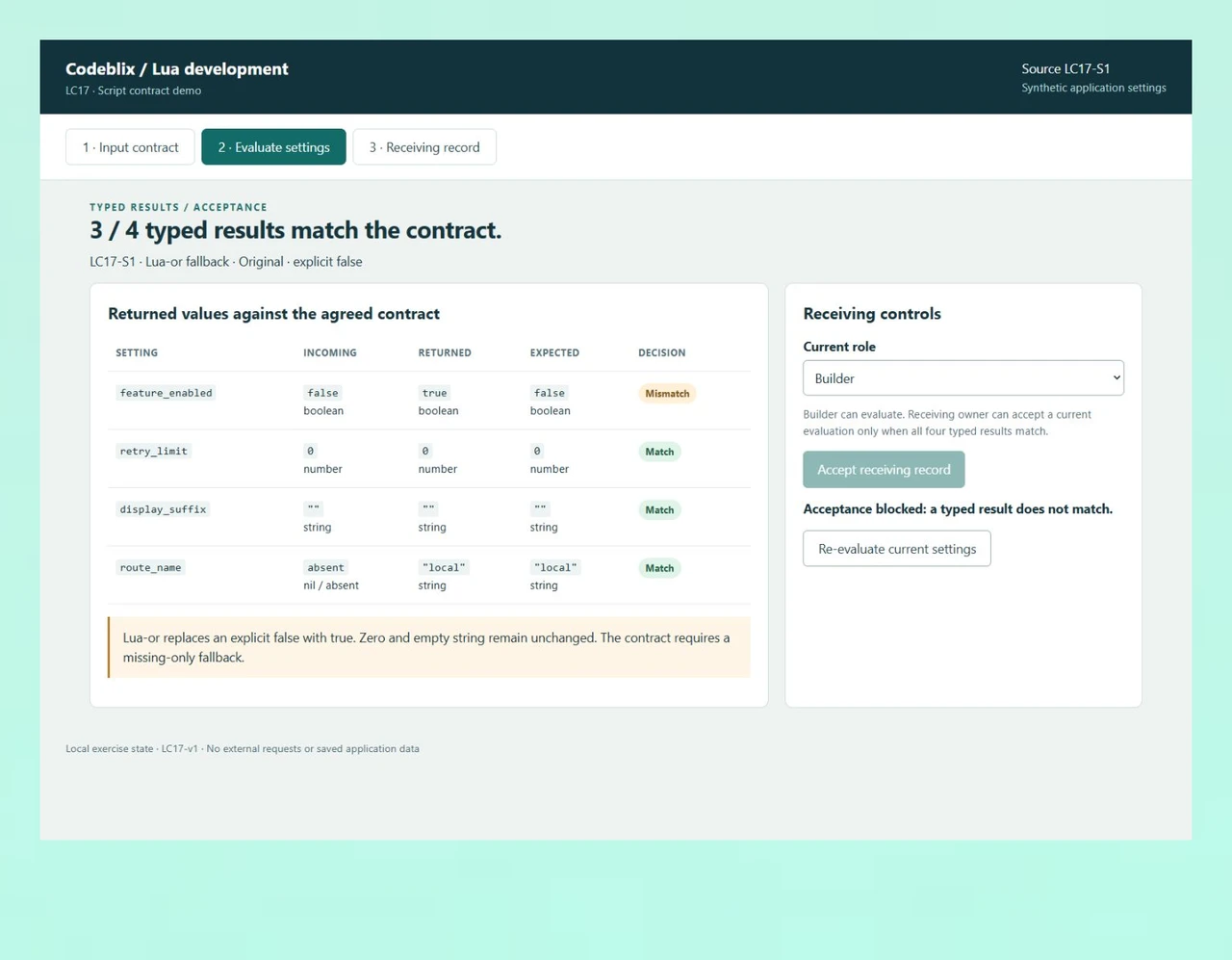
LC17 supplies feature_enabled as boolean false and gives it a default of true. The required output is false. A Lua-or fallback returns the default for this input, so only three of the four results match the contract. The missing-only rule preserves false and uses a default only for an absent setting. This is a concrete behaviour to include when commissioning configuration or extension work.
Keep zero and an empty string distinct from absence
The same fixture supplies retry_limit as numeric zero and display_suffix as an empty string. Both remain values under Lua's logical rules. The missing route_name receives the default string local. A host binding must preserve those types instead of applying another language's assumptions about empty values. Include the expected host-side representation in the agreed interface.
Reject a wrong type before accepting the handover
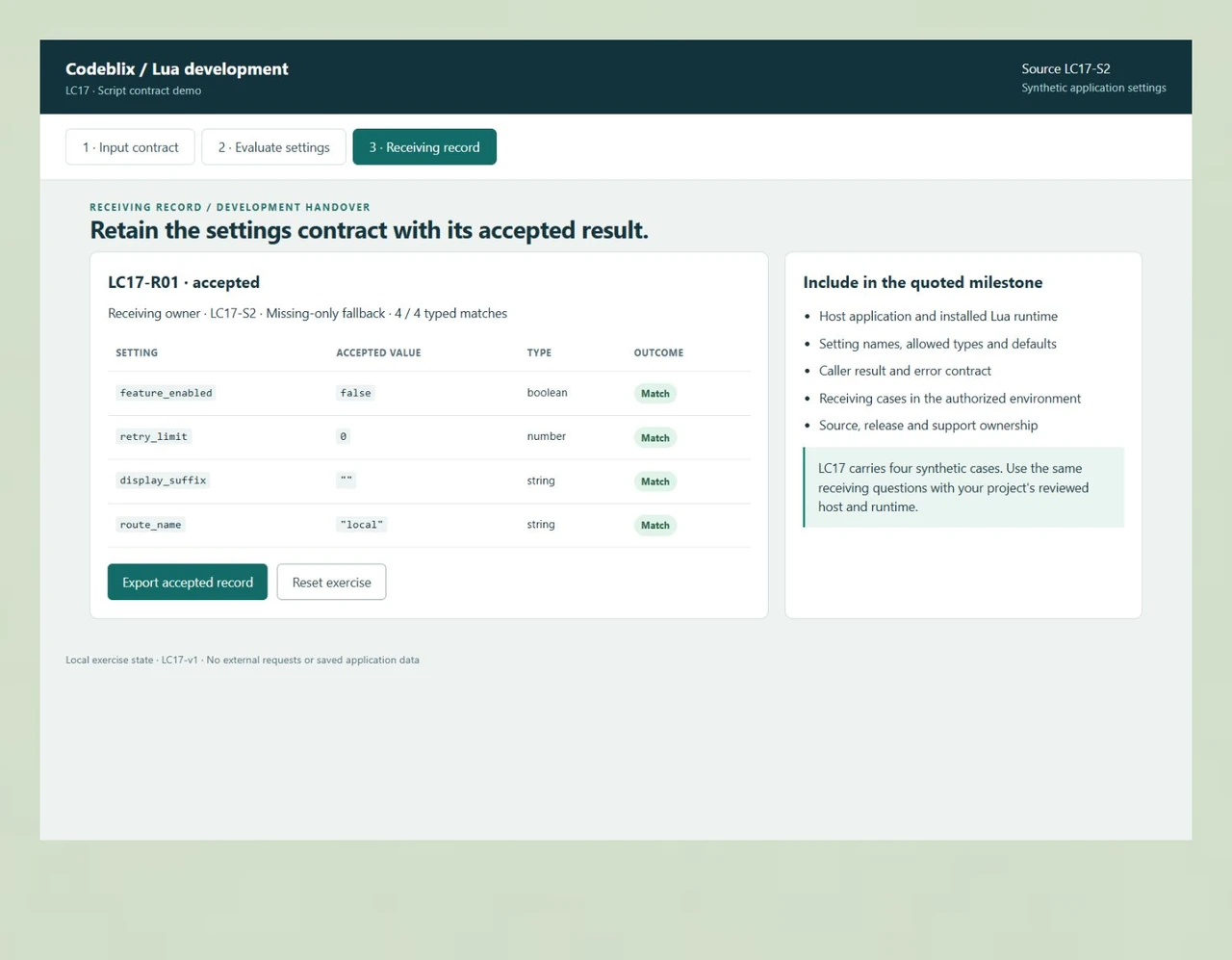
Changing feature_enabled to the string false produces a rejected input in LC17. It does not silently become a boolean. Changing a fixture or policy invalidates the earlier evaluation and receiving record. The receiving owner accepts only a current set of four matching typed results, then retains the source revision and exported values with the milestone.
Make the handling of optional settings part of the commission.
LC17 is a script contract demo with four synthetic settings. Evaluate the original values with Lua-or fallback, inspect the changed boolean, then use Missing-only fallback to preserve the agreed results. Receiving owner can accept the four matching cases and export the record.
Ask for an allocation against a result your team can receive.
Use the working exercise, primary language references and a bounded checklist to describe the first deliverable.
Inspect a present value before applying its default
Open LC17, evaluate the original fixture and inspect feature_enabled. Then choose Missing-only fallback and evaluate again. All four typed results should match before the receiving owner accepts and exports the record.
Open the script contract acceptance demoAgree the language's value model
Lua's reference manual distinguishes nil, boolean and the other value types. An absent table key and an explicit false are different inputs. Use that distinction when defining how application settings enter the script.
Consult Lua's official value and type referencePut fallback and caller errors in the interface
The logical-operator reference explains which operand Lua-or returns. The same manual documents protected calls and the error object available to the caller. Identify the required defaulting rule and error response in the commissioning brief.
Check the official logical-operator contractScope records around the scripting feature
If the script also needs a new configuration editor, record store or import interface, describe those application responsibilities separately. Include ownership of data validation and the approved exchange with the host so the allocation covers the usable end-to-end feature.
Discuss the surrounding custom applicationSix decisions before work enters the scripting layer
Connect the requested developer allocation to a particular host, a finite interface and an observable receiving result.
Identify the runtime and host
Name the actual Lua version or dialect, host application, operating environment and source repository. Provide the extension entry point, permitted APIs and a way to reproduce the current behaviour. Treat a platform-specific dialect, native module or vendor extension as a compatibility question to resolve during scoping.
Specify the values crossing the boundary
List each setting or callback argument with its type, allowed values and default. Distinguish absent fields from explicit false, zero and empty strings. LC17 uses a feature flag, retry limit, display suffix and route name. Your brief should identify whether the host passes those values through a table, a binding or an approved application interface.
State the script's authority
Describe which records, files, network operations or host functions the script may access. Identify the owner of permissions, execution limits and secrets. Ask the quotation to include the relevant host restrictions and validation; a scripting language alone does not define the application's access boundary.
Define successful and failed calls
Provide expected return values, type errors and caller actions. Lua's protected-call interface exposes a status and an error object; agree how the host receives and records them. Include an invalid input and a failed callback in the receiving scope, alongside the normal result. Decide which errors stop the operation and which the caller can handle.
Receive evidence from the reviewed environment
Use the LC17 contract to make the optional-setting decision concrete, then execute the corresponding cases in the project's authorized runtime and host. Include empty input, explicit values, a type mismatch and a changed-source rerun. Compare both the returned value and its type before the receiving owner accepts the milestone.
Transfer source and operating responsibility
Agree the script source, binding changes, dependency versions, receiving fixtures and observed outputs to be handed over. Name the person who authorizes the release and the person who operates it afterwards. Include rollback, diagnostic access and support arrangements in the development agreement.
Price the first scripting deliverable
- Supply one prioritized change, the requested development allocation and the hours when your team can review it. Ask for the billing basis, start conditions and treatment of additional scope in the written quotation.
- Provide a sanitized fixture, the script entry point and the expected host response. Arrange source and environment access through your approved channel. The initial consultation needs a reproducible example rather than credentials or customer exports.
- Identify native bindings, external modules and vendor-owned interfaces that the change depends on. Existing extension code may need investigation before implementation can be estimated. Confirm permitted use and actual component compatibility with the responsible owners.
- If execution time or memory matters, describe a representative workload and an agreed measurement method. Include the host's scheduling and resource limits in the technical review rather than assuming a generic language benchmark represents the application.
Include the application work needed to operate it
- For an existing script migration, identify the current runtime and destination, changed APIs, module dependencies and representative inputs. Request a rehearsal and equivalent output checks before scheduling the release.
- For an integration, list each allowed host call, its arguments, result types and error handling. Include the host-side changes and responsible vendor in the estimate; confirm the interface actually exists before committing to a connector.
- Separate an application extension from a platform-specific game or device assignment. Name the exact SDK, dialect and deployment target so Codeblix can review the appropriate project scope and delivery capacity.
- Specify the source package, receiving tests, release instructions and operator notes your team needs. Agree diagnostic access, support contact and the process for later revisions, including who decides whether changed configuration requires a fresh receiving run.
Six records linking a Lua setting to an accepted host result
LC17 gives the development brief a small, inspectable contract before it reaches the application's scripting layer.
| Record | Example inputs | Required output and control |
|---|---|---|
| Host boundary | Application / runtime / script entry point / permitted calls | Name the environment in which the actual integration must be received. |
| Setting definition | Key / allowed type / default / expected value | Keep absence separate from a present boolean, number or string. |
| Source fixture | LC17-S1 / false / 0 / empty string / absent route | Retain the incoming representation and reject a string in the boolean field. |
| Fallback policy | Lua-or / Missing-only | Evaluate the same inputs under each policy without changing their expected types. |
| Typed result | Returned value / returned type / match or rejection | Require four matches; an invalid input cannot receive acceptance. |
| Receiving record | LC17-R01 / source revision / policy / Receiving owner | Export accepted values and invalidate the receipt when the source or policy changes. |
Evaluate the original fixture with Lua-or fallback. feature_enabled returns true instead of the expected false; zero and the empty string remain unchanged, and the absent route becomes local. The result is three matches out of four. Return to Input contract, choose Missing-only fallback and evaluate again: all four results match. Builder cannot accept the result. Select Receiving owner and accept LC17-R01, then export its four typed values. A repeat acceptance is disabled. Changing the input to the string false clears the receipt; evaluate to see the boolean case rejected. Reset the exercise to restore the original fixture and role.
Bring the same host contract to each quotation.
Ask providers how their engagement will receive the specific application change, alongside their allocation and hiring arrangements.
| Option | Published focus | Ask in your demo |
|---|---|---|
| Hyparz | Lua developer hiring enquiries with allocation, interviews, account management and payment options. | Which typed host-setting cases and actual runtime results are included in the allocated development work? |
| Rootfacts | Lua scripting enquiries covering embedded uses, application extensions and custom development. | Who defines the host-call boundary, and what source and receiving evidence accompany the first deliverable? |
| Right People Group | Lua contract developer and consultant matching across different host and platform specialisms. | How will the selected engagement verify explicit settings, caller errors and the receiving owner's acceptance? |
Provide the runtime, four typed cases and the required missing-only policy with your enquiry. Ask the quotation to identify the host-side implementation, the authorized verification environment and the evidence your receiving owner will retain. Use LC17 to explain the result; include execution in the actual reviewed host as a delivery condition.
Category reference: Lua primary reference: protected calls at the host boundary. Lua 5.4 value, logical-operator and protected-call references accessed 3 November 2026. LC17's keys, defaults, fixture revisions and receiving permissions are original exercise assumptions.
Include the application owners around the script.
Coordinate the configuration records, host interface and receiving responsibilities needed to use the development result.
Explore Codeblix marketplace servicesAgree the first result of your Lua engagement
These commissioning questions connect the requested allocation to the application's host and receiving owner.
What should we include when requesting dedicated Lua developers?
Name the host application, installed runtime or dialect and the first scripting change. Include the requested allocation, permitted interfaces, source ownership and a small fixture with expected typed results. Codeblix can then review project fit, capacity and the work to include in a written quotation.
Can we commission one application extension first?
Describe the extension entry point and the application behaviour to deliver. Supply the approved host API, current source and a representative receiving case. The estimate can cover investigation, script and binding changes, verification in the reviewed environment and the agreed handover.
How is the development allocation quoted?
Request a stated billing basis, allocation period, review availability and scope-change process. Existing-code investigation, native bindings, migrations and release support affect the work required. Ask the quotation to identify those responsibilities and the conditions for starting the engagement.
What can our receiving owner check in LC17?
The working contract evaluates four synthetic settings and shows each value, type and acceptance outcome. Lua-or changes an explicit false to its default; Missing-only preserves it. Zero and an empty string remain values. The receiving owner can accept four current matches and export their record.
What happens when a setting has the wrong type?
In LC17 the string false fails the boolean input rule and prevents acceptance. Define the equivalent input validation and caller error behaviour for your own application. Include the actual error response in the milestone's receiving cases rather than assuming the host will coerce the value.
Can the engagement cover an existing runtime migration?
Provide current and destination runtimes, module dependencies, native bindings and vendor restrictions. Agree representative inputs, expected outputs and a recoverable rehearsal. Compatibility and any host-side changes need review before the migration scope and release assistance are confirmed.
How do we include external calls and execution limits?
List permitted functions, resource limits and the owner of credentials or application permissions. Describe successful callbacks, failed calls and the host's response. Include verification of that boundary in the quoted work; the language reference does not establish the host application's access policy.
Which source and host evidence belong in the Lua handover?
Ask for the changed source, runtime and module notes, interface definitions, receiving fixtures and observed host results. Agree release and recovery instructions, diagnostic ownership and support terms. Retain the accepted source revision with its typed output so later changes can be checked against a known result.