
Commission the records, the write rules and the working application.
A business owner and technical lead should be able to explain what enters storage, who may change it and how an incorrect batch is recovered.
Replace fragile references with explicit relationships
Decide which record owns each identifier. Separate a client from its projects and a project from its entries. Define required fields, unique keys and the treatment of archived parents. This gives imports, forms and reports a consistent way to refer to the same business record.
Approve changes against visible acceptance cases
A successful import needs more than a row count. Retain input positions, rejection reasons, accepted values and the input revision the approver accepted. Use a small, repeatable batch to establish duplicate handling, client boundaries and numeric precision before migrating the wider dataset.
Receive an application with an operating handover
Include the screens, access roles, database constraints, documented interfaces and recovery procedure in the project scope. Name the system owner and agree the restore test, support hours and administrator handover that complete delivery.
A useful database preserves relationships when the input is difficult.
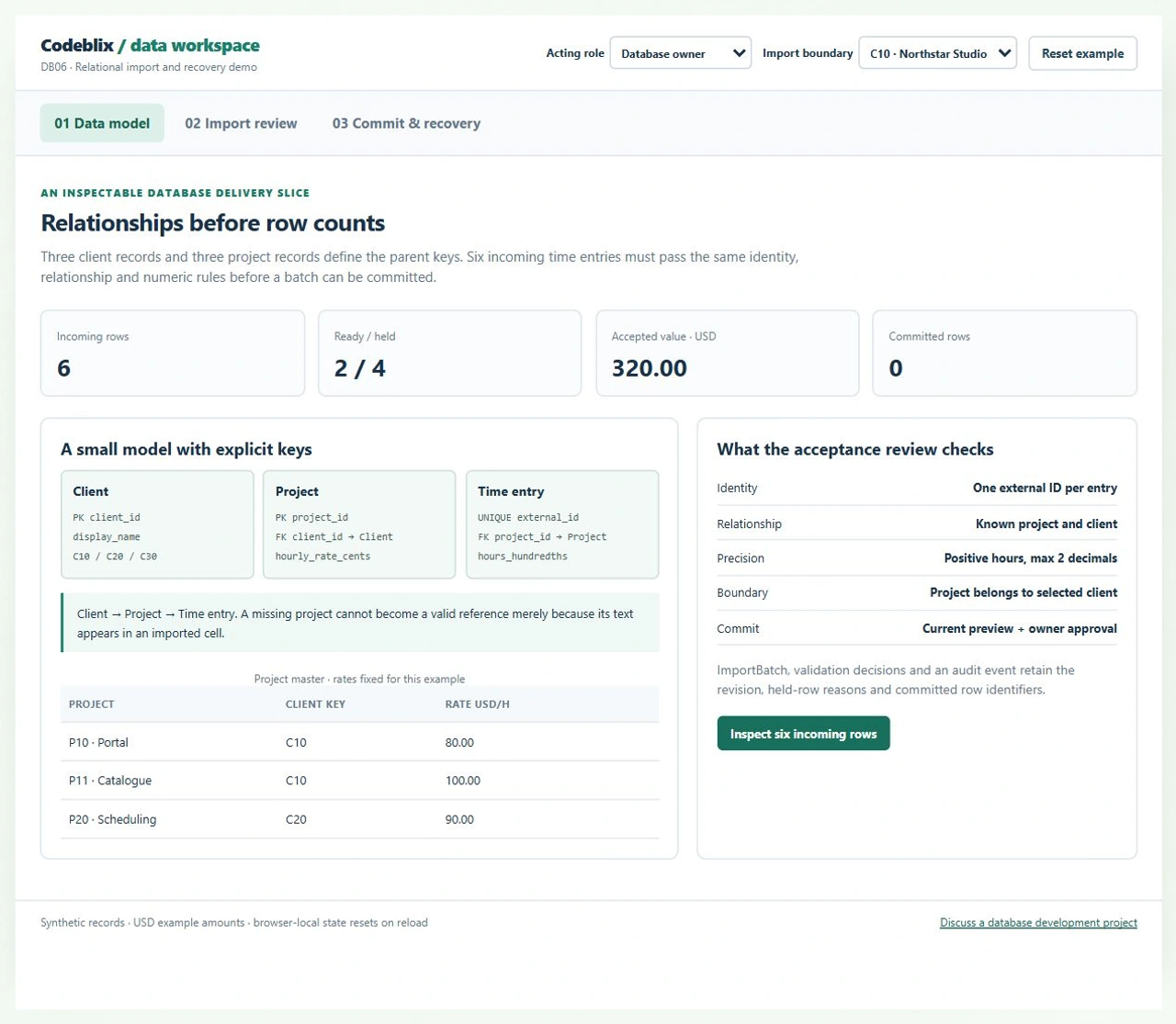
DB06 connects clients, projects and time entries. Follow six incoming rows through validation, correct a repeated identifier and inspect a committed batch with a protected parent record.
Give the quotation a repeatable acceptance exercise.
Use the working example to name the same records, failure cases and recovery outcomes in each development proposal.
Run DB06 from validation to recovery
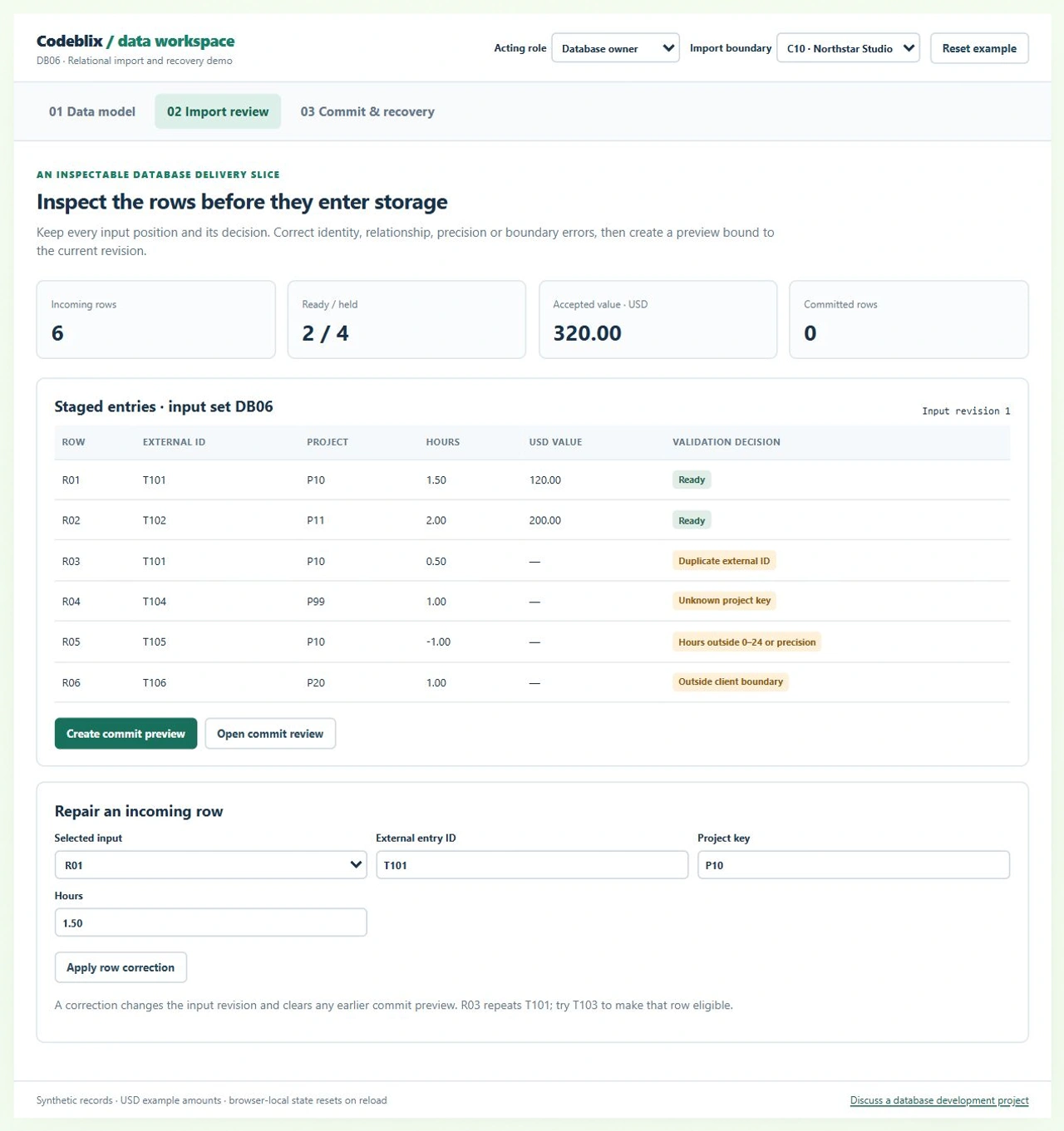
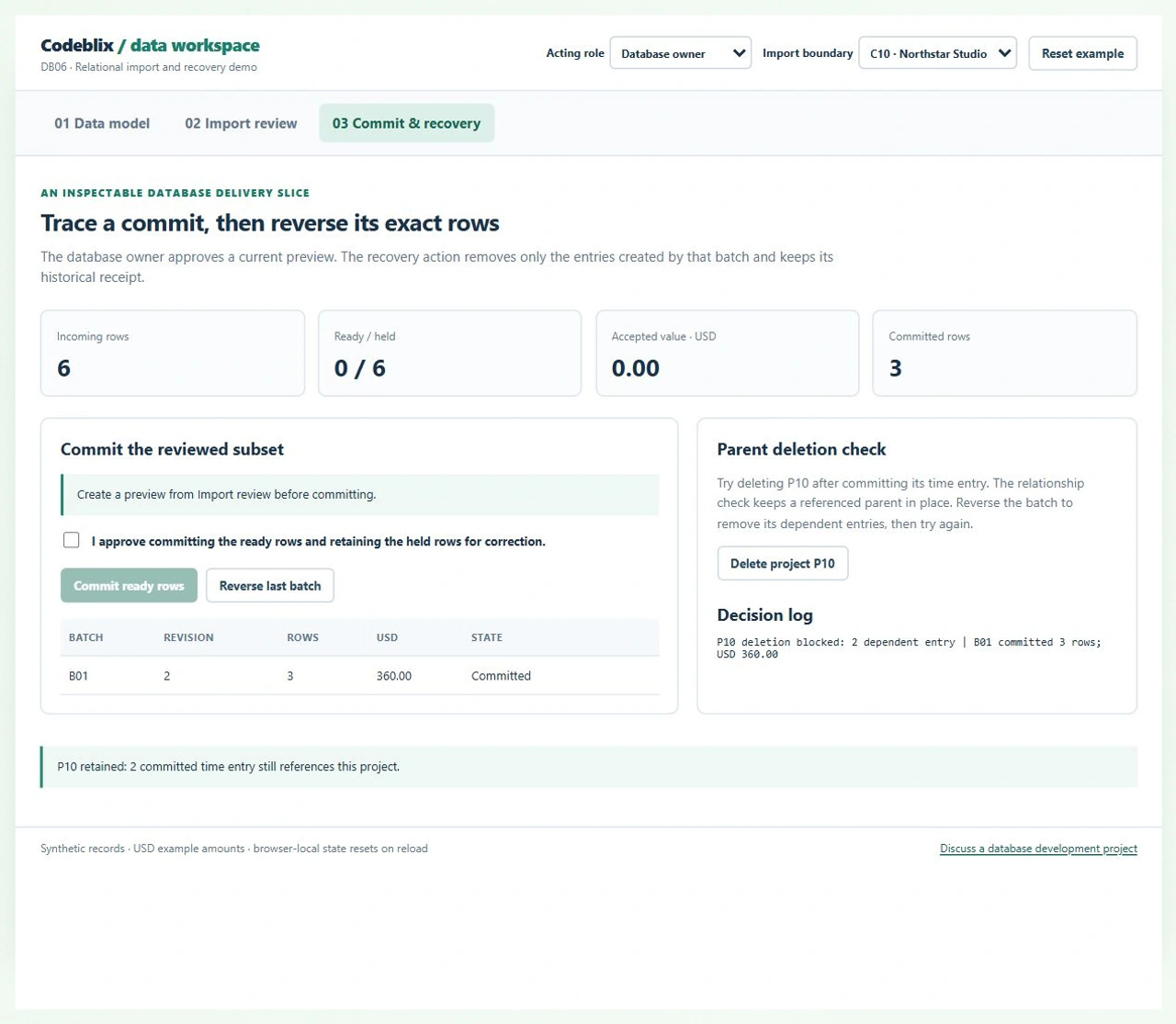
Inspect the six incoming rows. Change R03 from T101 to T103, apply the correction and create a new preview. Approve it as Database owner, commit three rows and try deleting P10. Reverse the batch to inspect the retained receipt and released dependency.
Try the relational import and recovery demoConnect the application to the business workflow
A database project may support tasks, project records or customer handoffs. Specify the application actions and reporting outputs alongside the storage model, so the delivery includes the work people need to complete.
Inspect consulting client and project recordsSeparate application development from ongoing database operations
Monitoring, backup scheduling and performance review require named operating responsibilities. Include the relevant service arrangements in your project handover and retain a clear owner for the database application itself.
Explore database operations requirementsRepair a specific action in an existing Laravel application
When the record model already serves the business and a particular request fails, define that failure and its acceptance result before commissioning a replacement application. Keep the corrective patch and regression work within a clear repair scope.
Request a scoped Laravel bug fixCommission a SQL Server reporting milestone
When an existing SQL Server application needs a report or stored-procedure change, specify that programming allocation and its expected result separately from a complete database application build. A report-grain exercise makes independent source totals and unpaid records part of the acceptance brief.
Request a dedicated SQL Server programming quoteCommission an Oracle package or batch milestone
For an Oracle-backed application, identify the package, caller and transaction owner before allocating the development work. A batch failure exercise makes staged changes, rejected inputs and the commit decision part of the receiving brief.
Request a dedicated Oracle development quotationCommission a Lua application extension
If an application uses Lua for configurable behaviour, define the host interface and the values entering each script. An optional-setting exercise helps your receiving owner agree how explicit values, defaults and type errors should behave before commissioning the extension.
Request a dedicated Lua development quotationBind mobile record details to the current request
A record service can return a valid response after the application has selected another record. Include the client request identity and screen lifecycle in the receiving brief for an Objective-C application change, alongside the service contract and release owners.
Request an Objective-C application development quotationDefine the desktop export request alongside its record service
A desktop export needs a stable source record and a permitted output operation. Include document IDs, revision rules and the approved service contract in an Electron development enquiry, then agree which request the desktop application may receive and which destination it may use.
Request an Electron desktop development quotationKeep editable drafts attached to their server records
A React interface needs stable record identifiers and a clear save response from its data service. Include those IDs, revision rules and validation outcomes in a monthly development enquiry, then agree the editable component and backend responsibilities together.
Request a monthly React development quotationConnect editorial blocks to authoritative records
A dynamic WordPress section needs a defined record source, editable attributes and fallback content. Include those boundaries with the Gutenberg block library request, and agree which editorial content remains shared across pages.
Discuss Gutenberg block and pattern developmentCommission the MySQL implementation backlog
When your record application runs on MySQL, include the database version, existing schema and representative identity rules in the development enquiry. Agree the programmer allocation and receive client-scoped key behaviour with the application change.
Discuss dedicated MySQL developmentScope PostgreSQL revision and period behaviour
For a PostgreSQL application backlog, identify the entity whose rules change over time and the receiving cases at each date boundary. Include competing revisions, withdrawn history and publication responsibility with the development allocation.
Arrange dedicated PostgreSQL developmentCommission the MongoDB nested-record operation
For MongoDB application work, identify the parent document and nested task that a developer should change. Agree revision conflicts, receiving totals and source handover with the project scope or monthly allocation.
Request MongoDB project developmentCommission the partial-profile application change
For an existing Zend application, define which profile fields a monthly development task may change. Agree how omission, zero, false and explicit clears pass through the form, request handler and stored record.
Discuss monthly Zend developmentCommission a CFML reporting increment
For a ColdFusion application report, define the date window, allowed status and records behind the exported total. Arrange a monthly development allocation around the query, operating screen and receiving evidence.
Request monthly ColdFusion developmentCommission a J2EE service operation
Connect your Java application command to its affected records, failure outcome and repeatable request result. Discuss a monthly development allocation with a receiving checklist for the service and database handoff.
Request monthly J2EE developmentConnect an interactive 3D configuration
When a browser-based 3D workspace sends a selected product into your application, brief the visual controls alongside the model identity, units, revision and receiving API. Keep scene behavior and data acceptance connected in the project quotation.
Request a WebGL development quoteCommission an Access frontend milestone
For an existing Microsoft Access application, brief the affected forms, VBA routines, reports and linked tables as a defined programming milestone. Include the editable source, user-PC dependencies and the frontend distribution and receiving record.
Request an Access programming quotationScope a Rails association-loading milestone
When the application backlog includes order retrieval, agree the parent records, associated customers and lines, missing-relationship behavior and receiving trace together. Connect the database responsibility to a monthly Rails programming engagement.
Discuss monthly Rails programmingDefine product and option quantities for an OpenCart change
For store programming, identify the product records, option values and order transitions that own inventory updates. Use an option-price and stock receiving case to separate a permitted selection from a shortage before commissioning the integration work.
Scope monthly OpenCart programmingDeliver one complete database workflow in six stages
Start with a small business process that includes its troublesome records, then expand after the data and application behaviour are accepted.
Define the work and its source of truth
Choose the first users, record types and decisions. Bring a small anonymised extract and the reports it must support. Identify who owns each source and where an approved update should be recorded.
Agree keys, relationships and field rules
Map stable identifiers, parent references, allowed states and required values. Specify decimal precision, dates, duplicate policy and archival behaviour. Make the expected outcome of each invalid input part of the requirements.
Build the access and write paths
Scope forms, search, filters, imports and APIs around the same rules. Assign reader, operator and approval permissions. Include server-side checks and database constraints so every supported write path preserves the agreed relationships.
Rehearse migration and reconcile the result
Stage the import, show accepted and held rows, and reconcile both counts and values to the source. Review corrections before committing. Define whether a batch is rejected in full or an explicitly approved subset is accepted.
Prove recovery and concurrent changes
Demonstrate stale-edit rejection, duplicate retry handling and the result of a failed multi-step write. Test deletion of a referenced parent, correction of an accepted record and recovery from a backup using the agreed operating dataset.
Deploy with ownership and support agreed
Confirm hosting, data location, access administration and release approval. Hand over the schema, source code, interface contract and operating instructions. Record the support boundary and the owner who signs off the first live workflow.
Scope the database and the application together
- List tables or document types, key relationships, field validation and lifecycle states. Include a permission matrix for each supported create, update, export and delete action.
- Specify the user interface, reports and API endpoints included in the delivery. Identify whether the work is a new application, an extension or an existing-system replacement.
- Review each external interface for authentication, direction, frequency, rate limits, error responses and ownership. Quote connection work after the interface is inspected.
- Select the database technology against data relationships, existing systems, access patterns, concurrency, hosting and support requirements. Agree the supported versions in the proposal.
Make migration and recovery measurable
- Reconcile source IDs, duplicate references, missing parents, dates and decimal values before cutover. Preserve an approved field mapping and a list of held records.
- Agree the import policy explicitly: reject the whole batch or approve a validated subset. Record the source edition, row decisions, accepted totals and confirmation owner.
- Specify backups, retention, recovery objectives and restore testing. A compensating correction for an accepted batch needs its own audit trail and dependency checks.
- Use a pilot extract to verify permissions, representative queries and concurrent edits. Define the release window, rollback decision and the reconciliation that permits wider rollout.
Request a quotation with clear deliverables
- Provide record types, example row counts, expected growth, peak users, the most important reports and difficult write scenarios. Give anonymised samples through the agreed project channel.
- Separate discovery, data cleanup, application development, migration, interfaces, deployment and continuing support in the quotation. Hosting and third-party licences need their own line items.
- Name the source-code owner, data owner and administrator. Include schema documentation, access setup, interface documentation and operating instructions in the handover.
- Agree support hours, escalation, monitoring responsibilities and how a future schema or source-format change is estimated. Test delivery against your accepted cases.
Six records that make a database quotation testable
DB06 supplies a small relational example for reviewing identity, imports and recovery. Replace its example entities with your business records while retaining explicit acceptance outcomes.
| Record | Example inputs | Required output and control |
|---|---|---|
| Client | C10 Northstar Studio; C20 Cedar Works; C30 Harbor Services | A stable client key defines the import boundary; labels can change without replacing identity. |
| Project | P10 and P11 belong to C10; P20 belongs to C20 | Known parent references and rates of USD 80, 100 and 90 per hour support the worked example. |
| Time entry | External entry ID, project key and hours with up to two decimal places | Reject a repeated external ID, unknown project, non-positive hours or a project outside the selected boundary. |
| Import batch | Input revision, selected client, accepted entry IDs and accepted total | Changing an input or boundary invalidates the prior preview; approval applies to the current revision. |
| Validation decision | R01–R06, ready or held status and a specific reason | Retain all six positions. A partial commit requires an explicit decision to keep held rows for correction. |
| Commit and recovery receipt | B01, input revision 2, three entries and USD 360.00 | Keep the receipt when reversing the batch; a project with committed dependent entries remains protected. |
The original C10 batch accepts R01 at 1.50 × USD 80.00 = USD 120.00 and R02 at 2.00 × USD 100.00 = USD 200.00. Four inputs are held, leaving two ready rows worth USD 320.00. Correcting R03 to the unique ID T103 adds 0.50 × USD 80.00 = USD 40.00. The new preview contains three ready rows and three held rows, totalling USD 360.00. After owner approval, B01 records those three entries. P10 deletion is blocked by its two committed entries. Reversing B01 removes its exact three entries while retaining the historical USD 360.00 receipt.
Ask each development company to demonstrate the same write cases
Bring your data model and acceptance batch to the quotation discussion. Confirm the application, migration and continuing support included in the engagement.
| Option | Published focus | Ask in your demo |
|---|---|---|
| ScienceSoft | Database and access-application deliverables, architecture, implementation and after-launch support. | Which team delivers the import preview, database constraints, role checks and restore exercise for our dataset? |
| Belitsoft | Custom database software, SQL schema and constraint engineering, modernization and migration. | Show duplicate retry, missing-parent and concurrent-edit outcomes using the source IDs we will migrate. |
| Chetu | Custom database models, application development, integration, migration and concurrency controls. | Reconcile the accepted subset to the source and demonstrate how an incorrect batch is corrected without losing its receipt. |
DB06 contributes a repeatable six-row exercise with exact amounts, named rejection reasons, revision-bound approval and a dependency-aware reversal sequence. Use those outcomes as acceptance criteria for your own application.
Category reference: PostgreSQL documentation on unique, primary-key and foreign-key constraints. Include the required integrity rules and supported database behaviour in the development scope.
Connect the database to the work it supports.
Use project records, operational responsibilities and database administration requirements to define the application handoffs.
Explore business workflow requirementsQuestions to settle before commissioning the database project
Turn the required data behaviour into named deliverables, acceptance tests and an operating owner.
Can Codeblix develop the database and its user application?
Yes. Codeblix offers custom business software development covering the agreed data model and the application people use to work with it. The consultation establishes records, access roles, import rules, reporting needs and interfaces before the delivery is quoted.
What information is needed for a project quotation?
Prepare an anonymised extract, record relationships, required forms and reports, expected volumes and a role matrix. Include a duplicate, a missing reference and an invalid value with the expected outcome. Identify the source owner, hosting constraints and the person who approves delivery.
How should imported duplicates and missing references be handled?
Define the stable key and matching policy before importing. Decide whether an existing key means update, skip or hold, and whether an unknown parent blocks a row or the whole batch. DB06 holds a duplicate T101 and an unknown P99 while retaining their original input positions.
Can we approve only the valid rows in a batch?
Include that policy explicitly in the application requirements. A partial import needs a current preview, accepted count and total, visible held-row reasons and an authorised confirmation. DB06 demonstrates that decision; changing a row clears the preview before another commit can be approved.
How are access permissions enforced in the delivered system?
Specify permissions in the server-side application and supported data-access paths. Distinguish readers, operators, approvers and administrators, including their client or business-unit boundaries. Test direct requests and imports as well as the visible controls during project acceptance.
What happens when an accepted batch needs to be corrected?
Agree a recovery or compensating-change procedure that retains the original receipt, identifies the exact affected rows and checks dependent records. DB06 reverses the rows created by B01 and keeps its receipt. Backup restoration and correction of records with downstream dependencies need separate acceptance cases.
Which database technology and integrations will the project use?
Select them after reviewing the data model, current environment, supported interfaces, query patterns, concurrency and operating responsibilities. Identify each interface, version and authentication method in the quotation. Connection testing and any source-system changes should have named owners.
How are pricing, deployment and continuing support agreed?
The quotation should separate discovery, data preparation, application development, interfaces, migration, deployment and maintenance. Agree hosting costs, licence requirements, support hours, recovery objectives and code ownership alongside the acceptance milestones.