
Put the receiving screen in the development brief.
A request can finish after the user has moved to another record. The allocation should cover the result the application is allowed to display.
Keep the detail attached to the current request
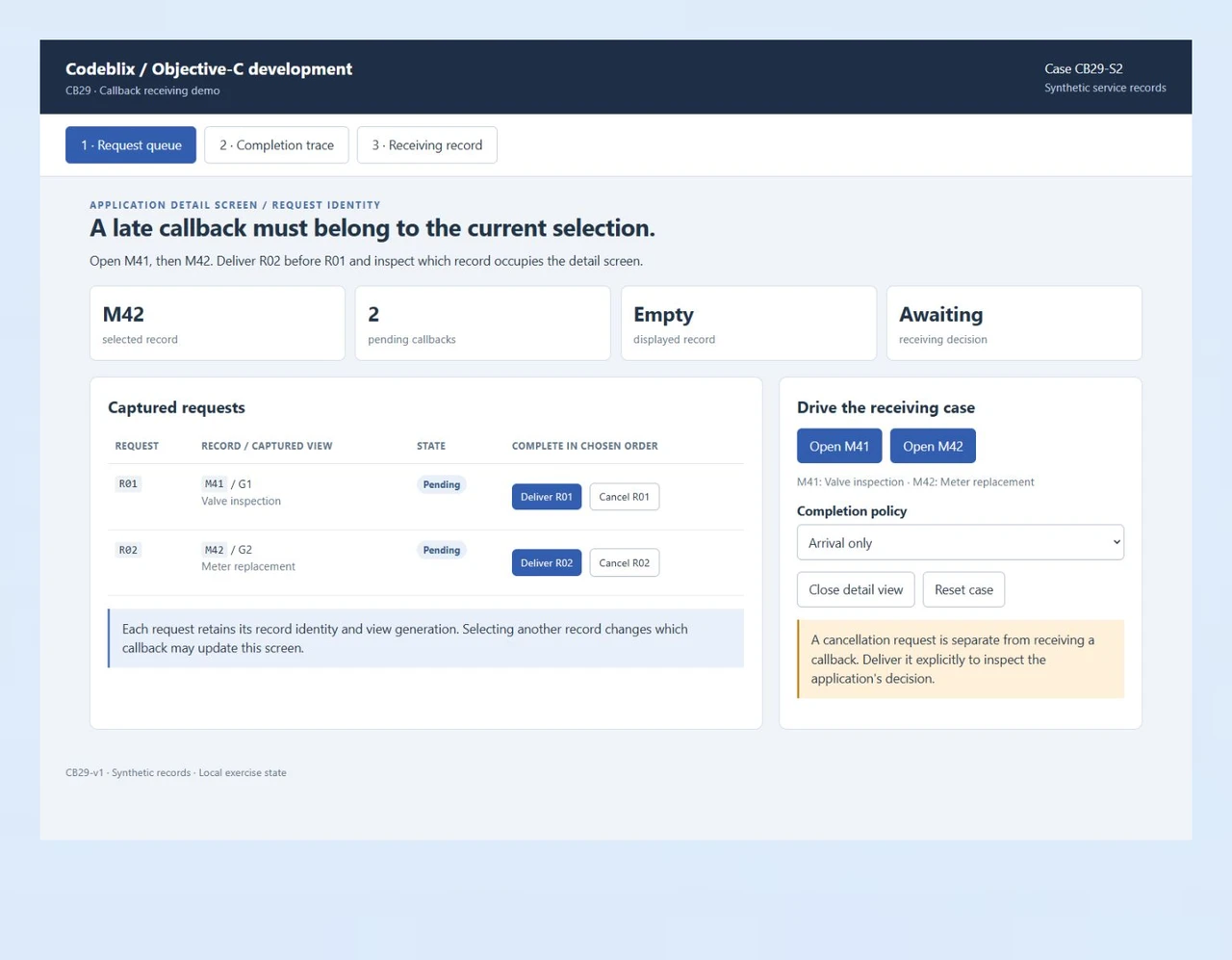
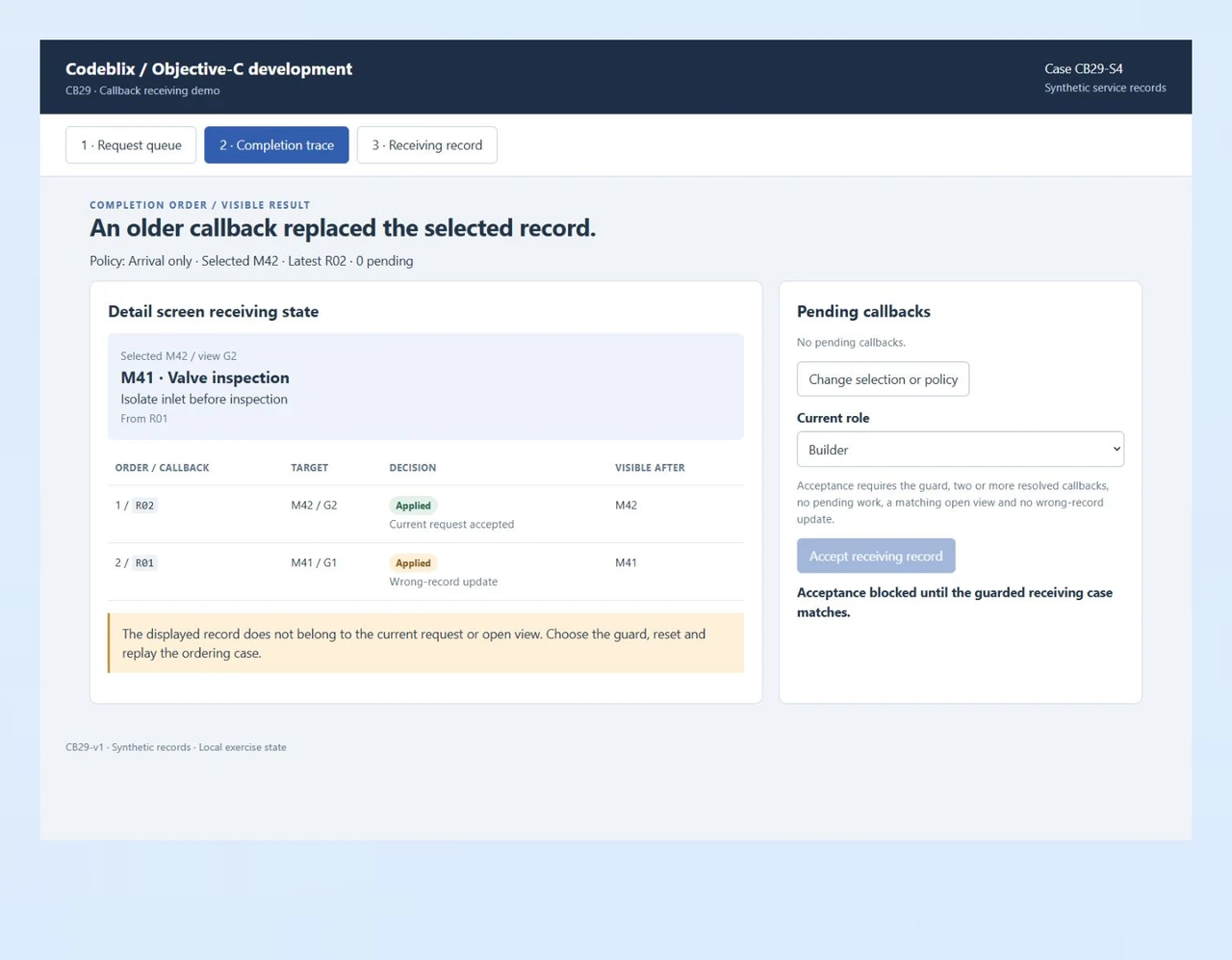
CB29 opens Valve inspection M41 as request R01, then Meter replacement M42 as R02. Delivering R02 first displays M42. With Arrival only, late R01 then replaces that detail with M41 even though M42 remains selected. Request identity guard checks the captured record, view generation and current request before applying a callback.
Receive cancellation and closed-view decisions
A request to cancel work and the application receiving its callback are separate events in the exercise. Deliver a cancellation-marked callback to see the guard ignore it. Close the detail view before a pending response arrives and check that it stays empty. Include the equivalent lifecycle and cancellation cases in the actual application milestone.
Keep the accepted result and its completion trace
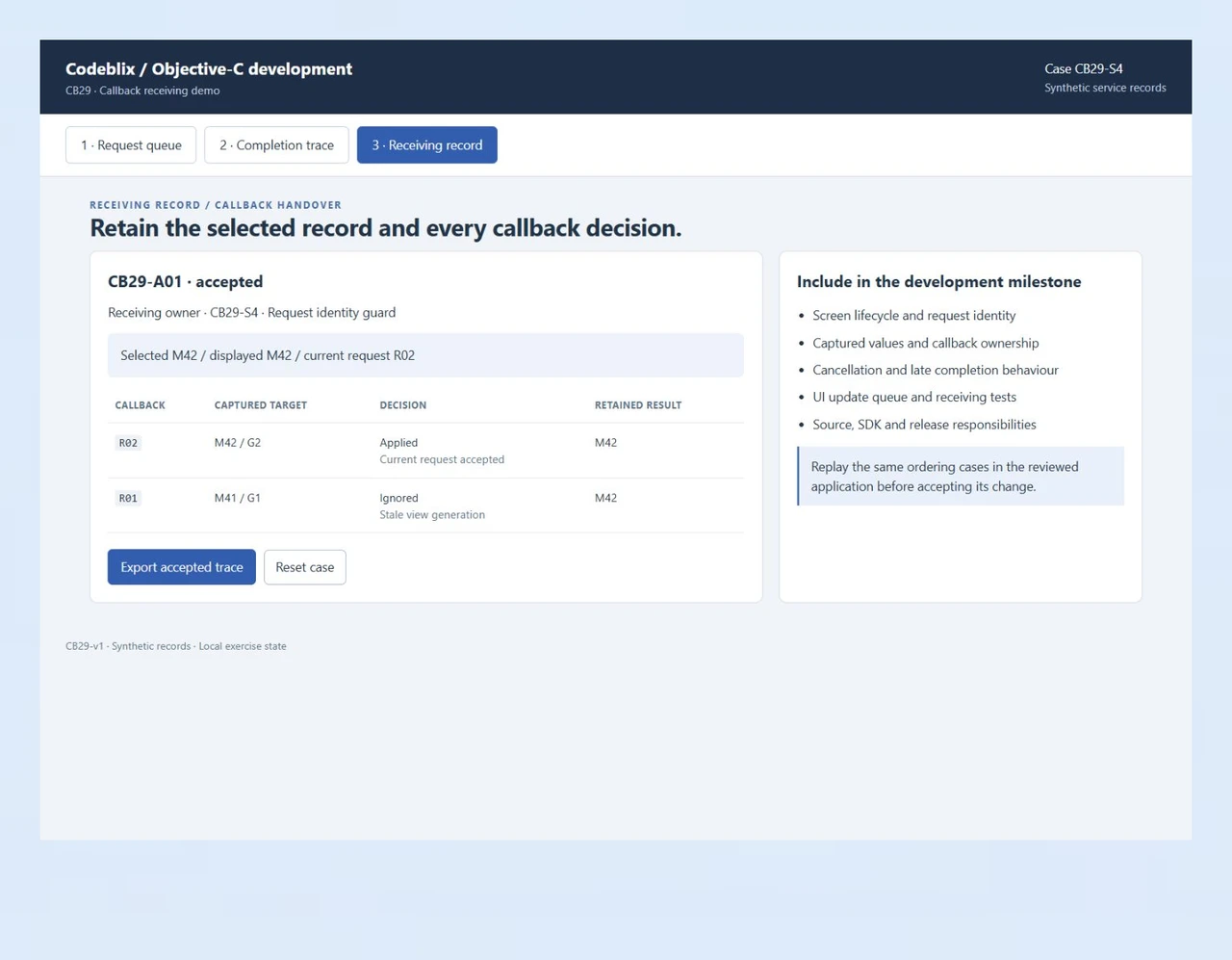
Under the guarded reversed-order case, R02 is applied and stale R01 is ignored; the visible record remains M42. Builder can drive the exercise, while Receiving owner accepts a matching, fully resolved trace. The export retains the selected record, displayed record, current request and each callback decision. A new request or policy change clears the earlier receiving record.
Agree which callback may update the selected record.
CB29 is a callback receiving demo with two synthetic service records. Queue M41 followed by M42, deliver the newer response first and inspect the late result. Replay with Request identity guard to keep M42 visible, then let Receiving owner accept and export the trace.
Use a reversed callback to define the first deliverable.
These resources turn a screen-level problem into an allocation with a receiving condition.
Replay an older request completing last
Open M41 and M42 in CB29. Deliver R02 and then R01 to expose the Arrival only result. Choose Request identity guard, reset the case and repeat that order. The guarded trace should apply R02, ignore R01 and retain M42 for the receiving owner.
Open the callback receiving acceptance demoIdentify values captured by the callback
Apple’s archived Blocks and Variables reference explains the capture of local values at block creation. Use it to frame a source review of request identity and captured state. Confirm object ownership with the project’s actual memory-management configuration and current SDK documentation.
Read Apple’s archived block-capture referenceSpecify the response to cancellation
Apple’s archived operation guide describes how running operations participate in cancellation and why an application should avoid blocking its main thread while waiting. Ask for the precise behaviour of the operation or networking API used by your application, including late completion and cleanup.
Consult Apple’s archived operation-lifecycle referenceCoordinate the record service behind the screen
A client-screen change can depend on record identity, error responses or an API maintained by another team. Include the approved service contract and its owner in the quotation. State whether any server-side change is required to supply a result the Objective-C client can receive safely.
Scope the surrounding record applicationSix boundaries for an application maintenance milestone
Connect the requested development time to the buildable source, an observable defect and a result your application owner can receive.
Identify the application and build responsibilities
Provide the source repository, application target, installed Xcode and SDK versions, deployment targets and dependency files. Identify UIKit, AppKit or other frameworks actually used by the project. Confirm who supplies a buildable environment and who controls signing, distribution and any vendor-owned components.
Capture the screen and request lifecycle
Describe the user action, selected record, request identity and point at which the result reaches the screen. Supply a short reproduction with two records and a reversed completion order. Include navigation away, repeated selection and a refresh of the same record so the change is bounded by more than the normal success path.
Specify callback ownership and permission to update
Agree which values the callback captures and which current application state it must check before updating the view. State the permitted UI update queue, object ownership and cleanup responsibilities. Review these against the actual project configuration, including its memory-management mode and library behaviour.
Define cancellation, errors and stale results
Identify what a cancellation request means for the operation in use and how a late callback is recognized. Specify the caller response to an error, an empty result and a closed view. Apple’s archived operation guide describes cancellation of running work as cooperative; the receiving brief should state the application behaviour instead of assuming every callback disappears.
Replay the receiving cases in the application
Use CB29 to agree the reversed-order result, then run corresponding cases in the authorized application build. Verify request identity and visible detail together. Include cancellation, navigation away and repeat selection, plus the project-specific error case. Keep the observed trace or test output with the changed source revision.
Hand over the change and its release conditions
Ask for the source change, build instructions, dependency notes and receiving cases with observed results. Name the person who approves distribution, the recovery steps and the support contact. Include any store-submission or internal-distribution assistance as explicit work, with the responsible account owner involved.
Bring a reproducible application task
- Identify one prioritized defect or extension, the requested allocation and the review time available from your team. State who prioritizes the work and who accepts the resulting application behaviour. Request an explicit billing basis and scope-change process.
- Supply sanitized sample records, a reproduction sequence and expected screen states. Keep credentials, signing material and customer exports out of the initial enquiry; arrange access through an approved project channel.
- List third-party frameworks, binary-only dependencies and services that the change touches. Source recovery, an unavailable build environment or vendor coordination can be separate investigation work before implementation is estimated.
- For a performance issue, define the device or environment, representative workload and measurement you need. Include the observed delay or resource symptom in the brief; a generic language or staffing claim does not establish an application improvement.
Include the work around the source edit
- For a Swift interoperability change, identify the existing boundary, exposed types and callers. Include the bridge or module interface and receiving cases for both sides. Confirm compatibility with the installed tools before committing to a migration scope.
- For an SDK or operating-system update, name current and destination versions, dependencies and supported targets. Quote a build rehearsal, regression cases and release assistance as identifiable responsibilities.
- For a backend integration, describe permitted calls, request identity, authentication ownership and error contracts. Confirm the actual interface and any service-side work during scoping rather than assuming a connector is already available.
- Agree the source package, reproducible build notes, acceptance evidence and release/recovery instructions to deliver. Define diagnostic access, operating contact and support terms for later callbacks, navigation changes or dependency updates.
Six records connecting a request to its receiving screen
CB29 makes the selected record, callback identity and final display independently inspectable.
| Record | Example inputs | Required output and control |
|---|---|---|
| Application build | CB29-v1 / synthetic two-record fixture | Name the real source revision and reviewed build for commissioned receiving work. |
| Current selection | M42 / view generation G2 / latest request R02 | Keep the user’s current selection separate from any arriving response. |
| Captured request | R01=M41/G1 / R02=M42/G2 | Retain the request identity, record and captured view generation. |
| Completion trace | R02 first / R01 second / applied or ignored | Record the receiving decision and the visible record after each callback. |
| Receiving policy | Arrival only / Request identity guard | Check current request, open view and cancellation state before applying the result. |
| Acceptance record | CB29-A01 / CB29-S4 / Receiving owner | Retain selected M42, displayed M42 and the applied/ignored callback trace. |
Open M41 and then M42 with Arrival only. Deliver R02 and R01 in that order: M42 remains selected, but the older callback leaves M41 displayed and acceptance is blocked. Choose Request identity guard and reset the case. Repeat the two opens and reversed delivery order. R02 applies M42; R01 is ignored as a stale view generation. Builder cannot accept the trace. Select Receiving owner and accept CB29-A01, then export the two callback decisions. A repeat acceptance is disabled. Opening another record clears the receipt. To inspect cancellation, reset, queue the two requests, cancel R01 and deliver it after R02. To inspect navigation away, close the detail view before delivering pending callbacks and verify that the guarded view stays empty.
Ask providers to quote the same application result.
Compare the proposed allocation with the source, lifecycle cases and evidence needed to receive your specific change.
| Option | Published focus | Ask in your demo |
|---|---|---|
| Plus8Soft | Objective-C maintenance and development enquiries with part-time, full-time and project engagement options. | Which reversed-completion and screen-lifecycle cases are included in the quoted application milestone? |
| PNN Soft | Objective-C application development, code maintenance, integration and consultation with flexible collaboration. | Will the handover retain request identity, visible screen results and the observed receiving trace? |
| Enfin | Objective-C application engagements covering hourly or dedicated work, testing, deployment and maintenance. | Who owns the build and distribution conditions, and how is a stale callback verified before acceptance? |
Give each provider the same source boundary, two-record reproduction and expected callback decisions. Ask the quotation to cover the actual application build, implementation and receiving output, alongside allocation and support terms. CB29 supplies a concrete ordering discussion; the commissioned milestone should include evidence from the reviewed Objective-C project.
Category reference: Apple primary archive: operation objects and cancellation. Apple archive references: Blocks and Variables updated 8 March 2011; Operation Queues updated 13 December 2012; accessed 3 November 2026. Review current SDK and ownership rules for the actual project. CB29’s records, request generations and receiving permissions are original exercise assumptions.
Connect the client change to its record and release owners.
Include the service contract, application build and operating responsibilities needed to receive the development result.
Explore Codeblix marketplace servicesAgree an Objective-C change your team can receive
Resolve the build, allocation and lifecycle conditions before requesting a start date.
Which project details belong in an Objective-C development enquiry?
Identify the application target, source repository, installed tools and the first change to commission. Include the requested allocation, responsible application owner and a sanitized reproduction with expected screen behaviour. Codeblix can then review dependencies, capacity and the work to include in a written quotation.
Can we begin with a bounded maintenance change?
Provide the affected screen, callback entry point and reproduction steps. Identify surrounding services, build access and the receiving owner. The quotation can distinguish investigation, implementation, application verification and release assistance for that first result.
What allocation information affects the quotation?
State the required review overlap, expected allocation period and prioritized backlog. Build recovery, vendor coordination, dependency upgrades and distribution assistance can change the scope. Request the billing basis, start conditions and approval process for additional work in writing.
Which result does the callback receiving demo establish?
CB29 queues two synthetic detail requests and lets you deliver their callbacks in either order. Arrival only can display an older record after the selection has changed. Request identity guard checks the current request and view before applying a result. Receiving owner can accept a matching resolved trace and export its decisions.
How should cancellation and navigation away enter the milestone?
Include a cancellation-marked callback and a response arriving after its detail view closes. Specify whether the application ignores the result, updates another owner or records an error. Verify that behaviour with the actual operation or networking API instead of relying on a cancellation request alone.
Can the scope include a Swift boundary or SDK update?
Provide the current interfaces, exposed types, dependency versions and target tools. Include callers on both sides, a build rehearsal and regression cases. Compatibility and release responsibilities need review before Codeblix confirms the development allocation and migration scope.
Who supplies signing and distribution access?
Identify the authorized account owner and intended delivery route for the application. Arrange any required access through the project’s approved process. The quotation should state who builds, signs, approves and distributes the result, and which assistance is part of the engagement.
Which records accompany acceptance of the application change?
Request the changed source revision, build and dependency notes, reproduction fixtures and observed results. Include callback identity and screen outcomes where they belong to the task. Agree release recovery, diagnostics and support ownership so your team can operate and revise the accepted change.