
Commission a report with explicit acceptance criteria.
State what one report row represents and how each total will be reconciled before estimating the implementation.
Keep each amount at its intended grain
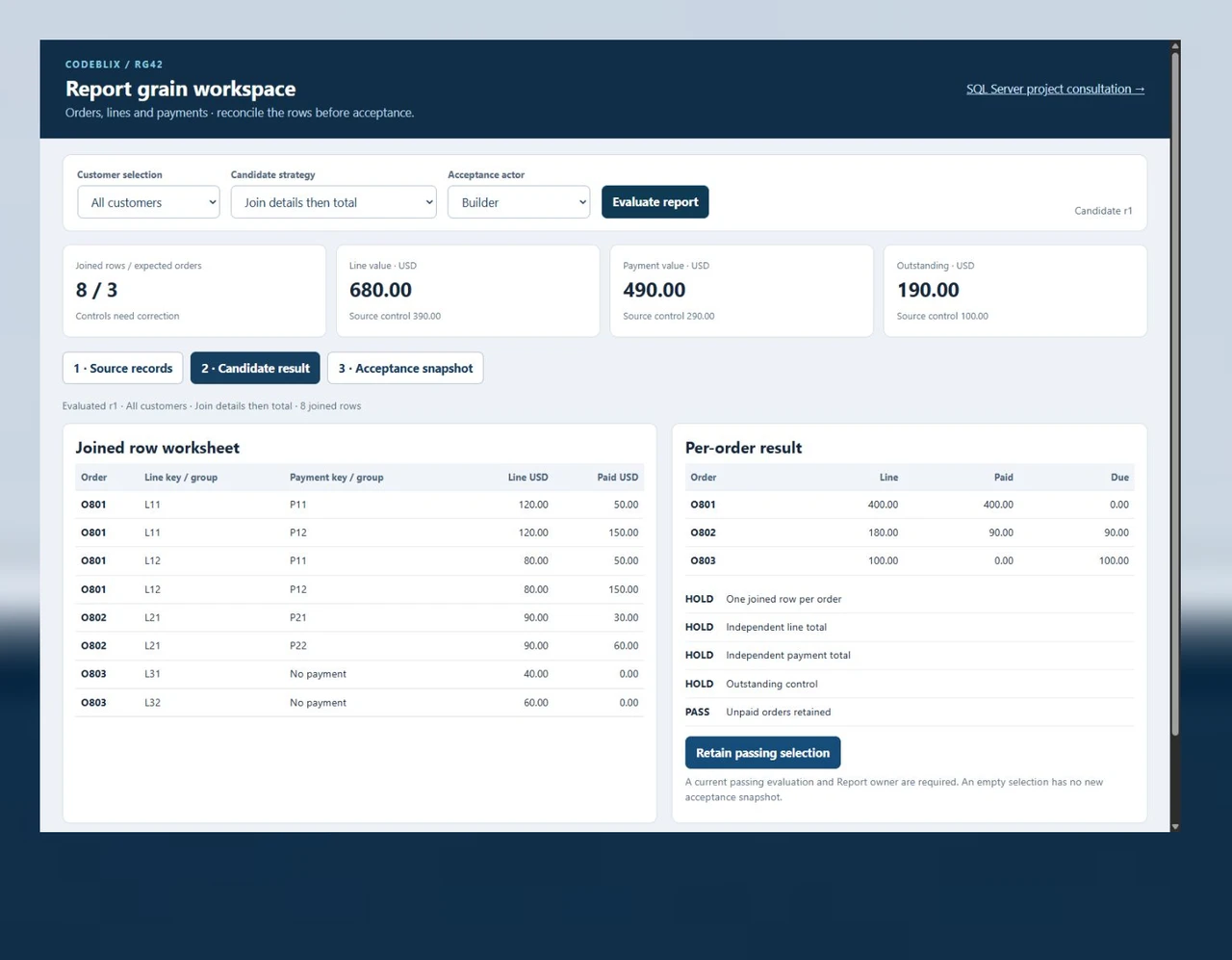
An order can have several lines and several payments. Joining both collections directly can repeat each line for every payment and each payment for every line. RG42 makes that multiplication visible: eight joined rows produce USD680 in line value and USD490 in payments from source totals of USD390 and USD290.
Check more than the final balance
For Acorn’s two orders, the raw detail join inflates line value and payments by the same amount. Its USD100 balance still looks correct. Reconcile line value, payment value and the result grain independently; a plausible balance alone is an incomplete acceptance condition.
Preserve the report’s exceptions and selection
Order O803 has no payment and must remain visible with USD100 outstanding. The exercise also includes an empty customer selection. Retain the strategy, customer filter, expected totals and actual rows with the accepted snapshot so a later filter change cannot silently replace the evidence.
Give the programmer a report case your receiving team can replay.
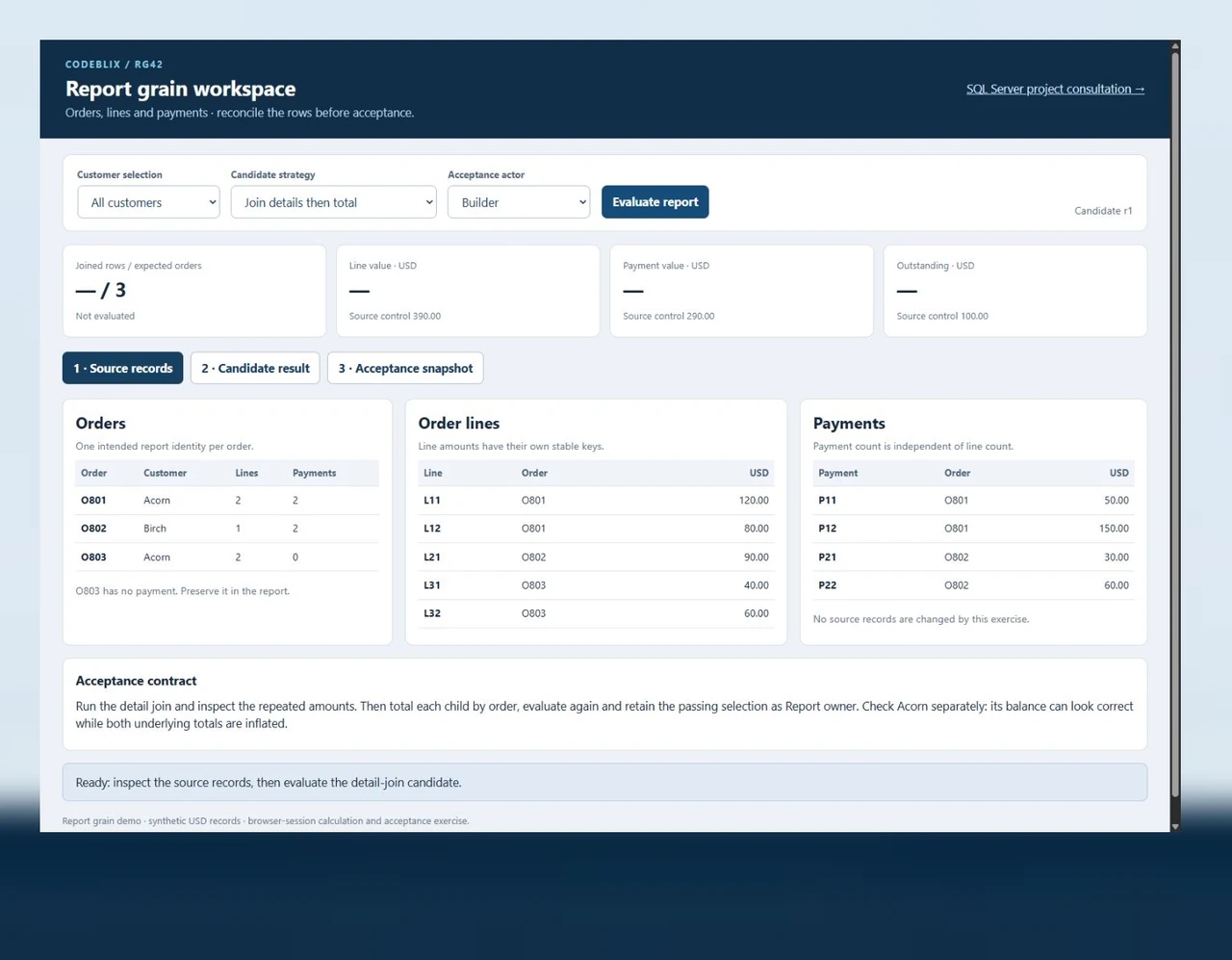
RG42 is a report grain demo with three synthetic orders, five order lines and four payments. Run the detail-join candidate, inspect the inflated totals, then aggregate each child by order before joining. A Report owner can retain the passing selection.
Make the quotation specific enough to estimate.
Use the exercise and primary SQL Server references to prepare a finite programming brief.
Reconcile the three-order example
Run the All customers selection with Join details then total. Inspect O801’s four line/payment combinations and the inflated totals. Select Total each child by order, run again and switch the actor to Report owner before retaining the passing snapshot.
Run the report grain acceptance demoState which unmatched rows must survive
Microsoft’s JOIN reference describes how a left outer join preserves unmatched rows from its left input. Identify the equivalent preserved records in your application report. RG42 keeps O803 visible even though it has no payment row.
Read Microsoft’s JOIN referenceDefine the grouping before adding totals
Microsoft documents GROUP BY as returning one row per group. In the programming brief, identify the group keys for each source collection before those totals meet the report’s output row. The exercise lets the receiving team inspect the two alternatives using the same records.
Check the official GROUP BY contractCommission a complete database application separately
If the project also needs a new data model, editing screens and an import workflow, include that application boundary in its own development brief. Keep it identifiable alongside the SQL Server report or procedure milestone.
Discuss a custom database application projectCoordinate the calling ASP.NET application
Where an ASP.NET application consumes the report or procedure, identify its request parameters, response contract and receiving owner. Application amendments and SQL report changes need compatible acceptance cases across the shared boundary.
Commission an ASP.NET programming engagementSix decisions for a SQL Server development engagement
Use one report result to connect the allocation, implementation boundary and receiving evidence.
Inventory the installed SQL Server environment
Provide the edition and version, database compatibility level, application stack, source repository and deployment method. Identify the report or stored procedure being changed, its callers and any scheduled consumers. Confirm licensed dependencies, authorized access and a suitable staging environment.
Define the report row and source records
Name the report key and the source keys that can repeat beneath it. RG42 has three orders, five lines and four payments. Specify whether the output is one row per order, line, customer or period, then list the source totals that the result must preserve.
Agree unmatched records and filter behaviour
Decide what happens when an order has no payment, a customer has no orders or a source value is missing. Supply a successful result alongside these exceptions. Keep the customer filter and inclusion rules in the acceptance brief rather than leaving them implicit in a screen label.
Review the implementation against the real workload
Inspect the existing joins, aggregations, parameters and permissions before choosing a change. Microsoft documents the row-preserving behaviour of outer joins and the one-row-per-group result of GROUP BY. In the application review, settle types, rounding, date boundaries and any stored-procedure or reporting-tool contract.
Reconcile the candidate before accepting it
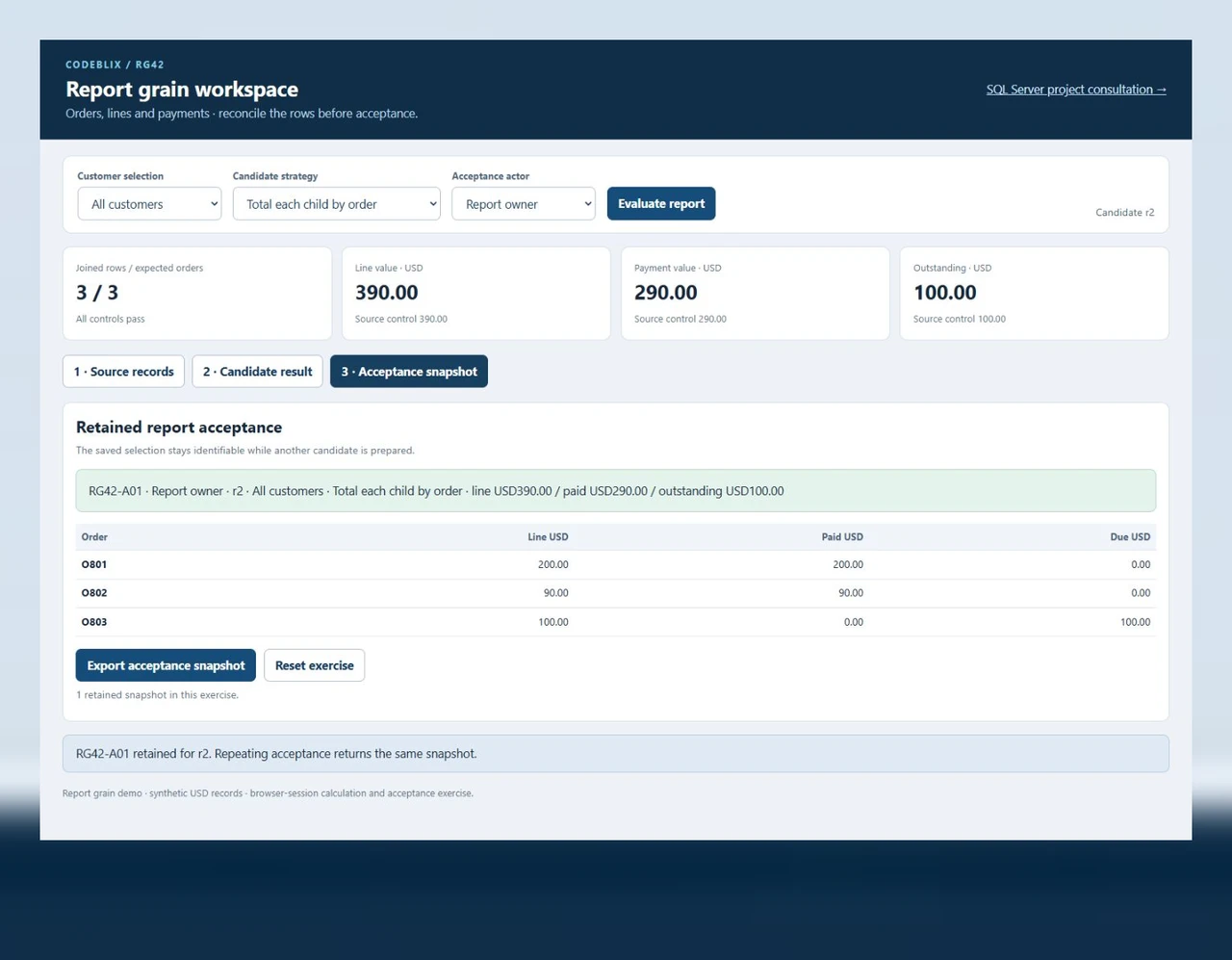
Run the same synthetic records through the old and changed paths in staging. RG42’s order-grain candidate returns three joined summary rows: USD390 line value, USD290 paid and USD100 outstanding. Confirm O803 remains in the result and repeat the customer-specific checks before the receiving owner accepts the revision.
Receive the source and release evidence
Agree the release window, database change scripts where required, backup and recovery responsibilities and application smoke checks. Retain the changed query or procedure, parameter contract, expected-result cases and execution evidence. Put ongoing support and any performance investigation within explicit commercial responsibilities.
Supply the information that changes the estimate
- Name the required allocation, communication overlap and first deliverable. Include the person who prioritizes the backlog and the person who accepts the SQL result. Ask the quotation to state the billing basis, start conditions and scope-change process.
- Provide sanitized schema definitions, the relevant query or procedure, parameter examples and expected rows. Arrange approved access separately; use synthetic or authorized anonymised records in the initial discussion rather than sharing credentials or customer exports through the enquiry form.
- Identify the report grain, child-table keys and inclusion rules. Include duplicate-looking legitimate amounts, missing child records and a no-data filter so the implementation cannot be accepted from one convenient total.
- List the applications, reports, exports and jobs that consume the changed result. Describe result column names, data types, ordering requirements and existing error handling. Include vendor ownership and permissions where another party must change a caller.
Separate correctness, performance and operating support
- For a slow report, agree a representative workload and a permitted measurement method before promising an improvement. Capture the relevant execution evidence in the reviewed environment. The RG42 arithmetic example supplies correctness checks, not a performance benchmark.
- For a migration or version change, review the supported source and target environments, compatibility level, dependencies and result semantics. Rehearse recovery and application checks on staging before scheduling a production change.
- For data arriving from another service, define the system of record, approved interface, field mapping, timing and rejected-input behaviour. Include destination-side validation and vendor responsibilities in the quoted integration scope.
- Confirm who monitors and operates the database and calling application after release. Agree incident contact, support hours, access administration and the commercial treatment of further reporting or procedure work.
Six records for a report total that can be accepted
RG42 connects the programming brief to source identities, the report grain and retained receiving evidence.
| Record | Example inputs | Required output and control |
|---|---|---|
| Order | O801 Acorn / O802 Birch / O803 Acorn | Keep one report identity per order and retain O803 without a payment. |
| Order line | L11=120 / L12=80 / L21=90 / L31=40 / L32=60 | Reconcile the five line records to USD390 independently of payment rows. |
| Payment | P11=50 / P12=150 / P21=30 / P22=60 | Reconcile four payments to USD290 without repeating them for each line. |
| Report selection | All / Acorn / Birch / Cedar with no orders | Carry the selected customer into both the source controls and the displayed result. |
| Candidate evaluation | Detail join:8rows,680/490 / order grain:3rows,390/290 | Check joined-row grain, line total, paid total, balance and unpaid-order retention separately. |
| Acceptance snapshot | RG42-A01 / Report owner / passing candidate revision | Retain the evaluated strategy, customer and rows; a changed selection needs a fresh evaluation. |
Run All customers using Join details then total. O801’s two lines meet two payments, creating four combinations; O802 creates two and O803 remains as two unmatched line rows. The joined values total USD680 and USD490, leaving USD190. Change to Total each child by order and run again: three summary rows reconcile to USD390, USD290 and USD100. Select Report owner to retain RG42-A01 for that evaluated revision. Change the filter to Acorn and re-run: USD300, USD200 and USD100. The retained All snapshot stays unchanged. Birch reconciles to USD90 paid against USD90 of lines. Cedar returns no orders and no new acceptance snapshot. Reset starts a new exercise.
Give providers the same report acceptance boundary.
Ask how the quoted engagement will establish the report grain, preserve exceptions and hand over the result.
| Option | Published focus | Ask in your demo |
|---|---|---|
| Citta Solutions | SQL Server developer engagements, stored procedures, migration and database design. | Which source controls and unmatched-order cases will accompany the changed report? |
| Jellyfish Technologies | SQL development engagements covering reporting, integrations and performance work. | How will the engagement distinguish a report-total correction from a measured performance improvement? |
| Programmers.io | SQL consultant allocation with dedicated, augmentation and project engagement models. | Who accepts the parameter contract, report grain and preserved customer selection at handover? |
Ask each provider to replay O801’s two-by-two join, the unpaid O803 and the Acorn filter whose balance can conceal inflated values. Agree the actual SQL Server and calling-application checks in the engagement. The original RG42 selection and snapshot give your receiving team a finite result to evaluate alongside the quotation.
Category reference: Microsoft primary reference: GROUP BY result groups. Microsoft JOIN reference updated 21 September 2026; GROUP BY reference updated 29 September 2026. Both accessed 2 November 2026. The synthetic control totals are RG42 acceptance assumptions.
Keep the reporting milestone within the wider project.
Connect the SQL Server result with its application, receiving team and operating responsibilities.
Explore Codeblix marketplace development engagementsAgree the SQL Server engagement and receiving evidence
Use these questions to prepare a quotation request with a defined result and delivery responsibility.
What should I include in a dedicated SQL Server programmer enquiry?
Identify the SQL Server environment, the report or procedure involved and the first milestone you need delivered. Include the requested allocation, source ownership, application callers and acceptance owner. A sanitized expected-result dataset helps Codeblix review the scope before confirming capacity and commercial terms.
Can the engagement cover one existing report or stored procedure?
Provide the current definition, parameters, callers and expected output. Include a case that fails today and the behaviour that must remain compatible. The written scope can then identify investigation, implementation, result reconciliation and release assistance for that bounded change.
How is the programming allocation quoted?
The estimate depends on the reviewed backlog, environment, source availability and delivery responsibilities. Ask for the billing basis, allocation period, review cadence and treatment of additional requests in writing. Include migration work, deployment assistance and continuing support explicitly when required.
What does the report grain demo let our team inspect?
It lets you inspect source orders, lines and payments, run two report strategies and reconcile expected against actual totals. The detail join multiplies child records; the order-grain candidate reconciles them independently. The Report owner can retain a passing current selection and export its acceptance snapshot.
Can a plausible outstanding balance still hide a report error?
Yes in the exercise: the Acorn detail join increases line value and payments by the same amount, so the balance remains USD100. The acceptance checks compare both source totals as well as the balance and row grain. Supply equivalent independent controls for your own report.
Will the quotation include a performance improvement guarantee?
Agree the investigation, workload and measurement conditions before setting a performance target. A correct synthetic report total does not establish production execution time or capacity. Include the reviewed execution evidence and agreed acceptance threshold in the scope where performance work is commissioned.
How should an application or reporting-tool integration be handled?
Identify the consuming application, approved access method, parameters and response columns. Agree permissions, data types, null handling and failure behaviour with the receiving team. Test against the authorized environment and include any caller-side work or third-party licences in the quotation.
What should we receive at the end of the milestone?
Request the changed source, parameter and output contract, environment notes, acceptance dataset and observed results. Retain the report selection with the release evidence. Agree deployment and recovery instructions, the operating contact and the terms for future SQL Server support or backlog changes.