
Commission the store behavior that needs to change.
Monthly programming can cover a sequence of store improvements when each change has a defined owner, input and receiving result.
Make product choices understandable
Specify which choices a shopper must make, which services are optional and how each choice changes the price. Include empty selections, incompatible values and unavailable options in the brief. Receive the displayed unit amount and line amount against the same agreed product data.
Connect availability to the selected option
A product-level quantity does not explain whether a particular finish is available. Identify the quantities used by the store, the settings that govern stock warnings and the stage when an order changes inventory. Test the selected option separately from the shared product limit.
Keep extensions and the storefront working together
A theme, checkout extension or inventory feed can change the result of a programming task. Map those dependencies before assigning the work. Receive the revised journey on the devices, store languages and customer groups included in your engagement.
Follow a selection from price to receiving.
The OC79 demo separates product quantity, finish availability and the value of an optional service. Inspect the accepted line and the later request that is refused.
Start with a product that exposes the important cases.
OC79 is a small receiving exercise for discussing option pricing and stock behavior before commissioning an implementation.
Run the required-choice and quantity cases
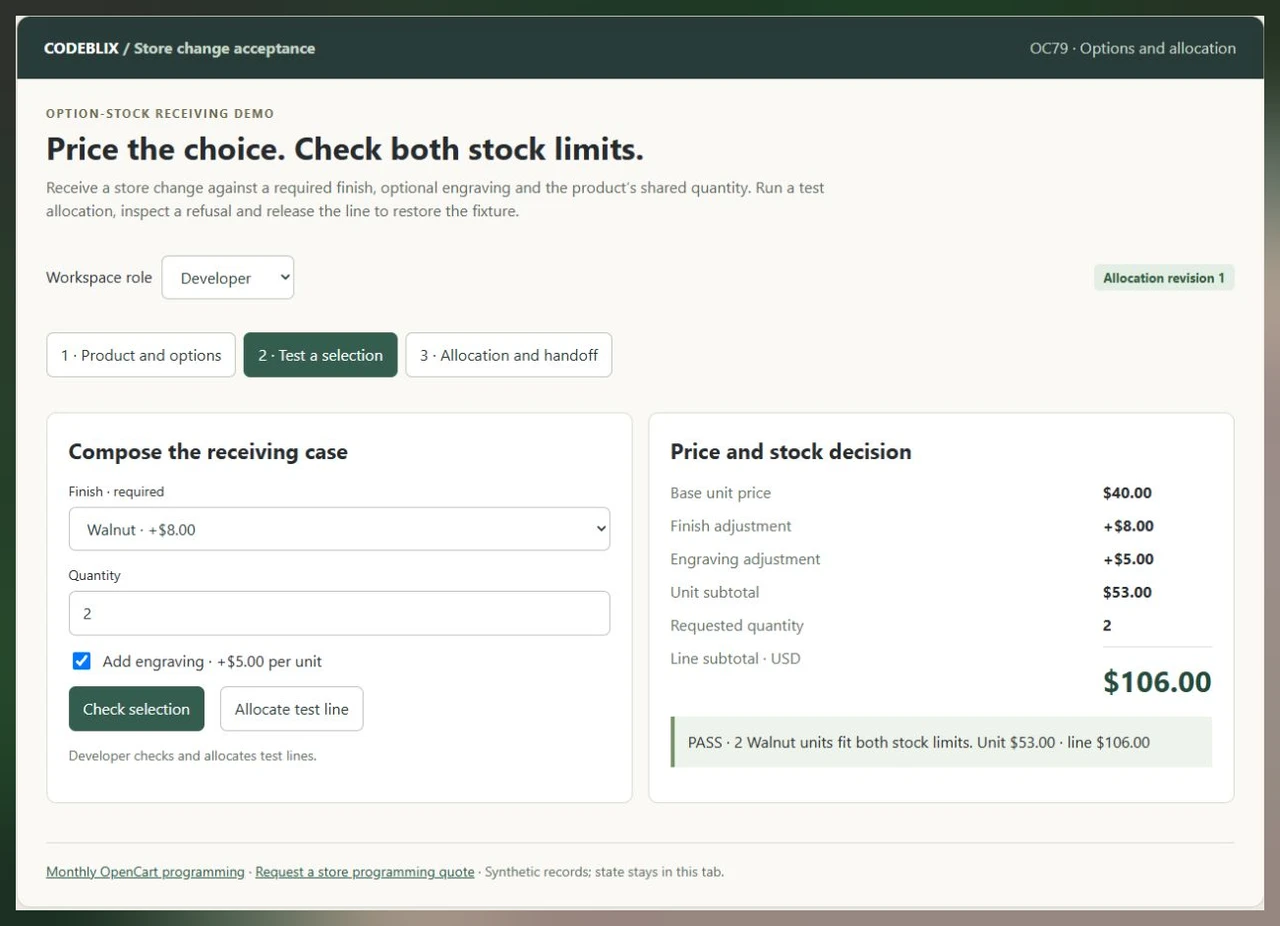
Open the demo as Developer and check an empty finish. Select Walnut and request one unit to exercise the two-unit test-line minimum, then request three to exceed the opening Walnut quantity of two. Each refusal should explain the failed condition and leave the allocation ledger untouched.
Open the option-stock receiving demoCheck the amount before accepting the line
Choose two Walnut lamps with engraving. The example base is USD 40.00, Walnut adds USD 8.00 and engraving adds USD 5.00 per unit. The unit subtotal is USD 53.00 and the line subtotal is USD 106.00. Allocate that test line and check that the product remainder becomes five while Walnut becomes zero.
Separate a refused request from an accepted allocation
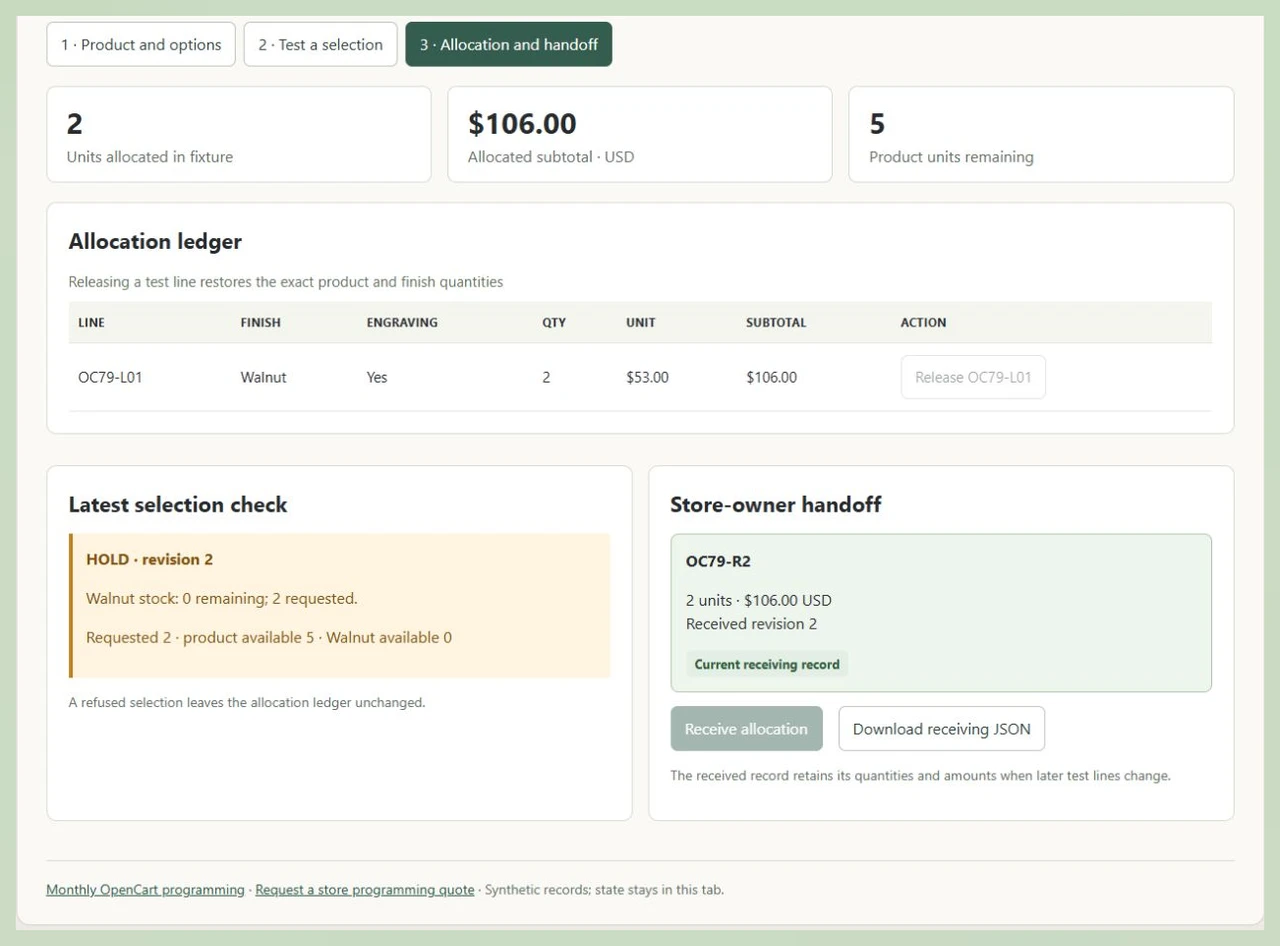
Checking another two Walnut units now produces a hold against zero Walnut stock, even though five product units remain. The earlier valid line stays at two units and USD 106.00. Switch to Store owner to receive that existing allocation, download its record, then return to Developer and release the line to restore the opening quantities.
Map the exercise to your installed checkout
OC79 applies an explicit synthetic policy: allocation deducts the product and finish quantities together, and release restores them. Agree how the actual store handles cart validation, order status, stock deduction, cancellation and competing requests. The OpenCart 3 checkout controller is a primary reference for required options, product minimums and configured stock behavior; version and extension differences belong in the implementation scope.
Inspect the OpenCart 3 checkout controllerScope, implement and receive store changes in a controlled sequence.
Use the monthly arrangement to keep ownership and receiving decisions clear as priorities change.
Establish the installed store boundary
List the OpenCart release, PHP runtime, theme and extensions involved in the requested journey. Identify the repository or editable package source, staging store and account owners. Describe the existing checkout result with synthetic products and representative option records.
Write a bounded change request
Name the shopper or administrator action, required product data and expected result. Separate storefront presentation, server validation, inventory updates and external feed work. Prioritize the monthly queue with the store owner and agree how an urgent fault affects planned improvements.
Develop against a repeatable staging case
Implement the agreed change in a controlled branch or package. Check the extension mechanism and theme overrides used by the installed release. Exercise the valid path and refusals with repeatable records, including missing required options, changed stock and an interrupted integration response.
Receive both the shopper result and the administration result
The reviewer checks amounts, selected option identities, messages and stock transitions. The store owner confirms that staff can maintain the affected product settings. Recheck the complete journey after any compatibility adjustment and record the release candidate that satisfied the agreed cases.
Launch with explicit recovery and support ownership
Agree the release window, affected configuration and recovery point with the deployment owner. Transfer the package or source revision, setup notes, acceptance evidence and unresolved issues. Specify who investigates checkout incidents and how further changes enter the monthly programming allocation.
Store inventory and access
- Supply the installed OpenCart and PHP versions, store URLs, theme identifier, extension names and versions, and a map of local modifications. Identify who can authorize staging access and who controls the production release.
- Describe the catalog records needed for the change: products, product options, option values, customer groups, currencies and store languages. Use representative synthetic records when sharing a reproducible issue.
- List any stock feed, fulfilment handoff, payment extension or shipping service touched by the requested work. Establish available documentation, test accounts and technical ownership before estimating an integration.
Monthly allocation and change boundaries
- Ask for an allocation suited to the prioritized work rather than assuming a universal monthly package. Confirm the rate or fee, billing unit, working overlap, start date and review availability during scoping.
- Specify how a task is estimated, approved and received. Include time for investigating an unfamiliar extension and resolving a compatibility issue when those are part of the engagement.
- Agree how urgent requests, blocked work and additional capacity are handled. Identify the person who can reorder the queue and authorize a change to the written commercial scope.
Release, migration and operational support
- A store upgrade or catalog migration needs its own data mapping, media handling, URL preservation and reconciliation cases. Distinguish that work from a smaller option or theme change in the quotation.
- State whether the engagement includes deployment execution or supplies a release package to your team. Assign backups, recovery checks, hosting changes and external subscription costs to named owners.
- Receive editable changes and installation instructions under the agreed terms. Confirm support coverage, defect reporting, incident escalation and the approval process for the next development item.
Receive the option identity, amount and inventory effect together.
Use the OC79 record model to turn a broad store request into a testable programming item.
| Record | Example inputs | Required output and control |
|---|---|---|
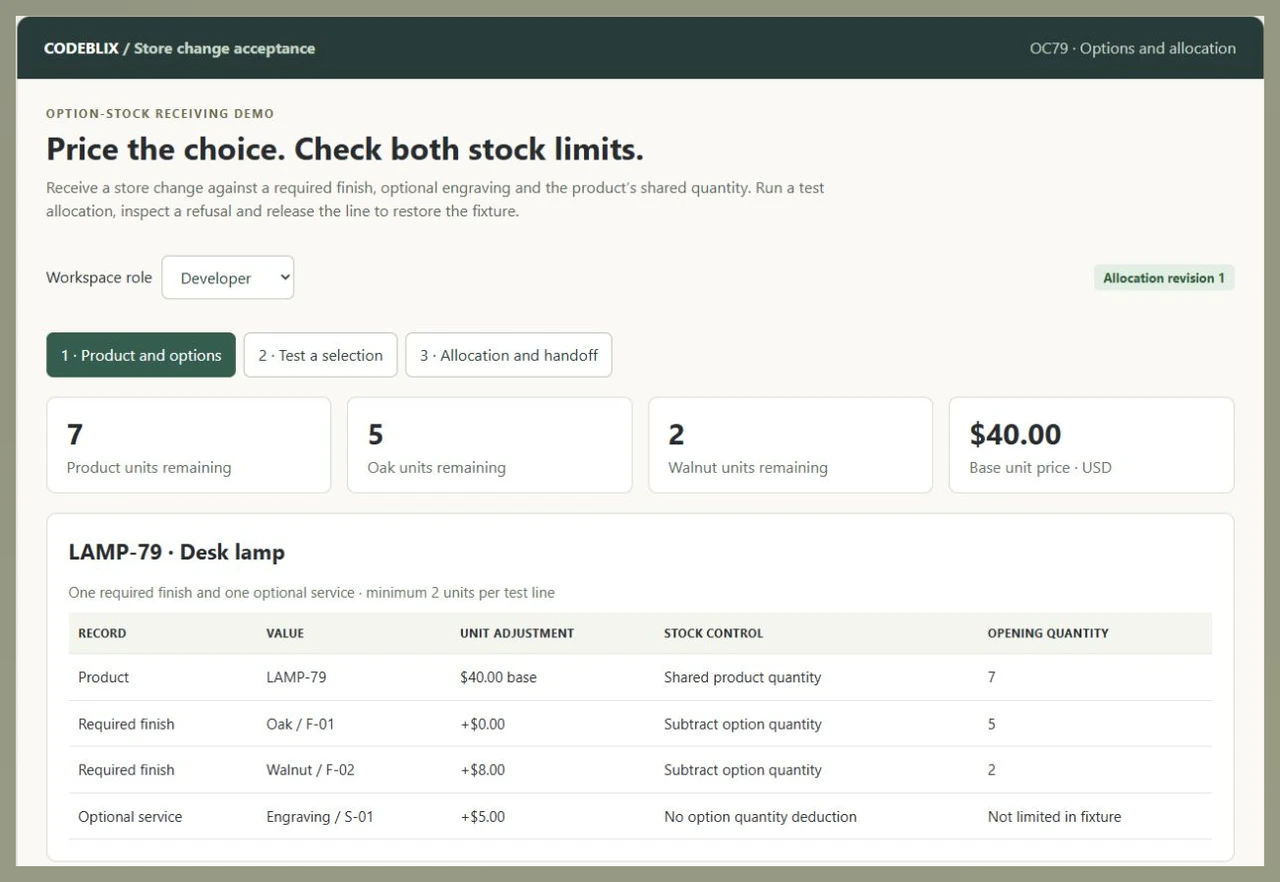
| Product basis | LAMP-79 / base 4000 cents / opening quantity 7 | Check the shared product limit independently of the selected finish. |
| Required finish | F-01 Oak +0 cents / qty 5; F-02 Walnut +800 cents / qty 2 | Reject a missing finish and a request beyond its remaining quantity. |
| Optional service | S-01 engraving +500 cents per unit | Include the adjustment only when selected; the example service has no option-stock deduction. |
| Receiving request | Quantity 2 / Walnut / engraving / unit 5300 cents | Show the expected 10600-cent line amount before test allocation. |
| Test allocation | OC79-L01 / product remainder 5 / Walnut remainder 0 | Update both tracked quantities once; a refused follow-on request adds no line. |
| Handover evidence | OC79-R2 / two units / 10600 cents / allocation revision 2 | Retain accepted values when a released line changes the current fixture. |
The fixture opens with seven product units: five Oak and two Walnut. A three-unit Walnut request fails its finish limit. Two engraved Walnut lamps pass at USD 53.00 each, producing a USD 106.00 allocation and leaving five product units with no Walnut units. A second Walnut request is held without changing the earlier line. The Store owner can receive that valid allocation as OC79-R2. Releasing OC79-L01 restores product seven, Oak five and Walnut two; the downloaded receiving record keeps its earlier quantities and amount.
Send each provider the same store-change evidence.
Compare quotations using a shared version inventory, product case, compatibility boundary and receiving responsibility.
| Option | Published focus | Ask in your demo |
|---|---|---|
| iFlair | Describes hourly, monthly and fixed-scope hiring alongside module, extension and migration work. | Which theme or extension dependencies and option-stock cases will be included in our monthly item? |
| Webkul | Describes engagement models, project assessment, code review and continuing maintenance. | What stock-check timing, cancellation case and receiving evidence will be attached to the delivered package? |
| Concept Infoway | Describes monthly programming, customization, extensions, integration and store maintenance. | How will the selected option, quoted amount and inventory effect be verified on our installed release? |
Attach your own product and option identifiers, expected price arithmetic and stock-transition cases to the enquiry. OC79 supplies an interactive example that makes a shortage visible without losing the earlier accepted line.
Category reference: OpenCart 3 cart implementation. The source shows option price adjustments and separate stock checks. Confirm the implementation for your installed release and configured extensions.
Connect the store with the rest of your software
Explore related custom application work and identify the data or operational dependencies needed by your ecommerce project.
Explore marketplace development offersBefore commissioning monthly OpenCart work
Use the enquiry to settle the store boundary, commercial arrangement and release responsibilities.
Can we book monthly programming for an existing OpenCart store?
Send Codeblix the store version, priority improvements and desired working arrangement. The scoping discussion establishes the application dependencies, development allocation and receiving milestones for the quotation. Confirm the actual start date and coverage before booking.
What makes a store-change request ready to estimate?
Include the action that needs to change, a reproducible product example, expected outcome and affected theme or extensions. Identify the owner who approves the change and the person who can provide a controlled staging environment.
How is the monthly price established?
Request a quotation against the programming allocation, review needs and operational responsibilities your store requires. Set the fee or rate, billing basis, additional work and treatment of blocked tasks in the written arrangement.
Can the scope include product options and stock behavior?
Specify required and optional choices, price adjustments, product and option quantities, customer-group rules and the relevant order transitions. Agree the stock-warning or refusal policy and its timing for the installed store. Receive valid selections and shortage cases against the same fixture.
What does the OC79 demonstration help us decide?
It runs price calculations and an explicit test-allocation policy on synthetic product records. You can inspect a missing finish, a quantity refusal, a USD 106.00 accepted line and exact stock restoration. Use those cases to agree the actual checkout and order-status implementation during scoping.
Will installing a change affect our existing extensions?
Supply the current extension and theme inventory and identify the journeys they control. Include staging checks for those dependencies in the work item. Compatibility findings may require an adjustment to the scope or coordination with the extension owner before release.
Can migration or external service work be included?
Describe the source records or service contract, technical owner and test access. Quote the mapping, reconciliation, error handling and recovery work explicitly. Hosting, subscriptions and production credentials remain subject to the access and ownership arrangements agreed for the project.
What is handed over after a store improvement is accepted?
Receive the agreed source or package revision, installation and configuration notes, receiving evidence and the list of unresolved items. Set the launch approver, recovery owner, support response and route for requesting further monthly work.