
Give the allocation a result to receive.
A monthly engagement needs a clear unit of delivery. Use an editable list to agree what the component must preserve as its records move.
Keep an unsaved instruction attached to its record
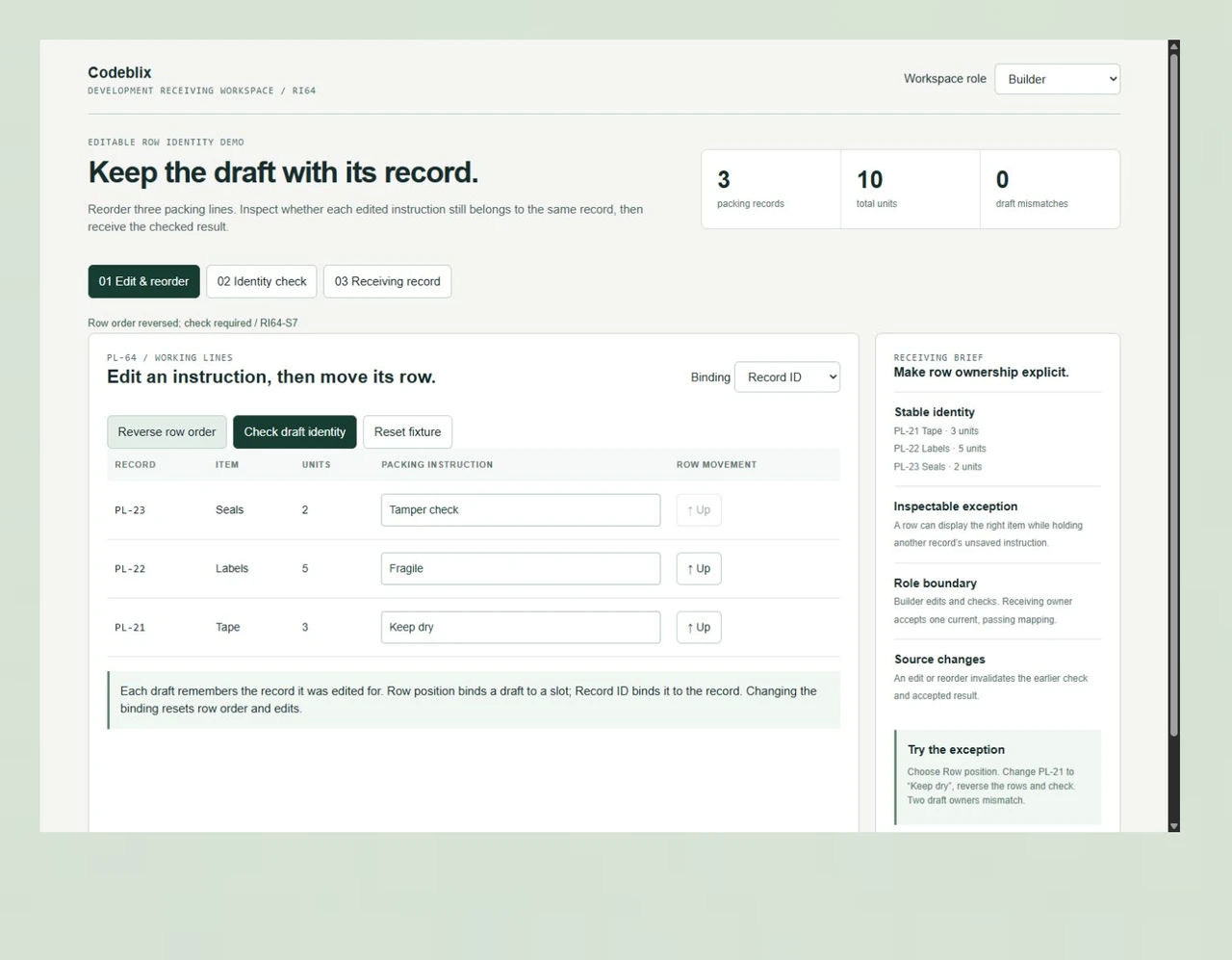
PL-21 Tape contains 3 units and the instruction Cold store; PL-22 Labels contains 5 units and Fragile; PL-23 Seals contains 2 units and Tamper check. The working list totals 10 units. Each instruction draft retains an owner ID independently of its visible row position, making an ownership error inspectable even when the item names and unit total still look correct.
Expose a reorder that silently moves the wrong draft
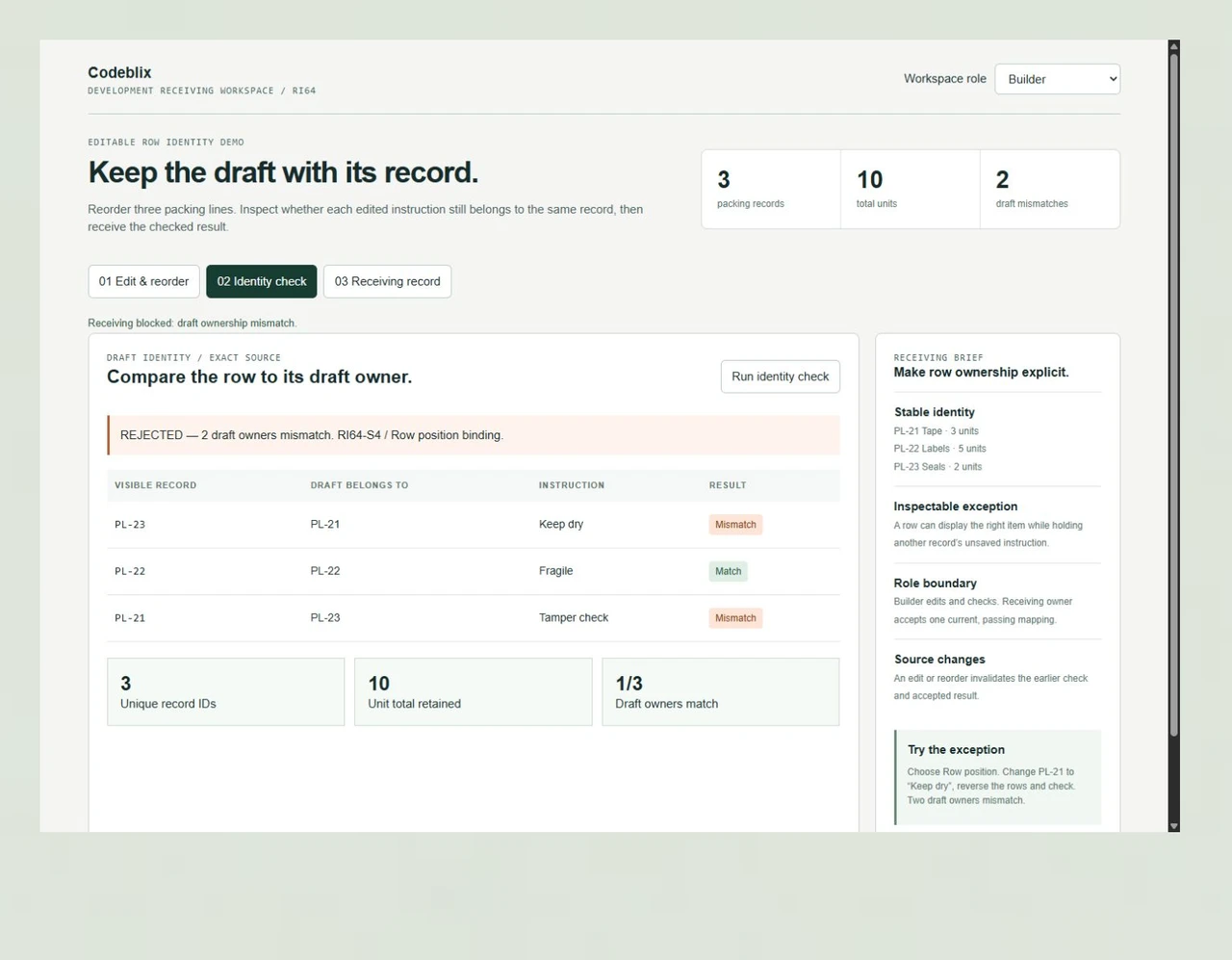
Select Row position binding, change the PL-21 instruction to Keep dry and reverse the list. PL-23 now occupies the first slot but displays the draft owned by PL-21; PL-21 displays the draft owned by PL-23. The middle PL-22 record still matches. The identity check rejects two mismatches out of three records. Record ID binding preserves the matching owner through the same reorder.
Receive a current mapping with explicit ownership
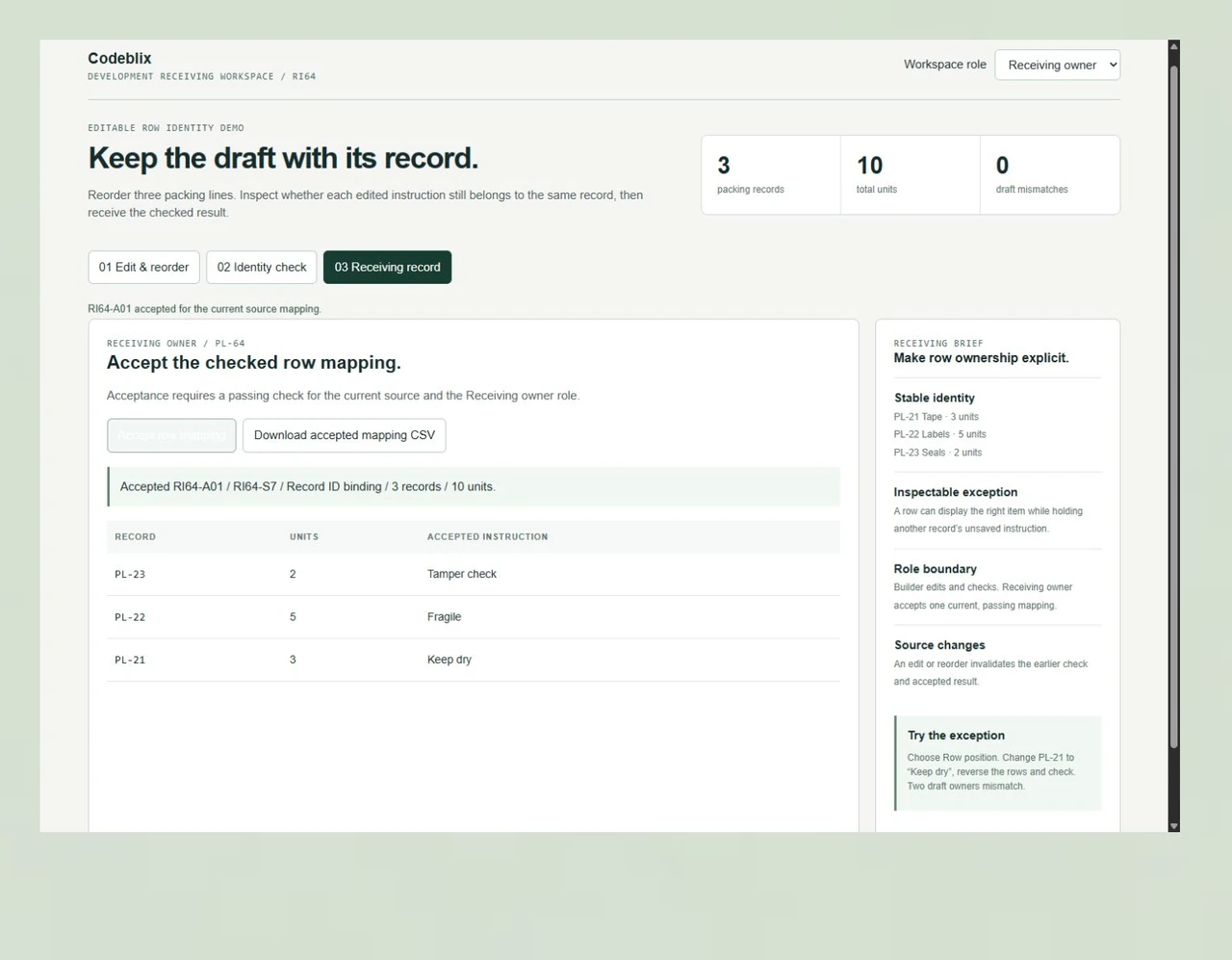
Builder can edit and run the identity check. Receiving owner can accept only a passing result for the current source version. RI64-A01 retains the three IDs, instructions and unit quantities, with an accepted-mapping CSV. A later edit, row movement or binding change clears the earlier check and acceptance so the owner receives the current component result.
Receive the right draft on the right row.
The RI64 packing-list exercise holds three records and ten units. Edit an instruction, reverse the rows and inspect its draft owner. Compare Record ID and Row position binding, then accept a passing mapping as Receiving owner.
Bring a record, an edit and its receiving rule.
Use the working exercise and primary React references to prepare a concrete development enquiry.
Inspect a draft ownership exception
Open the packing-list exercise and choose Row position binding. Edit PL-21 to Keep dry, reverse the rows and run the identity check. Two mismatches block acceptance. Change to Record ID binding, repeat the edit and reversal, then check again. Receiving owner can accept the three matching records and download their mapping.
Open the editable row identity demoAgree stable keys for movable records
React’s primary list reference describes how keys identify items between renders and warns that an array index can cause subtle bugs when items move, are inserted or are deleted. Ask the receiving brief to name stable identifiers from the actual data and demonstrate the component’s draft behaviour when its order changes.
Consult React’s primary list identity referenceSpecify the array update boundary
React’s Updating Arrays in State reference explains creating a new array when updating state, including copying before reversing or sorting. Include the changed row order, retained draft values and expected state update in the commissioned component’s receiving cases, alongside the application’s persistence contract.
Review React’s primary array-state referenceInclude the record service in the scope
If the interface edits server-backed records, identify the API owner, stable IDs, revision fields and validation responses. Quote any required service changes alongside the React component. Agree what the user sees when a saved record has changed elsewhere or a backend rejects the update.
Scope the surrounding record serviceSix decisions for the React milestone
Agree the backlog, state boundaries and receiving conditions together with the development allocation.
Select the monthly backlog and decision owner
Name the interface to change, its business users and the person who accepts the result. Identify the first month’s priorities, review availability and dependencies on design or backend teams. Request the allocation, billing basis, start conditions and process for reprioritizing unfinished work in the written quotation.
Locate the application and component boundaries
Supply the React version, source repository, package lockfile and current development and release commands. Identify the affected page, its parent component and the API contract. Agree whether the work covers an existing component, a new workflow or recovery of a build that cannot currently run.
Define record identity before editable state
List the stable record identifier, fields editable by the user and changes that reorder or replace rows. React’s Rendering Lists reference explains that keys help match items when they move, are inserted or are deleted. Include a stable key strategy and the intended lifetime of each draft in the project receiving brief.
Specify the edit, reset and update rules
Agree which changes remain local drafts, which require a server save and what happens after cancellation, record deletion or refreshed data. React describes state as a snapshot and recommends treating arrays in state as immutable. Ask the implementation to preserve those boundaries while meeting the application’s actual save and conflict rules.
Run the receiving fixture in the application
Use representative records to exercise typing, reordering, insertion, deletion and validation. Include keyboard navigation, focus behaviour and the effect of a failed save. Receive observed results against the changed source revision and supported browsers; include equivalent identity checks in the commissioned React component.
Close the month with a reproducible handover
Agree the changed source, component notes, receiving results and release procedure the application owner will receive. Identify deployment approval, rollback responsibility and access expiry. Record completed work and the remaining backlog separately, with a clear decision about support or the next development allocation.
Define the work and review capacity
- Bring a prioritized backlog with one receiving owner and a realistic review schedule. Include working hours of overlap, planning meetings and the process for clarifying blocked tickets. Confirm the monthly allocation and available capacity through the quotation discussion.
- Provide the affected source, dependency versions and a repeatable development build. Use sanitized records for the initial review. Identify access approvals, environment owners and whether build recovery or dependency upgrades are part of the first milestone.
- Describe the editable records and their stable identifiers. List validation rules, save and cancel behaviour, deletion and reorder cases, and the expected treatment of drafts after refreshed server data. Include a concrete example where the wrong draft would affect a user decision.
- Name supported browsers, screen sizes, keyboard tasks and expected focus behaviour. Include the design source and any existing component library. State which accessibility, visual and performance checks the owner needs to receive for the commissioned change.
Agree the service and release handover
- For API integration, provide request and response examples, authentication ownership and error responses. Scope backend changes explicitly. A browser draft needs an agreed persistence boundary, conflict response and retry behaviour before it becomes a complete application workflow.
- For an existing interface migration, identify which screens and stored data move, which URLs and permissions remain authoritative, and how the old workflow is retired. Quote compatibility checks and staged release responsibilities together with the component changes.
- For commercial terms, request the monthly billing basis, included responsibilities, review dependencies and approval process for additional work. Agree how unused capacity, blocked work or a changed priority are handled rather than assuming a fixed output from a calendar month.
- For support, agree the diagnostic information that can be shared, the source revision to retain and the response route for a defect. Include changed build instructions and receiving fixtures in the handover. Define the scope of later maintenance and dependency updates separately.
Six records connecting a draft to its owner
The RI64 fixture separates a record’s identity from the position where its instruction appears.
| Record | Example inputs | Required output and control |
|---|---|---|
| Packing record | PL-21 / Tape / 3 units | Retain the same record ID when the row changes position. |
| Instruction draft | Owner PL-21 / Keep dry | Compare the draft owner with the visible record rather than accepting an unchanged unit total. |
| Row order | PL-23, PL-22, PL-21 after reversal | Move the records while applying the selected Record ID or Row position binding. |
| Source version | RI64-S1, incremented after an edit or reorder | Clear the earlier identity check and accepted result whenever the source changes. |
| Identity check | Three unique IDs / 10 units / three draft-owner matches | Reject the two mismatches produced by reversing a position-bound draft list. |
| Accepted mapping | RI64-A01 / current source / IDs, units and instructions | Allow Receiving owner to accept one passing mapping and download its exact rows. |
Choose Row position, edit PL-21 to Keep dry and reverse the order. The visible PL-23 row displays Keep dry from owner PL-21; visible PL-21 displays Tamper check from owner PL-23. PL-22 remains Fragile with its own owner. The check rejects two mismatches, although 3 + 5 + 2 still equals 10 units. Change to Record ID; this resets the fixture. Repeat the edit and reversal. All three draft owners match their visible records. Builder cannot accept. Select Receiving owner, open Receiving record and accept RI64-A01. Its CSV contains three rows in the accepted order and retains the current source version. Return to the editor and change an instruction: the earlier acceptance and download are cleared.
Quote the same component result.
Use the same editable records and receiving cases when discussing a monthly development engagement.
| Option | Published focus | Ask in your demo |
|---|---|---|
| Thinkitive | Hourly or monthly developer hiring, dedicated-team, time-and-material and fixed-price models, with timesheet and collaboration terms. | Which draft-to-record mapping and reorder cases will the receiving owner run in the changed component? |
| APPWRK | Hourly, monthly and fixed-project plans, requirements review, developer selection and application maintenance. | How are component acceptance, review dependencies and the unfinished monthly backlog recorded? |
| MultiQoS | Full-time, part-time and hourly hiring enquiries, requirements review, onboarding and frontend support. | Does the source handover include the edited-row fixture, browser results and release responsibilities? |
Give each provider the same record IDs, edit sequence, reorder and persistence rules. Request the allocation and the result to receive in the same quotation. Use RI64 to agree the draft-ownership case, and include the edited React component, observed receiving results and release handover in the commissioned work.
Category reference: React primary reference: State as a Snapshot. React’s primary references cover list identity, immutable array updates and state snapshots. Apply their component rules alongside your application’s persistence and receiving requirements.
Connect the editable record service.
Include the data contract and release responsibilities needed to receive the complete application change.
Explore Codeblix marketplace servicesAgree the monthly React development scope
Resolve the backlog, review capacity and component result before confirming the engagement.
What should a monthly React development enquiry include?
Provide the application, first backlog items, source boundary and person who accepts the work. Include the requested monthly allocation, review availability and target release. A sanitized editable-record example helps Codeblix review the dependencies and prepare a written quotation.
Can the engagement cover an existing React application?
Share its React version, package lockfile, build instructions and a reproducible change request. Identify the affected component and any API dependencies. The scope can include investigation, implementation and receiving checks for that bounded change, with release responsibilities agreed separately.
What determines the monthly quotation?
The requested allocation, backlog complexity, dependency condition and review overlap affect the work. Build recovery, service changes, design and deployment may add responsibilities. Request the billing basis, capacity, start conditions and process for approving additional work in writing.
What does the editable row demo let our owner inspect?
RI64 edits three synthetic packing instructions, reverses row order and compares each draft owner with the visible record. Row position binding produces two mismatches after reversal; Record ID binding retains the matching owners. Receiving owner can accept a current, passing mapping and download its three rows.
How should the project handle unsaved edits?
Agree the draft lifetime for reordering, refreshed records, deletion, cancellation and a failed save. Identify stable IDs and the server persistence contract. Include those cases in the receiving milestone so an instruction cannot silently move to a different business record.
Can API changes be included with the React work?
Identify the API owner, request and response fields, permissions and validation behaviour. Include required backend changes explicitly in the scope, with receiving fixtures for save failures and conflicting revisions. Confirm service access and deployment responsibilities with their authorized owners.
How will the monthly backlog be reviewed?
Name the receiving owner and review schedule, then agree the evidence attached to completed items. Record blocked dependencies and unfinished work separately. The engagement terms should explain reprioritization, additional approvals and how the next allocation is confirmed.
What should our team receive at handover?
Request the changed source revision, build instructions, component and API notes, receiving results and release procedure. Retain the record-identity fixture and observed browser checks. Agree rollback ownership, access expiry and the support route for defects or later dependency changes.