
Buy a property portal for your existing agency network
Acquire Property-1 around partner publication authority and the correct enquiry handoff.
Request Property-1 for an existing agency network. Work two partner mandates, similar listing titles, corrected recipients and a partner departure before purchase.
Buy Property-1's domain and application for an existing independent-agency network's shared public property channel. Request the individual software package through the current Property-1 Flippa listing. The acquisition concerns a digital portal foundation. The buyer brings its own agency relationships, authority to publish material and responsibility for enquiries.
This worked purchase case uses two fictional partner agencies to examine publication, a corrected property record and one partner's departure. Property-1's documented scope is agency profiles, storefronts, property listing management, public discovery and direct enquiries. The case does not imply transferred properties or agency contracts, MLS or CRM synchronisation, syndication, automated valuations or unverified restricted-access controls. Essential additions belong in the agreed purchase scope.
Request the portal around a partnership mandate you already hold
Request the Property-1 source-and-domain acquisition offer →
Inspect the Property-1 asset page and broad property-portal purchase brief. Read the linked user document and technical document, then ask Codeblix to demonstrate the agency, property and enquiry paths relevant to your network.
Confirm the current price, availability, financial representation, source package, domain transfer, service accounts and assistance through the actual sale. Demonstration properties and promotional wording on a public page are not evidence of an included agency audience or subscription income. Any required payment integration or partner billing lifecycle should be separately demonstrated and agreed.
The network is buying a channel for existing partner responsibility
Imagine a fictional network with Elm North Agency and Harbour West Agency. They remain independent businesses, each responsible for the property information it supplies and the enquiries it receives. The network wants a shared public destination under a portal it owns. These relationships and names are artificial purchase examples, not agencies included in Property-1's sale.
Elm North supplies one permitted fictional listing, while Harbour West supplies another. The network appoints a portal operator to maintain its shared channel. The purchase goal is not merely placing both properties on a homepage. It is keeping each agency's authority, current information and contact responsibility understandable when something changes.
This is a specific operating mandate. The buyer already knows which partners it represents and wants an owned software foundation for that arrangement. It should ask whether the delivered application supports its publishing model directly, whether a human operator procedure is sufficient, or whether a precisely scoped addition is necessary before the network adopts it.
Keep portal ownership distinct from each agency's listing mandate
The network can own the application while an agency remains responsible for its supplied property material. Write those two responsibilities separately. The portal operator needs to know which person may approve a storefront, confirm a listing correction and request removal. The agency needs to know where its public information and enquiry destination appear.
Before the software workshop, prepare an authority record for the fictional partners. Identify the approved name, brand material, listing source and contact route. Ask the seller to demonstrate the actual profile and property controls with that material. The buyer should then map its proposed operator and partner roles to the delivered application arrangement.
Use the real observed account behaviour to make the purchase decision. Some networks may accept a central authorised person maintaining records through current controls. Others require partners to perform specific actions independently. State the exact action and visibility needed; a multi-agency description is the beginning of that enquiry, not proof of every proposed permission.
Use a two-partner publication-mandate record
| Network question | Elm North example | Harbour West example |
|---|---|---|
| Who approves the agency identity? | Named authorised partner contact | Named authorised partner contact |
| Which property may be published? | Fictional reference EN-01 | Fictional reference HW-01 |
| Who confirms a correction? | The source agency for EN-01 | The source agency for HW-01 |
| Where does an enquiry belong? | Elm North's agreed test recipient | Harbour West's agreed test recipient |
| Who can act in the application? | The actual demonstrated account or authorised portal operator | The actual demonstrated account or authorised portal operator |
| What happens on departure? | Agreed partner instruction and current public-record procedure | Agreed partner instruction and current public-record procedure |
Attach the schedule to the offer request. It gives Codeblix two concrete identities and two property references to follow through a seller demonstration. The buyer can then record which controls are current and which proposed operating requirement would need additional work.
Keep the schedule simple enough that the next portal operator can read it. The important information is who supplied a record, who may approve a change, where an enquiry belongs and who acts in the actual application. Those answers remain useful after the acquisition, when an ordinary partner correction arrives.
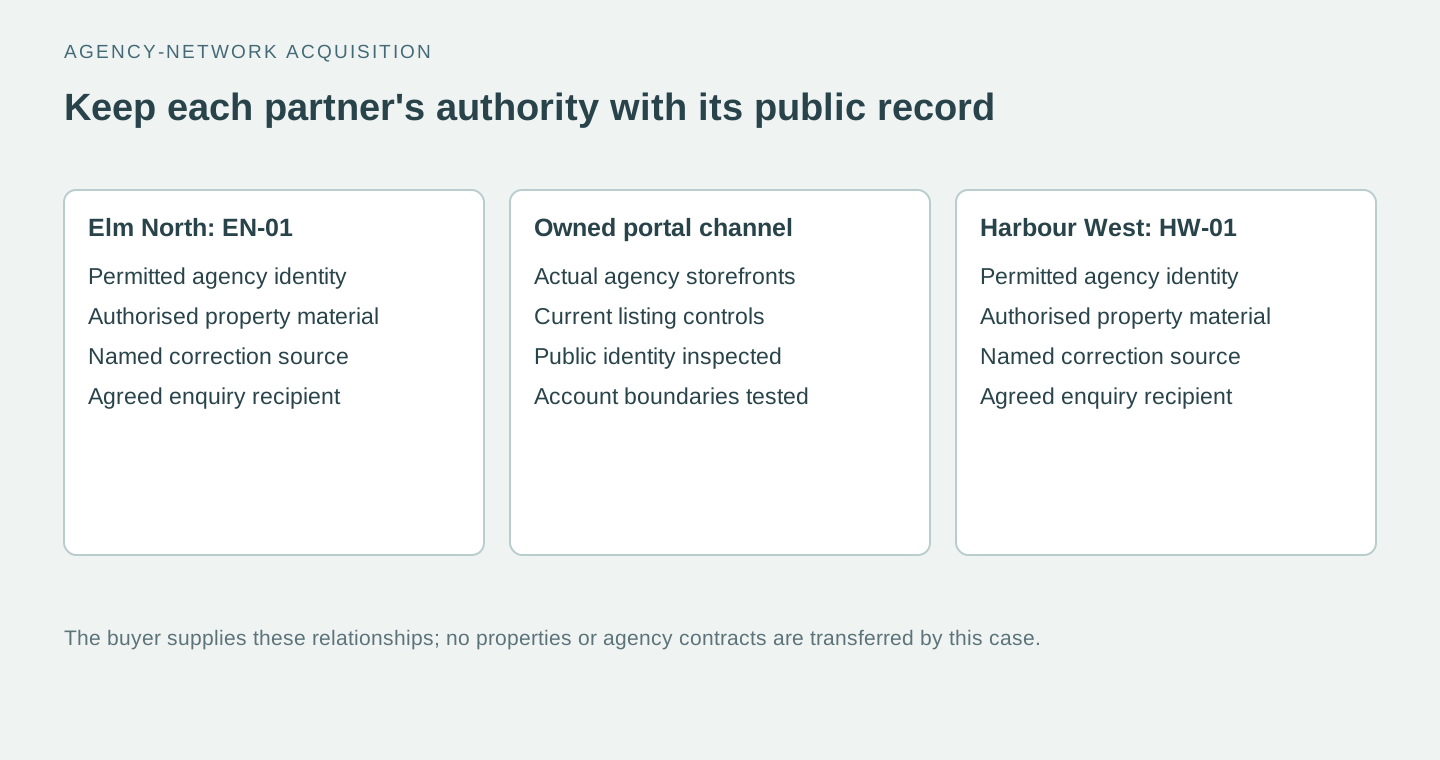
Publish each artificial property through its intended operator route
Ask the seller to enter EN-01 through the actual account arrangement proposed for Elm North. Use an artificial location, description, image and contact information the workshop controls. Then repeat the exercise for HW-01 through Harbour West's intended route. Keep the actual record identity visible.
Open each public property and agency storefront. Compare the displayed agency, reference and contact information with the mandate record. The buyer should recognise which partner the visitor is viewing and which person is responsible for maintaining that information. Ask how the current workflow handles the transition from an operator edit to the public result.
Where the application requires a central owner action, record that actual behaviour. The buyer can decide whether it fits a small network's operation. If it requires independent partner approval or a separate publication review stage, request the exact additional control rather than describing an unobserved process as already delivered.
Distinguish two similar public titles with a partner crosswalk
Give both artificial properties a similar public title, such as Courtyard Apartment. The buyer's workshop labels remain EN-01 and HW-01, attached to different source agencies in the human mandate record. Ask the seller to map those labels to the actual application records and fields used in the demonstration. The example does not claim an automatic agency-prefix generator.
| Workshop reference | Public example title | Source authority | Enquiry responsibility |
|---|---|---|---|
| EN-01 | Courtyard Apartment | Elm North's named partner contact | Elm North's controlled workshop recipient |
| HW-01 | Courtyard Apartment | Harbour West's named partner contact | Harbour West's controlled workshop recipient |
The similar title makes the purchase test useful. A portal operator should identify the correct record from its agency relationship and actual application identity, rather than select a listing merely because the name looks familiar. The buyer can check the public agency label, source material and current contact route against the crosswalk.
Ask a second authorised operator to locate each artificial property using the actual delivered navigation. Have them explain which partner may approve a change before they edit anything. This gives the network a practical training example and helps the buyer see whether the current account and record model fits its intended operation.
Make a correction originate from the responsible partner
For the worked scenario, Elm North corrects one factual detail in EN-01 before the network distributes the public link. The partner contact confirms the change through the network's agreed human procedure. Ask the seller to demonstrate the current property-editing route and inspect the public result for that same reference.
The operator should be able to connect the partner's instruction with the application record it changed. This matters when two partners supply similar property descriptions or use different source references. The network's own record should preserve enough context for a colleague to identify the correct agency and listing without guessing from a photograph.
Then ask the second fictional partner to identify which information it is permitted to act on through its current account. Inspect the actual visibility and editing boundary. The buyer's proposed partnership rules should match the controls it has seen, with any missing restriction or delegation clearly placed in the separate-work schedule.
Trace an enquiry to the agency that owns the response
Use a harmless artificial enquiry for EN-01 with details and a recipient controlled by the authorised workshop. Ask the seller to demonstrate the current contact path and identify its actual destination. Then repeat the exercise for HW-01. The buyer should be able to explain which agency receives each request.
The existing enquiry path may involve an application record or an external delivery mechanism. Accept the demonstrated boundary explicitly. A confirmation displayed to a visitor and receipt by the intended agency are different observations, so retain the relevant evidence for the particular route shown.
The network also needs a human follow-up owner. Its portal can present a contact route while the agency remains responsible for answering a prospective customer. The purchase decision should identify that handoff clearly, rather than assume the acquired software includes the partner's sales staff, CRM process or response commitment.
Resolve a changed recipient through the partner's authority
Add one controlled change to the fictional contact exercise. Elm North asks the network to use another agreed workshop recipient for future EN-01 enquiries. The partner contact confirms the instruction through the buyer's human procedure. Ask the seller to show where the current application stores or uses the relevant destination and how an authorised person changes it.
Repeat a harmless test through the actual current enquiry route, using only details the workshop controls. Inspect the resulting destination and compare it with the new instruction. The operator should record the reference, responsible agency, changed information and observed result together. This tests a real partner-channel responsibility that continues after the portal is purchased.
Keep the earlier enquiry explanation intact. A new destination for future requests is a different fact from the destination of a message already handed off. The network's mandate record should make both understandable. If the buyer requires forwarding, additional alerts or a recipient-approval feature, identify that exact outcome and ask the seller to demonstrate or separately scope it.
Keep a public status change connected to the old reference
Change the fictional availability of EN-01 through the actual supported property control or removal route demonstrated by the seller. Inspect the public result and revisit the earlier link. The buyer should record exactly what a visitor sees for that current state.
Elm North remains responsible for confirming the real-world change in the scenario. The portal operator performs the permitted application action. The network should be able to explain both parts of that procedure, especially where an old link has already been shared by someone outside the portal.
Use this example to decide the buyer's minimum acceptable public behaviour. It may require a clear changed state, an unavailable page or another specifically agreed result. Any additional redirect, archived-property record or automated external feed update should have a defined scope. The current offer should be accepted against the behaviour actually demonstrated.
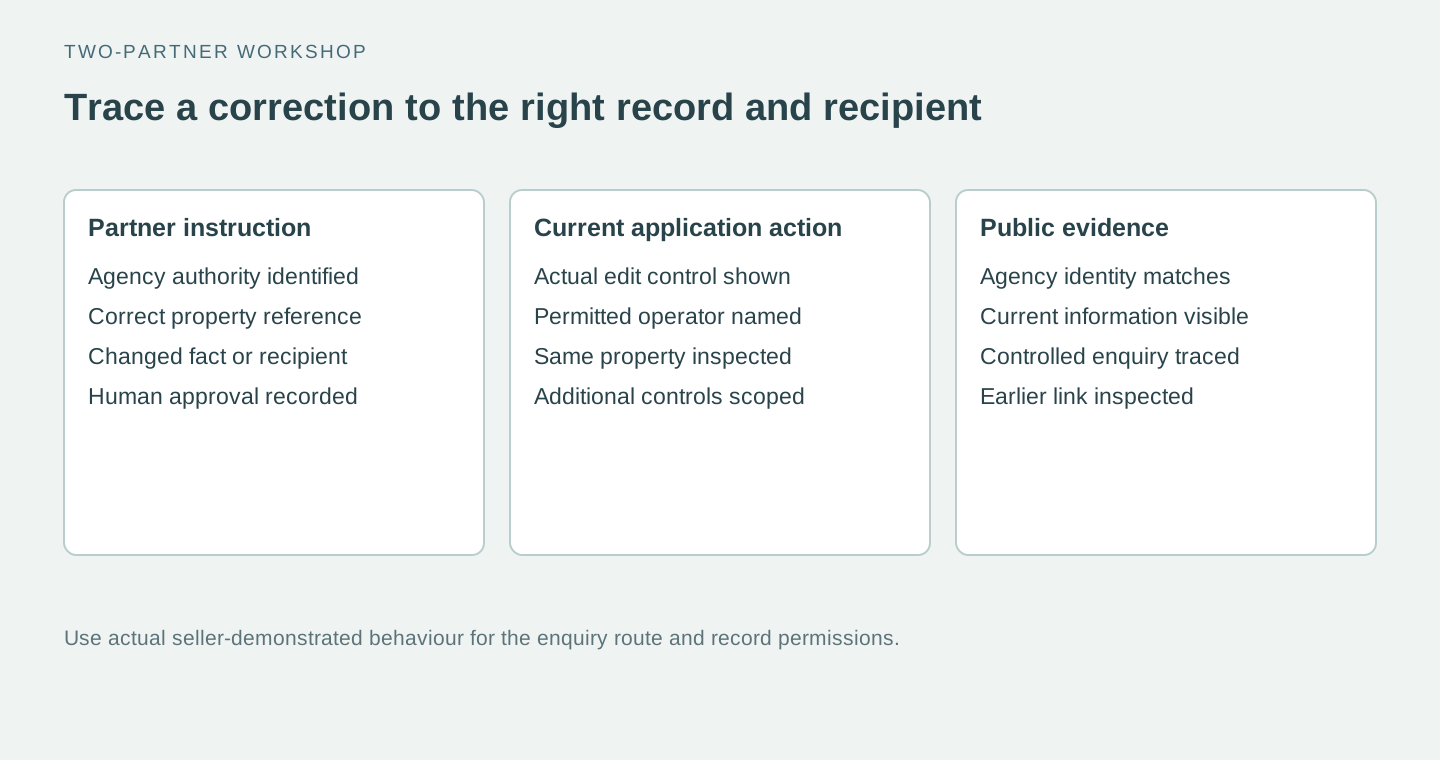
Use the departing partner as the network's central exception
Now Harbour West stops participating in the fictional shared channel. The network receives an authorised instruction covering its public identity, supplied properties and enquiry route. The buyer should identify who can approve that instruction and who performs the relevant action in the delivered application.
Ask the seller to demonstrate the current controls available for the storefront and HW-01. Inspect the public result, including the earlier property link and the agency route. Record what remains visible, what changes and which further human task the operator needs to perform.
This is a purchase question about an existing partnership mandate. The buyer should know how its owned channel handles a partner's departure before it imports real listings. The application does not transfer the agency relationship or decide the parties' arrangements; the network supplies the authorised instruction and accepts the actual digital procedure.
Separate already delivered enquiries from future publication
A partner may have received enquiries while it participated. Removing future public material does not by itself explain those earlier communications. The network should identify the actual records and external destinations involved in the demonstrated contact path and assign responsibility for any outstanding response.
For the fictional departure, give Harbour West one earlier artificial enquiry. Ask the operator to explain where that message went and who is responsible for its next action under the network's own procedure. Use only permitted workshop information. The goal is a clear human handoff, not a claim that the software can retract messages from an external inbox.
Keep that explanation with the departure instruction. A later operator should be able to distinguish an enquiry already handed to a partner from a public route that should no longer invite new ones. This makes the portal purchase useful for the ongoing responsibilities the network actually holds.
Close the departure instruction with an observable public result
The departing-partner example should finish with more than an internal note saying complete. Ask the authorised portal operator to revisit Harbour West's public route and HW-01 through the links retained in the workshop record. Compare the actual result with the departure outcome the network agreed to accept.
The buyer might accept removal of the supplied public material through the current controls, or require a particular explanatory route as additional work. The important point is that the mandate record names the expected result and the evidence used to confirm it. That lets a second operator understand why the departure task was closed.
Then inspect Elm North's separate artificial record again. Its continuing mandate and enquiry route should still be understandable after Harbour West's change. Ask the seller to demonstrate the current record boundary directly. This provides a concrete two-partner continuity test for the application purchase while keeping any missing restriction or automated clean-up requirement explicit.
Accept agency charging as a separate operating choice
The broader asset's intended model centres on agency platform access. An existing partner network may organise its own contribution or access arrangement differently from a new public subscription business. Explain the proposed model to Codeblix and ask for the actual current configuration and implementation boundary.
Payment integration and recurring billing should be accepted only to the extent demonstrated and included in the agreed package. The buyer can purchase a suitable publishing foundation while specifying any additional partner-billing work. Its existing network arrangement does not establish a live subscription lifecycle in the software.
Keep the current listing's financial representation separate from the buyer's future commercial plan. No paying agency base or verified portal income is established by the two artificial partners. The acquisition concerns a named application and the operating channel the buyer is prepared to own.
Move the accepted mandate into a small permitted live catalogue
After accepting the artificial workshop, the buyer can agree how the first real partner material will be prepared. Each agency supplies the information and images it is authorised to publish, with the source reference and intended enquiry recipient. The network operator uses the same mandate record it already understands from EN-01 and HW-01.
Keep the first agreed content set small enough for a complete check through the current interface. Compare the agency identity, public property information and destination with the supplied instruction. The buyer should identify who confirms that comparison before it distributes the public channel to its partners' audiences.
This is an operating transition to agree, rather than a claim that the acquisition includes a bulk property importer or an external data feed. If the partners require a particular transfer format or automated exchange, provide a permitted sample and request its own scope. The existing portal package and the partner's source systems should remain identifiable throughout that discussion.
The accepted two-partner example gives the buyer a practical starting point for those real records. It can explain how an instruction becomes a public property and how an enquiry reaches the right partner. That makes the acquisition request specific enough for Codeblix to confirm the included application work and the buyer's remaining content responsibilities.
Give a new portal operator the mandate record before the keys
Ask another authorised person to follow the fictional network record. They should identify Elm North's corrected property, Harbour West's departure instruction and the recipient of each earlier test enquiry. Use the actual demonstrated account arrangement and the network's human authority schedule.
The person should know which current control they can use and whom to ask before changing public information. If the buyer needs a new delegation or approval feature to make that handover workable, describe the exact action and expected result. A clear human procedure may be sufficient for the initial network if the buyer accepts it deliberately.
Confirm the source, domain, documents, service ownership and agreed assistance through the current transaction. The buyer needs a technical owner for the application and an operating owner for the partner channel. Those roles can work together without assuming the software itself supplies the network's publication authority.
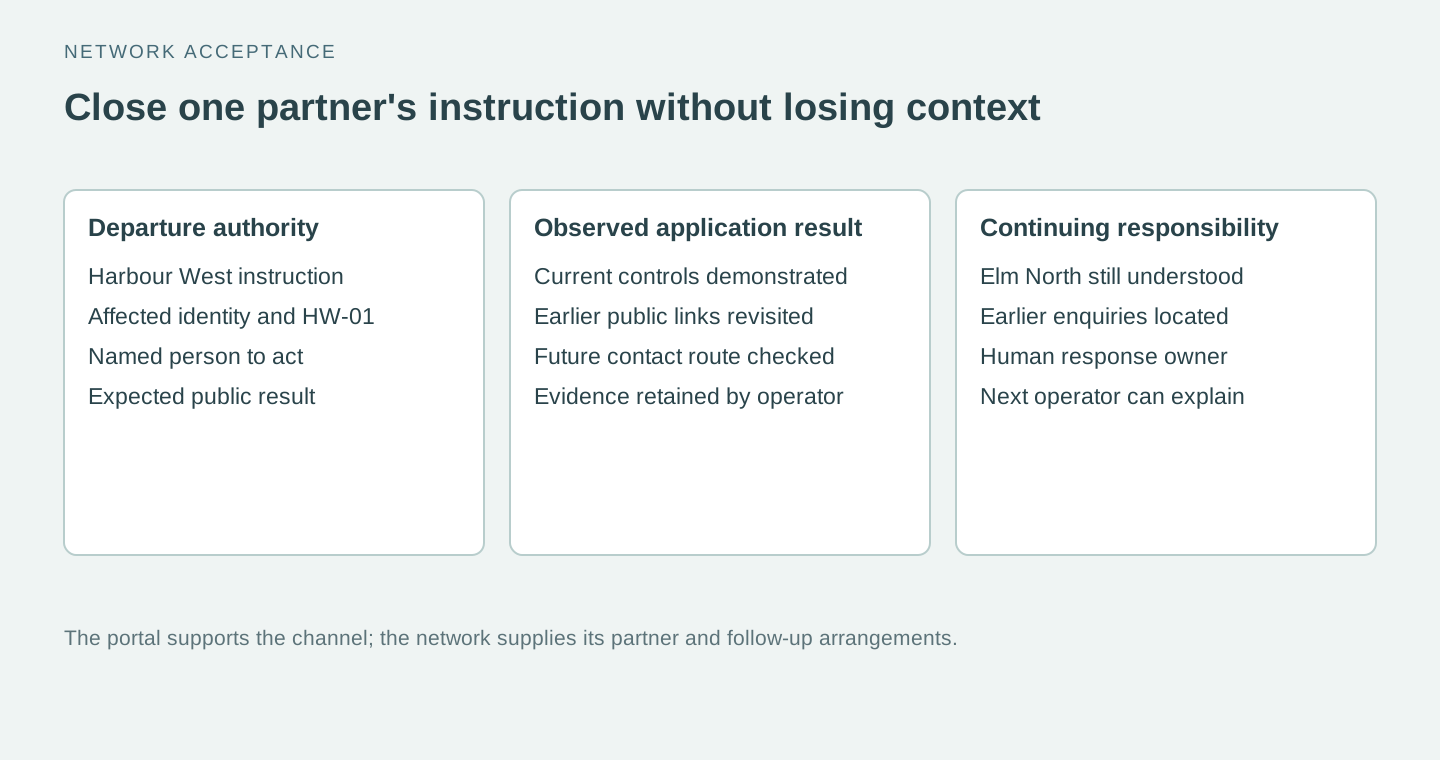
Complete the agency network's portal purchase record
Keep the two-partner crosswalk, corrected-recipient example and observed departure result with these answers. The buyer should be able to hand that record to another authorised operator and have them identify the next action without guessing which agency owns the information. Open items give Codeblix specific questions to address before the application is accepted for real partners.
- Prepare two permitted artificial partner identities and one property reference for each.
- Ask Codeblix to demonstrate publication, a correction and the actual enquiry destinations.
- Work the departure of one partner through the current controls and human responsibility record.
- Agree the application transfer and any required additions before adopting the portal for real partners.
Request the Property-1 acquisition package on Flippa with the completed publication-mandate record. The buyer is acquiring an owned public channel whose partner authority, property information and enquiry responsibility it can explain and maintain.
Explore the products discussed
Explore related acquisition offers