
Real estate website for sale: buy Property-1 domain and source
Acquire the property portal package, then agree the agency, listing and enquiry scope.
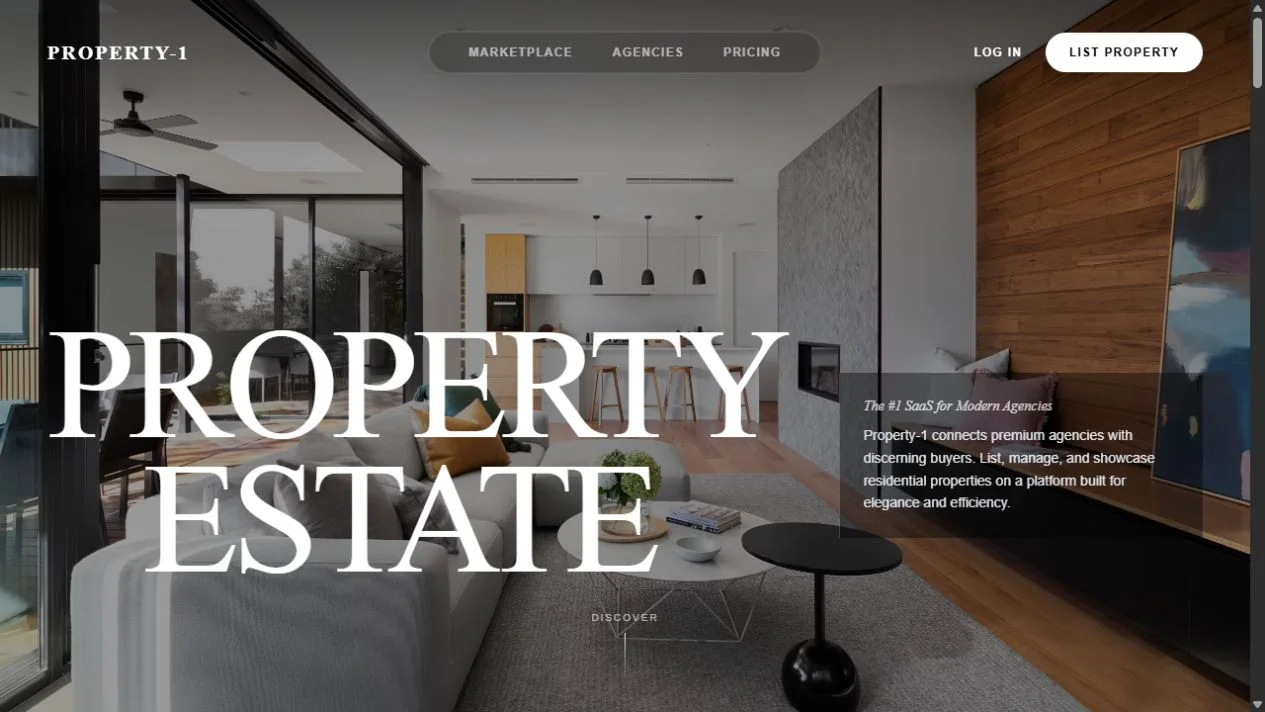
Buy Property-1 as an owned real estate marketplace foundation. Request the domain and source package, inspect agency publishing and enquiry delivery, and agree the transfer through its current Flippa listing.
If you want a real estate website for sale with an owned software foundation, Property-1 is a named acquisition opportunity from Codeblix. Request its domain, source package and product documents through the current sale listing. The package is intended for a buyer who wants to operate or adapt a multi-agency property portal, with agency storefronts, property records and public enquiries.
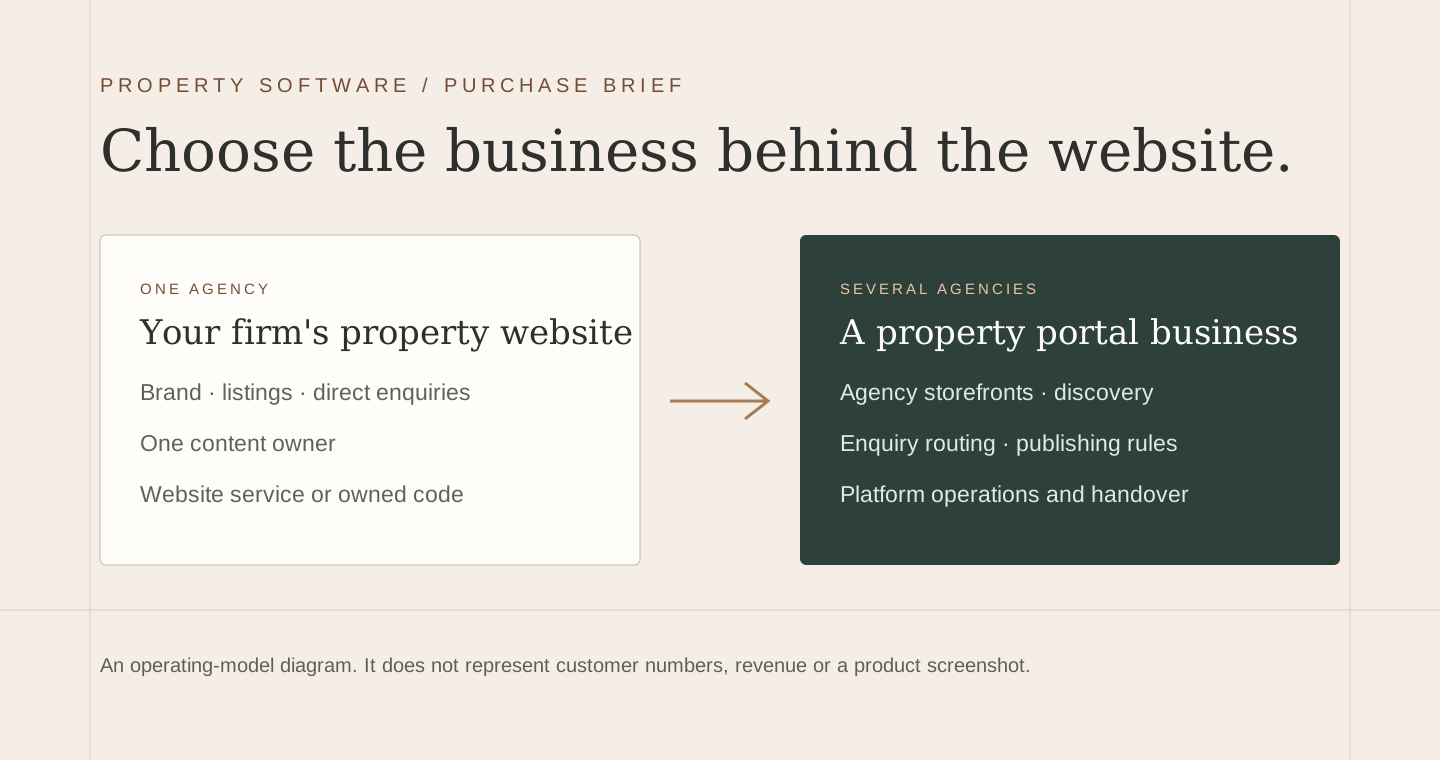
The purchase needs to match your intended business. One agency may need a managed website; a portal operator needs several agencies to coexist under clear publishing and enquiry rules. The purchase brief below uses Property-1 as the concrete product to inspect. It does not treat source-code ownership as proof of an established property audience, and it does not assume that buying a portal creates agency subscribers.
Acquire Property-1 with its domain and software foundation
Request the Property-1 package and contact Codeblix on Flippa →
Property-1 is offered through Codeblix as a starter real estate marketplace business. A buyer can request the domain, source-code package, product documents and agreed transfer terms through the Property-1 marketplace listing. Its current Flippa page is the place to check the asking price, availability and financial representation before making an offer.
The intended purchaser wants to operate a property portal or adapt an owned foundation for a defined agency market. The software package and the operator's commercial plan are separate. No established agency network, search position or subscriber income should be inferred from the existence of a product demonstration. Ask Codeblix to demonstrate the agency, property and enquiry workflow against your intended purchase brief.
The first purchase decision happens before you choose a builder
Write down who will add a property on the first working day. If the answer is your own negotiator or administrator, your primary need is probably an agency website. If the answer is an independent agency that you hope to recruit, you are planning a platform business. If your clients will each receive a separate branded installation, you may be building a software service for agencies. These models can share visual components while requiring different permissions, support arrangements and commercial terms.
An agency website should make one firm's stock and contact routes clear. Its operator normally controls the brand, listing standards and follow-up process. A portal operator must decide how several firms coexist. Which agency owns a listing? Can another agency represent the same property? Who can take a disputed listing offline? Where does an enquiry go when an agency stops using the service? These decisions affect data design and support work, not merely the design of the homepage.
A buyer who already runs an agency may reasonably prefer a managed website service. The value is less operational work and a predictable support relationship. A buyer who wants to create a regional property directory may prefer an owned foundation, provided they can handle hosting, agency onboarding and product maintenance. Neither route wins because it has more features. The correct route is the one whose responsibilities match the business you intend to run.
Which property business are you buying software for?
Four ownership routes, with four different exit doors
The word “builder” can describe a hosted editor, a theme installed on your hosting, a custom development service or a complete product foundation. Ask which one you are being quoted for. You need to understand both the entry cost and what happens if you stop using the supplier. A cheap monthly service can be good value, but only when its restrictions are acceptable. An owned application can be useful, but only when someone can operate and update it.
A hosted agency site
You pay a supplier to operate the website platform. Check control of the domain, custom content, listing export, cancellation arrangements and whether your preferred integrations are included. Treat “we can connect it” as a separate scope until a working exchange has been demonstrated.
A theme or template
You receive presentation assets for a supported system. A theme is not automatically a listing-import service, a property data licence or an agency CRM. Ask who updates the underlying system and how custom changes affect future updates.
A commissioned application
A developer builds against an agreed brief. The important documents are the specification, acceptance examples, repository access and support terms. Confirm what happens when the original developer is unavailable, rather than relying on a verbal promise of permanent help.
An existing software business foundation
You buy a named product, domain and agreed assets. Inspect the application and the transfer package separately. Existing code may save build work, while agency recruitment, payment activation and local positioning still belong to the new operator.
For each route, ask the same closing question: if you move away in a year, what can you take with you, in what format, and with whose help? The answer should name files, data and account ownership. “You own your website” is too vague to settle whether you receive the source code, an export, a database backup or simply the right to use the service while paying.
A useful comparison starts with responsibilities
| Purchase question | One agency's website | Owned multi-agency portal |
|---|---|---|
| Who publishes? | Your staff, under one firm's standards. | Several agencies, with platform rules and separate ownership. |
| Who receives enquiries? | Your agency's agreed inbox or workspace. | The correct agency for each property and storefront. |
| What are you paying for? | A website service, implementation or reusable package. | A software foundation plus the responsibility to operate a platform. |
| What needs transfer? | Domain, content, data and any agreed code. | Those assets plus platform services, operational knowledge and agency relationships, if any are included. |
| What needs proving? | Publishing, contact delivery, support and export. | Those journeys plus agency separation, moderation and the current commercial state. |
Use this table to shorten a supplier conversation. If you need one agency website, there is little value in spending an hour discussing a future subscription network. If you are buying a portal, do not spend the whole demonstration choosing colours. Ask the seller to demonstrate the relationship between the agency account, its properties and its enquiries.
Walk one property through the entire enquiry chain
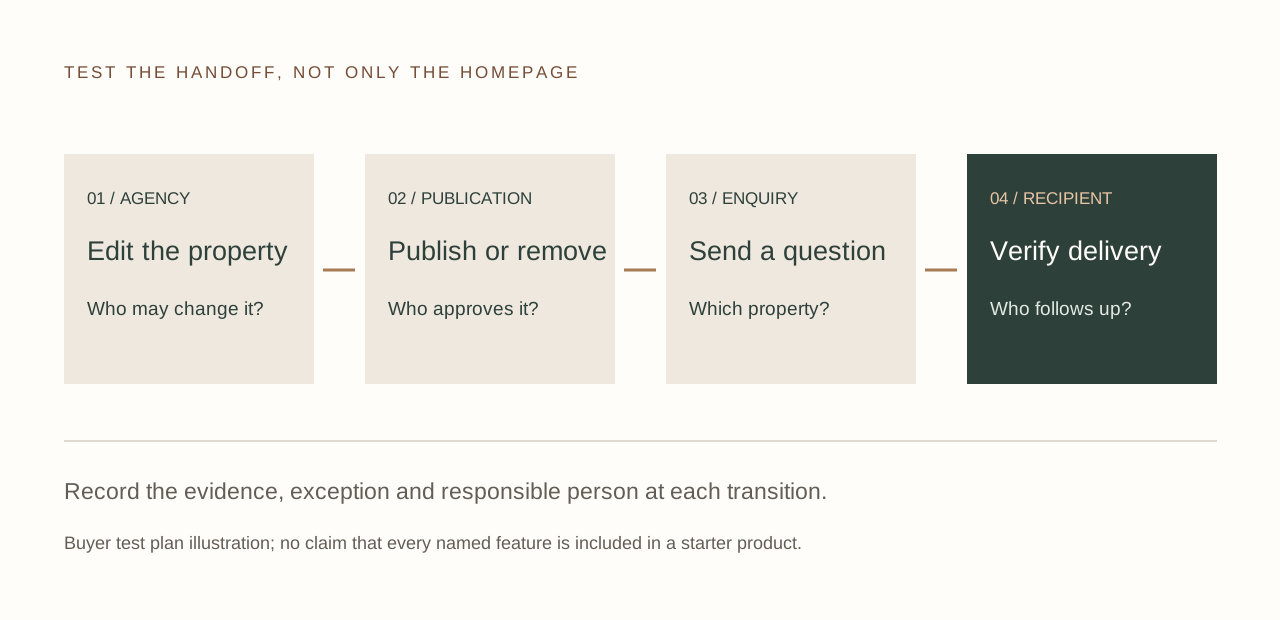
Prepare a fictional property with a clear reference, a price, a location, a contact person and a status. Ask the seller to add it through the same interface an agency will use. Observe which fields are required, how photographs are handled, and whether the person editing it understands when the change becomes public. A demonstration should show where responsibility changes hands.
Then open the public listing as a visitor. Compare the public address, price and availability with the agency record. Send a harmless test enquiry using details you control and a clearly marked test message. Ask to see the actual destination. A success message on the website is not the same evidence as receipt by the right agency. If the current implementation prepares an email or uses an external service, record that boundary accurately.
Finally, change the property status or remove it. Follow an old public link and check what a visitor sees. Ask what happens to saved references and previous enquiries. You are not demanding every possible feature from a starter product. You are identifying which states it handles and which operating procedures the buyer must supply. Those missing procedures belong in the purchase decision and handover notes.
The agency boundary is the product boundary
A portal can look convincing with one agency account because there is no competing owner. Request a demonstration with two clearly labelled test agencies. Each should have its own storefront and one property. Ask the operator to switch roles and show which records each account can view or change. The test matters even when you trust the seller: accidental cross-agency access becomes a buyer support problem after transfer.
Separate public information from private working information. A published telephone number may be intended for everyone. An unpublished property, an enquiry history or an internal note may have a different audience. Write down the intended visibility instead of using the phrase “secure accounts” as a substitute for an actual access check. If a requirement is not implemented, the seller should say so and describe the change needed.
Also decide who controls an agency's departure. Can the agency export its own records? Who removes its public profile? What happens to enquiries already sent? A purchase does not need elaborate automation for every exception, but it does need an operator who can explain the process. For a small launch, a documented manual procedure may be enough. It must still identify the person with authority and the evidence they retain.
Property-1 is a product to inspect, not a shortcut around inspection
Property-1 is presented by Codeblix as a real estate marketplace starter with agency storefronts, property listing management, public discovery and direct enquiries. The listing provides the product documents and a link to the current Flippa sale. It is relevant when your intended purchase is a multi-agency foundation rather than a simple brochure site for one firm.
Keep the claims narrow. The existence of property listings in a demonstration does not prove that independent agencies are paying to publish. A proposed agency subscription model does not establish a fully activated billing lifecycle. Ask the seller to show the current state of payments, the services that must move to buyer accounts and the work expected before accepting real agency subscriptions.
Read the documents before the call and bring unanswered questions into the walkthrough. If you require a specific property feed, agency CRM connection, automated valuation, mapping licence or jurisdiction-specific workflow, make it an explicit scope item. Do not infer it from the broad phrase “real estate software”. Property-1's value to a particular buyer depends on the verified foundation and that buyer's remaining work.

Import promises deserve a separate page in your notes
Property websites often depend on information that starts elsewhere. An agency may already manage its stock in a CRM or receive photographs from a marketing team. A buyer should draw the actual source-to-website path. Name the source system, the format, the update frequency, the person who resolves conflicts and what happens when an item disappears from the source.
A file upload and a continuous integration are different products. A developer can demonstrate a successful import of one prepared file without proving that daily changes, deletions and duplicate references are handled. Ask for a representative update: change a price, withdraw a listing, replace a photograph and resend a record that already exists. If the proposed foundation has no import facility, price the manual operating work instead of pretending it will appear after the sale.
Ownership of content also deserves a clear answer. Confirm who has permission to publish the supplied photographs, descriptions and floor plans. When acquiring source code, separate the software licence from rights in third-party imagery and property records. The buyer should receive an inventory of demonstration assets and instructions for replacing anything that is not intended for their live operation.
Ask for evidence before deciding what the domain is worth to you
A memorable domain can help a property product feel coherent. Its age alone does not prove search visibility, useful links, a clean history or an audience. Treat the domain as one asset in the package. Ask who controls the registration, how it transfers, whether email services depend on it and which renewal responsibilities you will inherit.
If the seller represents traffic or commercial history, inspect the supporting records in the current sale process. Distinguish a public page that loads from a property enquiry that reached an agency, and distinguish both from a paying subscriber. For a starter product, it is reasonable for the value discussion to focus on the software, documents, brand and transfer work. It is not reasonable to silently replace missing business evidence with assumptions about what an old domain might achieve.
Marketing plans should also be specific. “Rank for property searches” does not identify a customer or an operating advantage. A regional portal could begin by serving a known group of agencies with a clear publishing need. A software provider could focus on a repeatable website service. Decide which customer conversation you can actually start after purchase, then assess whether the product supports that offer.
Build a cost sheet that includes the work you will keep doing
The purchase price is only one part of first-year ownership. Include hosting, service accounts, email delivery, maintenance, content preparation and any agreed implementation. A managed website quote may already cover some of these items. An owned foundation may give you more control while requiring you to arrange them separately. Compare the same responsibilities on both sides.
The calculator below uses numbers you enter. It does not estimate income, agency conversions or a return on the purchase. Replace every starting amount with a supplier quote or your own assumption. If a service has a usage charge, add an allowance and record the usage level it assumes. Keep staffing time visible in your written plan even if you do not enter a cash amount for it.
First-year ownership assumptions
A planning tool based on your inputs. It excludes revenue and does not predict the cost of unquoted custom work.
Turn the handover into a property operations rehearsal
- Identify the buyer-owned domain, repository, hosting and application services.
- Set up the intended administrator and a clearly labelled test agency.
- Publish a fictional property through the normal agency interface.
- Send an enquiry using an address you control and verify its destination.
- Change the property's status and check its old public link.
- Remove the test content and keep the agreed setup and support notes.
Ask the seller to describe a clean setup under buyer-owned accounts. The repository should come with understandable setup instructions and a list of required services. The domain, hosting and any application services should have named owners after transfer. Avoid leaving an important service attached to a seller account simply because the demonstration works there.
Use a small rehearsal before inviting agencies. Create the intended administrator, add a test agency, publish a fictional listing, send an enquiry, change the status and remove the test content. Confirm how to recover from a mistaken edit and how to obtain a current backup or export. The rehearsal should expose the remaining configuration work while the seller can still answer questions.
Finally, agree support in terms of actions and boundaries. Who answers setup questions? Who handles a defect in the delivered workflow? Are new integrations or design changes separate? A written answer makes the transaction easier for both sides. You can compare the final proposal with other online businesses for sale without confusing an implementation service, a software asset and an established operating business.
The purchase memo you should be able to finish
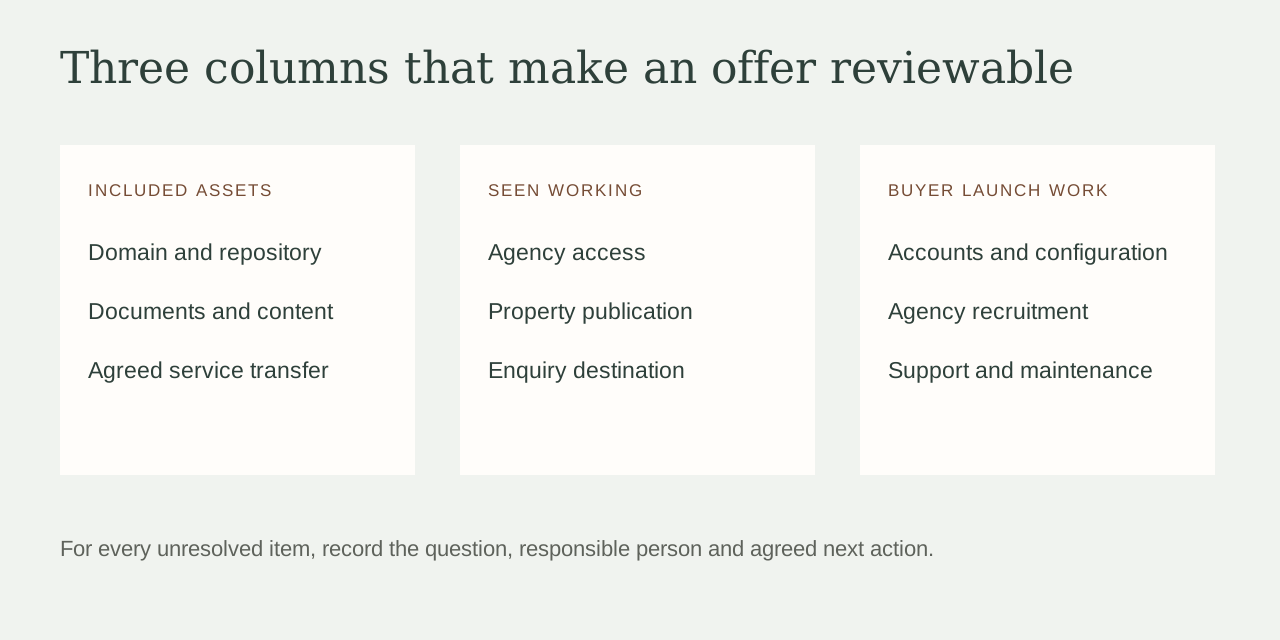
Before making an offer, complete a short purchase memo in plain language. Name the intended customer, the role your business will play and the product route you have chosen. List the included assets, the demonstrated workflow and the launch tasks that remain yours. Add the questions that would change your decision if the answers were different. A useful memo can be shared with a developer, business partner or seller without requiring them to decode your assumptions.
For an agency website, the memo may prioritise publishing, enquiry delivery, export and support. For a portal, it should also address agency boundaries, moderation, the current payment state and the effort needed to recruit agencies. Your decision is stronger when it states the work you are prepared to do. Buying more code does not remove that work; it changes where the starting line sits.
Evidence to collect before an offer
When those answers are clear, the next step is straightforward: open the Property-1 product and sale page, read the linked documents and ask Codeblix to demonstrate the unresolved parts. Make the purchase around the product you have inspected and the operating role you intend to own.
Two buyers can inspect the same portal and reach different decisions
Consider an agency owner who wants to replace a dated website before adding a second office. Their staff already have a familiar listing process, and one administrator handles incoming enquiries. For this buyer, the strongest proposal may be a managed site that fits the existing process, gives the business control of its domain and provides a dependable export. Buying a platform with multiple agency roles could create more administration than the business needs. The owner should not feel obliged to buy a software business merely because its source code is available.
Now consider an operator with relationships across a small network of independent agencies. They want to offer those agencies a branded presence in a regional property directory. Their purchase brief is different: each agency needs a clear identity, its own records and a known enquiry destination. The operator needs publishing rules and an onboarding procedure. An existing portal foundation may give them a useful starting point, but its relevance rests on those verified workflows and the operator's ability to recruit the first agencies.
Neither example needs a speculative income forecast. Both need a clear explanation of the customer, the operating task and the purchase boundary. A demonstration that is insufficient for one buyer may be enough for the other, because their acceptance criteria differ. This is why comparing products solely through a feature count often produces an expensive mismatch.
What should make you pause before an offer?
Pause when the seller cannot show who receives an enquiry, when important accounts have no transfer plan, or when an advertised integration is actually an unpriced development idea. Pause when the current commercial position is described only through hypothetical subscriber numbers. These are questions to resolve, not automatic reasons to dismiss the software. The useful next action is to request the missing evidence and make the purchase conditional on an agreed answer.
Also pause if nobody on the buyer side can own the first month of operations. Someone must know how an agency joins, how a listing correction is made and how a service problem is escalated. If the buyer plans to hire technical help, introduce that person to the documents before completing the transfer. A second pair of eyes can test whether setup instructions are usable without requiring the original developer to improvise every step.
Proceed when your purchase memo is specific enough that another person can repeat the main test. They should be able to identify the software version or delivered repository, find the intended account, publish the test property and confirm its enquiry route. That is more useful than a broad promise that the site is ready for every real estate business. It gives you a defined foundation to accept, operate and improve.
Explore the products discussed
Explore related acquisition offers