
Buy a marketplace business built around enquiries and supplier quotes
Acquire the introduction workflow while keeping the underlying client contract separate.
Request HitByGlam, Property-1 or FruitKiwi for an enquiry-led marketplace purchase. Compare provider access, request handoff and the separate customer contract before agreeing an individual asset.
Choose a marketplace business for sale around the transaction you actually want to support. If your intended business sells professional tools and discovery while customers arrange the underlying work separately, Codeblix offers several focused foundations to inspect: HitByGlam for beauty-professional enquiries, Property-1 for agency property discovery, and FruitKiwi for produce sourcing requests and quotes.
This acquisition brief is for a buyer who deliberately wants an enquiry or sourcing platform rather than assuming the application will collect every customer payment. The software can still have its own paid plans or visibility products. Those platform fees are separate from a professional's service agreement, a property transaction or a supplier's produce invoice. Inspect both relationships before making an offer.
Request the offer that matches your external-contract model
- Request the HitByGlam domain and software package from Codeblix for portfolio discovery, style briefs and professional enquiries.
- Request the Property-1 acquisition package for agency storefronts, property listings and enquiries.
- Request the FruitKiwi source and domain package for B2B produce sourcing, supplier storefronts and quote comparison.
Check current price, availability, financial representation and transfer scope on each Flippa listing. These are separate assets, not an automatically bundled purchase. Tell Codeblix which business model you intend to operate and ask for the relevant product documents and walkthrough before discussing an offer.
The internal product pages provide another route to the package: HitByGlam, Property-1 and FruitKiwi. Read those scopes individually. Similar high-level marketplace language does not make the three applications interchangeable, and buying one does not confer rights to the others.
Put the platform fee and the customer contract on different rows
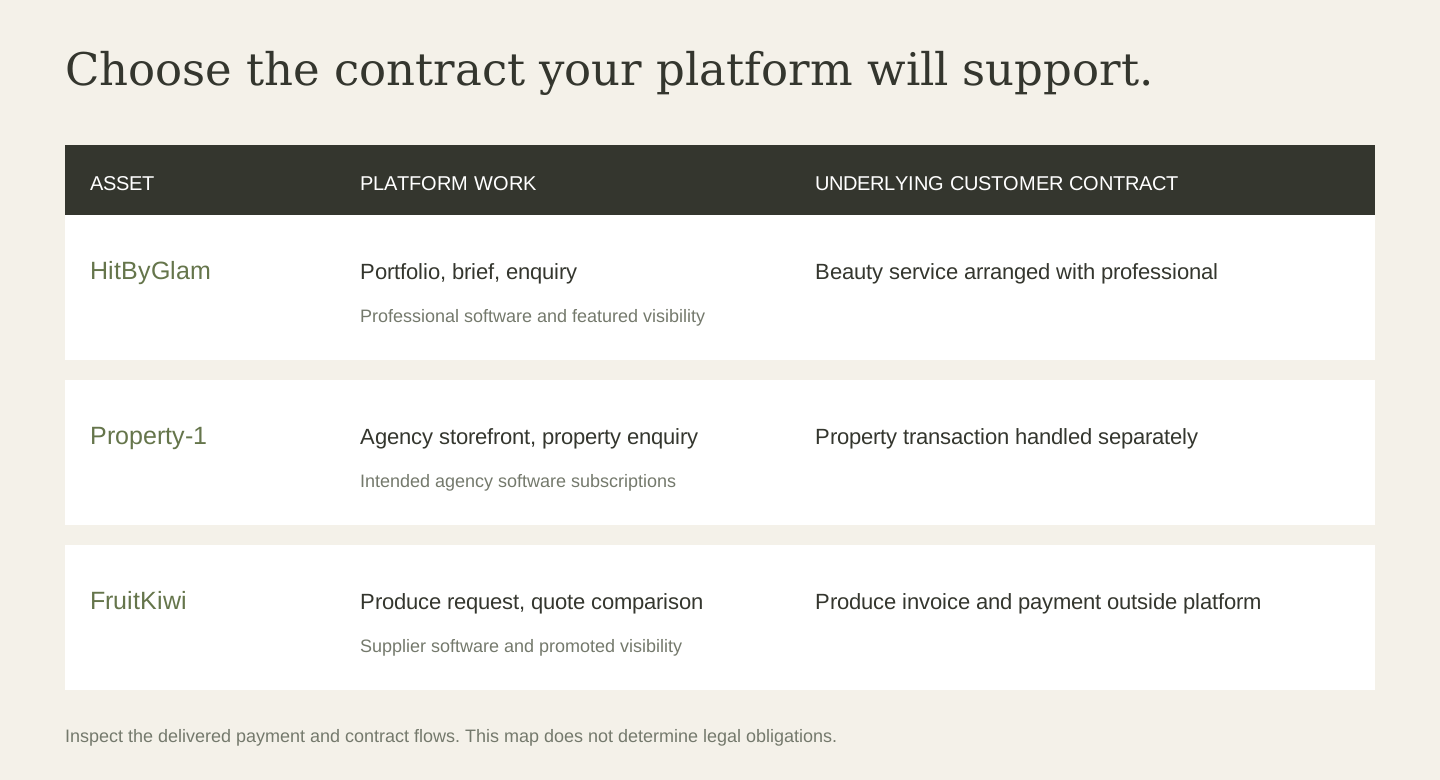
Start your purchase sheet with two questions. What does a provider pay the platform for? What does the customer pay the provider for? In an enquiry-focused business, the first answer might be software access or clearly labelled featured visibility. The second answer concerns the actual beauty service, property agreement or produce supply arrangement. The product may help the parties find each other without handling that underlying payment.
That separation affects what the software needs to demonstrate. A provider-plan checkout does not prove a customer service payment flow. An enquiry record does not prove that the provider accepted the job. A quote-comparison page does not prove that the buyer paid the selected supplier. Keep each claim attached to the screen, record or external evidence that supports it.
This operating design also does not determine every legal or commercial obligation. Those depend on the actual offer, agreements and deployment. Avoid describing an asset as removing all responsibilities because payments take place elsewhere. The acquisition question is narrower: what does the delivered application do, and which responsibilities must the buyer arrange around it?
Buy HitByGlam when the professional relationship begins with a visual brief
HitByGlam's documented scope centres on approved beauty-professional profiles, portfolios, inspiration boards, style briefs, enquiries, proposals and messages. It is relevant to a buyer who wants to operate a discovery and enquiry product for professionals and studios. The proposed software model uses professional plans and labelled featured visibility.
The source boundary matters: this is not a delivered appointment, service-deposit or service-payment platform. If your intended offer depends on automatic appointment confirmation or collecting a customer's beauty-service payment, make that requirement explicit. Do not assume it exists because profiles show services or availability information.
Request a fictional customer brief in the seller walkthrough. Follow the selected professional, the brief and the resulting conversation. Ask what the provider can see, how they prepare a proposal and where the customer is directed next. The buyer needs to understand the enquiry handoff, including any human work needed to complete the service agreement.
Buy Property-1 when the agency owns the property enquiry
Property-1 is offered as a real estate marketplace foundation with agency storefronts, property listing management and public enquiries. The buyer should decide how agencies will publish and how each enquiry reaches the correct firm. The intended agency subscription model is separate from a property sale, lease or other agreement reached through the agency.
Ask for a test with two fictional agencies and distinct properties. Send a marked enquiry for one property and inspect its destination. The fact that an agency has a storefront should not obscure who owns the record or who is expected to respond. If a specific agency CRM, listing feed or payment integration is required, request evidence for that exact addition.
Do not treat property values shown in a demonstration as transaction volume. The acquisition is a software and domain package unless separately evidenced operating assets are included in the current sale. A buyer can use an existing foundation to build a regional offer, but agency recruitment, content maintenance and follow-up procedures remain work to organise.
Buy FruitKiwi when a quote needs to remain a sourcing conversation
FruitKiwi's product scope includes seasonal produce discovery, supplier storefronts, multi-supplier requests for quotes, structured comparison, messaging and sourcing lists. Its intended platform income comes from supplier software plans and promoted listings. Produce invoices and produce payments are outside the platform's delivered commercial flow.
This can suit a buyer who wants to operate sourcing software for businesses rather than become the direct seller of every item in a catalogue. That operating choice still requires clear supplier relationships and accurate product information. The software does not prove that a supplier has stock, can deliver to a location or has accepted a particular order.
Bring a fictional request with a quantity, destination and relevant constraints. Ask the seller to show how several suppliers respond and how the buyer compares those responses. Identify where the conversation becomes a supplier agreement or invoice outside the application. Keep the handoff explicit so your eventual customers understand which part the platform supports.

Choose which object your buyer hands to a provider
A style brief, a property enquiry and a produce request are not interchangeable leads. Each contains different information and creates a different next action. Before buying, write down the object your customer will submit and what the provider needs to answer usefully. That determines which package deserves the most detailed walkthrough.
| Asset | Customer hands over | Provider's next job | Underlying payment boundary |
|---|---|---|---|
| HitByGlam | A structured style or service enquiry. | Discuss the request and prepare the relevant proposal. | Service appointments, deposits and service payments are not the delivered platform scope. |
| Property-1 | An enquiry linked to an agency or property. | Respond through the agency's property process. | The property agreement is separate from intended agency software access. |
| FruitKiwi | A sourcing request and quote context. | Clarify availability, terms and the supplier offer. | Produce invoices and payment take place outside the platform. |
If your proposed customer cannot give the information required by one model, the application may be a poor fit even when the interface is attractive. Choose the product around a clear handoff you can support, then ask the seller to demonstrate that handoff with a request you understand.
Inspect the recipient route before counting an enquiry
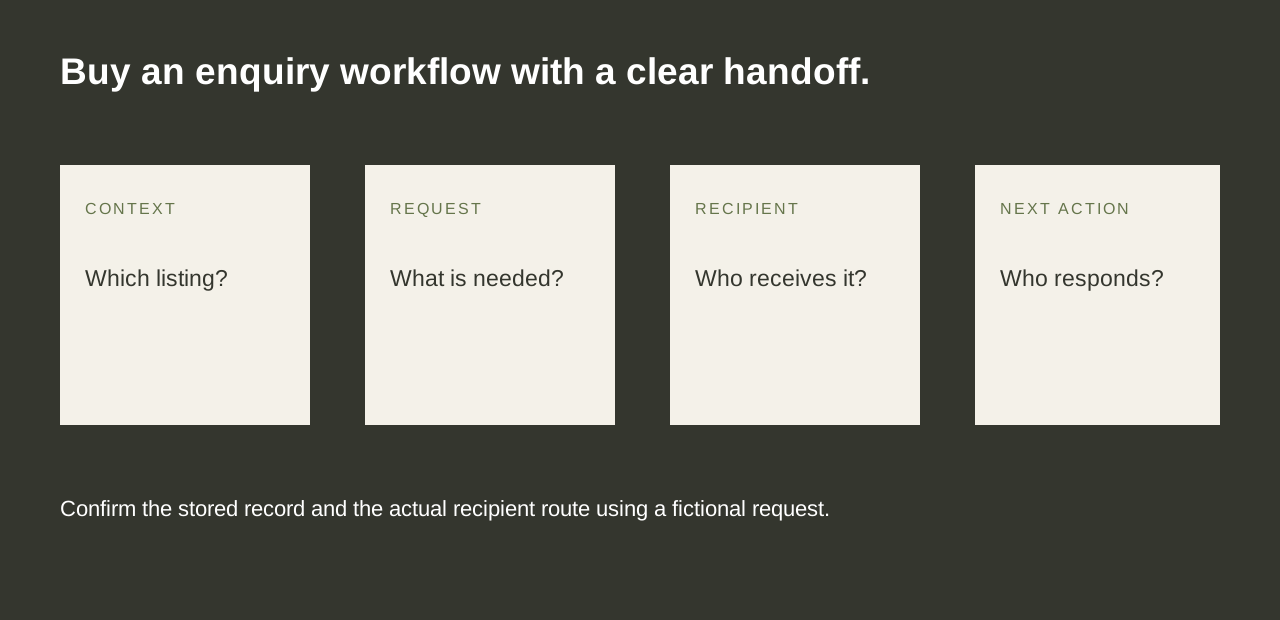
Create a fictional request and submit it using details you control. Observe the confirmation, then inspect the provider's record and the actual communication route the product represents. A success banner establishes that the website accepted an action; it does not independently prove a recipient received or read the request.
Ask the seller which parts are stored in the application and which depend on email, messages or another configured service. If an external connection is not active in the demonstration, record that configuration task. The buyer should know how they will identify a failed handoff and what evidence is available for a support conversation.
Then follow one correction. Change a request detail through the supported process and see whether the provider can understand which version is current. If updates require a new message, that may be a reasonable operating procedure. It should be described accurately rather than presented as a synchronised transaction workflow without evidence.
Ask what the platform promises after the introduction
An introduction can create an expectation that the platform will resolve everything that happens next. Decide what your business actually offers. You might support application access and accurate profile presentation while the parties agree the underlying work directly. You might provide additional human coordination under separate terms. The purchase should not hide those choices behind a broad marketplace label.
Request the public contact, support and policy surfaces included in the package, then compare them with the service you intend to operate. Treat demonstration wording as editable content that needs buyer assessment. It is not proof that your proposed responsibilities are already settled for every customer and location.
A clear boundary also improves seller negotiations. You can ask whether an unimplemented case needs a software change, a manual procedure or different public wording. Those answers affect the launch work and purchase price without requiring an earnings forecast. Keep them in the transfer notes so the first operator does not have to invent the policy after a complaint.
Keep provider subscription access separate from the enquiry result
A provider may pay for software access or visibility and still receive no suitable request in a particular period. The buyer should define the product being sold to that provider. Is it a workspace, a storefront, access to particular tools or a defined featured placement? Avoid turning software entitlement into a guarantee of customers.
Ask the seller to demonstrate the relevant plan and owner controls. Which features change with a plan? What can the provider still access after a change? Which parts require buyer-owned payment configuration? Current financial information must be obtained through the sale listing, not inferred from the existence of a pricing page.
This distinction is useful when comparing the three assets. HitByGlam's professional software offer, Property-1's intended agency access and FruitKiwi's supplier tools serve different users. A shared subscription idea does not establish that the same pricing, onboarding or support model will work for all three.
Make visibility a defined product rather than an implied endorsement
Some of these platforms include or contemplate paid visibility. Ask what an operator can actually configure and what the provider receives. A featured position should have an identifiable location, duration or eligibility rule where implemented. It should not imply that a payment proves the provider's quality or that the platform guarantees an enquiry outcome.
For your first offer, decide whether featured visibility is necessary at all. A buyer might focus on the provider software and a coherent directory before introducing paid placement. If placement is part of the launch, inspect how it is labelled and how the operator stops or changes it. Keep the evidence tied to the individual product's implemented controls.
The same principle applies to approval badges or public profiles. Ask what the approval actually means in the delivered application and who performs the corresponding check. Do not turn a technical publishing permission into a promise of professional accreditation, property verification or supplier capacity that has not been established.
Use a boundary map to shortlist the acquisition
Which external agreement do you want your software to support?
The selector does not rank the businesses or predict returns. It narrows the seller conversation to the customer object and operating relationship you intend to own.
Compare transfers by what a new operator must take over
For any selected asset, request the domain, repository, documents and required service-account inventory. Identify which demonstration records can remain as examples and which must be replaced before launch. Ask who controls public content, profile approval and the operational response to an unresolved request.
The technical handover should let the person responsible for your deployment understand the application and its external dependencies. The commercial handover should name any genuine relationships that are included, with evidence where represented. Do not combine those into a single claim that a populated application is a ready-made customer network.
Make the first operating exercise small. Use two fictional providers, one request and a clear follow-up. Ask the future operator to repeat the process from the documents. The outcome should be an understandable request, a known recipient and a practical next action. If that requires additional development, obtain an explicit scope before making the offer.
Buy the introduction workflow you are prepared to operate
A beauty-service request should carry the look, not a false appointment
For a HitByGlam purchase test, prepare a fictional customer who has an occasion, a preferred style and a question about a professional's service. Ask the seller to show how the inspiration or brief is connected to the selected professional. The provider should be able to understand the request without the buyer having to explain a private demonstration script.
Now inspect the wording after submission. Does the customer know that they have sent an enquiry rather than secured an appointment? Is the professional's proposal or next response visible through the documented workflow? If the intended platform does not collect a service deposit, the message should not create an expectation that a booking is financially secured. These details determine whether the buyer can operate an honest enquiry service around the software.
End the test by identifying the off-platform agreement you would expect the parties to make. You are not asking the application to become a salon checkout system. You are making sure its handoff matches the offer you intend to sell, with a clear distinction between professional software access and the actual beauty service.
A property enquiry should identify both the listing and its agency
For Property-1, use two fictional agencies with similar-looking properties. Send the enquiry from the property the test visitor actually selected. Ask the seller to show the resulting context and destination. The buyer needs to know whether an agency receives enough information to recognise the property and respond appropriately.
Then ask what happens if the property is withdrawn or the agency changes its public information. The application may retain an enquiry, display a changed property state or rely on an operator procedure. Establish the delivered behaviour rather than assuming a full sales-progression or lettings-management system. The underlying property agreement still belongs to a separate commercial process.
This small example makes the purchase more concrete. It checks listing ownership, the visitor's context and the agency handoff in one test. If the buyer wants to sell additional agency services, those can be discussed separately, with an explicit scope and a clear answer about which parts the current package supports.
A produce quote needs the request context that made it meaningful
For FruitKiwi, prepare a fictional business request that names the product category, quantity, destination and a relevant timing constraint. Ask the seller to show how suppliers receive or respond to that context and how the buyer compares their offers. A low displayed price is not enough information to decide whether two quotes concern the same supply requirement.
Inspect the point where the software's sourcing work ends. Does the buyer continue a conversation with the chosen supplier? Which details should be confirmed in the supplier's own offer or invoice? The product's documented scope leaves produce payments outside the platform, so the buyer should not market the application as guaranteeing stock, delivery or settlement.
If your intended customers need a more formal purchasing workflow, identify the missing records or approvals explicitly. That may be a separate development or operating requirement. The current acquisition can still be relevant as a sourcing foundation, but its value should be assessed against what is delivered, not against an assumed procurement suite.
Keep the first support report tied to a real application record
Ask the seller how an operator would investigate a message that a provider says they never received. The answer should name the available application record, the communication route and the next check. If the platform does not retain delivery evidence for an external channel, record that limitation. The buyer can then decide whether an additional service or a documented support procedure is needed.
Also decide what information a customer should supply when reporting a problem. A provider name alone may not identify the relevant request. A property reference, campaign or request identifier can make the support conversation more useful where the product provides it. Avoid promising a central case-management system if that is not in the delivered scope.
These practical details help a new owner run a focused marketplace without expanding every enquiry into a platform-managed transaction. They let the operator explain what happened in the application, what requires a response from the provider and what belongs to the separate agreement between the parties.
Check whether a repeated request creates a second obligation
Use a seller-authorised fictional request, then inspect the supported response to a customer submitting again. The buyer should understand whether there are separate enquiry records, a visible conversation or an operator step. Do not assume that repeat submissions become confirmed orders or that the application has a duplicate-detection feature.
Ask how your intended support team would explain the two records to the provider. The important acquisition question is whether the delivered workflow preserves enough context to avoid a mistaken response. Any additional consolidation, notification or approval requirement should be agreed separately rather than advertised as present in the package.
The right acquisition for this brief is the one whose boundary you can explain to both sides of the marketplace. A customer should know what submitting a request does. A provider should know what their platform plan or listing provides. The operator should know where application support ends and another commercial relationship begins.
External-contract acquisition file
Request the relevant package from HitByGlam's sale, Property-1's sale or FruitKiwi's sale. For a broader asset shortlist, browse online businesses for sale. Agree the individual transaction against its documented package and the work you intend to perform.
Explore the products discussed
Explore related acquisition offers