
Recruitment website for sale: acquire GlobStaff's remote-services platform
Request the domain, source code and documentation for a provider marketplace with service storefronts and booking tools.
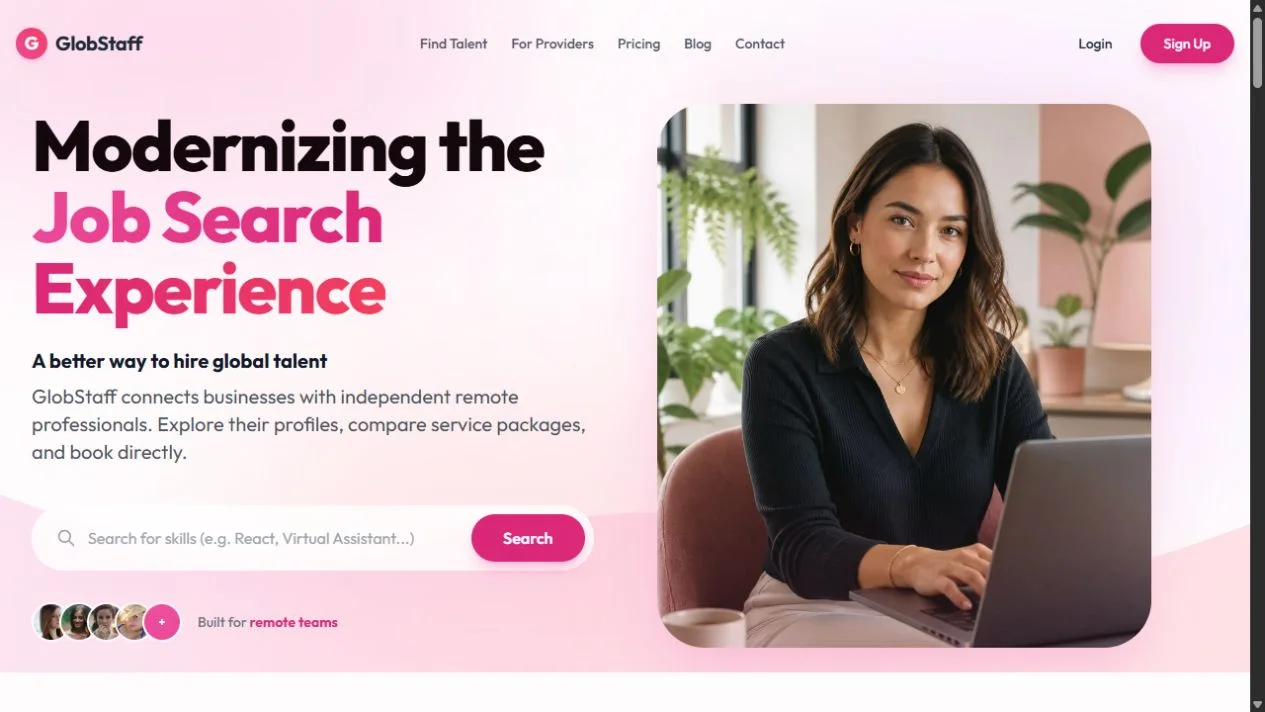
Buy GlobStaff's remote-services marketplace foundation. Request the domain and application package, inspect provider subscriptions and service bookings, and agree buyer-owned deployment and payment setup.
Acquire GlobStaff's remote-services marketplace foundation. Request the current domain, application and documentation package through Flippa. The product gives a specialist operator professional storefronts, service discovery and booking tools, with provider subscriptions as the intended platform model. Confirm current availability, price and the exact asset list in the sale discussion.
GlobStaff is a starter remote staffing marketplace offered through Codeblix and Flippa. Its documented product includes professional storefronts, skills and language discovery, provider services, booking requests, progress and completed-job reviews. The intended platform model is provider subscriptions. It is an asset for a buyer to launch and operate; the existence of those features does not establish customers or subscription income.
This acquisition offer is for a marketplace product foundation. It does not include a recruitment agency, a delivery team, client contracts or an applicant-tracking system unless expressly documented in the agreed package. Buyers who want a specialist remote-provider network can use the ownership details below to define an offer and request the relevant demonstration.
Three purchases can sit behind the same staffing search
A recruitment tool, a service agency and a marketplace serve different owner roles. Recruitment software may support an internal hiring process. A service agency may employ or contract people and sell managed work to clients. A marketplace provides a place for independent providers and customers to discover each other and use a defined service workflow. You should not value one as though it automatically includes the other two.
GlobStaff's documented foundation is the marketplace route. A provider presents skills, languages and services; a customer discovers a relevant professional and uses the booking tools; the owner manages the platform. If you need applicant tracking, payroll processing or an employer-of-record service, ask about those requirements separately. They should not be inferred from the phrase remote staffing.
| Purchase type | The buyer expects to own | Evidence to request |
|---|---|---|
| Specialist freelance marketplace | A provider network and its platform service | Provider storefront, service discovery, booking and owner controls |
| Managed remote service agency | A delivery team and client service commitments | Actual contracts, delivery arrangements and commercial evidence |
| Recruitment or staffing software | A tool for an organization's hiring or staffing process | The exact applicant, placement or payroll features required |
A buyer can choose to add services around an acquired product later. That is a business plan, not an included feature. Put any essential additional service, integration or contractual arrangement in the purchase brief. This keeps the conversation focused on what the current asset actually provides.
Review GlobStaff's current Flippa listing to confirm availability, price, financial information and the transfer package. Bring a clear description of the customer relationship you want to own. It will make the seller walkthrough more useful.
Follow a professional from storefront to completed work
Start the demonstration with an ordinary provider account. Ask to see the information that appears on a professional storefront, including the skills, languages and services a visitor can review. Then switch to the public view and try to find that provider through the documented discovery tools. The point is to connect the provider's input with the customer's decision.
Next, follow a service booking. What does the customer request? What does the provider receive? How is progress represented? Where does a completed-job review fit? A complete demonstration should show the relationship between these stages. A collection of disconnected screenshots is less useful when you are deciding what you will be responsible for supporting.
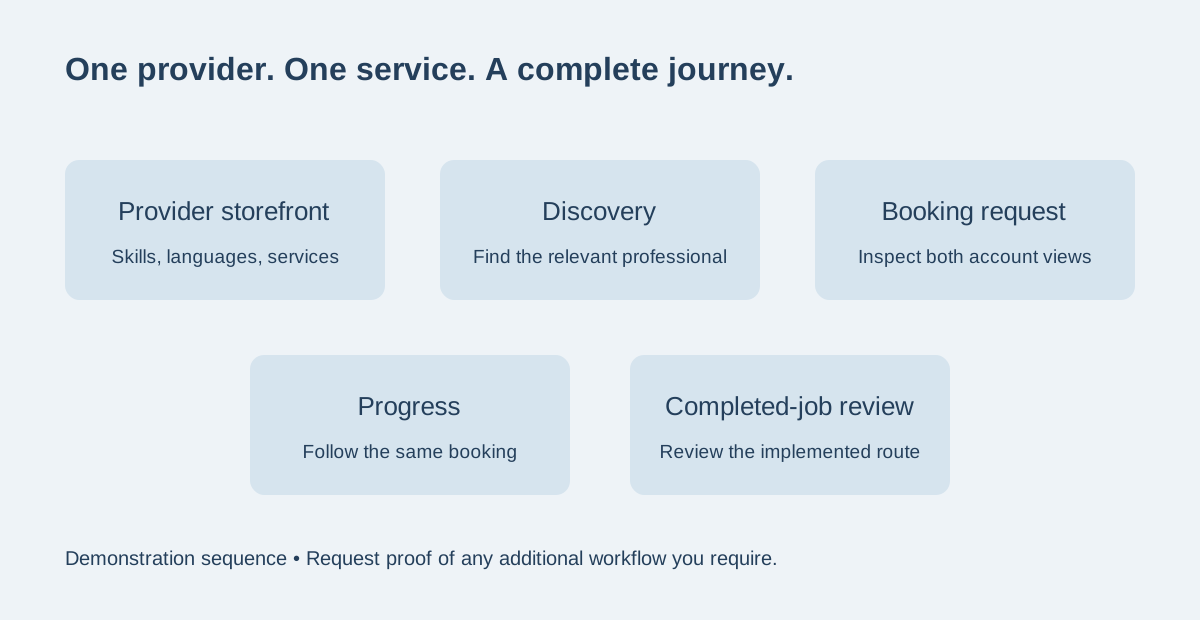
Use a service you understand for the exercise. A hypothetical remote administration service might have a clear description, a stated scope and a provider who can explain what the customer is requesting. This test does not claim that such a provider or customer currently trades on GlobStaff. It gives you a recognizable scenario for checking the software.
Watch what happens when the request needs clarification. Does the demonstrated route provide enough context for the parties? Which actions can the owner take? If you want a particular dispute process, time-tracking connection or work-delivery integration, ask for proof that it exists. Record additional requirements rather than treating familiar marketplace conventions as automatic inclusions.
A narrow provider community gives the owner a concrete offer
Owning software does not supply a professional network by itself. A prospective buyer needs a sensible answer to two questions: which providers would be approached first, and why would customers look for them here? A specialist community can help answer both, provided the buyer understands the audience and can explain the platform's service.
For example, someone who already works with multilingual remote assistants may understand the importance of language presentation and a clear service description. Someone who serves independent small businesses may know which administrative tasks those clients purchase. These are possible buyer advantages. They are not statements that GlobStaff already owns those communities or has secured their demand.
Prepare a provider offer using the current product. It could describe a professional storefront, discovery by relevant attributes, service presentation and a supported booking route. If your sales pitch relies on automatic matching, guaranteed leads or a capability you have not seen, revise it before basing an acquisition on it. GlobStaff should not be described as an AI matching service on the evidence reviewed here.
- Name one provider group you could realistically contact.
- Describe one type of customer who already buys that work.
- Choose a service scope that can be presented clearly.
- Identify which documented screens support that relationship.
- List the owner tasks needed to keep profiles and requests useful.
This makes the platform easier to evaluate commercially. You are no longer asking whether a large generic marketplace could be successful. You are asking whether this product can support a particular offer, for a particular audience, under an operating plan you can deliver.
Provider subscriptions are a service commitment
The intended GlobStaff model is provider subscriptions. For a buyer, that is a reason to examine the plan controls and the provider's experience of paying for access. It is not evidence of existing recurring revenue. Ask the seller for the current financial and customer records associated with the sale, and distinguish implemented billing capability from actual paid activity.
A provider considering a subscription will want to understand the service received. The owner needs to be able to explain the plan, the relevant features and the support available. Ask what can be configured, what the provider sees and how account changes are managed. If your intended plan structure requires new rules, treat those rules as development requirements.
| Commercial question | Product question | Owner decision |
|---|---|---|
| What is the provider paying for? | Which storefront, service and platform capabilities are included? | Write a specific offer using demonstrated features |
| Who maintains the account? | Which controls belong to the provider and the owner? | Assign onboarding and support responsibilities |
| How are plan changes handled? | Show the current plan settings and relevant account states | Identify configuration and any new development |
| What commercial performance exists? | Separate test data from dated customer and payment evidence | Base the purchase assessment on records, not a forecast |
Be equally careful with promoted visibility or other possible future offers. Do not assume that a feature exists because another marketplace uses it. Describe the current asset first, then discuss additions with their own scope. A focused plan that uses demonstrated capabilities is easier to price and transfer than an open-ended promise to build every marketplace feature later.
Stripe is in test mode: make payment activation a named task
GlobStaff's reviewed configuration uses Stripe in test mode. A buyer should know this before assessing the launch. Test mode can help demonstrate a product journey, but it does not establish live payment processing or sales. Payment activation and end-to-end checks belong in the buyer's launch work.
Ask the seller which settings must be replaced with buyer-owned service credentials and which account steps the buyer must complete. Review the technical documentation for the deployment configuration. Do not put live credentials in public discussions or source files. The purchase agreement should identify the service-account responsibilities without exposing confidential values.
Agree an acceptance sequence that distinguishes the software transfer from the launch configuration. You may first inspect a documented test journey, then deploy the asset under buyer control, then complete the payment configuration and agreed checks. The exact sequence belongs in the transaction discussion. The important point is that no one treats a successful test screen as evidence of a completed live launch.
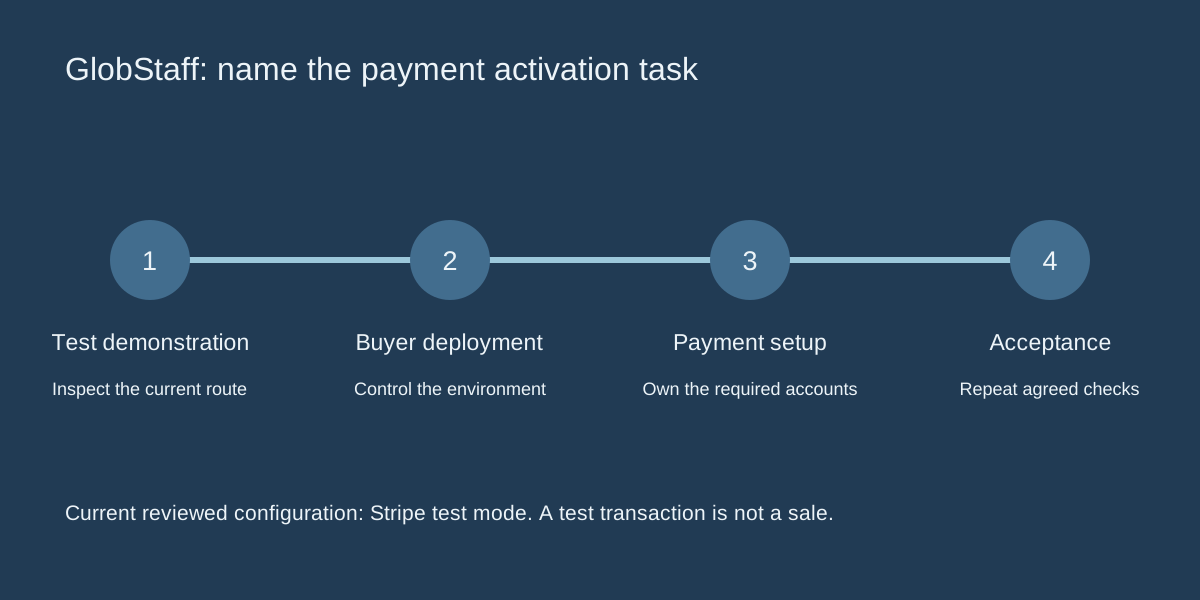
If the deal includes setup help, ask what that help covers. If the buyer will configure payments independently, assign the task to someone with the required access and skills. A clear owner for the task is more useful than a vague assumption that payments will be ready immediately after the domain transfer.
Choose a remote-platform role before you shortlist
GlobStaff is a relevant platform foundation to inspect. Review storefronts, service discovery, bookings and provider plans. Verify the transfer package and decide which launch tasks your team can complete.
Ask for agency evidence before treating any asset as an agency acquisition. GlobStaff's documented offer is a starter marketplace. Client contracts, team commitments and established agency income should not be inferred from that offer.
Keep your system requirements explicit. Applicant tracking and payroll are different purchase requirements from provider storefronts and marketplace bookings. Request a demonstration of every essential function.
If the community role fits, compare GlobStaff with the other SaaS businesses available through Codeblix. Keep the comparison focused on the customer you can reach and the service you can maintain. Shared subscription terminology does not make two products equally suitable for the same owner.
Inspect the owner account as carefully as the public directory
The public product is what providers and customers see. The owner account is where the operator manages branding, prices, users, content and platform bookings. A purchase review should include both. Ask the seller to demonstrate the administrative actions that would be part of your ordinary week.
For a small specialist network, that might mean reviewing a new profile, correcting content, checking a booking state and helping a provider understand an account setting. Ask which actions the current controls support and which require a technical change. Do not assume an administrator can resolve every possible situation through the interface.
Also examine access and ownership. Who will hold the domain account, the repository, hosting access and external service accounts after transfer? How will old access be removed or changed? Which documentation explains routine deployment and maintenance? These questions are part of buying a product you can control after the seller conversation ends.
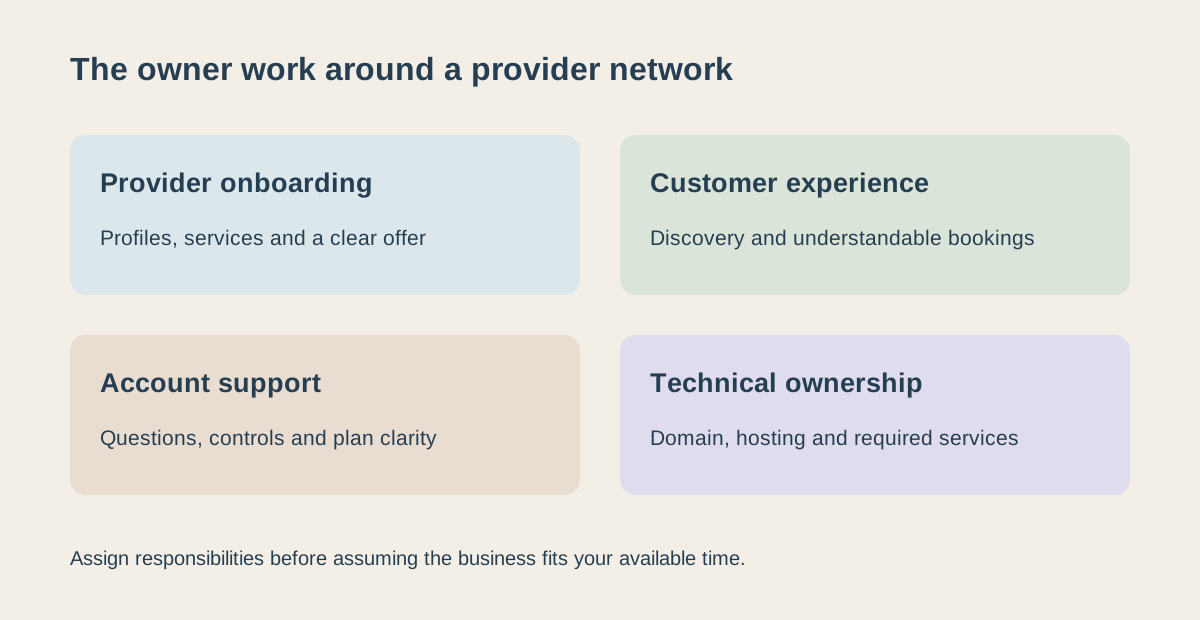
Read the GlobStaff user documentation to follow the product roles, and the technical documentation to understand the application handover. Use those documents to prepare specific questions about deployment, required services and the agreed support scope.
A small network still creates recurring work
A marketplace can be considered as a side project, but it still needs an operator. Providers may need onboarding help. Customers may need clearer service information. Account and booking questions may arrive at inconvenient times. Before buying, decide which tasks you will handle and which require another person.
Write a weekly responsibility sheet without predicting income. Include provider outreach, profile review, customer questions, account support and technical upkeep. Then identify the hours you can reliably offer. If your available time is limited, choose an audience and service promise that fit that limit. Software ownership does not remove the need to keep the marketplace useful.
For a family business project, assign access and spending control deliberately. A parent and adult family members might divide product review, provider research and content maintenance. The buyer responsible for the acquisition should understand the platform's commitments and retain control of the business accounts. Treat learning and ownership as reasons to evaluate the project carefully, not as proof of future earnings.
The same principle applies to a developer buying the asset. Technical ability may reduce dependence on a contractor, but it does not supply a provider community or customers. A buyer with strong commercial contacts may have the opposite gap and need technical support. A sensible offer accounts for the work that remains after the purchase.
Make the included assets and additional work visible
The acquisition discussion should name the domain, application source, documentation and any other agreed deliverables. Ask which materials are sample content and what the buyer should replace. Confirm what rights and transfer steps apply to the included assets. The current Flippa listing and the written transaction agreement should be the reference for that scope.
Separate configuration from new development. Setting up the buyer's service accounts is different from building a new integration. Rebranding a storefront is different from adding a new marketplace role. If a requirement determines whether you can sell the service, resolve it before committing to the asset rather than leaving it as an informal future request.
- Describe the specialist service you want the platform to support.
- Demonstrate the existing provider, customer and owner journeys.
- List every essential configuration task and new feature separately.
- Agree the domain, repository, documentation and support scope.
- Repeat the agreed acceptance journey under buyer control.
Ask for evidence behind any claim about traffic, customers or revenue. A provider directory with demonstration profiles is not a customer base. A configured subscription plan is not a payment history. A professional-looking domain is not proof that demand will arrive. The buyer can still value a starter foundation, but the valuation decision should use the asset and records actually being offered.
Test a specialist offer with a bilingual administration scenario
Suppose a prospective owner knows a small community of bilingual remote administrators and wants to serve businesses that need help in two languages. This is a hypothetical buyer plan, not a claim about GlobStaff's current network. It is useful because it puts the documented language, skills and service presentation features into a recognizable purchase brief.
Write one provider profile for the demonstration. Give the service a clear scope, such as a defined administrative task, and state the languages relevant to the exercise. Ask the seller to show where that information is entered and how it appears publicly. Then use the discovery tools to find the provider from the customer's side.
Now follow a booking request for that service. The customer should be able to understand what is being requested. The provider should be able to recognize the request and its context. Ask how progress and completion are represented, then inspect the completed-job review route. If your intended service needs a specific document exchange or delivery method, ask whether it is implemented rather than assuming that the booking feature covers it.
| Buyer brief detail | Demonstration question | Purchase consequence |
|---|---|---|
| Two relevant service languages | How are languages presented and used in discovery? | Confirm that the current presentation fits the intended audience |
| A defined administration service | Can the provider state the scope clearly? | Identify any additional fields or content work needed |
| A booking that needs clarification | What context is available to the parties and owner? | Record the support process and any missing functionality |
| A completed piece of work | How do progress and completed-job reviews connect? | Use the demonstrated route in the acceptance brief |
This kind of exercise reveals more than asking whether the platform is suitable for remote work in general. It shows whether the particular service you want to sell can be described, found and followed through the existing product. If it can, you have a concrete basis for discussing ownership. If it cannot, the gap can be priced and scoped before you buy.
Compare the base purchase with your required launch package
Some buyers want a code and domain transfer because they can handle the remaining work. Others need help with branding, service configuration or deployment. State your expectation before comparing an offer with another asset. Two asking prices are difficult to assess if one includes defined setup work and the other covers only the product foundation.
Create three columns in your own notes: demonstrated base features, agreed configuration and additional development. Put storefronts and the demonstrated booking route in the first column. Put buyer-owned account settings and agreed branding work in the second when included. Put a new integration or a changed workflow in the third unless the seller proves it is already part of the asset.
Then ask how each included task will be accepted. A configuration task can have a clear completion check. A new feature should have its own scope. A future idea that has not been agreed should not quietly become a condition of the base transfer. These boundaries help the buyer understand both the purchase price and the work still to fund.
The same clarity applies to support. Ask what help is included after handover, how questions are raised and which types of work are outside that support. A buyer with technical experience may need little assistance. A commercial operator may want a defined setup arrangement. Either can be a sensible route when the agreement matches the buyer's actual needs.
Bring a specialist brief to the seller
A useful first message to the seller can be short and specific: you are considering a platform for a named professional niche, you want to review the provider and booking workflows, and you need to understand the current asset package and payment setup. That is enough to begin a focused purchase discussion without sending an unbounded feature wish list.
Attach a small acceptance brief to your own notes. Name one provider, one service description and one test booking. State which owner controls you need to inspect. Add the Stripe test-mode configuration and the buyer's launch responsibilities. If you intend to charge provider subscriptions, ask to see the plan controls that support your proposed offer.
Compare the seller's answers with your actual capacity. Can you maintain the technical setup? Can you explain the service to providers? Can you reach the first customer group? If a gap has an identifiable owner and cost, it can be considered in the acquisition. If the whole plan depends on an unsupported assumption, revise the plan before the offer.
Open GlobStaff's product and documentation page, then review the current Flippa sale to discuss the package with Codeblix. If you are comparing several operating models, return to the online business collection with the same buyer brief. Choose a foundation whose workflow you have inspected and whose commercial role you are ready to take on.
Explore the products discussed
Explore related acquisition offers