
Buy a contractor-panel platform for an existing agency
Acquire GlobStaff for a permitted service roster, with a clear human work promise.
Request GlobStaff for an existing agency contractor panel. Match permitted profiles, provider accounts and service requests without assuming private dispatch or payroll.
Buy GlobStaff's domain and application for an existing service agency's permitted contractor panel. Codeblix offers the software asset through the current GlobStaff Flippa listing. An agency considering a recruitment website for sale should distinguish this purchase from acquiring a staffed company: the offer concerns the digital marketplace foundation, with the included assets and assistance confirmed in the transaction.
This worked purchase case is for an agency that already has relationships with professionals and wants an owned way to present their services and handle customer requests. It does not imply that Codeblix supplies contractors, clients, contracts, employment arrangements or delivery capacity. The buyer brings its own permitted relationships. The acquisition decision is whether GlobStaff's existing provider-led workflow can support the agency's actual customer promise without pretending to be a private roster, applicant-tracking system or payroll product.
Request an agency-specific acquisition scope for the existing application
Request the GlobStaff application and domain package →
Start with the GlobStaff sale page, its current documents and the broad GlobStaff ownership brief. Those describe the individual product offer. Tell Codeblix that your proposed use is an agency's own authorised panel, and ask which current screens, account roles and service records support it. Any private-directory restrictions, allocation controls or new agency permissions you require must be separately demonstrated or scoped.
GlobStaff currently has no AI feature requirement. Its connected Stripe environment is in test mode, so neither the preview nor demonstration bookings establish live charging, payouts or revenue. Keep buyer-owned payment activation in the transaction record. The agency's existing ability to perform work is a separate fact; it does not turn the acquired application's test payment state into a completed live integration.
The purchase starts with a panel the buyer is entitled to present
Imagine a small service agency with several professionals it is entitled to introduce to customers. One fictional professional, Jo, offers business-directory clean-up. A fictional customer wants a public supplier list checked and returned in an agreed format. The agency wants an owned digital channel for that service. These people and the work are purchase examples, not actual GlobStaff providers, customers or completed jobs.
Before assessing the software, the buyer records what it is entitled to publish about Jo and the service. That includes the permitted profile text, service description, image and contact arrangement. An agency's internal spreadsheet is not automatically permission to create public professional storefronts. Ask the relevant people for the authority your intended publication needs, and identify who can approve or withdraw a profile.
The purchase outcome is therefore more specific than building a provider audience. This agency has a panel and must decide how its existing human commitments map to a provider-led marketplace. It may find the delivered workflow suitable. It may discover that it needs new private access or agency-assignment work. Either answer is useful before it purchases the wrong operating model.
Separate panel membership from application account ownership
A person may belong to the agency's permitted panel while owning a provider account in the application. The agency may coordinate customer work while the application records the provider as the service owner. Those relationships should be written down rather than collapsed into a generic staff label.
Ask the seller to show the normal provider account and public storefront. Who edits the professional description? Who publishes a service? What can the platform owner change? GlobStaff documents owner controls for users, branding, content, prices and platform bookings, but those controls should not be treated as proof of any particular agency subaccount or assignment hierarchy.
For Jo's fictional service, the agency should identify the actual person behind each permitted action. If an administrator will help prepare a profile, ask how that is done within the delivered roles. If the agency expects to operate every provider account centrally, make that requirement explicit. Do not assume a shared login or an unimplemented impersonation feature is an acceptable substitute for the ownership arrangement the buyer needs.
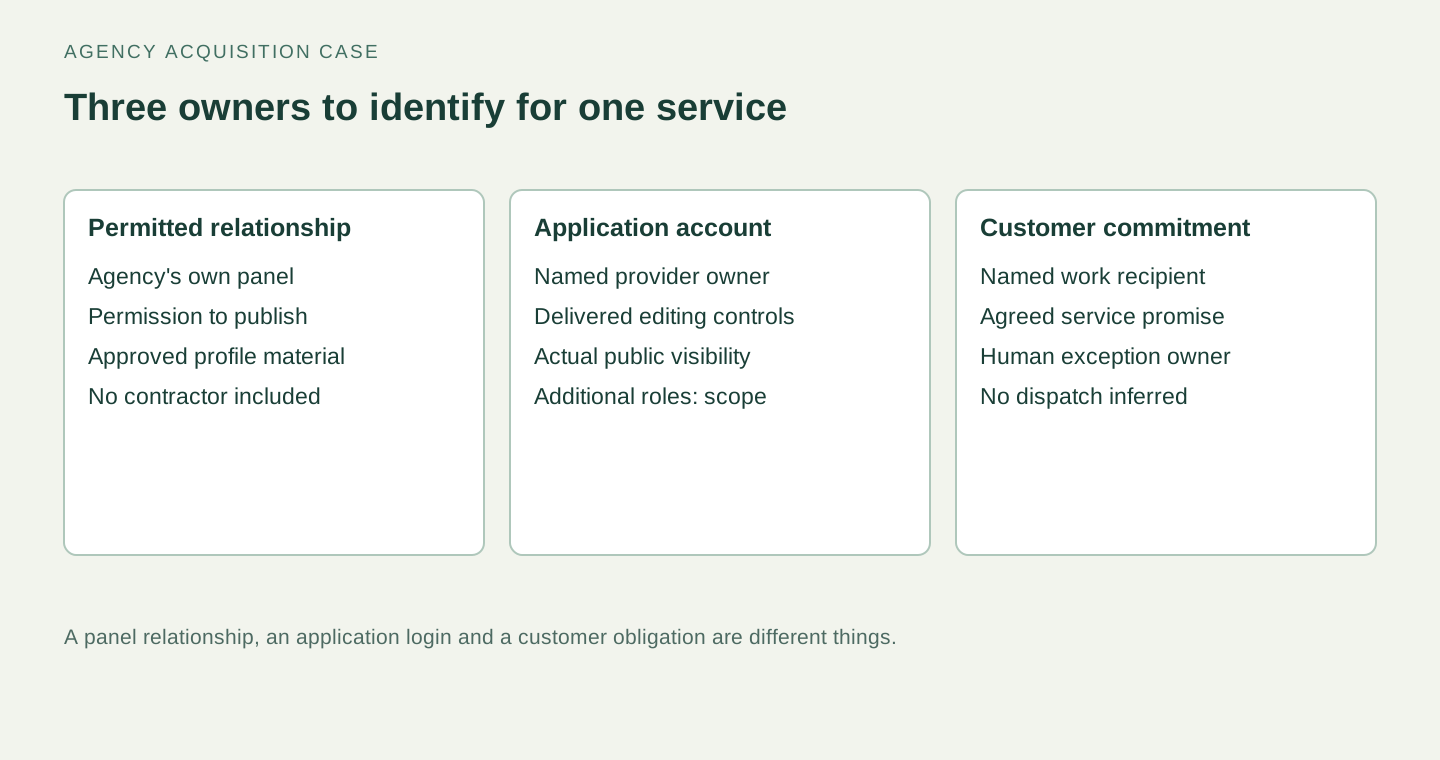
Write one service promise before importing a whole roster
The agency's first acquisition example should contain one understandable service. In the fictional case, the customer supplies a permitted public directory list, Jo checks specified fields, and an agreed result is returned outside any unproved specialist delivery integration. The agency identifies the expected work, the person responsible and the procedure for a question or exception.
Now compare that promise with the current service presentation. Can the relevant information be expressed clearly in the existing provider and service fields? What can the customer see before requesting work? Which details belong in the agency's own agreement or human procedure? A clear boundary is better than implying the application automatically verifies the quality or completeness of the deliverable.
Do not make an acquisition depend on a fictional universal service package. Translation, design, bookkeeping and administration can involve different inputs, responsibilities and specialist requirements. This buyer should begin with a service it already understands and is entitled to offer. Any additional industry controls or delivery integrations should be evaluated separately rather than inferred from the existence of a booking.
Use a roster-authority-to-work-promise schedule
| Responsibility | Fictional service example | Purchase question |
|---|---|---|
| Publication authority | Jo approves the agreed professional and service description. | Which current account controls that published information? |
| Customer promise | The agency explains the directory-checking scope and exceptions. | What is represented in the application, and what remains an external agreement? |
| Work recipient | The named professional receives the permitted request. | Does the current provider workflow match that responsibility? |
| Progress authority | The responsible operator records the supported state. | Who can change it, and what does the customer see? |
| Exception owner | The agency handles an unclear input or unavailable professional. | Which response is a human procedure or separately required feature? |
| Payment readiness | The buyer has not yet accepted live charging. | What buyer-owned configuration and integration evidence remain? |
Keep this schedule with the offer request. It describes the operating relationship the buyer is trying to acquire software for. The seller can answer each question against the existing application, identify a limitation or quote a change. An unanswered row should remain open; it should not become an implied feature in the buyer's customer pitch.
The schedule also helps the agency explain why it wants ownership. Its goal may be control over its permitted service presentation and operating channel, rather than a new subscription product for an unknown professional audience. That is a coherent acquisition reason, but the application must still be accepted at its actual role and account boundaries.
Follow the named professional through the actual request path
Ask the seller to use the fictional professional and service throughout a demonstration. Start from the public discovery view, find the professional through the delivered skills or language tools, inspect the service and create an authorised test request. Then open the provider's view for that same record.
The buyer should observe the information each party receives. A customer who sees a professional's name may expect that person to do the work. An agency that intends to choose a different person later must be clear about that promise and determine whether the application supports the needed allocation behaviour. Do not assume a marketplace owner console includes a private dispatch system.
Use the result to decide whether the current provider-led model is acceptable. The agency may choose to present individual professionals and keep its coordination procedure human. Or it may require a more central agency workflow before purchase. In the latter case, identify the required change and acceptance separately; the current digital asset should not be described as already delivering it.
Keep discovery visibility distinct from a private approved panel
GlobStaff includes professional storefronts and public discovery. That may be exactly what an agency wants for an outward-facing service channel. It may be unsuitable if the buyer expects only selected customers to see a private panel or if different clients must see different professionals. The word approved in the agency's own procedure does not establish those software restrictions.
State the visibility requirement in the offer. Is the professional meant to be publicly discoverable? Does the agency need a private customer route? Must a service be hidden from everyone except a particular account? Ask for the precise delivered behaviour. Private directories, customer-specific access and restricted roster groups should remain additional requirements unless demonstrated in current source and runtime.
In the fictional case, the agency is willing to publish Jo's approved storefront publicly, so public discovery is not a defect. Its main requirement is that the customer promise and work recipient remain clear. Another buyer could reach a different decision. This purchase case is useful because it tests a real visibility choice rather than calling any provider directory an agency portal.
Define what progress means to the customer and the agency
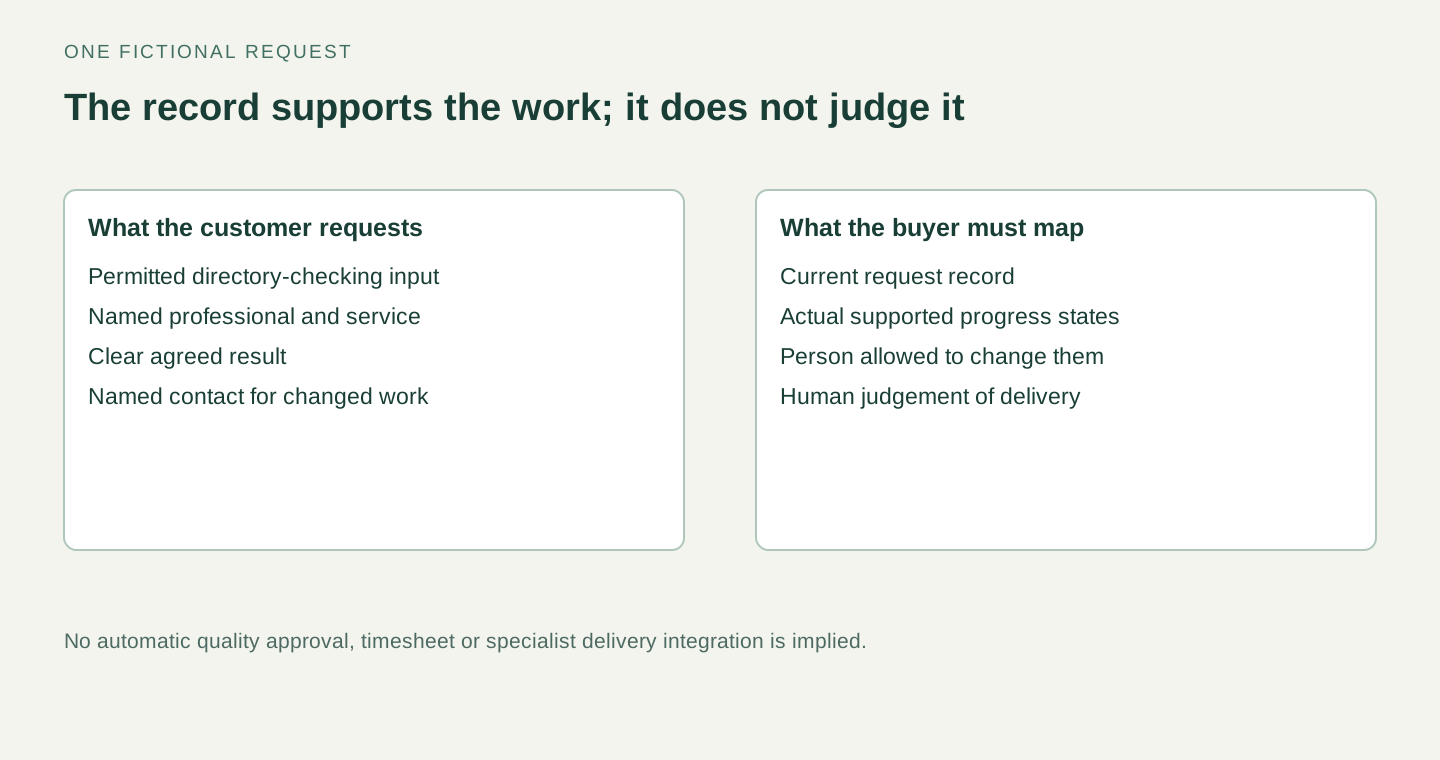
GlobStaff's documented workflow includes bookings, progress and completed-job reviews. A state in that workflow is an application record. The buyer must decide how it relates to the actual work the agency promises. Recording progress does not independently establish that a particular external deliverable meets the customer's agreed standard.
For the directory example, the agency can name the human who decides whether the supplied input is usable and the person who responds when a field is ambiguous. It should then ask the seller which progress states the current application supports and which actors can change them. Use those actual states in customer language rather than inventing an approval stage because the agency would like one.
If the buyer requires file validation, multi-stage quality approval, timesheets or a specialised acceptance checklist inside the application, request those capabilities explicitly. They should not be inferred from a progress label. The agency may choose a documented human procedure instead, but it should understand that operating commitment before buying.
Test the case where the named professional cannot take the request
A permitted panel is still a group of people with changing availability. Bring one exception to the acquisition workshop: Jo is unavailable when the fictional customer requests the service. Ask how the current application represents the request and what the provider or owner can do. Record the demonstrated behaviour without assuming automatic reassignment.
The agency then decides its own customer procedure. It might contact the customer, offer a different permitted professional or decline the work under its agreed terms. Those are operating choices, not current software features claimed here. If the business depends on automatically rotating jobs among contractors, that is a separate requirement to demonstrate and scope.
This exception exposes the primary buying outcome. The agency is not merely purchasing a directory of names; it is buying software that must fit an existing human service commitment. If the current request model is incompatible with that commitment, the buyer should hold the offer discussion until the mismatch is resolved rather than import the whole panel and discover it after launch.
Make a changed customer brief a deliberate agency decision
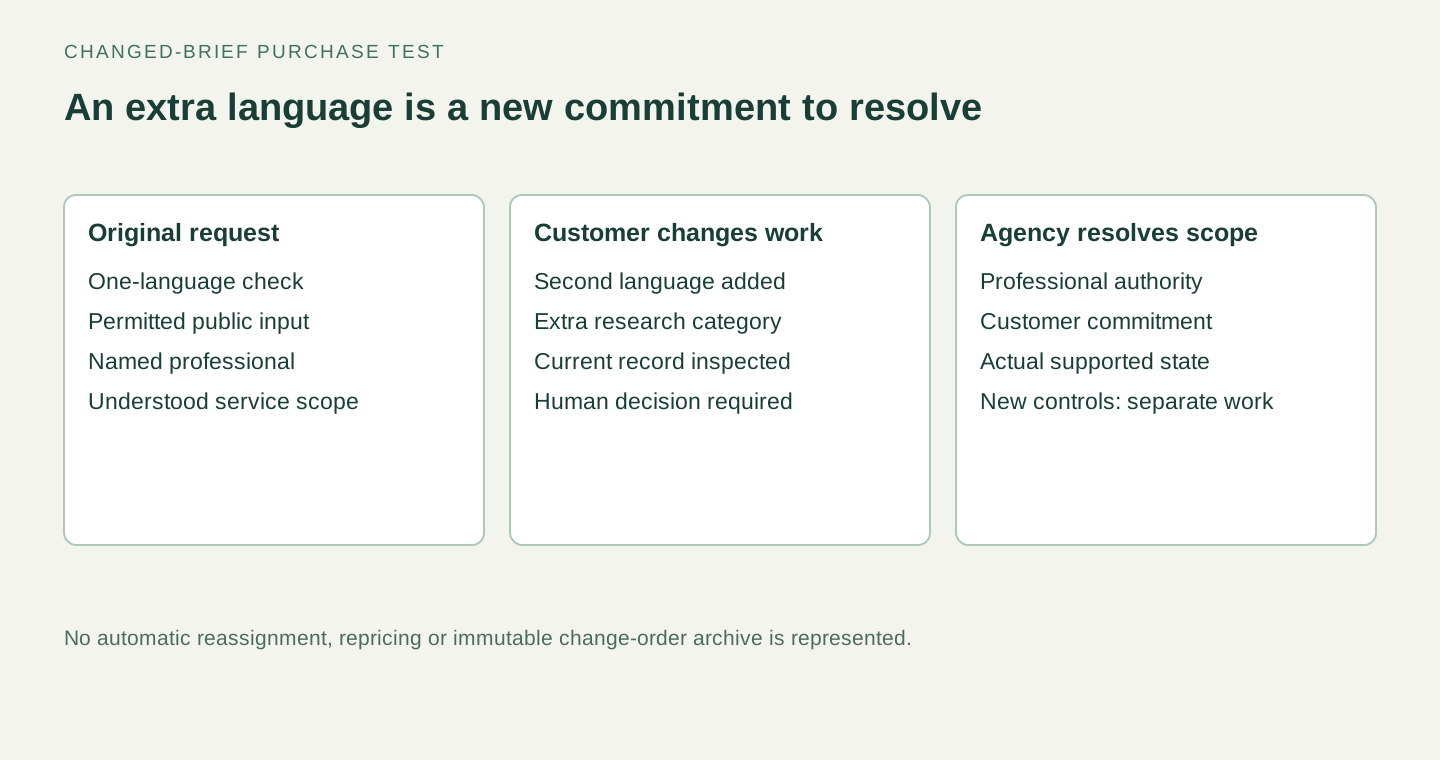
Extend the fictional request once. The customer initially asks Jo to check a public directory in one language, then asks for a second-language result and an additional category of research. That may be reasonable new work, but it is not automatically the service the professional accepted. The agency needs a person who can explain the change to both parties and agree what happens next.
Ask the seller where the current application preserves the request information and which supported actions the parties can take. Do not assume it has a formal change-order document, automatic repricing or an immutable archive of every earlier brief. If those capabilities are essential, request evidence or a separate scope. Otherwise, document the human procedure and the permitted place where the agency will retain the agreed work description.
Then add the changed request to the authority-to-work schedule. Who is entitled to accept it for the professional? Who explains any changed commitment to the customer? Which application status should remain unchanged until the human decision is made? The buyer should use the actual delivered state model rather than label the work accepted merely because someone received a message outside the application.
This is especially relevant when the agency represents several professionals. A skill or language field can help discovery, but it is not a promise that every person on the panel can complete every expanded request. An agency's existing knowledge of its panel may make the human decision easier. It still needs to confirm that the public description and the individual service promise remain accurate.
Include this amended-brief example in the purchase walkthrough. If the supported application and a clear agency procedure can explain it, the buyer has a concrete operating model. If the model depends on an unbuilt assignment or approval feature, keep the acquisition decision open until that requirement is resolved. The digital asset should support the service the agency is actually prepared to sell.
Do not confuse provider plans with the agency's own service income
GlobStaff's intended platform model includes provider subscriptions, alongside service-booking and payment foundations. An existing agency may have a different commercial relationship with its professionals and customers. Buying the application does not decide whether the agency will charge its panel for software access, retain the current plan configuration or request a change.
Ask which existing plan and publication conditions apply to provider accounts. The current handover material records paid-plan publication checks. If the agency's intended model requires a different entitlement, identify it as an explicit configuration or development question. Do not bypass a current gate casually and then claim the product's subscription lifecycle has been accepted unchanged.
Likewise, the agency's revenue from work it performs is separate from represented revenue in the software asset sale. No current customer income, contractor earnings or live booking turnover is established by the demonstration. Confirm the financial representation through the current listing, and keep the agency's own future service arrangements out of the acquired asset's historical claims.
Accept live payment readiness as its own named commitment
The reviewed connected Stripe environment is in test mode. The agency should know this at the start of the acquisition discussion, then keep the required buyer-owned payment work visible. A test booking can help inspect the software without proving a real card charge, provider payout, refund or paid renewal.
GlobStaff's handover documents distinguish automated checks from real payment and banking integration evidence. Ask which accounts must be transferred or recreated, who owns the merchant relationship and which agreed checks remain before live use. Do not put credentials in the roster schedule or public sale conversation. The schedule needs responsible owners and evidence locations, not secret values.
The agency should also understand the limits of the current payment product. The handover material excludes escrow, a wallet and automatic refunds. A service agency may have its own customer resolution procedure, but that does not create a payment feature in the application. Confirm any required additional process or implementation before representing it in a customer offer.
Preserve a controlled route when a professional leaves the panel
The buyer's relationship with a professional can change after the acquisition. Its operating record should identify who can request a profile change, who acts on that request and what happens to open customer work. Ask the seller to demonstrate the actual owner and provider controls relevant to the case; do not infer a specialised offboarding system.
For the fictional panel, consider Jo withdrawing permission for a future public offer while a previously accepted request still needs a response. Separate those two matters. The agency must handle its real service commitment, and the application may have particular supported controls for profile, user or booking records. The purchase question is whether those controls and the buyer's human procedure fit together.
Keep historical demo records separate from this exercise. Sample professionals and reviews are not transferable panel relationships or evidence of genuine agency work. The buyer should use artificial test material and its own permitted live information only after it has agreed the setup, access and operating procedure it intends to use.
Purchase a channel your agency can explain without hidden dispatch work
Before making an offer, have the agency owner describe the fictional service from a customer's point of view. Who is being chosen, what work is requested, who sees it and who responds when something changes? Then have the technical owner describe which part is delivered software and which part is a human agency procedure.
If the two accounts disagree, correct the purchase brief. A provider storefront can be a useful agency channel without becoming an ATS or a workforce management system. A manually coordinated exception can be acceptable without being described as automated dispatch. The buyer should acquire a product it can present honestly and operate consistently.
Request the exact source, domain, documentation and agreed assistance through the individual GlobStaff offer. Confirm any required custom work separately. The agency's panel remains its own relationship asset; the software acquisition is the decision to own a particular digital channel for that panel's permitted service promise.
Complete the permitted-panel acquisition record
- Choose one permitted professional and an understandable service rather than importing the whole panel first.
- Ask Codeblix to demonstrate that service through the existing customer and provider views.
- Record mismatches between the delivered model and the agency's actual authority or customer promise.
- Agree the individual asset transfer and any additional work before presenting the new channel as ready.
Contact Codeblix on the GlobStaff Flippa listing with the completed authority-to-work schedule. A specific existing-panel purchase request gives the seller something concrete to demonstrate and the buyer a clear basis for deciding whether to acquire this application.
Explore the products discussed
Explore related acquisition offers