
Account planning software that connects customer goals to action
Account planning software brings customer objectives, stakeholder knowledge, existing business and expansion opportunities into one coordinated plan. Codeblix develops custom account planning applications for teams whose customer structure, evidence rules and review process need a dedicated workspace. Connect each growth idea to a customer outcome, an accountable next action and a decision your team can explain.
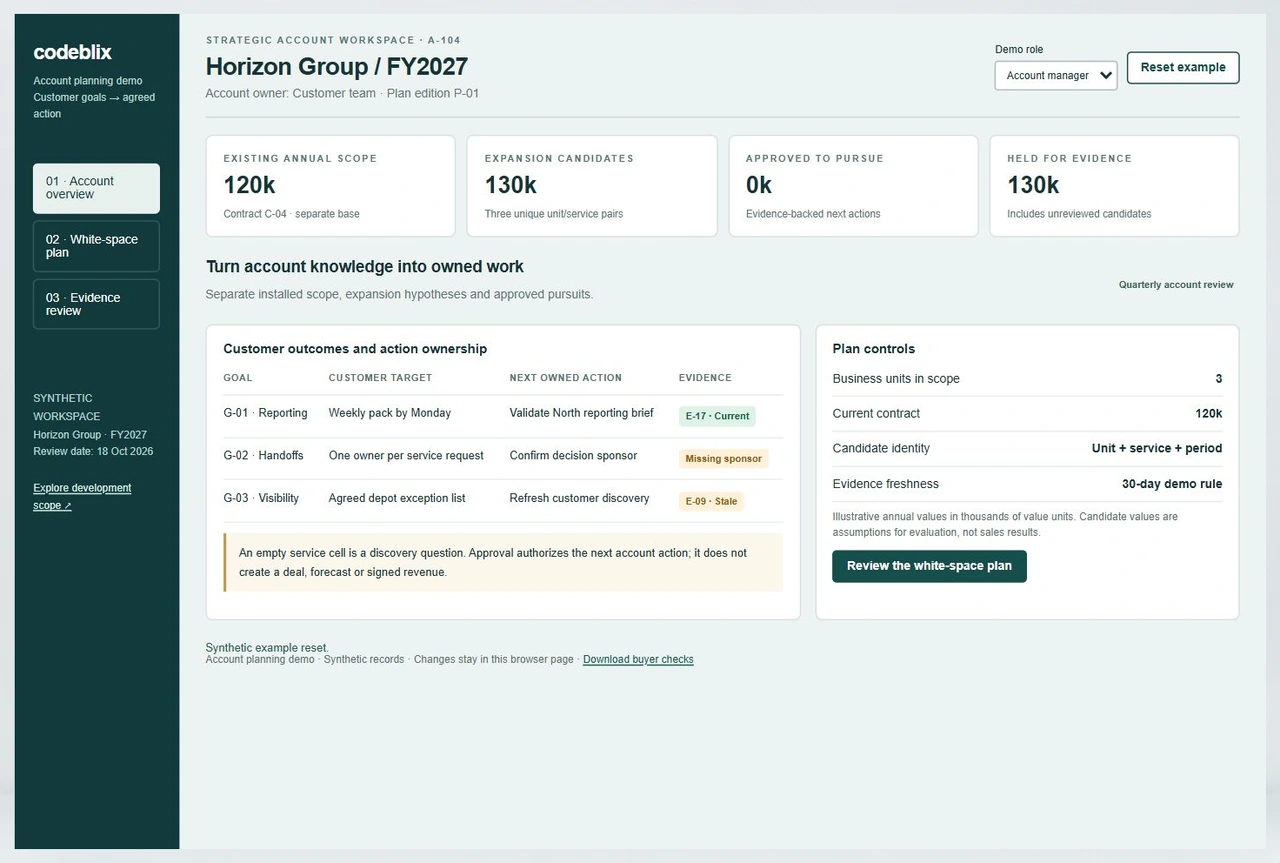
Make the growth plan useful between review meetings.
An account plan becomes operational when the team knows which customer outcome matters, what supports the opportunity and who will act next.
Lead with the customer's objective
Record the customer's stated outcome, the business unit it affects and the evidence behind it. Distinguish a confirmed priority from a seller's assumption. A target such as an agreed weekly reporting pack gives the next discovery conversation a clearer purpose than a generic account growth percentage.
Give white space a qualification path
White space is an unexplored or underserved combination of business unit and offering. An empty matrix cell starts a question; it earns an opportunity value only after discovery provides a credible basis. Keep installed scope, expansion hypotheses and approved pursuits in separate totals.
Tie review decisions to owned actions
For each candidate, name the action owner, next customer interaction, supporting evidence and review date. Return missing sponsor information or outdated assumptions to discovery. Preserve the decision history when the account team revises its plan.
Follow one growth idea through the account plan.
The account planning demo uses Horizon Group, three business units and three service categories. Start with the customer goals, inspect an expansion candidate, then review the evidence supporting its next action.
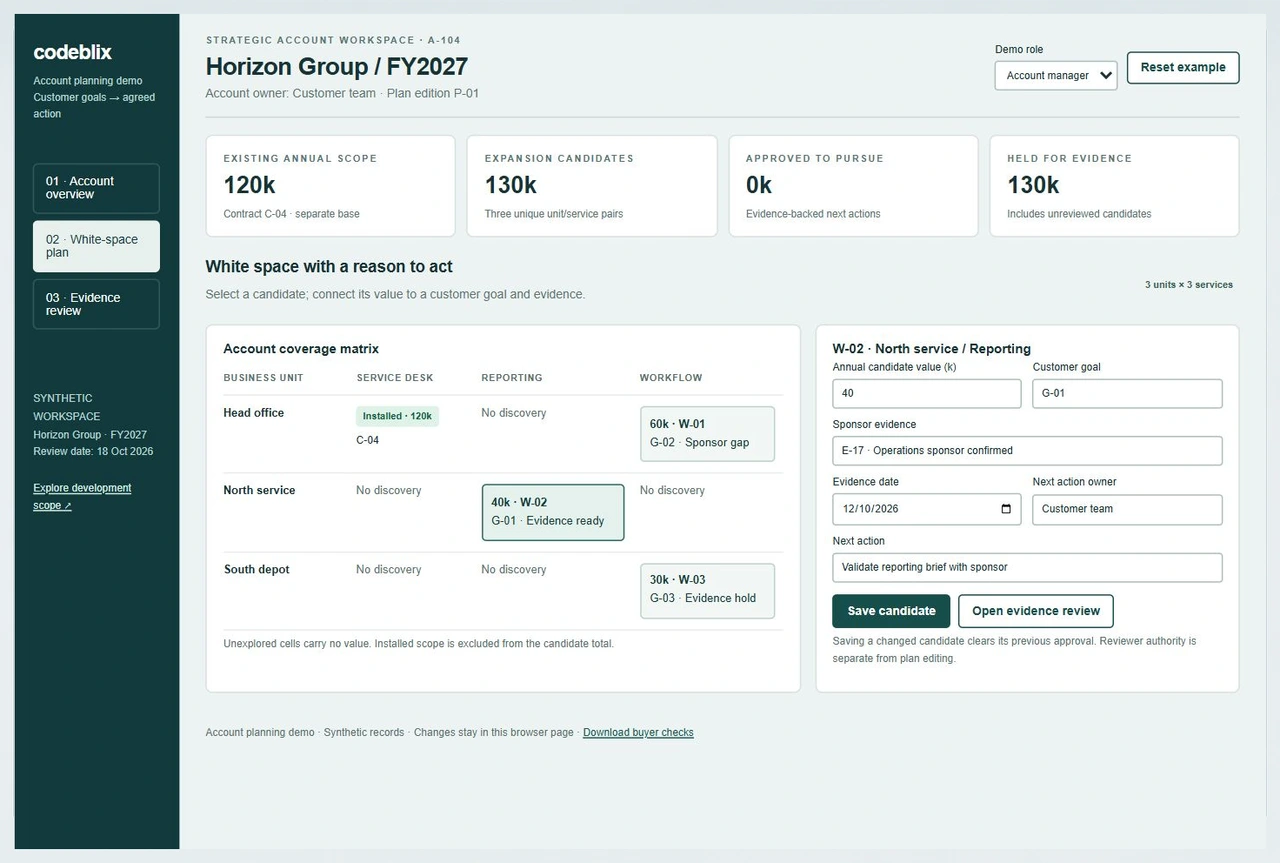
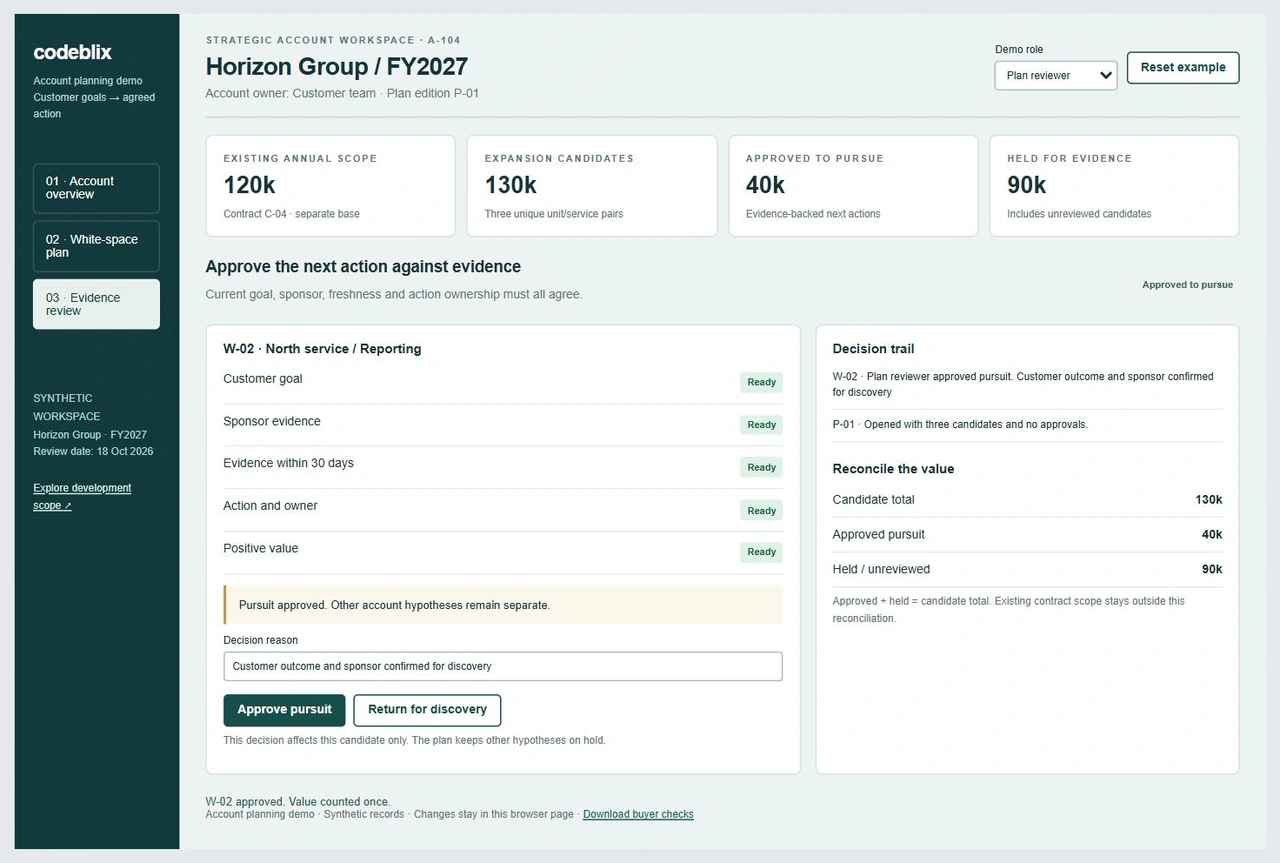
Try the North reporting pursuit
Open the white-space plan and inspect W-02 for North service. Attempt approval as Account manager, then switch to Plan reviewer. Approve the evidence-backed 40k candidate and compare the approved and held totals. Select W-01 or W-03 to see why missing sponsor information and stale evidence stop approval.
Try the account planning demoKeep the account plan connected to forecast review
An approved account action and a submitted period forecast answer different questions. When discovery creates an opportunity, preserve its account-plan reference while the forecast team applies its own stage, amount, close-date and period rules.
Compare sales forecasting requirementsSeparate customer growth from territory responsibility
Territory planning decides which team covers an account. Account planning then organizes the customer objectives and expansion work inside that relationship. Share account identities and responsible teams without allowing a territory reassignment to erase the growth plan's earlier decisions.
Explore territory ownership planningFrom customer context to a reviewed account action
Use a repeatable planning cycle for strategic customers with several business units, buying groups or service lines.
Define the customer and planning scope
Link the account, parent group, operating units and planning period using stable identifiers. Agree which existing contracts, opportunities and customer teams belong in the review. Record the currency and value period before comparing commercial amounts.
Capture customer outcomes and relationships
Document customer goals, their source and the stakeholder roles involved. Record whether a sponsor is confirmed, which decision role remains unknown and when the information was checked. Keep sensitive contact details behind the appropriate permissions.
Map installed scope and discovery gaps
Place the current offerings against the customer's business units. Reference the contract or source record behind an installed cell. Add discovery candidates with their own identity so the same unit, service and period cannot silently appear twice.
Qualify the expansion candidate
Connect its value assumption to a customer goal, sponsor evidence and a concrete next action. Check evidence freshness, owner availability and any conflicting source information. Keep unsupported candidates visible as discovery work instead of presenting every gap as an active deal.
Review the pursuit decision
Give the authorized reviewer the candidate edition, evidence and decision reason. Approve the next action or return it with a named follow-up. Recheck a changed scope or value rather than carrying an earlier approval into a different commercial assumption.
Reconcile execution at the next account review
Follow the assigned action, customer response and resulting opportunity record. Agree any CRM handoff and reconcile accepted updates. At the next review, retain prior decisions, refresh the customer evidence and retire assumptions that no longer describe the account.
Account-team permissions and customer sharing
- Account managers maintain customer context and draft growth candidates. Specialists contribute to assigned actions. Plan reviewers authorize pursuits within their remit. Administrators maintain account-team access, templates and evidence policies.
- Define parent-account visibility, unit-level restrictions and export permissions. A customer-facing review pack needs its own approved fields; internal relationship assessments and commercial assumptions should not flow into it automatically.
- Keep editing authority distinct from review authority. Record the relevant candidate version, reviewer and reason. Scope application authentication, server-side authorization and audit retention as explicit acceptance requirements; the browser demo illustrates the review workflow using selectable roles.
Imports, CRM boundaries and data ownership
- Bring an anonymized customer hierarchy, service catalogue, installed-scope file, sample plan and one disputed expansion idea. Reconcile duplicate accounts, renamed units and contract periods before migrating plan history.
- For each CRM interface, specify object IDs, field ownership, read/write direction, access scopes, update timing and retry identity. Decide whether the account plan references an opportunity or creates one after approval. Validate that behavior against the chosen CRM and its available API.
- Preserve the source and checked date of customer evidence. Agree retention, deletion, customer consent and access requirements for relationship information. External enrichment, document extraction and AI suggestions require separately agreed data sources and review controls.
Pilot scope, quotation and ongoing ownership
- Pilot a small account portfolio through one review cycle. Test an incomplete sponsor record, a changed business unit, a stale discovery note and an edited approved candidate. Reconcile installed and expansion values before adding portfolio reporting.
- The quotation should identify account counts, unit hierarchy depth, template variants, users, evidence attachments, reports, CRM interfaces and historical imports. Price hosting, training, support and any third-party licensing as identifiable parts of the project.
- Agree backups, restoration checks, monitoring, support hours and responsibility for failed imports or handoffs. Keep a dated account-plan export and a reconciliation route so teams can recover useful context during a system change.
Six connected records for a useful account growth plan
Use this original record model and worked example to compare a specialist planning product, a CRM extension or a custom Codeblix application.
| Record | Example inputs | Required output and control |
|---|---|---|
| Account and planning scope | Customer A-104, parent group, three business units, FY2027, account team and value basis | Keep stable unit identities; reconcile reorganizations and avoid counting a subsidiary twice. |
| Customer outcome | Goal ID, affected unit, stated target, source, checked date and confirmation state | Separate the customer's confirmed priority from an internal growth assumption. |
| Stakeholder evidence | Decision role, sponsor status, evidence reference, source date and permitted readers | Show missing or stale knowledge without inventing influence or authority. |
| Installed coverage | Unit, offering, contract/source ID, active period and existing annual scope | Keep the 120k contracted base outside the expansion candidate total. |
| Expansion candidate | W-01/W-02/W-03, unit, service, period, value assumption, customer goal and evidence | Use a unique unit/service/period identity and requalify material changes. |
| Action and review decision | Candidate edition, owner, next action, reviewer, decision reason and follow-up | Count an approved pursuit once; an edit clears approval and returns the value for review. |
The synthetic Horizon Group plan has an existing Head office service-desk contract of 120k value units. Three expansion candidates are kept separate: Head office workflow W-01 at 60k, North reporting W-02 at 40k and South workflow W-03 at 30k. Their total is 130k, not 250k. W-01 lacks sponsor evidence. W-03 cites a 20 August discovery note, outside this example's 30-day freshness rule on 18 October. W-02 has goal G-01, sponsor reference E-17 dated 12 October and an owned discovery action. A Plan reviewer approves that 40k pursuit, leaving 90k held: 40 + 90 = 130. Repeating approval changes neither value nor decision count. Editing W-02 to 45k clears its approval and makes the new candidate total 135k, all held until review. These annual value units support a reproducible planning exercise; approval is permission to pursue the next action, rather than booked business or forecast probability. Your team chooses its own evidence criteria and real commercial value basis.
Ask each provider to explain the same growth candidate
These primary references describe current account planning approaches. Use the Horizon example to ask how evidence, account structure and review decisions work in your setting.
| Option | Published focus | Ask in your demo |
|---|---|---|
| Altify Accounts | Salesforce-native account planning, whitespace opportunities, relationship insight and collaborative reviews. | Show how a changed customer goal affects an already reviewed pursuit and its linked Salesforce records. |
| Kapta | Customer goals, ownable actions, account-plan collaboration, deliverables and tailored reporting. | Demonstrate which fields enter a customer review pack and how internal sponsor assumptions remain restricted. |
| DemandFarm | White-space growth plans, relationship maps, opportunity planning and in-application account reviews. | Trace one unit/service candidate through discovery, evidence refresh and a changed value without counting it twice. |
A CRM extension can fit when the account hierarchy and review policy already match its objects. A specialist planning application may suit a shared account methodology. Discuss custom development when your business-unit model, evidence decisions or cross-system handoffs require tailored behavior. Compare configuration effort, adoption, licensing, data preparation and support. The questions above identify behavior to verify; they do not assert that a named vendor lacks it.
Category reference: Kapta: customer goals and account planning actions. Primary product references accessed 18 October 2026. The Horizon record model, candidate arithmetic, working demonstration and acceptance checklist are original Codeblix buyer resources.
Connect account strategy with the rest of your sales operation.
Use shared customer identities while keeping account objectives, territorial responsibility and period sales estimates clear.
Explore professional-services softwareQuestions before choosing an account planning application
Agree the account structure and review decisions before choosing the workspace.
What is account planning software used for?
It coordinates customer objectives, relationship knowledge, current business and growth actions for selected accounts. Teams use it to maintain a shared account plan, evaluate expansion candidates and prepare useful reviews. The important output is an evidence-backed next action with a responsible owner.
Can Codeblix build a custom strategic account planning application?
Yes. Codeblix can scope and develop an application around your account hierarchy, service matrix, evidence policy and review roles. Start with an anonymized plan and one difficult account decision. The scope can identify the required screens, imports, permissions, interfaces and acceptance checks.
How does account planning differ from ordinary CRM pipeline tracking?
Pipeline tracking follows individual opportunities through sales stages. Account planning coordinates the wider customer relationship, including goals, business units, installed services and work that is still in discovery. Link the two through stable account and opportunity IDs while retaining their different decision rules.
Does every empty white-space cell represent revenue?
An empty cell indicates that coverage or discovery needs investigation. Record whether the customer has a relevant need, who sponsors it and what supports a value estimate. Keep cells with no discovery unvalued, and keep early candidates separate from approved pursuits, forecasts and contracts.
How should teams handle outdated sponsor or customer information?
Store a source and checked date, then apply the freshness and confirmation policy agreed for your account process. Route stale or conflicting evidence to its owner for validation. The demo uses a 30-day rule to make that decision visible; your organization determines the appropriate criteria.
Can an approved pursuit be changed?
A changed value, customer objective or service scope can alter the basis of the decision. Preserve the earlier edition and return the changed candidate for review. The demonstration clears approval after an edit and recalculates the held total so an older decision cannot authorize different assumptions.
Can we begin with account-plan spreadsheets?
A file-based pilot can establish account identities, coverage, candidate keys and the review output. Define import templates, reject duplicate records and reconcile totals with the source file. A CRM connection can then be specified around confirmed objects, permissions, timing and failure handling.
What determines the cost and implementation scope?
Key factors include account and unit counts, template variation, roles, evidence storage, historical data, reporting and CRM interfaces. Hosting, training and support also affect the project. Share representative plan files and expected usage so Codeblix can quote the pilot and later expansion separately.