
Commission a result you can reconcile.
Use a representative application report to connect monthly programming work to a concrete acceptance outcome.
Agree what the final day includes
A through-day filter must account for records later that day. Define the application clock and its lower and upper boundaries so the receiving owner can distinguish a valid late record from the first record on the next day.
Match the total to identifiable records
Receive the selected dispatch IDs alongside carton and value totals. The CF71 exercise includes two Ready records, five cartons and USD 145.00, while explaining why four other source records remain outside the report.
Carry the criteria into the handoff
Keep a record of the reviewed date window and status with the export. A changed filter should require a new review, giving the monthly backlog owner a repeatable way to accept each reporting increment.
Receive the rows behind the total.
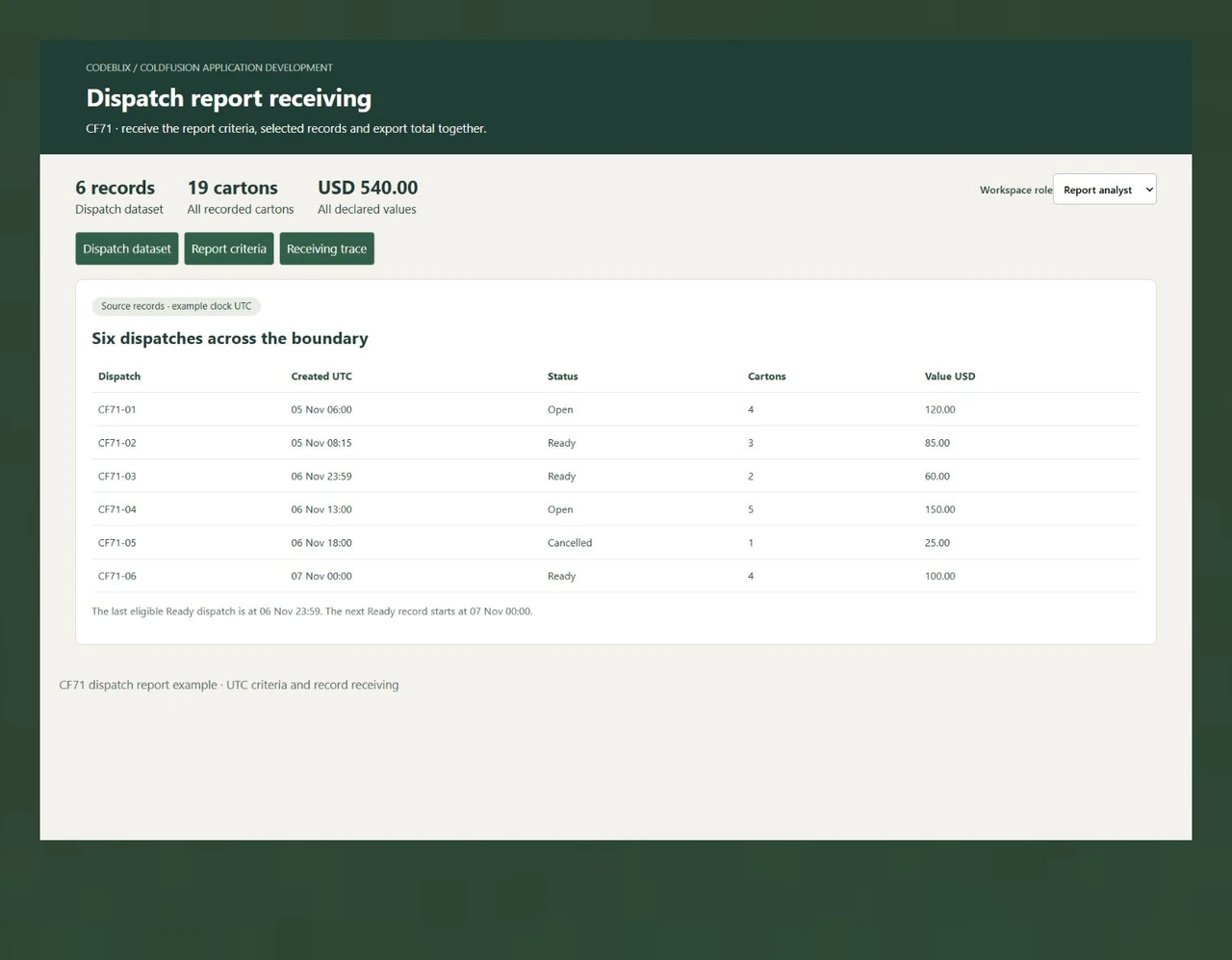
The CF71 workspace makes a two-day Ready report inspectable, from its date boundaries to the six-record receiving trace.
Inspect the receiving example.
Use CF71 and current Adobe references to describe the output your application team needs.
Run the complete-day report exercise
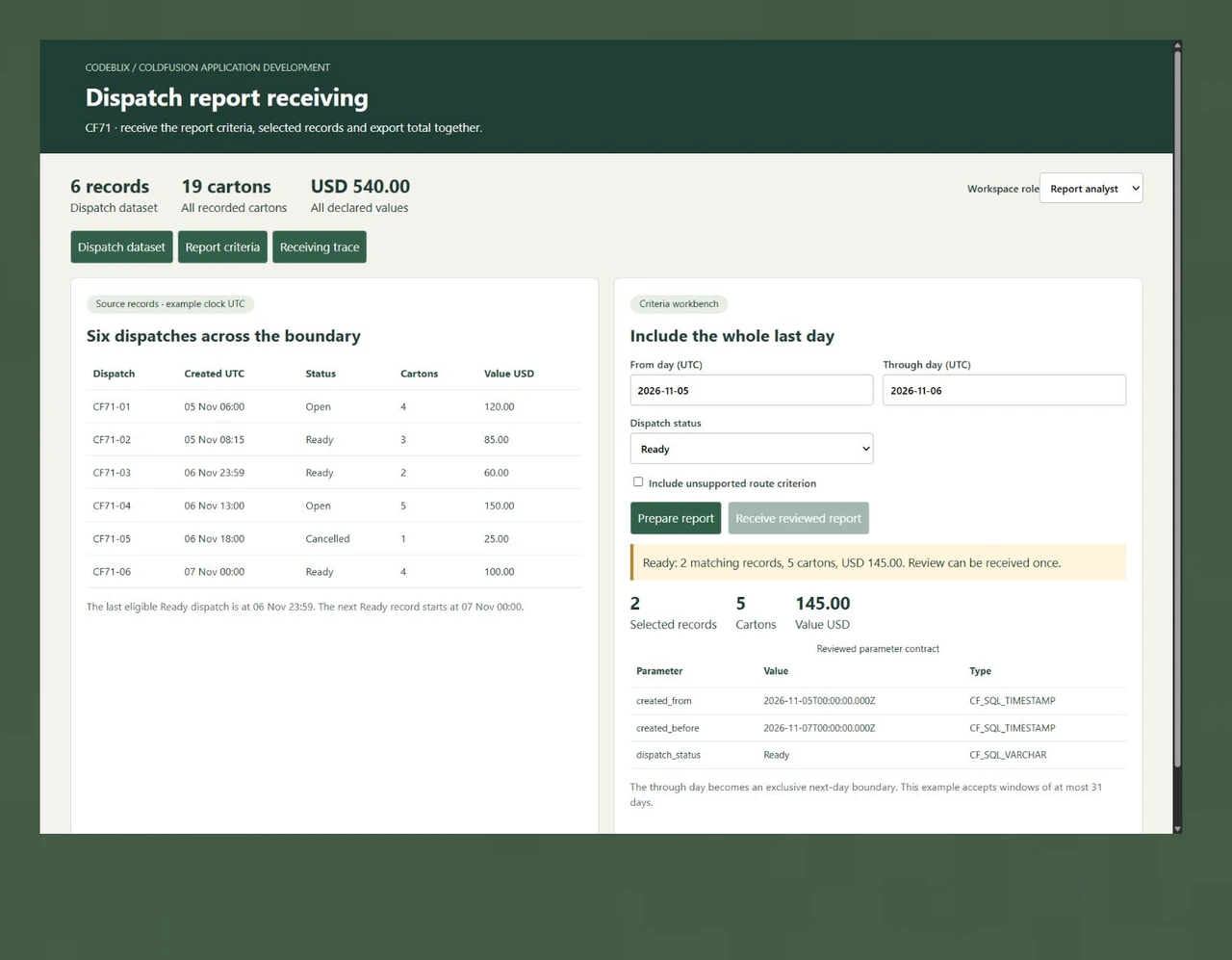
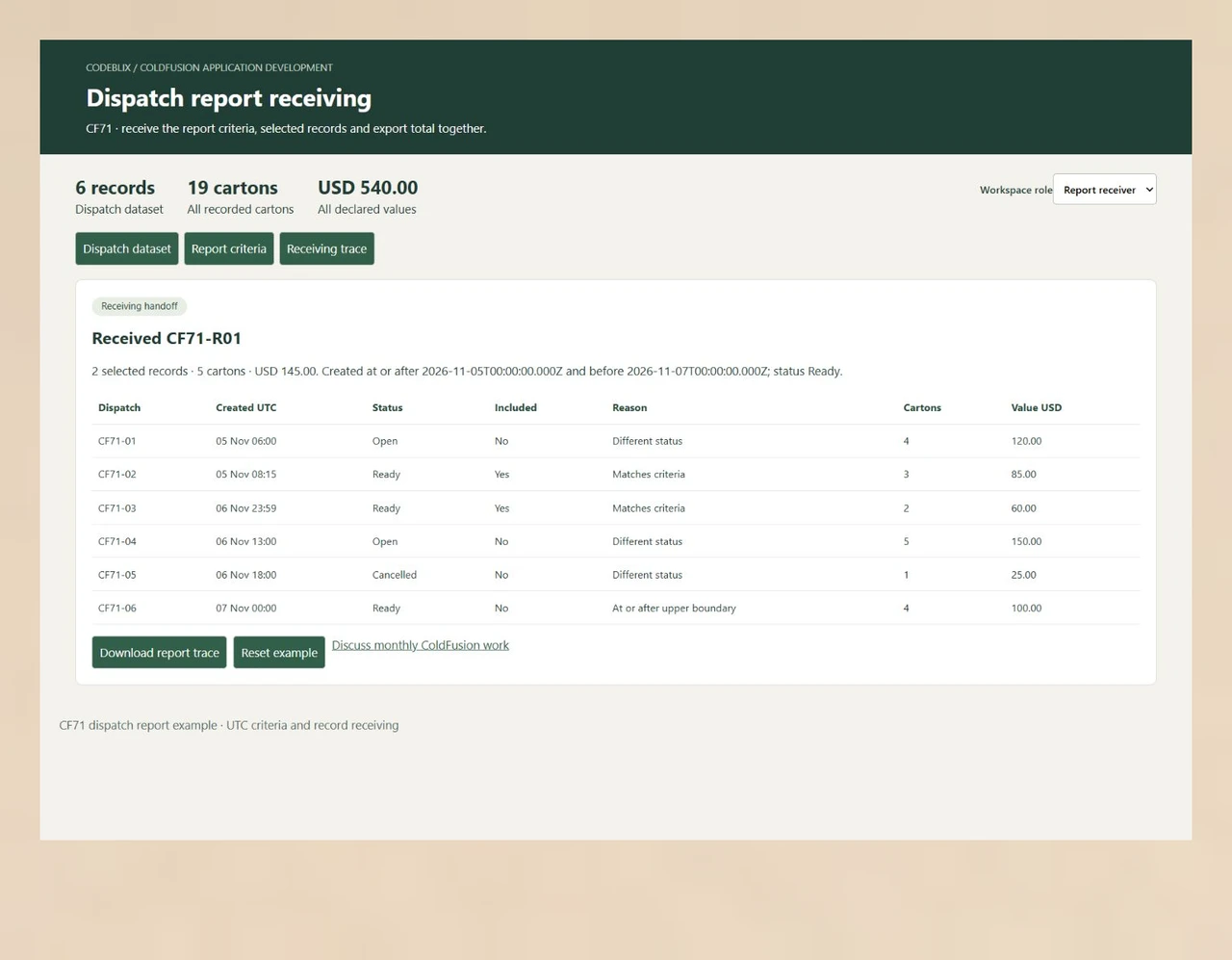
Open Report criteria and prepare the default Ready window for 5–6 November. It includes CF71-02 and CF71-03, including the record at 23:59 on the final day. Switch to Report receiver, receive once and inspect the six-record trace; the 00:00 record on7 November is excluded.
Open the CF71 report-receiving demoDefine parameter types in the implementation
Adobe documents cfqueryparam as a way to validate query-parameter types and use bind variables where supported by the database. Agree the actual timestamp and status parameters with the developer, and receive their behaviour against your application data source.
Adobe cfqueryparam reference — updated 18 May 2026Receive query results and metadata
Adobe’s cfquery reference describes passing a query to a data source and result information including record count, parameter values and cached state. Request the relevant receiving evidence for the deployed version and the report’s agreed cache policy.
Adobe cfquery reference — updated 18 May 2026Include the source-data responsibility
Define which stored records, allowed statuses and downstream exports belong to the development task. Bring the data owner into decisions about inconsistent timestamps or status values so the received report has an agreed interpretation.
Plan the supporting database application workSet the monthly development brief.
Use the first application task to settle the branch, data boundary and receiving responsibilities.
Identify the ColdFusion environment
Provide the actual CFML engine and version, application framework, database driver and deployment arrangement. Identify the repository and staging owners. Explain whether the request maintains the current application, changes its runtime or includes a defined integration.
Choose the first observable output
Select one report, request handler or screen that belongs in the initial allocation. Supply sanitized input records and the expected response. Name the business owner who will inspect the output and the developer-facing conditions for receiving it.
Specify the report contract
For a date-window report, define its clock, allowed statuses and boundary convention. List the parameters and their types, output fields and expected totals. Include records immediately before and after the boundary, together with status exclusions.
Develop and reconcile one increment
Receive the application request, returned rows and downloadable output together. Inspect a valid report, invalid criteria and a valid empty result. Compare record identities and totals rather than accepting a completed screen or success message alone.
Receive the dependent behaviour
Check the consumers, scheduled tasks and exports affected by the change. Include actual database permissions, parameter handling and query-result metadata where they belong in the scope. Agree any legacy-data correction before changing the reporting interpretation.
Confirm the ongoing allocation
Prioritize the next work after receiving the initial result. Confirm the available monthly capacity, commercial terms and collaboration window with Codeblix. Assign source handover, deployment, rollback and defect handling to named owners in the engagement.
Describe the application work
- Share the engine, runtime version, CFML framework, dependencies and database connection requirements without sending credentials. Identify the modules and request paths involved, the current source-control arrangement and a representative staging dataset.
- Separate application development from engine licensing, infrastructure administration and ongoing hosting operations. State which parties supply each prerequisite and whether the work includes upgrades, scheduled jobs, API endpoints, report exports or an editing interface.
- For reporting work, give the developer the meaning of each input and output column. Specify the reporting clock, allowed status values, expected record IDs and treatment of empty results. Include a last-day record and a next-day record in the receiving sample.
- Discuss the monthly work queue, priority owner and capacity for accepting increments. Ask Codeblix to confirm the requested allocation and commercial terms. Define the review cadence and how additional requirements affect the planned work.
Agree the receiving handoff
- Exercise the commissioned query through the actual CFML request path and database driver. Receive invalid input handling, authorized access and denied requests, with an identified owner for reviewing application and data-source permissions.
- Compare the report’s returned IDs, record count and totals with its export. Confirm that an empty result is communicated clearly and that changing a prepared filter cannot reuse an earlier review. Include the expected query-cache behaviour where caching is in scope.
- Before correcting legacy timestamps or status codes, produce an inventory and obtain the data owner’s interpretation. Reconcile affected reports and scheduled outputs after a representative conversion, with the previous interpretation available for comparison.
- Require the changed source, environment prerequisites and completed receiving record at handover. Agree who deploys, who decides rollback, how defects are reported and which support arrangement applies after the monthly development period.
Six records in a report handoff
CF71 connects a source set, a reviewed window and a selected status to a reproducible receiving trace.
| Record | Example inputs | Required output and control |
|---|---|---|
| Source dispatch | CF71-01 through CF71-06 | Keep stable record IDs and distinguish source-set totals from selected-report totals. |
| Created timestamp | 06Nov 23:59 included;07Nov 00:00 excluded | Use the reviewed clock and receive the two adjacent boundary records. |
| Report window | From 5Nov 00:00; before 7Nov 00:00 UTC | Include the whole through day using an explicit next-day upper boundary. |
| Status criterion | Ready; allowed Open and Cancelled | Hold an unmapped value and document status-based exclusions. |
| Receiving review | Report analyst / Report receiver | Require a new review after criteria change and receive an eligible review once. |
| Inclusion trace | Six rows; two selected; five cartons; USD 145.00 | Export each source record with its included flag and exclusion reason. |
The six source dispatches contain 19 cartons and USD 540.00 in total. Prepare Ready records from 5 November through 6 November using the example UTC clock. CF71-02 contributes three cartons and USD 85.00; CF71-03 at 6 November 23:59 contributes two and USD 60.00. CF71-06 at 7 November 00:00 falls outside the upper boundary, while three other records have a different status. The Report receiver accepts the reviewed result once and downloads all six trace rows, with two included flags and a selected total of USD 145.00.
Request the same received report.
Give prospective providers the same sample records, criteria and acceptance responsibilities when discussing the development allocation.
| Option | Published focus | Ask in your demo |
|---|---|---|
| iSummation | CFML engineer enquiries with monthly rolling engagements, maintenance and migration discussions. | What first application increment and receiving record will establish the monthly working arrangement? |
| Evalogical | ColdFusion developer enquiries with full-time, part-time and ad-hoc engagement options. | How will the developer and receiving owner reconcile the report criteria, records and export? |
| Code District | ColdFusion application, database and API development enquiries with monthly or project engagement discussions. | Which runtime, database and dependent-output checks belong to the initial allocation? |
Use the returned records and trace to establish a shared receiving standard. Confirm the actual application branch, allocation and source responsibilities against that standard before commissioning later tasks.
Category reference: Primary reference: Adobe cfquery. Review query and result behaviour for the actual CFML engine, version, driver and database in the engagement.
Connect the report to its workflow.
Include the request handler, database result and downstream output in an application scope with clear responsibility for accepting each increment.
Browse marketplace development offersCommission your ColdFusion backlog
Resolve the application scope, monthly terms and receiving approach before scheduling development work.
What information starts a monthly ColdFusion development enquiry?
Provide the engine and version, application framework, database arrangement and prioritized change queue. Include a sanitized example of the first task, the expected result and a receiving contact. Identify access dependencies and the team responsible for deployment.
How is the monthly programming allocation agreed?
Discuss the backlog, working window and review cadence with Codeblix. Request confirmation of the allocation and commercial terms for the period you need. Agree the priority owner, acceptance responsibilities and treatment of additional work before development begins.
Can the work include reports and application interfaces?
Identify the request handler, operating screen and export you need as distinct outputs in the quotation. Receive them against the same sanitized dataset and criteria. Include permissions, validation responses and any scheduled consumer affected by the change.
What does the CF71 report example demonstrate?
It validates date and status criteria, calculates the selected dispatches and gives the Report receiver a one-time receiving action. The default report has two records, five cartons and USD 145.00. Its six-row CSV explains both included and excluded source records.
How should our team accept a complete-day report?
Specify the reporting clock and include records at the end of the final day and the start of the next day. Compare the returned record IDs, totals and export with the agreed criteria. Receive invalid windows and a valid empty result as separate cases.
Can an engine upgrade be included in the monthly work?
Describe the current engine, target version, dependencies and hosting constraints in the enquiry. Agree the required source changes and regression receiving cases before adding the upgrade to the allocation. Assign licensing, infrastructure and rollback responsibilities explicitly.
What affects the development quotation?
The condition of the application, change scope, report rules, data corrections and dependent outputs determine the work. Access arrangements and the team’s ability to receive increments also affect planning. Request a clear first deliverable and confirm the remaining monthly allocation.
What belongs in the ColdFusion source handoff?
Receive the changed source, runtime and driver requirements, accepted report cases and operating instructions. Include the criteria, source record IDs and reconciled outputs for the first increment. Agree release ownership, defect handling and the support route for subsequent application work.