
Make the requested store behavior testable.
A checkout brief becomes more useful when the owner can see the stock decision, projected balances and cases that must survive release.
Explain the failure with quantities
Identify the stock identity behind each selling option and record its available and requested units. A checkout message alone cannot show whether the problem lies in stock checking, a backorder rule or the point at which inventory is reduced.
Agree the business rule before coding
Decide who may authorise an insufficient-stock order and what the customer should see. Include whether negative inventory is permitted and how outstanding supply is followed up. Treat the stock debit and checkout permission as separate decisions.
Receive a repeatable acceptance case
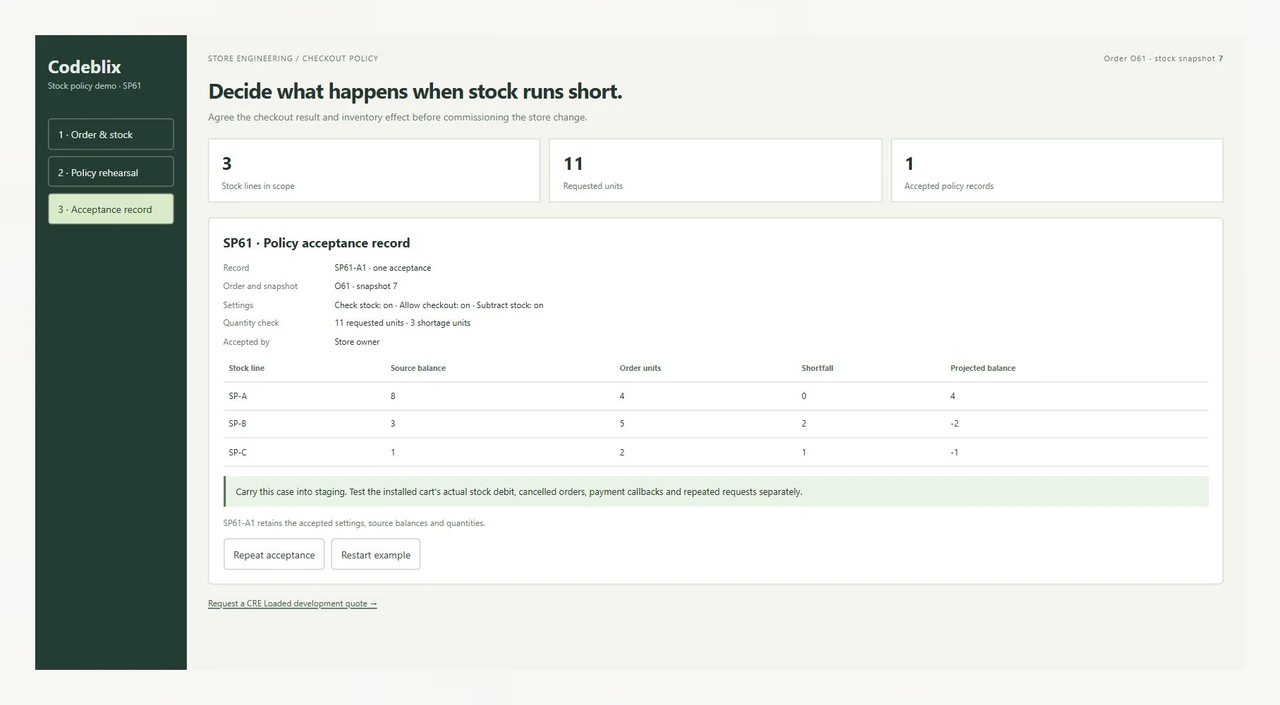
Keep the source balances, quantities and selected settings with the accepted example. Re-run the same case on the installed cart in staging, then extend it to callbacks, cancellation and concurrent purchasing before agreeing the release.
From stock evidence to an accepted checkout rule.
SP61 is a working stock-policy demonstration for order O61. Inspect the original balances, change the shortage settings and compare the projected quantities. Use the resulting acceptance record to explain the behavior you want commissioned in your own cart.
Put the stock decision beside the installed configuration.
Use the demonstration to communicate the requested policy. Confirm the cart release and customisations before applying the reference behavior to your project.
Try an insufficient-stock checkout case
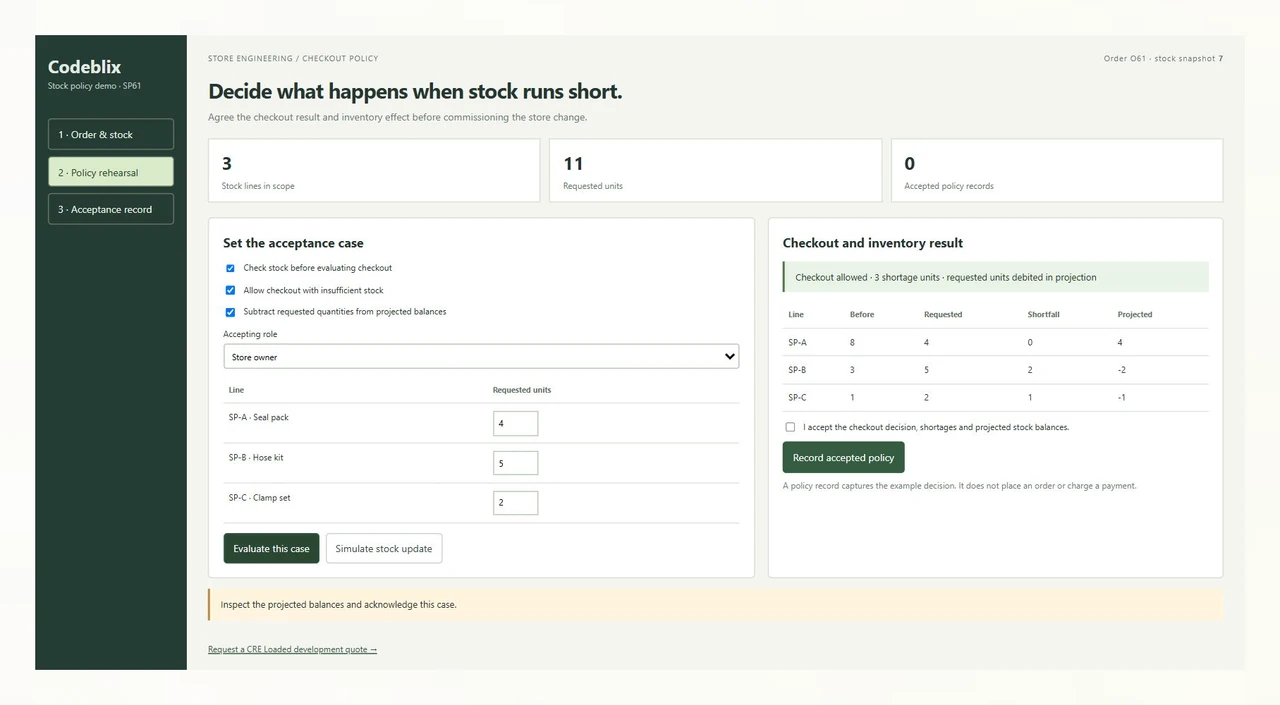
Open SP61 and evaluate its default order. Allow checkout with the shortage, inspect the negative projected balances and record the case as Store owner. Disable stock subtraction to compare retained balances, then simulate a stock update and confirm that an earlier evaluation needs repeating.
Open the stock policy acceptance demoIdentify the three stock controls separately
Loaded Commerce’s configuration reference describes Check stock level, Subtract stock and Allow Checkout as separate controls. That distinction makes a useful assessment checklist: record each installed value and trace which custom checkout code reads it.
Loaded Commerce primary reference: stock settingsCheck administrator ordering on its own path
The Customers/Orders reference distinguishes the methods configured for Create Order from the payment and shipping options offered to storefront customers. Include both order-entry paths in a quotation when either can trigger the stock change.
Loaded Commerce primary reference: order-entry settingsKeep osCommerce work attached to its own codebase
A separate osCommerce installation needs its own source and extension assessment. Commission that work with its actual release and checkout files, while keeping CRE Loaded acceptance cases tied to the cart they describe.
Discuss a separate osCommerce engagementCommission the cart change from reproduction to handover
Use one real store journey and a small synthetic order to agree the work, its boundaries and its acceptance.
Supply the installed cart and affected journey
Identify the CRE Loaded edition and release, PHP runtime, extensions, theme and checkout customisations. Provide source access through the agreed channel and describe the failing journey with synthetic products, expected messages and the owner who will accept the fix.
Quote the change and its receiving responsibilities
Set the deliverable, assessment effort, billing basis and review milestones. Name the people supplying staging access, stock rules and payment-provider documentation. Include source delivery, release assistance and the support arrangement in the requested terms.
Reconcile each requested stock line
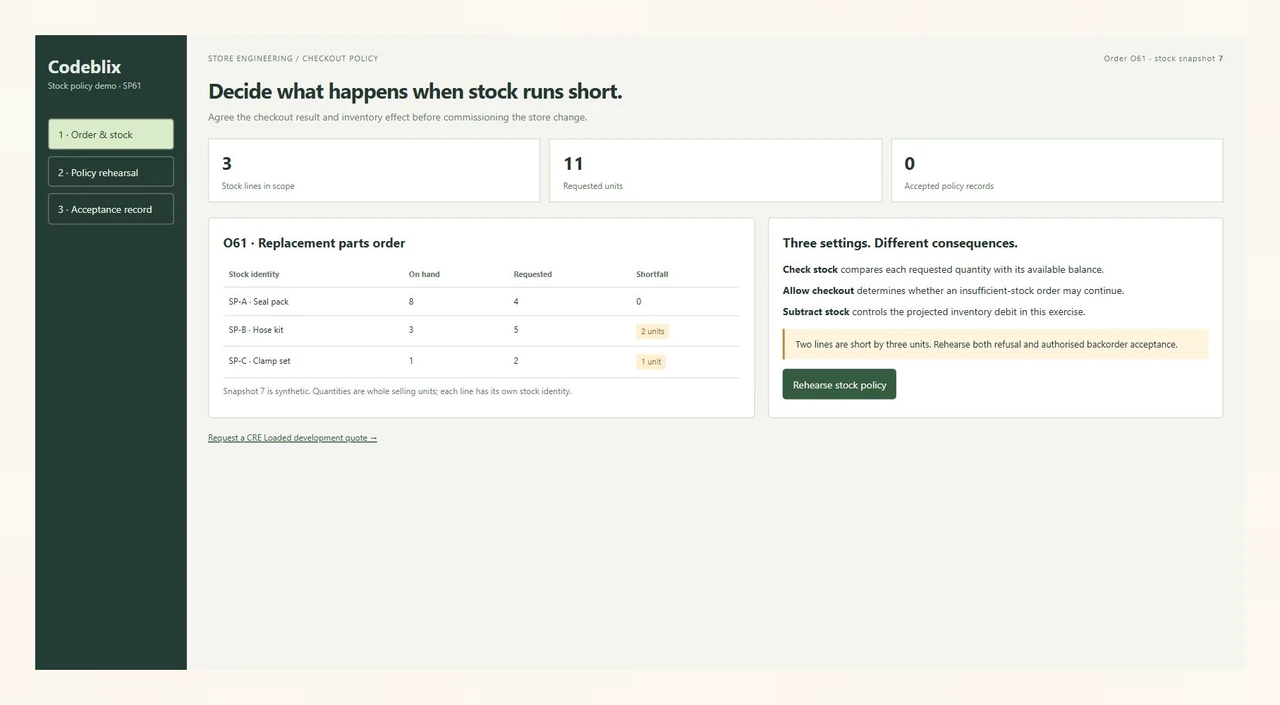
SP61 starts with Seal pack at 8, Hose kit at 3 and Clamp set at 1. Order O61 requests 4, 5 and 2 units respectively. Confirm which product, attribute or sub-product owns each balance before adopting this kind of example for the actual cart.
Exercise refusal, permission and stock changes
Evaluate with stock checking enabled and shortage checkout disabled to see refusal. Then allow the shortage and inspect its three missing units. Test the accepting role, acknowledgement and a stock update after evaluation so the accepted case uses the current snapshot.
Prove the installed implementation in staging
Repeat the agreed quantities against the commissioned code. Check customer checkout and administrator order entry independently, including payment callbacks, stock adjustments, cancellations and simultaneous requests. Record the observed debit timing and any recovery action.
Deliver the source and supported operating procedure
Receive the accepted source revision, changed settings, dependency notes and completed store-specific checks. Assign cutover, rollback and defect-triage responsibility. Keep maintenance scope and response terms attached to the development agreement.
The development request and access package
- Provide the installed release, edition, PHP and database versions, extension inventory and repository access arrangement. Describe one affected transaction and the observable result that would make the change acceptable. Share production credentials only through the agreed private access process.
- Map product IDs, model/SKU values, selling options and their actual inventory records. State the unit of sale and whether a request may contain fractional quantities. Include expected messages and the rule for a shortage or backorder.
- Name the store owner who decides checkout policy, the catalog team that maintains stock and the developer responsible for implementation. Agree which actions require approval and which changes force the case to be evaluated again.
- Request a scoped estimate covering investigation, implementation, regression checks and the receiving team’s deployment work. Clarify source ownership, third-party licences, start availability and how additional changes are priced.
Migration, integrations and ongoing operation
- For a migration, reconcile product identities, variants, customer groups, balances and open orders with a trial dataset. Record the handling of orders placed during cutover and the rollback point before a full transfer is authorised.
- If stock comes from an ERP, supplier feed or warehouse system, provide its API or import documentation. Define the authoritative balance, update direction, frequency, retry behavior and reconciliation owner. Ask for implementation of the connection as a named part of the quote.
- Agree where inventory is reduced relative to order creation, payment confirmation and cancellation. Test duplicate callbacks and simultaneous requests against the server implementation. A retained acceptance example should be accompanied by evidence from the installed cart.
- Set the deployment window, backup owner, smoke checks and recovery procedure. Separate the defect period from continuing platform upkeep, security patching, hosting operation and further store enhancements.
Six records for the stock-policy change request
Give every quoting provider the same source quantities and expected checkout decision.
| Record | Example inputs | Required output and control |
|---|---|---|
| Installed baseline | CRE Loaded release, edition, PHP, extensions and checkout files | Scope the actual installation and document existing modifications. |
| Stock snapshot | Revision 7; SP-A 8, SP-B 3, SP-C 1 | Carry source balances into the evaluated case; invalidate it after a stock update. |
| Order quantities | O61 requests SP-A 4, SP-B 5, SP-C 2 | Use whole selling units in this example and calculate each shortage separately. |
| Checkout policy | Check stock; Allow checkout; Subtract stock | Record refusal or permission alongside the resulting inventory projection. |
| Accepting authority | Store owner, Catalog editor, explicit acknowledgement | The owner accepts the current case after checking shortage and balance consequences. |
| Accepted result | SP61-A1; 11 requested units; 3 shortage units | Retain settings and all three source/result lines when acceptance is repeated. |
With balances 8, 3 and 1 against requests 4, 5 and 2, the two shortages are 2 and 1 units. Stock checking with shortage checkout disabled blocks the case. Allowing checkout and subtracting the requested quantities projects 4, -2 and -1. Turning subtraction off instead retains 8, 3 and 1. SP61 requires stock checking, a current evaluation, Store owner authority and acknowledgement before recording acceptance. A changed quantity, setting or stock revision invalidates the previous evaluation. The record captures the policy decision; the installed cart’s debit timing and order lifecycle are separate staging checks.
Ask providers to quote the same checkout outcome.
Use the three-line case to make scope, acceptance evidence and release responsibility concrete.
| Option | Published focus | Ask in your demo |
|---|---|---|
| WebTenet | Offers CRE Loaded / Loaded Commerce store development and invites a requirements-based quotation. | Will the quote trace our stock settings through both storefront and administrator order entry? |
| Daksh IT Solutions | Describes CRE Loaded design, development, customisation, integration and data-management services. | Which product and option balances will be reconciled before the checkout change is accepted? |
| SynapseIndia | Offers osCommerce/CRE Loaded development and modification of existing shopping-cart functionality. | Which duplicate-payment, cancellation and simultaneous-order cases are included in the delivery? |
Compare the written scope, installed-version fit, ownership of source changes and acceptance evidence alongside the quoted price. Ask which work is included for staging, cutover and continuing support. The same stock case provides a useful shared basis for those questions.
Category reference: Loaded Commerce primary reference: Check stock level, Subtract stock and Allow Checkout. Use the cart’s installed settings and source behavior as the final implementation reference. Extend the synthetic case with the actual product options, payment lifecycle and inventory connection.
Turn your store requirement into a software engagement.
Explore Codeblix marketplace development services and bring the specific cart, records and acceptance owner to your consultation.
Explore marketplace development servicesSettle the CRE Loaded engagement before development starts
Bring the installation details and the first customer journey you want changed.
What do I need to request CRE Loaded development?
Send the installed release and edition, runtime details, extension inventory and a description of the change. Include synthetic records that reproduce the checkout or administration issue. Name the person who can explain the operating rule and accept the delivered work.
Can Codeblix quote changes to an existing CRE Loaded store?
Bring the existing cart and required outcome for a technical consultation. The assessment checks source access, installed dependencies and the relevant order journey, then defines the implementation scope, delivery terms and any additional work needed.
What can our buyer inspect in the SP61 demonstration?
Inspect three source balances, edit requested quantities and evaluate checkout with or without shortage permission. Compare projected inventory with stock subtraction enabled or disabled. The Store owner can acknowledge a current allowed case and retain its acceptance record.
Why does the example show negative projected stock?
When shortage checkout and subtraction are both enabled, this example subtracts the full requested quantity. Three available Hose kits against five requested gives a projection of minus two. Agree whether that outcome is allowed and test how the installed cart represents backorders and later replenishment.
Should customer checkout and administrator order entry be tested together?
Include both whenever the commissioned change can affect their stock behavior. The platform reference distinguishes administrator Create Order method settings from customer-facing options. Verify each route’s actual payment, shipping and inventory handling on the installed version.
How are development cost and availability confirmed?
Request a quotation against the assessed codebase, priority task and acceptance cases. Agree investigation time, implementation, test coverage, release assistance, billing basis and start window. Include how the parties approve extra requirements and what support follows handover.
Can the quotation include data migration or a stock-system connection?
Yes, describe those deliverables explicitly with sample source records and interface documentation. Assign field and balance ownership, identity mapping, update frequency, failure recovery and reconciliation. Include a trial transfer or connection test before production cutover.
What should we receive when the checkout change is delivered?
Receive the agreed source revision, configuration changes, completed acceptance cases and release instructions. Keep stock debit and cancellation findings with the order example, along with the backup and rollback procedure. Name the team responsible for defects, upkeep and further development.