
Hire an osCommerce developer for a defined store change
Hire an osCommerce developer through Codeblix to deliver a specified store customization, module change or migration. Bring the installed version, source code and shopping journey that needs attention. Agree the implementation, checkout acceptance cases, release assistance and ongoing responsibility in a project quotation.
Commission the checkout behaviour your operation needs.
A store development brief should connect a shopper action to its exact catalog, calculation and order consequences.
Locate the affected store behaviour
Identify the storefront, administration screen or installed module responsible for the requested change. Show the cart inputs, delivery choice and expected order output. Record custom patches alongside the installed osCommerce and runtime versions.
Reconcile the amount before payment
Specify how product prices, vouchers, shipping and taxes enter the total. Decide the calculation order and rounding boundary. A payment amount should come from the accepted checkout calculation, with the same currency and order reference.
Keep exceptions visible to the merchant
Describe what happens when a destination is unserved, a voucher expires or a shipping option disappears. Define which changes require a new quotation and how repeated order requests identify an existing order. Include the staff view used to investigate a failed handoff.
Check delivery, recalculate the total and retain the accepted amount.
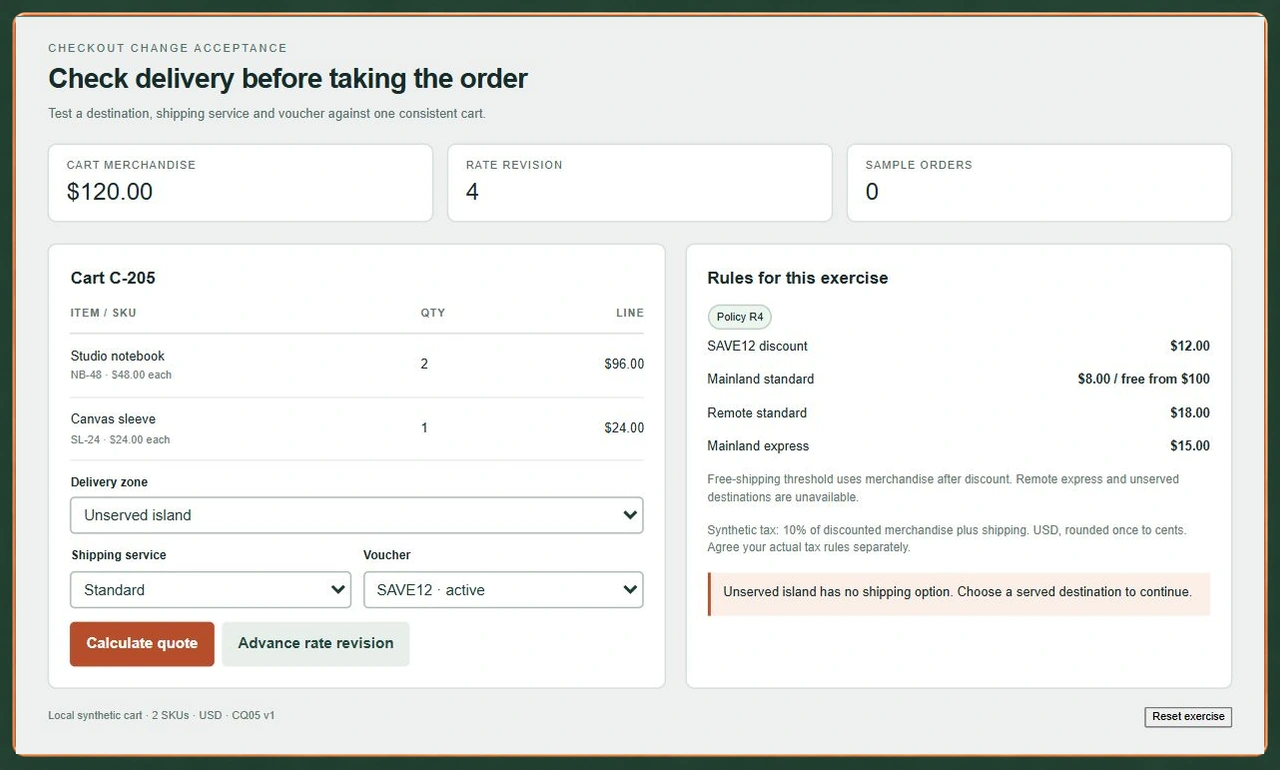
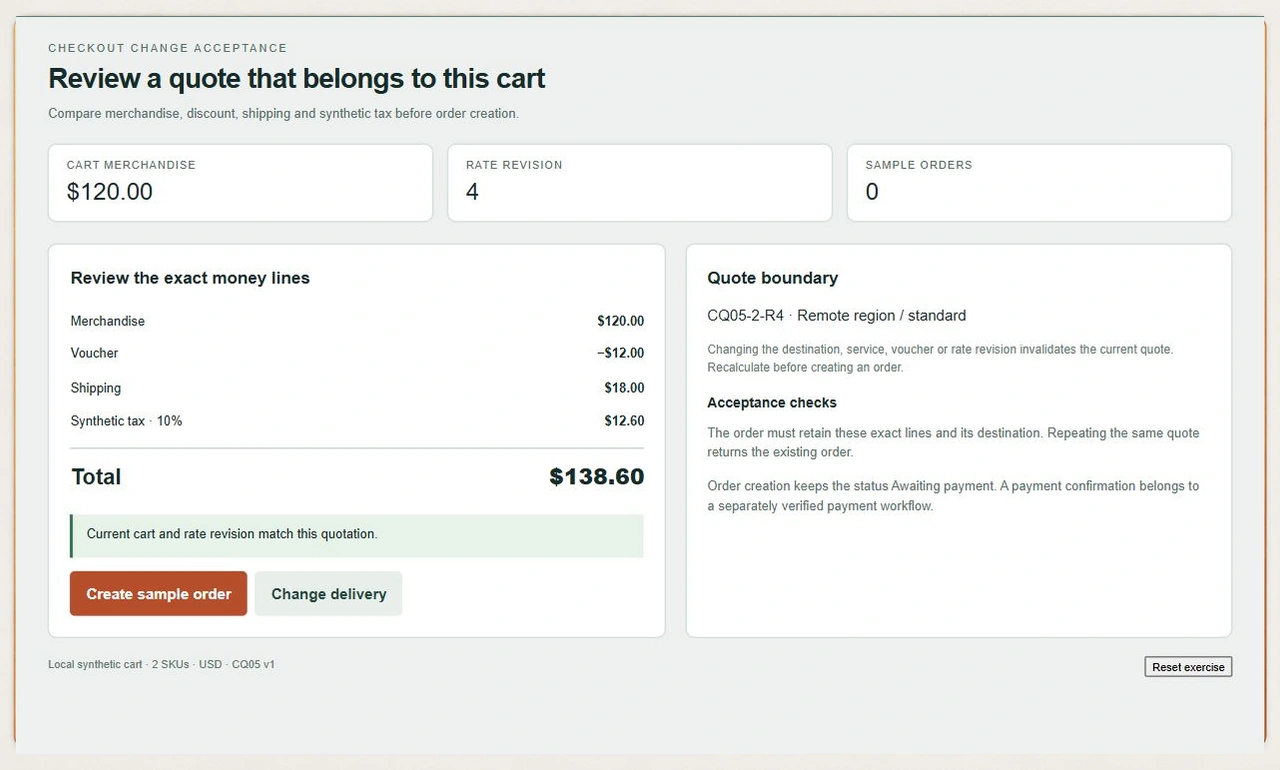
CQ05 is an interactive checkout quote demo. A two-item cart starts with an unserved destination. Select an eligible route, inspect the discount and shipping calculation, then create a sample order whose amount stays attached to its quotation.
Run the checkout quote exercise
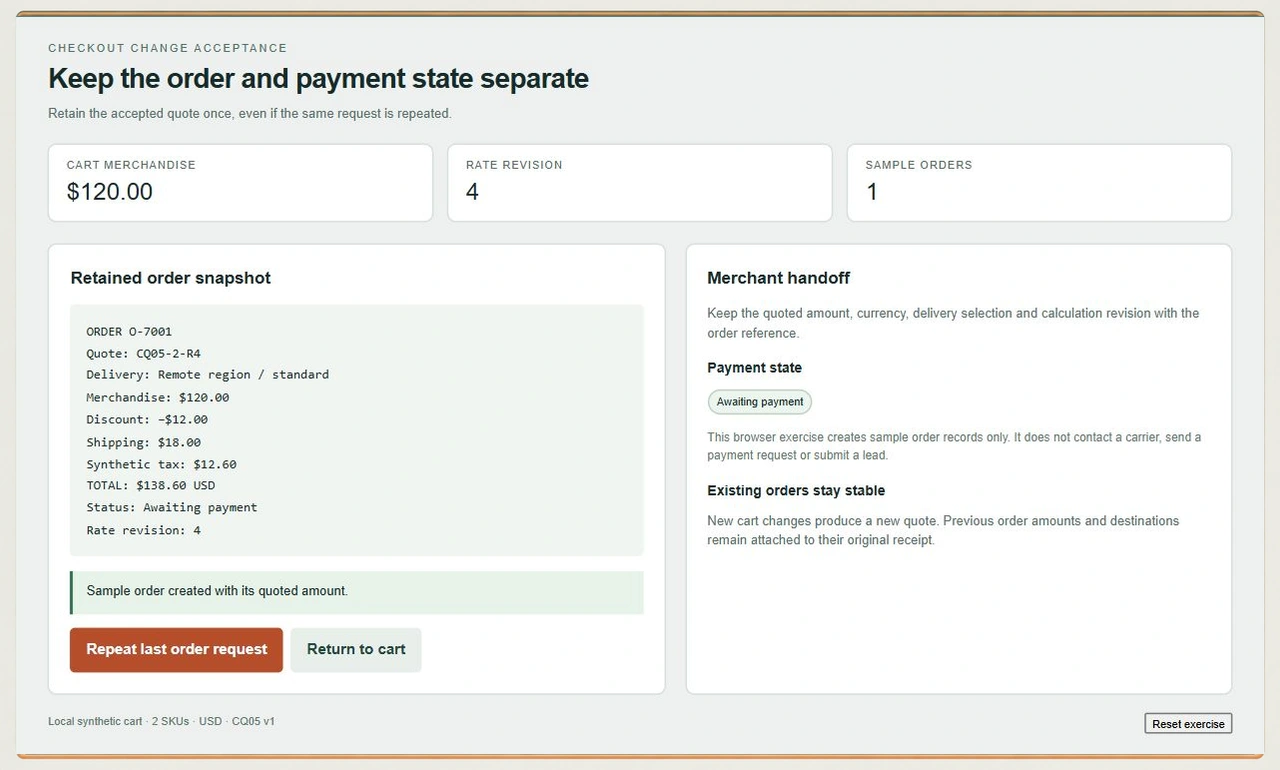
Try an unserved destination, remote express and an expired voucher. Then inspect a valid remote quote, create its order snapshot and repeat the request. Advancing the rate revision forces a fresh quotation.
Open the working checkout quote demoMatch module work to the installed release
The official osCommerce 2.4 library describes distinct shipping, payment and order-total module interfaces. Use documentation for the actual store branch and extension versions when estimating a change.
Review the osCommerce module referenceSpecify the existing payment confirmation path
For a store using the documented 2.3 PayPal Express Checkout module, the primary reference describes destination-based shipping checks and order confirmation. Review the installed module and present provider requirements as a separate integration work item.
Read the version-specific checkout referenceKeep other store platforms in their own brief
A PrestaShop multi-store pricing change involves different identifiers and platform code. Supply the actual platform inventory before selecting the implementation scope.
Discuss a PrestaShop development engagementSix steps for an osCommerce development engagement
Use one representative cart and a defined release boundary from the first discussion through handover.
Bring the store and change inventory
List osCommerce, PHP and database versions, installed extensions, themes and deployment arrangements. Identify the code owner and alterations made directly on the server. Describe the commercial outcome and the customer journey affected.
Turn the request into money and record rules
Set product identifiers, quantities, currency, destination zones and eligible services. Supply voucher validity, shipping thresholds, tax examples and rounding expectations. Agree who can authorize these business rules.
Quote the implementation boundary
Separate investigation, module or template work, data changes and external services. Agree milestones, development allocation, acceptance evidence and access arrangements. Confirm delivery capacity and terms for that defined scope.
Exercise a safe checkout copy
Implement and review the change using synthetic records in an isolated environment. Run served and unserved destinations, discount removal, a changed cart and a repeated request. Verify the storefront total and the merchant order record together.
Rehearse the release and recovery
Identify authorized source and data changes, backups, maintenance timing and recovery conditions. Reconcile catalog and order identifiers if records move. Have the store owner accept the complete shopping case before the production window.
Hand over the operating evidence
Retain the accepted commit, module configuration, deployment instructions and reconciliation results. Show staff where a blocked checkout or pending payment appears. Agree maintenance coverage and the process for commissioning further changes.
What to provide for a quotation
- Share a sanitized store inventory: versions, extension list, theme, source ownership and the affected URLs. Arrange private access through the agreed project channel.
- Provide example SKUs, quantities, currencies and delivery zones. Include the expected totals for a normal order and at least two failed-checkout cases.
- Name the decision maker for pricing, shipping, tax configuration and release timing. Identify who operates the store after the development task is accepted.
- Request an itemized scope covering investigation, implementation, verification, release help and follow-up. Capacity, dates and payment terms are confirmed with the quotation.
Module, data and integration scope
- For module customization, identify the existing extension and its modifications. Agree settings, shopper messages, administration controls and compatibility checks with neighbouring modules.
- For a carrier or payment connection, provide the selected service documentation, test account arrangements, request direction, identifiers, retries and reconciliation requirements. Include that connector explicitly in the scope.
- For migration, map product options, customer references, order history, media and old URLs. Rehearse with a recoverable copy and retain an exception list for rejected or unmatched records.
- Confirm hosting access, backup ownership and the release window. Schema and content transformations need their own authorized instructions and recovery criteria.
Accept and support the finished change
- Compare the accepted checkout lines with the order snapshot and any separately tested payment amount. Inspect failure messages and staff recovery steps as part of acceptance.
- Retain source changes, installation steps and the exact configuration used in verification. Record any external dependency or store condition that affects the result.
- Define who monitors updates, investigates errors and approves configuration changes. Agree response arrangements, support coverage and excluded work before handover.
- Repeat the relevant acceptance cases when shipping policies, vouchers, currencies or modules change. An old quotation must retain its original order context.
Six records for a reliable checkout change
Use CQ05 to make the development discussion concrete: delivery eligibility and calculation revisions must travel with the accepted amount.
| Record | Example inputs | Required output and control |
|---|---|---|
| Cart lines | NB-48 quantity 2 at $48; SL-24 quantity 1 at $24 | Reconcile line amounts of $96 and $24 with merchandise of $120. |
| Delivery selection | Mainland, Remote region or Unserved island; Standard or Express | Reject unserved destinations and remote express before creating a quotation. |
| Voucher decision | SAVE12 active; OLD12 expired; or no voucher | Apply the $12 reduction only for the active voucher and evaluate shipping after discount. |
| Calculation lines | $108 net merchandise; $18 remote shipping; $12.60 synthetic tax | Round the synthetic tax once in cents and retain a total of $138.60. |
| Current quote | CQ05-2-R4; cart revision 2; rate revision 4 | Invalidate the quotation when delivery, service, voucher or rate revision changes. |
| Order snapshot | O-7001; Remote region / Standard; $138.60; Awaiting payment | Return O-7001 for a repeated request and preserve its amount when the cart changes. |
C-205 starts at $120. Select Remote region and Standard with SAVE12: $120 minus $12 leaves $108, shipping adds $18, and the exercise tax is 10% of $126, or $12.60. The quote totals $138.60. Create O-7001 and repeat the request: the order count stays one. Mainland Standard is free because the discounted merchandise exceeds $100, producing $118.80 with the same synthetic tax rule. Changing the rate revision invalidates the current quotation while O-7001 retains its recorded amount.
Give each development provider the same checkout case.
Discuss who implements the store change, owns the calculation decisions and provides acceptance evidence. Confirm the proposed allocation and terms directly.
| Option | Published focus | Ask in your demo |
|---|---|---|
| Riseup Labs | Dedicated osCommerce hiring with full-time and part-time engagement options. | Who is responsible for the complete checkout acceptance case when the developer joins the project? |
| ProtonBits | Store development, customization, migration, maintenance and project or hourly engagement. | Which exact shipping, discount and payment-handoff checks accompany the module change? |
| Addon Solutions | Dedicated development for osCommerce stores, themes, modules and ongoing changes. | How are scope changes priced and how are the accepted order totals documented at handover? |
CQ05 supplies an original repeatable decision asset: three delivery zones, an expired voucher, two exact totals, a stale quote and one repeated order request. Ask each provider to apply those checks to the proposed store implementation.
Category reference: osCommerce primary reference: version-specific module interfaces. Confirm the installed osCommerce branch and module versions before applying either library reference. The demo arithmetic is an explicit business example, with its own synthetic tax assumptions.
Connect the store change with related software work.
Keep catalog, order and business-system responsibilities explicit when the store exchanges data with another application.
Explore the Codeblix marketplaceSet the osCommerce engagement boundary
Agree the store boundary, acceptance evidence and commercial terms before commissioning development.
How do I commission an osCommerce developer through Codeblix?
Send the installed store version and the change you want delivered through the consultation form. Include one reproducible shopping case and your expected result. Codeblix reviews the materials with you and agrees the implementation, allocation, acceptance steps and terms in a quotation.
Can the project cover a customized older store?
Bring the source repository, runtime versions and a list of installed extensions and direct patches. The review identifies which code paths the change reaches and whether compatibility work belongs in the scope. Agree the supported target environment before implementation begins.
What should a checkout change specify?
Supply cart quantities, currency, delivery zones, service availability, discounts, tax configuration and rounding examples. Describe when a quote becomes stale and how an order receives its accepted amount. Include shopper errors and the merchant recovery view.
What can I test in the checkout quote demo?
Try unserved delivery, unavailable remote express and an expired voucher. A valid remote standard quote totals $138.60; mainland standard totals $118.80 under the stated synthetic rules. Changing the rate revision blocks order creation until recalculation. Repeating an accepted request returns the same sample order.
Can a carrier or payment gateway be included?
Name the service and provide its current interface documentation and test arrangements. Scope authentication, amount and currency mapping, failure handling, callbacks and reconciliation explicitly. Agree the separate integration acceptance evidence with the store change.
How is a store migration estimated?
Define source and destination versions and inventory the products, options, customers, historical orders and URLs involved. Supply counts and sample exceptions. The quotation should include mapping, a rehearsal, reconciliation, release timing and recovery responsibility.
What determines the development price and start date?
The installed code, affected modules, expected behaviour, data work and external dependencies determine the estimate. Confirm available development allocation, investigation work, milestones and payment terms after review. Specify release assistance and maintenance coverage separately.
What should I retain after acceptance?
Keep the source revision, installation procedure, module settings and completed shopping cases. Retain order-total reconciliation and any tested integration outcomes. Name the operating owner and agree how updates, defects and future feature requests will be handled.