
Make identity rules part of the development scope.
A code can be unique across your whole application or only within one client. Letter-case behaviour adds a separate decision. Give the programmer an explicit receiving example for both.
Expose the complete collision group
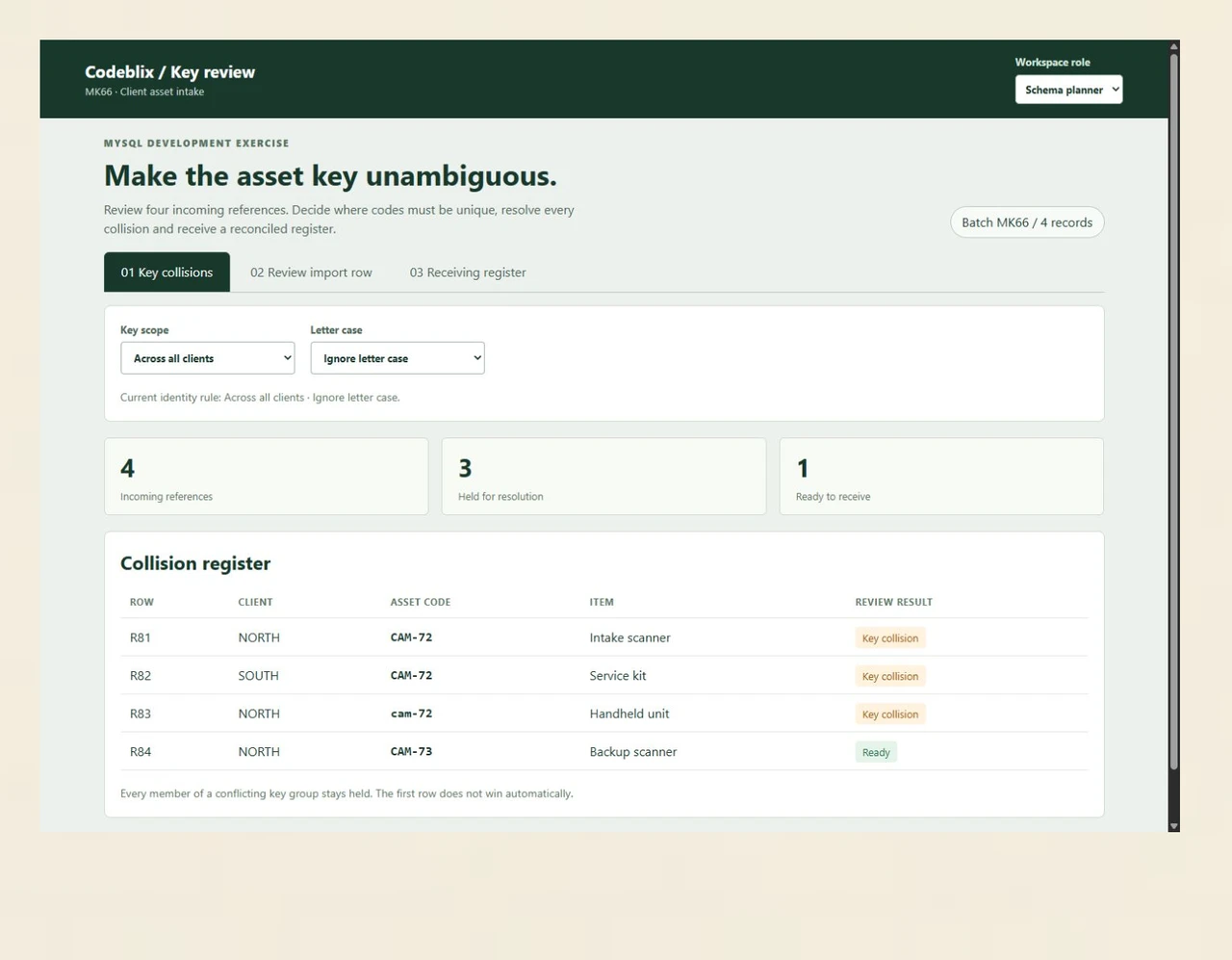
MK66 starts with NORTH / CAM-72, SOUTH / CAM-72 and NORTH / cam-72, plus NORTH / CAM-73. With a global key that ignores letter case, the first three rows collide: three held and one ready. Every member stays visible for review instead of silently selecting the first record.
Choose the namespace and comparison policy separately
Switch to a key scoped within each client. SOUTH / CAM-72 becomes distinct, while NORTH / CAM-72 and NORTH / cam-72 remain in conflict: two held and two ready. Keeping letter case makes all four distinct. The business owner decides which behaviour matches the actual asset identity.
Correct the reference and reconcile the receiving output
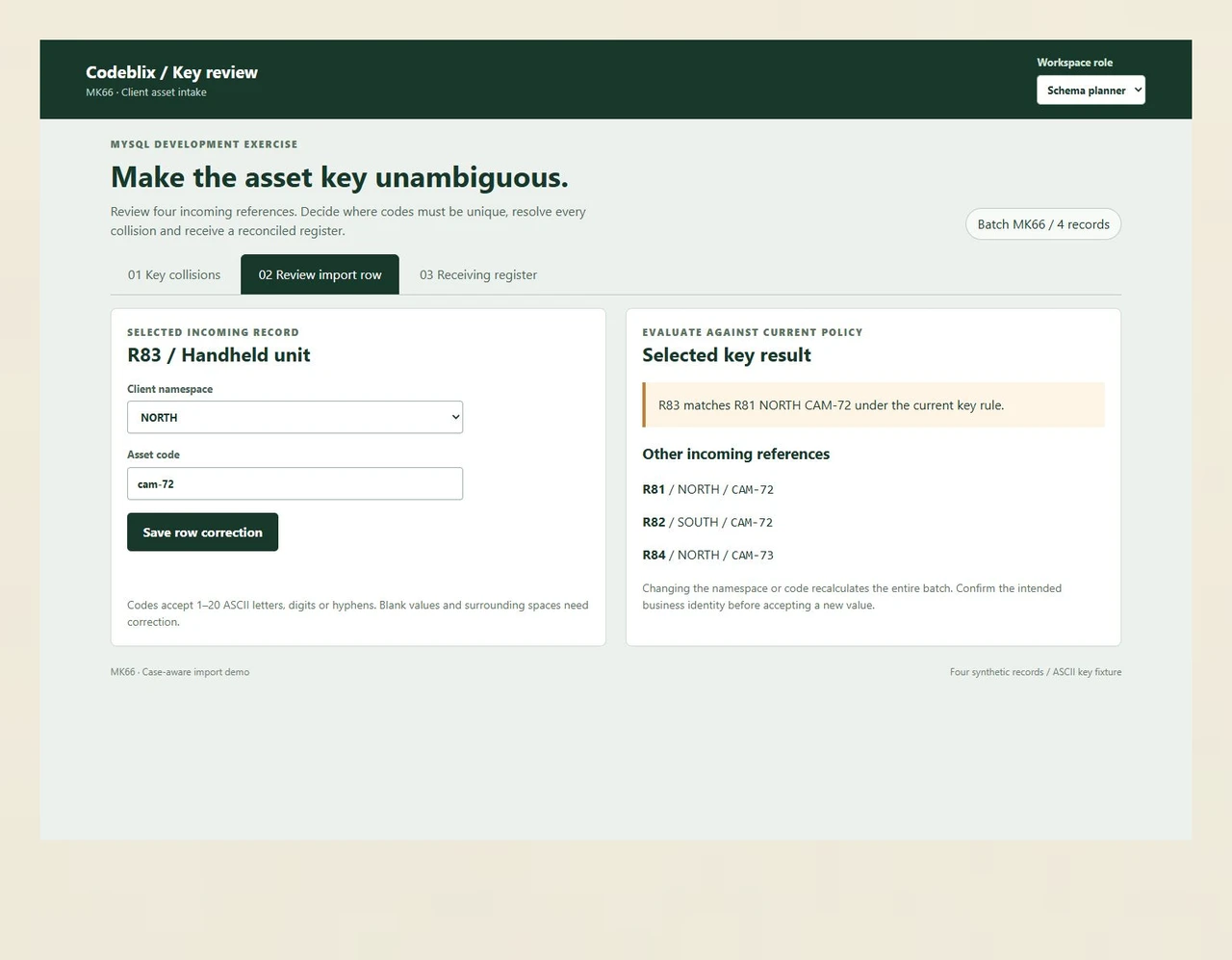
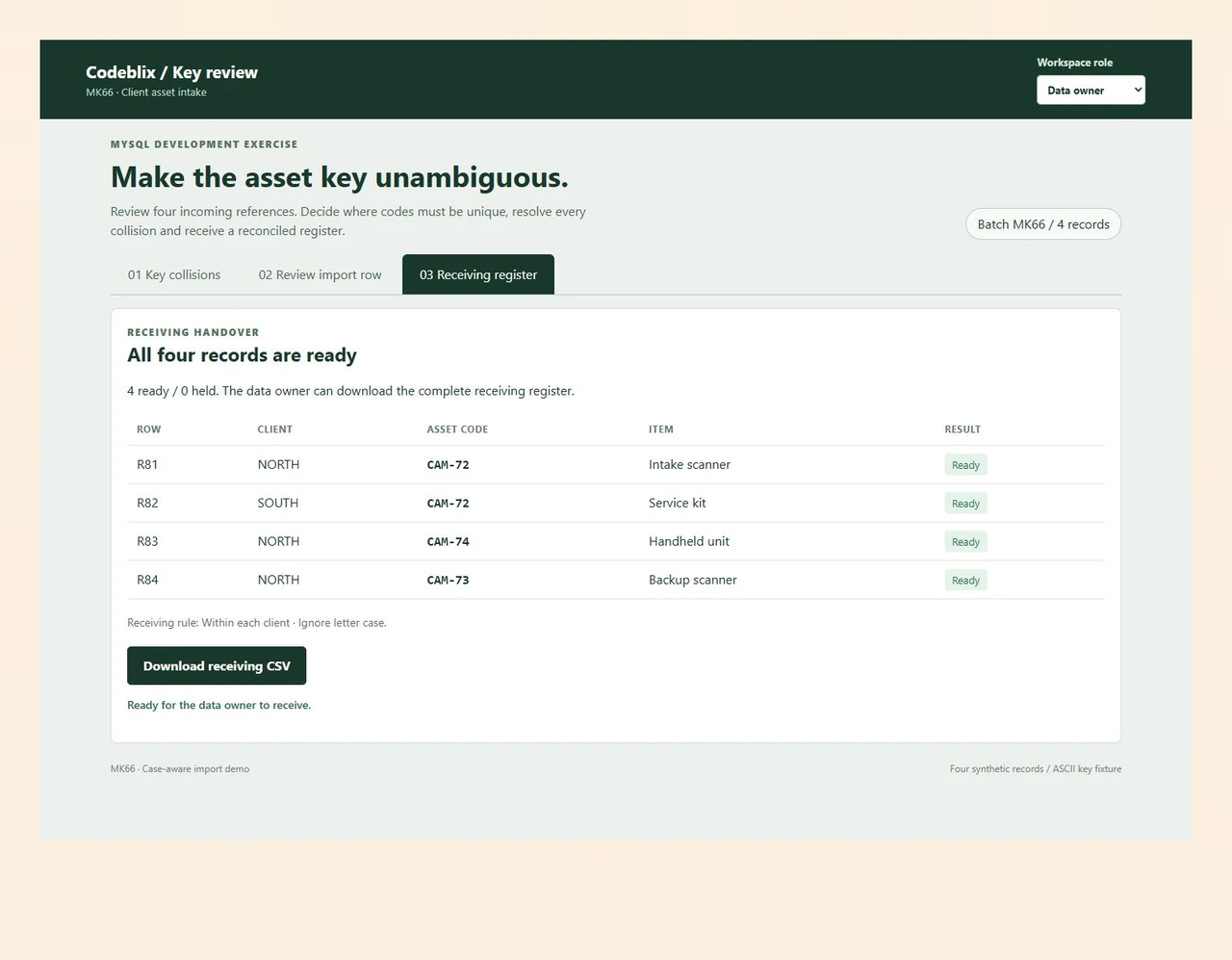
Keep the within-client rule that ignores letter case and change R83 to CAM-74. All four references are now distinct. Switch to Data owner and download the receiving CSV with each row identity, client namespace, asset code, rule and result. The register preserves both clients’ CAM-72 records.
Agree what makes a record distinct.
The MK66 workspace reviews four incoming asset references. Change the client scope and letter-case rule, inspect R83 alongside its conflicting reference, then correct the code and receive all four records.
Turn the key rule into an observable result.
Use the working asset-reference exercise and the MySQL primary references when requesting the development quotation.
Inspect the four-record key review
Open MK66 and compare global and within-client keys. Change the letter-case rule, review R83 and save CAM-74 as the correction. Switch to Data owner to receive the four-row register. The exercise uses ASCII asset codes so its comparison rules stay explicit.
Open the case-aware import demoConfirm the deployed comparison settings
The MySQL 8.4 reference describes how collation affects string comparisons. Include the database version, column definitions and expected matching behaviour in the development request. Receive the agreed examples in your application’s staging environment.
Consult MySQL’s string-comparison referenceReceive a complete required business key
The CREATE INDEX reference documents composite key parts and uniqueness constraints. Nullable fields need particular attention because a unique index permits multiple NULL values. Specify required values and application validation alongside the intended database key.
Review MySQL’s index and uniqueness referenceScope the surrounding record application
If your backlog includes a new record-management interface, name the input forms, operational roles and downstream handoffs. Quote those application responsibilities with the MySQL work so the database rules and daily workflow have the same receiving owner.
Discuss the surrounding database applicationSix decisions for the development engagement
Connect the requested database work to a representative application task, a receiving owner and an agreed delivery boundary.
Describe the application change and current environment
Provide a sanitized schema, the deployed MySQL version and storage engine, application language and connection layer. Identify the affected screens, imports and APIs. List the required backlog items and name the person who can resolve business-rule questions during development.
Agree the business key before changing constraints
Mark which fields identify a record and whether that identity belongs to a client, location or the whole application. Define letter case, blank values, allowed characters and required fields. Use the four MK66 references to make the expected collision groups visible in the project brief.
Receive the comparison behaviour in the selected database
MySQL’s primary documentation explains that nonbinary comparisons depend on collation. Confirm the actual column and comparison settings with the developer. Include representative language and character examples from your own data, then receive their observed results in the selected MySQL version.
Resolve existing records before the constraint change
Commission a duplicate inventory and an approved correction map before altering the schema. Assign decisions to a data owner. Receive the new application validation alongside the database constraint, including concurrent submissions and the user-facing response when a key already exists.
Deliver the application task against its receiving cases
Give the programmer a small representative import or record-editing task. Check the resulting keys, held rows and handoff output with the application owner. Include error handling, permissions, transaction boundaries and retry behaviour in the acceptance work for the commissioned implementation.
Agree capacity, release ownership and support
Confirm the backlog order, review cadence and available developer capacity. For a monthly engagement, agree the allocation, communication window and process for changing priorities. Receive source changes, schema scripts, a rollback procedure and the support responsibilities before scheduling release.
Define the programmer’s work
- Send the prioritized backlog with a representative screen, query or import for each task. Distinguish schema changes, application logic, data corrections and operational administration. Include the result your team will receive and the dependencies needed to start.
- Provide schema definitions, anonymized record examples, version information and an approved staging route. Identify existing indexes, collation settings and integration contracts. Keep production credentials with authorized access owners and agree the least access needed for the work.
- Define the record identity in business terms. Include client scope, case rules, whitespace, required values and allowed character sets. Name the data owner who can approve corrections when two existing records would share the intended key.
- For dedicated or monthly work, ask for confirmed capacity, communication times, review milestones and the commercial model. Agree how the backlog is estimated, how progress is demonstrated and how added requirements change the engagement.
Receive the release and continued ownership
- For a data migration, request a duplicate inventory, approved correction mapping and a sample reconciliation before the full run. Include record counts, rejected rows and checks of downstream references. Agree backup ownership and the point at which rollback becomes necessary.
- For application or API changes, specify authentication boundaries, concurrent writes, error messages and safe retry behaviour. Confirm the actual database constraint as well as the browser validation. Include integration credentials and third-party licences in the owner’s responsibility list.
- For query work, provide representative data size, the affected operation and its observed baseline. Agree a receiving workload and record the results in the chosen environment. Tie any performance target to that measured workload and its operating limits.
- Receive the changed source, schema scripts, deployment instructions and completed acceptance cases. Assign monitoring and defect triage after release. Confirm which maintenance, backup and later version-upgrade responsibilities belong in the ongoing development engagement.
Six records that make the identity rule reviewable
MK66 separates the incoming reference, its client namespace and the rule used to compare keys.
| Record | Example inputs | Required output and control |
|---|---|---|
| Client namespace | NORTH / SOUTH | Choose whether equal asset codes in different clients represent separate records. |
| Incoming reference | R81 / NORTH / CAM-72 | Keep the row identity and original asset context available during collision review. |
| Comparison policy | Within each client / Ignore letter case | Apply scope and letter case as two explicit decisions across the complete batch. |
| Collision group | R81 CAM-72 / R83 cam-72 in NORTH | Hold every conflicting member until the data owner resolves the business identity. |
| Corrected row | R83 / NORTH / CAM-74 | Save the reviewed correction and recalculate all four incoming keys. |
| Receiving register | Row / client / code / item / scope / case / result | Allow the data owner to export the complete batch after all records are ready. |
Start with a global, case-insensitive key: R81, R82 and R83 collide, leaving three held and one ready. Scope the key within each client: SOUTH / CAM-72 is distinct, so only NORTH / CAM-72 and NORTH / cam-72 stay held. Keep letter case and all four become distinct. Return to ignoring letter case, then correct R83 to CAM-74. The receiving output contains NORTH / CAM-72, SOUTH / CAM-72, NORTH / CAM-74 and NORTH / CAM-73, all marked Ready.
Request the same database development deliverables.
Give each provider the same schema sample, representative application task and expected key outcomes when requesting a quotation.
| Option | Published focus | Ask in your demo |
|---|---|---|
| vTeams | MySQL developer hiring with candidate selection, interviews, development services and engagement enquiries. | Will the scoped work include a client-key collision register and receiving output for the representative import? |
| SharpMinds | Dedicated MySQL developers and longer-term team arrangements through a recruitment and consultation process. | Which database comparison rules and application acceptance cases will the dedicated programmer receive first? |
| Programmers.io | MySQL development enquiries through dedicated-team, staff-augmentation and project-based engagement routes. | How will existing duplicate corrections, the constraint change and application handover be reconciled in the delivery scope? |
Receive one representative application operation with the intended key rules, real database constraints and explicit exception results before expanding the backlog. Agree source ownership, access boundaries and the review cadence for the commissioned work.
Category reference: MySQL primary reference: CREATE INDEX. Use the deployed MySQL version, actual collation and business identity as receiving inputs. Confirm the database behaviour in your authorized staging environment.
Connect MySQL development to the daily workflow.
Include the record interface, integrations and receiving owner when you scope the database backlog.
Explore marketplace development servicesAgree your MySQL development engagement
Set the backlog, record identity and receiving responsibilities before confirming the programmer allocation.
What should we send when hiring dedicated MySQL programmers?
Send the prioritized application backlog, deployed MySQL version, sanitized schema and representative records. Name the receiving owner and expected outcome for the first task. Include the application language, relevant integrations and the approved staging route so Codeblix can review the work and prepare a quotation.
Can we request a MySQL developer on a monthly basis?
Include the expected workload, preferred review cadence and collaboration hours in the enquiry. Codeblix can review a monthly development engagement against the backlog and available capacity. Confirm the allocation, commercial terms, deliverables and process for changing priorities before starting.
Can the engagement include schema and application changes?
Describe both responsibilities in the request: the database rule and the forms, imports or APIs that depend on it. Agree validation, permissions, error handling and receiving cases together. The quotation should identify the source packages and release tasks for each part of the change.
What does the case-aware import demo show?
MK66 reviews four synthetic asset references. Changing client scope and letter-case policy changes which rows collide. Correcting R83 to CAM-74 under the within-client rule that ignores letter case makes all four ready. The data owner can then download the complete receiving register.
How should we resolve existing duplicate asset references?
Commission an inventory of the records that would conflict under the intended key. Let the authorized data owner decide which references are corrected, merged or retained separately. Receive a correction map and reconcile dependent records before applying the schema change in the release plan.
How do we receive the database comparison rules?
Provide the required client scope, character examples, case rules and blank-value behaviour. Have the programmer confirm the selected MySQL version and column settings, then demonstrate the expected results in staging. Include application validation and concurrent-write cases with the database constraint.
What affects the development quotation?
Backlog size, existing schema condition, application changes, migration effort and receiving complexity shape the scope. Access dependencies, integration work and release assistance also affect the engagement. Request an explicit allocation and milestones, with an approval route for additional tasks.
What should our application owner receive at handover?
Receive the changed source, schema scripts, environment requirements and acceptance results for the commissioned backlog. Include data correction reconciliation, release and rollback instructions, and a walkthrough of exception handling. Assign ongoing maintenance and defect triage to named owners.