
Put failure scope in the development agreement.
A batch can contain valid work on both sides of a bad input. Specify the intended outcome and the person allowed to publish it.
Distinguish a batch rejection from a row rejection
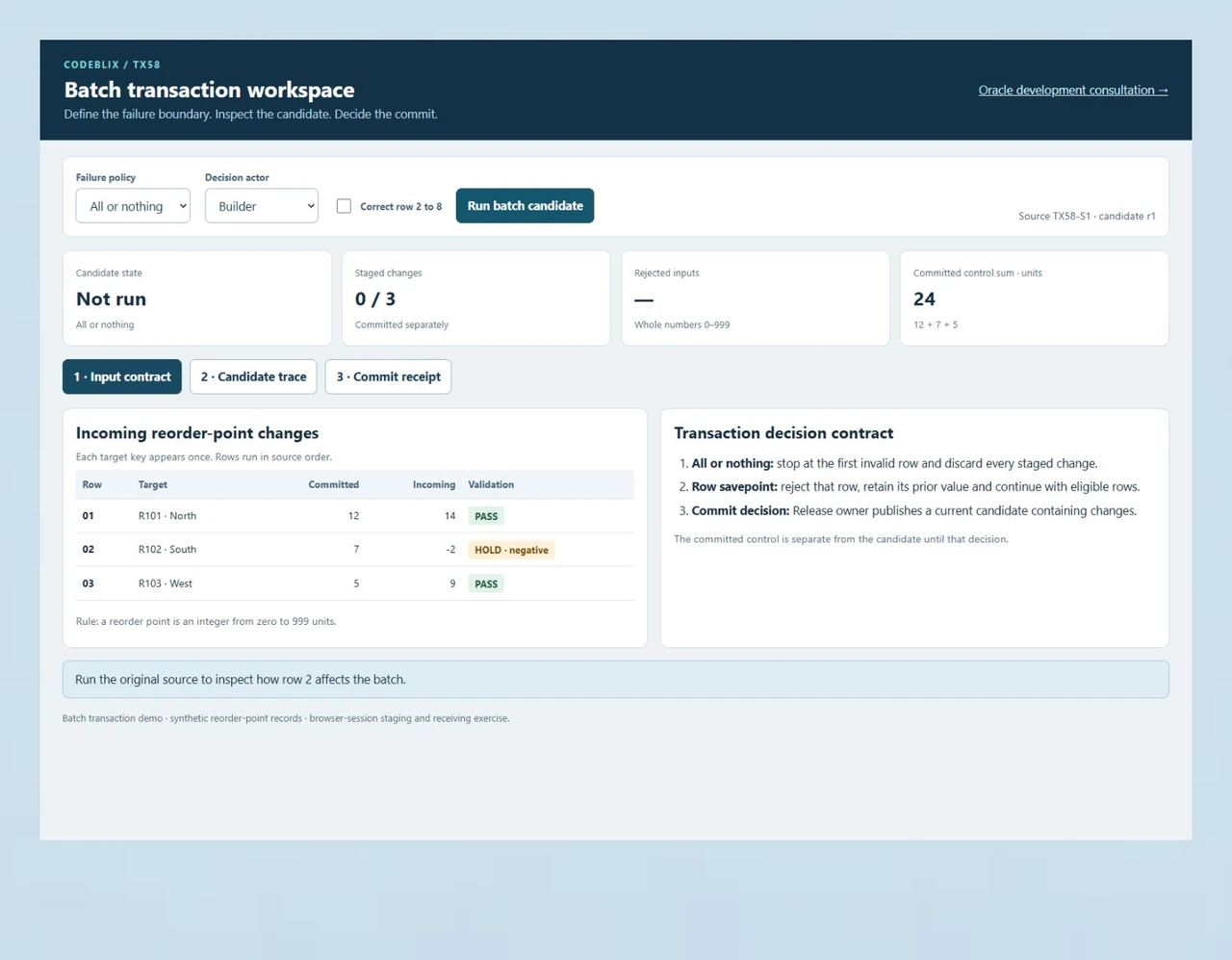
TX58 starts with reorder points of 12, 7 and 5 units. Its incoming values are 14, -2 and 9. The negative value fails the agreed validation rule. Under all-or-nothing processing the first change is undone and the third is not attempted. Under the row-savepoint policy the rejected input leaves its original value intact while the other two changes remain staged.
Inspect changes before the publication decision
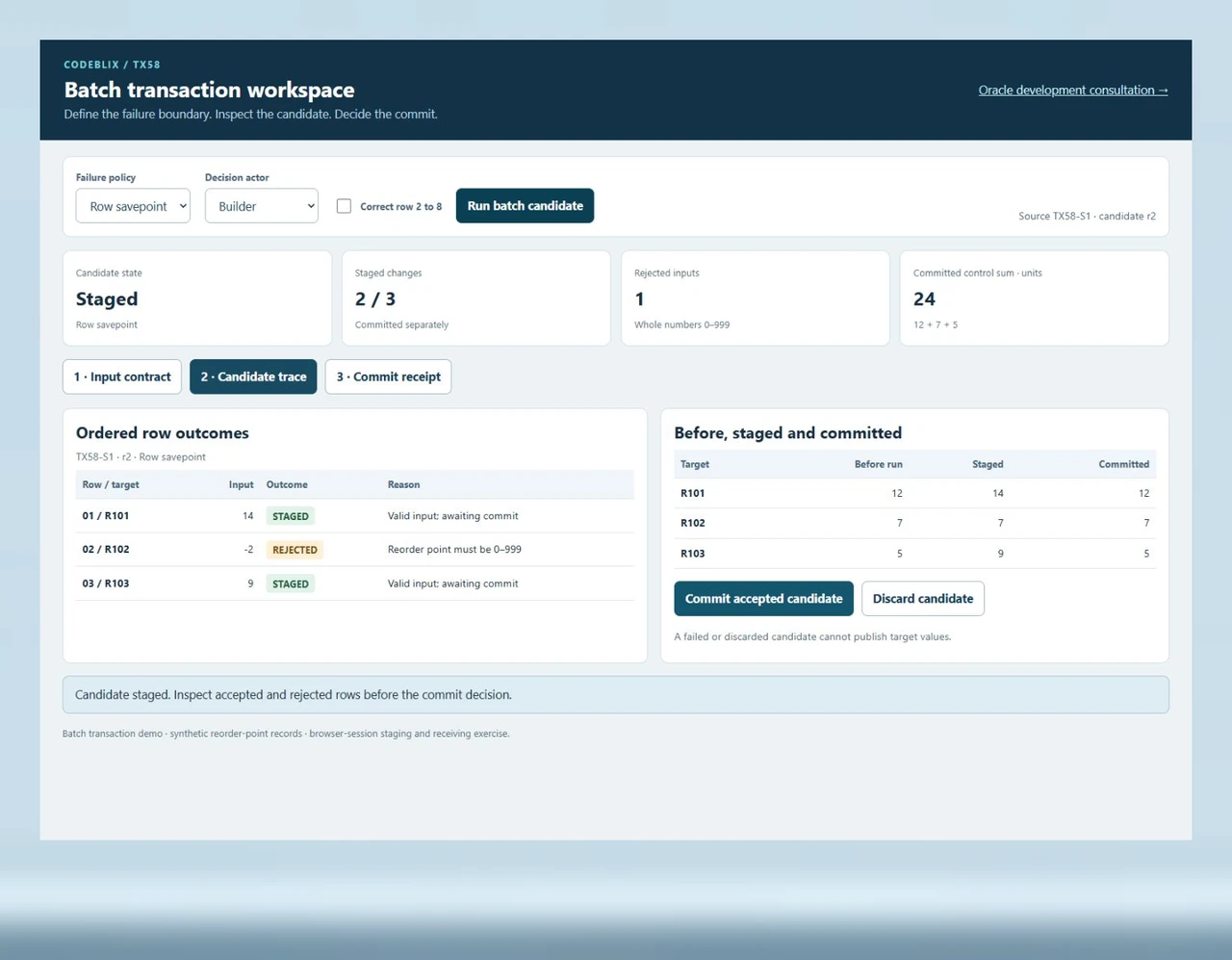
A staged value is a candidate awaiting the agreed transaction decision. In TX58 the row policy stages 14, 7 and 9 while the committed records remain 12, 7 and 5. The Builder can run and inspect the batch. Release owner must make the commit decision; a discarded candidate leaves the committed records unchanged.
Keep the rejection alongside the accepted result
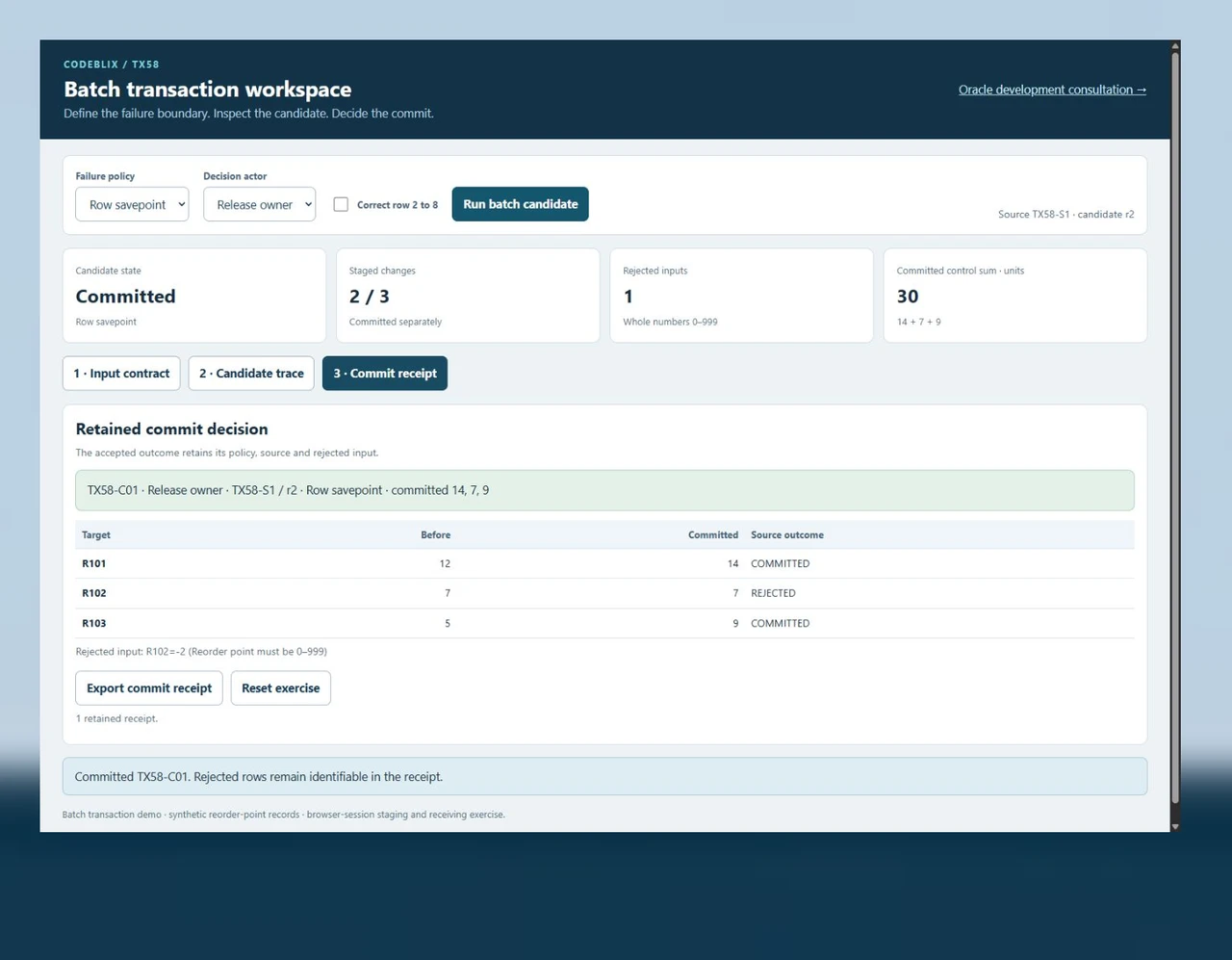
The receiving record identifies the batch policy, source revision, three resulting values and the invalid row. A repeated commit cannot apply the same candidate again. Correcting the source input creates a fresh candidate rather than editing the earlier receipt. This gives the buyer a concrete handover condition for a PL/SQL change.
Agree what survives an invalid row before commissioning the package.
TX58 is a batch transaction demo with three synthetic reorder-point changes. Run an all-or-nothing batch to see the first invalid row cancel the candidate. Then use a row-savepoint policy to stage two valid changes, inspect the rejection and commit the accepted result as Release owner.
Use an exception case to define the first deliverable.
These resources help the buyer state the required result and assess the quoted scope.
Replay the invalid-middle-row decision
Run All or nothing with the original source. The invalid second row cancels the candidate. Switch to Row savepoint, run again and inspect the staged values and rejected row before selecting Release owner and committing the accepted candidate.
Open the batch transaction acceptance demoName the transaction owner
Oracle's transaction-control reference distinguishes commit, rollback and rollback to a savepoint. Decide which application boundary is responsible for ending the unit of work. Include the expected retained records in the development agreement rather than relying on a generic failure message.
Read Oracle's transaction-control referenceSpecify the exception output
Oracle calls runtime errors exceptions and documents how they are handled. Provide an expected error identity and a receiving action for each rejected input. Keep the failing row and the caller's response identifiable when successful rows can continue.
Review Oracle's PL/SQL error-handling documentationInclude the surrounding database application
A package change may expose a larger need for new records, editing screens or an import process. Identify that application scope alongside the Oracle programming allocation so the quotation includes the interfaces and owners required to use the result.
Scope a custom database applicationCoordinate a separate SQL Server workload
Where a project also has a SQL Server report or procedure, retain a separate environment and acceptance result for that work. Specify the approved exchange contract between systems and reconcile each side before scheduling a shared release.
Discuss a SQL Server programming milestoneSix parts of an Oracle development brief
Connect the backlog to a reproducible failure case, an authorized environment and a receiving owner.
Identify the Oracle application boundary
Name the database edition and version, application runtime, schemas, package entry points and jobs involved. List Forms, APEX, middleware or ERP dependencies only where they actually belong to the project. Confirm the source repository, existing vendor responsibilities and a staging environment with approved access.
Describe the batch and its caller
Provide the source-row identity, target key, input contract and validation rules. State whether the caller or the package owns the transaction. For TX58 the inputs change reorder points for three known records; the rule permits only whole numbers from zero to 999 units. Supply representative successful, rejected and empty inputs for the real application.
Choose the recovery behaviour
Agree whether one rejected row cancels the whole unit or allows eligible rows to continue. Identify the savepoint location, exception handling and row-error output in the package review. Oracle documents full rollback, rollback to a savepoint and commit as distinct transaction controls. An exception alone should not be treated as the agreed whole-batch rollback policy.
Separate investigation from implementation
Review package dependencies, triggers, application calls and current error handling before estimating the change. Include source recovery or undocumented interfaces as explicit investigation work. Where performance is part of the commission, agree a representative workload and measurement method in the authorized environment.
Run the receiving cases in staging
Replay the successful rows, invalid middle row, corrected input, discard and repeat-attempt cases. Compare the actual target records with the agreed policy and inspect any error output. TX58 illustrates those decisions in a browser workspace; the delivery milestone should include execution evidence from the client's reviewed Oracle environment.
Handover the package and release responsibilities
Request the changed source, input and output contracts, receiving cases and observed results. Agree compilation order, permitted deployment actions, backup and recovery ownership and application checks. Name the support contact and the commercial treatment of further changes after the accepted milestone.
Bring source and operating constraints
- List the first package or application milestone, required allocation, communication overlap and review cadence. Identify the person who prioritizes the work and the person who accepts the resulting records. Ask the quotation to state its billing basis and start conditions.
- Supply sanitized definitions, dependency notes and a small input fixture with expected output. Arrange credentials through an approved access channel; keep passwords, connection strings and customer exports out of the initial enquiry.
- Identify licences, optional database features and third-party components that the work depends on. Confirm permitted use with the responsible owner before including a feature or migration path in the implementation scope.
- Describe schedules, caller retries, target-key constraints and existing monitoring. Agree how to distinguish an input error, a connection failure and an uncertain commit outcome so a retry does not silently repeat a completed change.
Receive an implementation your team can operate
- Ask for a recoverable staging rehearsal and an agreed production change window. Define who takes the backup, who authorizes the release and how the receiving application is checked after the database change.
- For a data migration, identify source and target versions, mapping rules, reconciliation controls and the treatment of rejected records. Price rehearsal, cutover assistance and post-cutover checks as identifiable work.
- For an external integration, state the system of record, direction, frequency and authorized interface. Include vendor approvals, application-side changes and error ownership; confirm actual connector availability during scoping.
- Agree the support boundary after acceptance: operating contact, response arrangements, permitted access and backlog handling. Distinguish the first development allocation from ongoing database operations or a wider application support contract.
Six records connecting an Oracle batch to its receiving decision
Use TX58's synthetic reorder-point changes to agree the unit of work and its rejection policy.
| Record | Example inputs | Required output and control |
|---|---|---|
| Committed target | R101=12 / R102=7 / R103=5 units | These values remain visible independently of any staged candidate. |
| Source batch | TX58-S1 / three ordered rows / values 14, -2, 9 | Preserve source row identity, target key and source revision. |
| Failure policy | All or nothing / Row savepoint | Choose whether a rejected input cancels prior changes or only its own row. |
| Staged candidate | Row policy: 14, 7, 9 / two valid changes / one rejection | Do not change committed records until the authorized decision. |
| Row outcome | Applied candidate / rejected / rolled back / not attempted | Explain the first failure and what happened to the other rows. |
| Commit receipt | TX58-C01 / Release owner / candidate source and policy | Retain resulting values and rejected row; reject a repeat commit of the same candidate. |
Start with the original source and run All or nothing. R101 is staged at 14, R102 fails on -2 and the candidate rolls back to 12, 7, 5; R103 is not attempted. Change the policy to Row savepoint and rerun: R101 = 14 and R103 = 9 remain staged, while R102 stays at 7 with a rejection. Committed records still show 12, 7, 5. Builder cannot commit. Select Release owner, commit the candidate and receive TX58-C01 with 14, 7, 9. A second commit is blocked. Reset the exercise, use the corrected source with R102 = 8, and run All or nothing: all three changes stage at 14, 8, 9. Discard them to leave committed values at 12, 7, 5. Export the latest receipt when a commit has been accepted.
Ask providers to quote the same failure and receiving conditions.
Provider engagement models are useful inputs. Compare them against the specific package behaviour and handover your project requires.
| Option | Published focus | Ask in your demo |
|---|---|---|
| Clarion Technologies | Oracle application and database services with full-time or part-time developer engagements and an interview process. | Who owns the transaction boundary, and which rejected-input cases are included in the quoted milestone? |
| i-verve | Oracle development, migration and maintenance engagements with dedicated, time-and-material and hourly options. | Will the handover distinguish staged changes, rejected rows and the final committed records? |
| RapidBrains | Remote Oracle developer allocation covering PL/SQL and database work, screening and a callback route. | Which executable receiving case and release responsibilities accompany the developer allocation? |
Give each provider the original TX58 input, the required failure policy and the expected final records. Ask for the corresponding implementation and staging evidence from the reviewed Oracle environment, plus the package source and caller contract. The browser exercise supplies a concrete receiving discussion alongside the commercial allocation.
Category reference: Oracle primary reference: transaction processing and control. Oracle transaction-control and PL/SQL error-handling documentation accessed 3 November 2026. TX58's three records, validation limits and actor permissions are original exercise assumptions.
Connect the package milestone to its application owners.
Identify the database, caller and operating responsibilities around the development engagement.
Explore Codeblix marketplace servicesPrepare an Oracle engagement with a defined first result
Resolve the environment, allocation and acceptance responsibilities before requesting a start date.
What should an enquiry for dedicated Oracle developers contain?
Name the Oracle environment, application and first backlog item. Include the requested allocation, source ownership, package or interface involved and the receiving owner. Provide a sanitized example with expected records and rejection behaviour so Codeblix can assess scope, capacity and commercial terms.
Can we commission a bounded PL/SQL package change?
Provide its source, entry points, dependencies and caller contract. Explain the failed input and the expected outcome, including any effect on earlier or later rows. The quotation can then identify investigation, package work, staging verification and release assistance for that deliverable.
How should the developer allocation be priced?
Ask for a written billing basis, allocation period, review cadence and scope-change process after the backlog is reviewed. Source recovery, migration, application-side work and operating support affect the estimate. Include those responsibilities explicitly when requesting the quotation.
What does the batch transaction demo demonstrate?
It runs two explicit failure policies on the same three synthetic inputs. The all-or-nothing policy cancels the candidate at an invalid middle row. The row-savepoint policy retains two valid staged changes and the rejected row. Release owner can commit that candidate and export the resulting receipt.
Should one rejected row cancel every change?
That is an application decision to specify before implementation. Some jobs require the entire unit to succeed together; others permit valid rows to continue with a clear rejection output. Agree the caller's transaction ownership and verify the chosen behaviour in the reviewed environment.
How are retries and uncertain outcomes included?
Identify a stable batch identity and describe the caller's retry conditions. Include a repeated request and a connection loss near the commit boundary in the receiving plan. The implementation should make an already completed outcome identifiable before another attempt can repeat the work.
Can the scope include migration or application integration?
List the source and target environments, approved interface, field mapping and responsible vendors. Include rehearsal, rejected-input reconciliation and caller-side changes in the estimate. Confirm actual access, licences and component compatibility during the technical review.
What should our team receive when the milestone is accepted?
Request the changed source, dependency and compilation notes, input/output contract, receiving cases and observed staging results. Agree release and recovery instructions, operating ownership and support terms. Keep the accepted batch identity and its rejected-input outcome with the handover.