
Receive the business rule at its boundaries.
A database change is easier to receive when the application owner can identify the exact day a revision starts, stops or conflicts with another record.
Find the conflicting period without flattening history
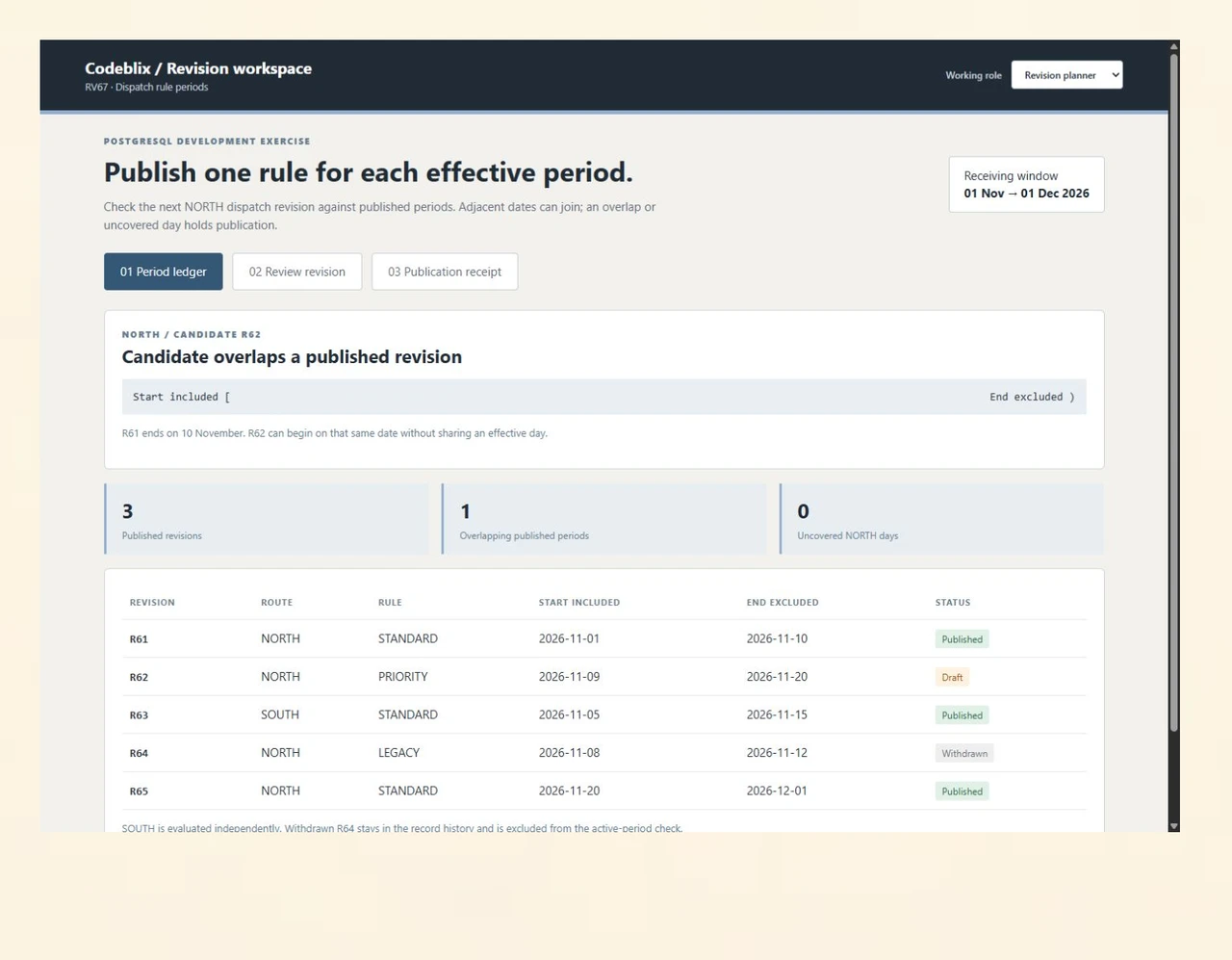
Draft R62 initially covers NORTH from 9 November up to 20 November 2026. Published R61 covers 1 November up to 10 November, so the draft shares an effective day with it. R63 covers SOUTH and is evaluated separately. Withdrawn NORTH revision R64 remains visible in the ledger but does not block the active-period check.
Treat an overlap and an uncovered day as different exceptions
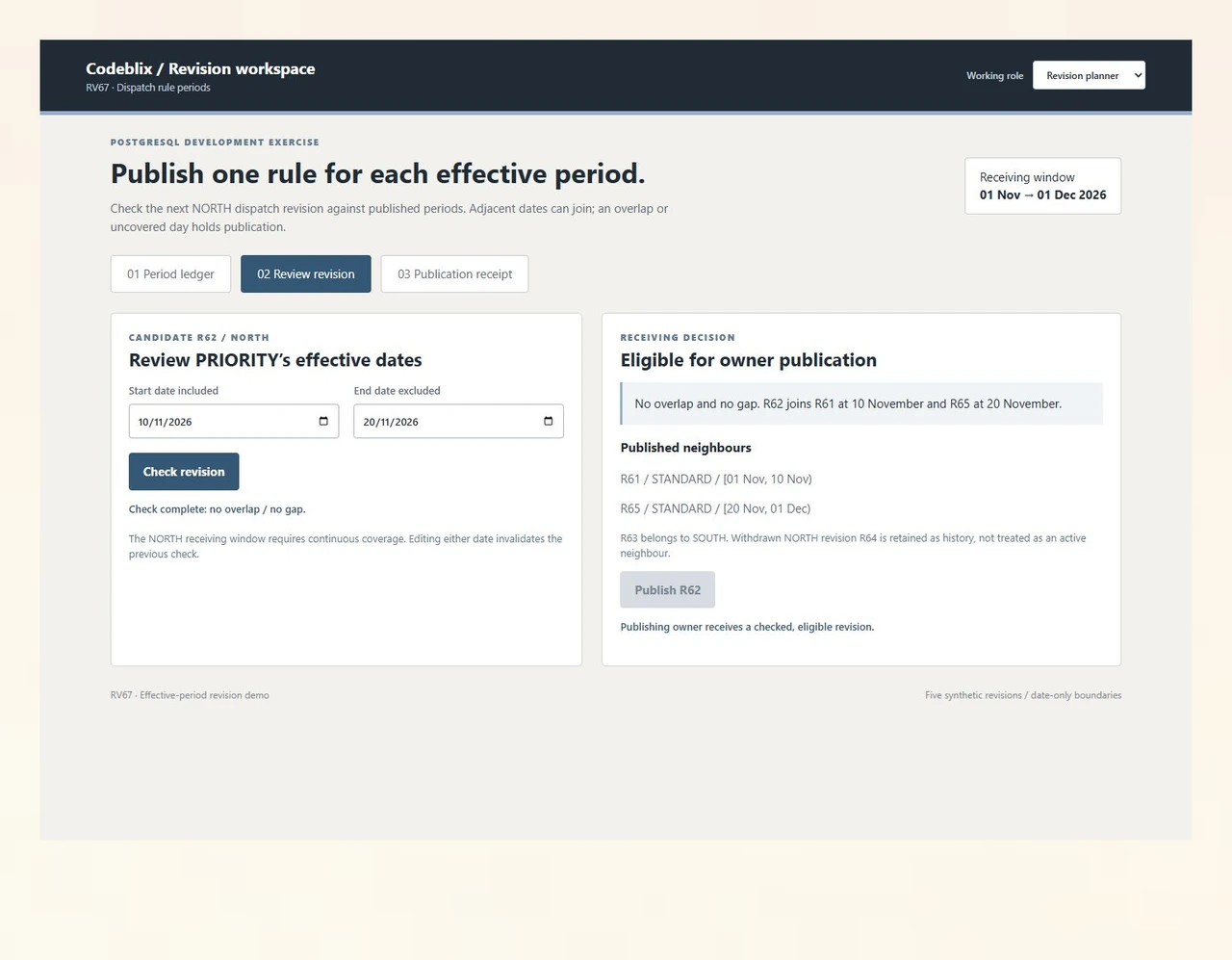
Move R62’s start to 11 November and the overlap disappears, but NORTH has no rule for 10 November. That one-day gap still holds publication because this receiving window requires continuous coverage. Set the start to 10 November instead: R62 meets R61 at its excluded end and meets R65 when the next period starts on 20 November.
Publish the checked dates and receive the full record set
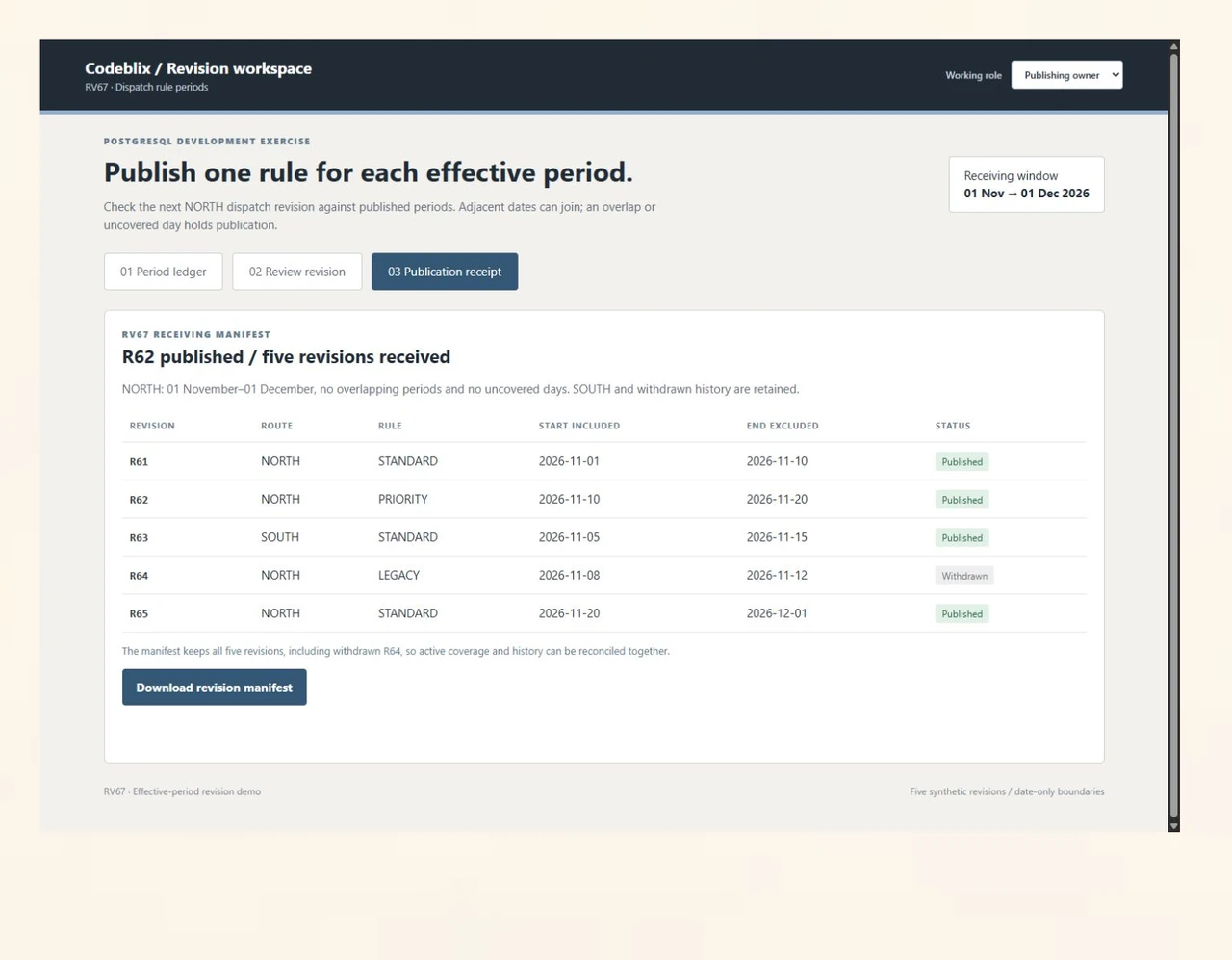
The revision planner checks the corrected 10–20 November period. A date edit makes that check stale. The publishing owner can publish an eligible revision, after which R62 is locked for editing in the exercise. Download five revisions with route, rule, included start, excluded end, status and active-period indicator: four published records and one withdrawn record.
Know which rule applies on each effective day.
RV67 places a draft NORTH dispatch rule between two published revisions. Review its date bounds, distinguish a conflict from a gap and publish the eligible revision. The receiving manifest keeps all five records, including withdrawn history.
Bring a revision your team can accept.
Use the executable period review and the PostgreSQL references to frame the first development task.
Run the draft-to-publication exercise
Open RV67, check the initial overlap and try a start date of 11 November to expose the gap. Correct the start to 10 November, check again and switch to Publishing owner. Publish R62 and download the five-record manifest to inspect active coverage alongside withdrawn history.
Open the effective-period revision demoAgree inclusive and exclusive dates
PostgreSQL’s range reference explains included and excluded bounds and shows how ranges can be checked for overlap. Put the exact date examples and chosen range type in the development brief. Confirm whether the application stores calendar dates or timestamps before agreeing the receiving cases.
Consult PostgreSQL’s range-type referenceChoose a guard that covers competing records
The constraints reference describes exclusion constraints and explains the limits of a row CHECK that depends on other records. Have the developer confirm the supported constraint, operator classes and deployment prerequisites for your PostgreSQL version. Receive concurrent writes as part of the implementation.
Review PostgreSQL’s constraint referenceInclude the surrounding operational interface
If the backlog also needs an editor, approval queue or receiving screen, scope those interfaces with the database work. Explain who maintains the revisions and who consumes the resulting records. Connect that responsibility map to the wider custom application quotation.
Scope the supporting record applicationSix steps from backlog to receiving decision
Give the programmer a specific application operation and define the evidence your team needs to accept the change.
Describe the operation and the existing database
Send the PostgreSQL version, application stack and a sanitized schema with representative records. Identify the query, API, editor or import to change. Put a receiving owner beside the first backlog item and explain the operational result that makes it complete.
Name the identity and lifetime of each revision
Identify the entity whose rules change over time, such as a route, plan or service level. Specify the included start, excluded end and statuses that participate in active coverage. Decide whether a gap is permitted and how withdrawn records remain available for reconciliation.
Agree database and application enforcement together
Ask the programmer to select the PostgreSQL constraints and transaction boundary for the actual environment. The primary constraint reference distinguishes row checks from restrictions involving other rows. Receive the database guard together with the application’s conflict response, including competing publication attempts.
Exercise the important boundary dates
Commission a small change that demonstrates an overlap, an adjacent period, an uncovered day and an inactive historical revision. Include missing dates, reversed bounds and a change made after a successful check. Reconcile the observed result with the business owner before expanding to the rest of the backlog.
Migrate existing periods with a decision record
Inventory conflicting or incomplete historical periods before changing the schema. Assign each correction to an authorized data owner. Receive a representative migration with before-and-after record counts, retained statuses and application behaviour at the affected boundary dates.
Confirm allocation, handover and release support
Agree the development capacity, review cycle and collaboration hours for a project or monthly allocation. Define who releases schema and application changes, who owns rollback and who handles defects. Receive the source package and acceptance record with the final backlog handover.
Set the backlog and receiving scope
- Provide a short sequence of prioritized tasks with the affected operation and expected result. Identify schema work, application changes, migration corrections and operational support separately. Include sample records that demonstrate the exceptions your receiving owner needs to inspect.
- Confirm the deployed PostgreSQL version, hosting arrangement, relevant extensions and application dependencies. Arrange an authorized staging route with sanitized data. The developer should know which deployment privileges and dependencies need the infrastructure owner’s review.
- For period-based records, supply the entity key, interval boundaries, status rules and history-retention requirements. Decide how a draft interacts with published revisions. Record whether missing coverage is an error, a permitted gap or a separate approval decision.
- State the expected collaboration window and the backlog ownership for a dedicated engagement. When requesting monthly capacity, ask for the agreed allocation, review cadence and commercial terms. Identify how new work is estimated and how a change in priorities is approved.
Receive durable implementation evidence
- For a schema migration, request a conflict inventory and approved corrections before release. Reconcile dependent references and status history as well as record counts. Have the data owner receive the representative conversion and decide how unresolved exceptions are handled.
- For APIs and editing screens, include authentication, authorization and conflict messages in the receiving brief. Test two competing writes against the actual database guard. Agree how a stale review is detected and what the user sees when publication cannot proceed.
- For timestamp periods, specify the time-zone interpretation and daylight-saving cases that matter to the application. RV67 uses calendar dates; a commissioned timestamp workflow needs its own receiving examples. Align database values, interface labels and downstream exports.
- For handover, receive the changed source, schema scripts, operating prerequisites and completed acceptance record. Assign backup, rollback, monitoring and incident responsibilities. Discuss ongoing query tuning or later version changes as identifiable items in the support allocation.
Six records behind a controlled revision change
The RV67 model connects the revision’s lifetime to its route, receiving result and publication responsibility.
| Record | Example inputs | Required output and control |
|---|---|---|
| Route identity | NORTH / SOUTH | Compare active periods only within the entity whose rule is being changed. |
| Revision record | R62 / PRIORITY / Draft | Keep the candidate’s identity and status visible while its dates are reviewed. |
| Effective period | [2026-11-10, 2026-11-20) | Include the start day and exclude the end day so neighbouring periods can meet without overlap. |
| Receiving decision | No overlap / no uncovered NORTH days | Invalidate the previous decision whenever the candidate’s dates change. |
| Publication owner | Revision planner / Publishing owner | Separate preparation and checking from publication of the eligible revision. |
| Revision manifest | Five records / four Published / one Withdrawn | Export the active-period indicator with historical status so the owner can reconcile both views. |
R61 is published for NORTH from 1 November up to 10 November. R65 is published from 20 November up to 1 December. Draft R62 initially starts on 9 November and conflicts with R61. Starting on 11 November leaves 10 November uncovered. Use 10 November as the included start and 20 November as the excluded end, then run the receiving check. Publish as the owner. The manifest contains R61, R62, R63, R64 and R65; withdrawn R64 has active_period No while the four published revisions have Yes.
Give each provider an observable receiving task.
Request a quotation against the same application operation, version requirements and temporal exception cases.
| Option | Published focus | Ask in your demo |
|---|---|---|
| Programmers.ai | PostgreSQL development teams, migration, integrations and flexible development engagement enquiries. | Will the first scoped task include explicit range boundaries, inactive-history treatment and a reconciled receiving manifest? |
| Binary Studio | Remote PostgreSQL engineers with candidate interviews, onboarding and dedicated development cooperation. | How will the receiving owner inspect concurrent publication and the stale-check behaviour of a period revision? |
| QArea | PostgreSQL development outsourcing with project estimates, specialist requests and team formation. | Which historical period conflicts and gap decisions will be resolved before the application and schema release? |
Ask the provider to demonstrate the exact boundary cases in your chosen environment, then reconcile the database outcome with the visible application message. Receive the source and operating instructions against that agreed task before committing a larger backlog.
Category reference: PostgreSQL primary reference: Range Types. Select constraints and extension prerequisites for the PostgreSQL version you operate. Include the business decision about permitted gaps in the application receiving scope.
Connect the database change to its operating process.
Scope the editing, approval and record handoff with the PostgreSQL backlog so the application owner can receive the complete operation.
Browse marketplace development optionsPlan your PostgreSQL programmer engagement
Resolve the delivery task, capacity and receiving responsibilities with the development quotation.
What does Codeblix need to quote dedicated PostgreSQL work?
Share the first application operation to change, the deployed PostgreSQL version, a sanitized schema and representative records. Include the receiving owner, required result and access dependencies. A prioritized backlog helps Codeblix review the development scope and confirm an appropriate allocation.
Can we arrange a PostgreSQL developer on a monthly basis?
Describe the anticipated backlog, collaboration hours and review schedule in your enquiry. Discuss the developer allocation and responsibilities with Codeblix, then confirm capacity and commercial terms. Agree how priorities, acceptance work and additional requirements are managed during the monthly engagement.
Can the development include the application editor and database guard?
Include both in the requested scope: the database restriction and the screen or API that creates the records. Specify authorized roles, competing writes and the message shown when a rule is violated. Receive the interaction and stored result together in the selected environment.
What can our team inspect in the revision demo?
RV67 checks NORTH revision R62 against published neighbours. A 9 November start overlaps R61; an 11 November start leaves a one-day gap. The 10–20 November period is eligible after checking. Its owner can publish once and download all five revisions, including the withdrawn historical record.
How should existing conflicting periods be handled?
Inventory conflicts under the intended entity and status rules before changing the schema. Give correction decisions to an authorized data owner and retain a mapping of the affected revisions. Reconcile historical statuses and dependent records after the representative conversion and before the release.
What receiving cases should we include for effective dates?
Include equal boundary dates, overlapping periods, missing coverage, withdrawn history and an empty or reversed interval. Check how a successful review becomes stale after an edit. For timestamp values, add the application’s time zones and daylight-saving boundaries to the actual database receiving cases.
What determines the size of the PostgreSQL engagement?
The backlog’s application changes, database condition, migration exceptions and integration responsibilities determine the work. Access and release dependencies also affect the plan. Request an allocation, review points and deliverables that match the tasks your team can receive.
What belongs in the development handover?
Receive the source changes, schema scripts, supported environment and acceptance evidence for the agreed work. Include historical-data reconciliation, deployment and rollback instructions, and the exception-handling walkthrough. Assign the maintenance owner and the process for triaging defects or requesting further backlog items.