
Connect the development allocation to a verifiable change.
A useful Silverstripe brief connects the requested development time to specific page identities, destination checks and a receiving team that can accept the result.
Turn an allocation into a deliverable
Connect the requested developer time to a prioritised CMS change, review window and acceptance result. Define who supplies access, answers content questions and decides whether the delivered work meets the agreed scope.
Keep page identity separate from its address
For a relocation, carry the stable page ID through the old and new paths. Include descendants and occupied destinations in the review so a neat-looking parent change does not conceal an unexpected route collision.
Make the handoff reproducible
Receive the accepted source changes, installation instructions and the routing map used for validation. Retain outstanding decisions, redirect ownership and support responsibilities with the completed acceptance record.
Inspect the section, the move and the handoff.
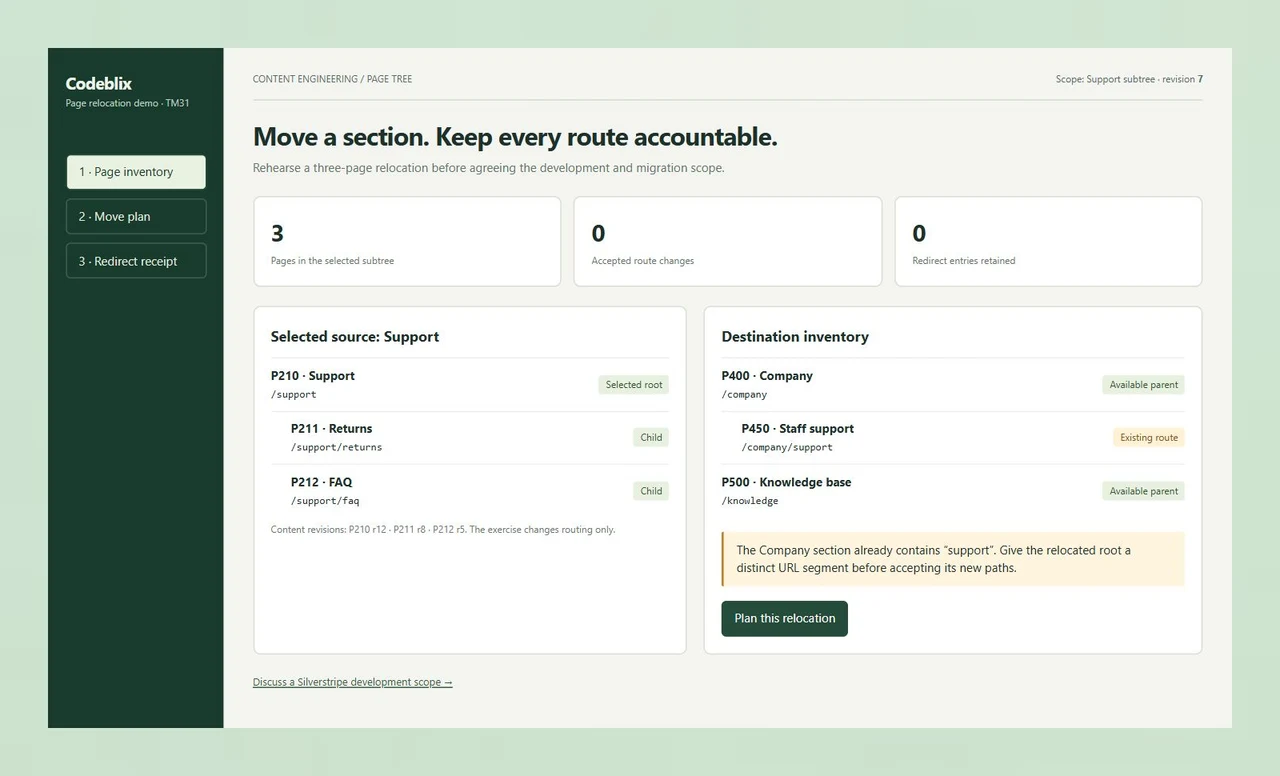
TM31 is a working page relocation demonstration. Move Support and its two child pages beneath a chosen parent, resolve the existing route and inspect the accepted destination map. Keep this example alongside your installation details when requesting development terms.
Put the routing example alongside your installation details.
Use the working exercise to describe your acceptance task, then confirm the relevant APIs, extensions and content hierarchy in the codebase being commissioned.
Try the three-page move before requesting terms
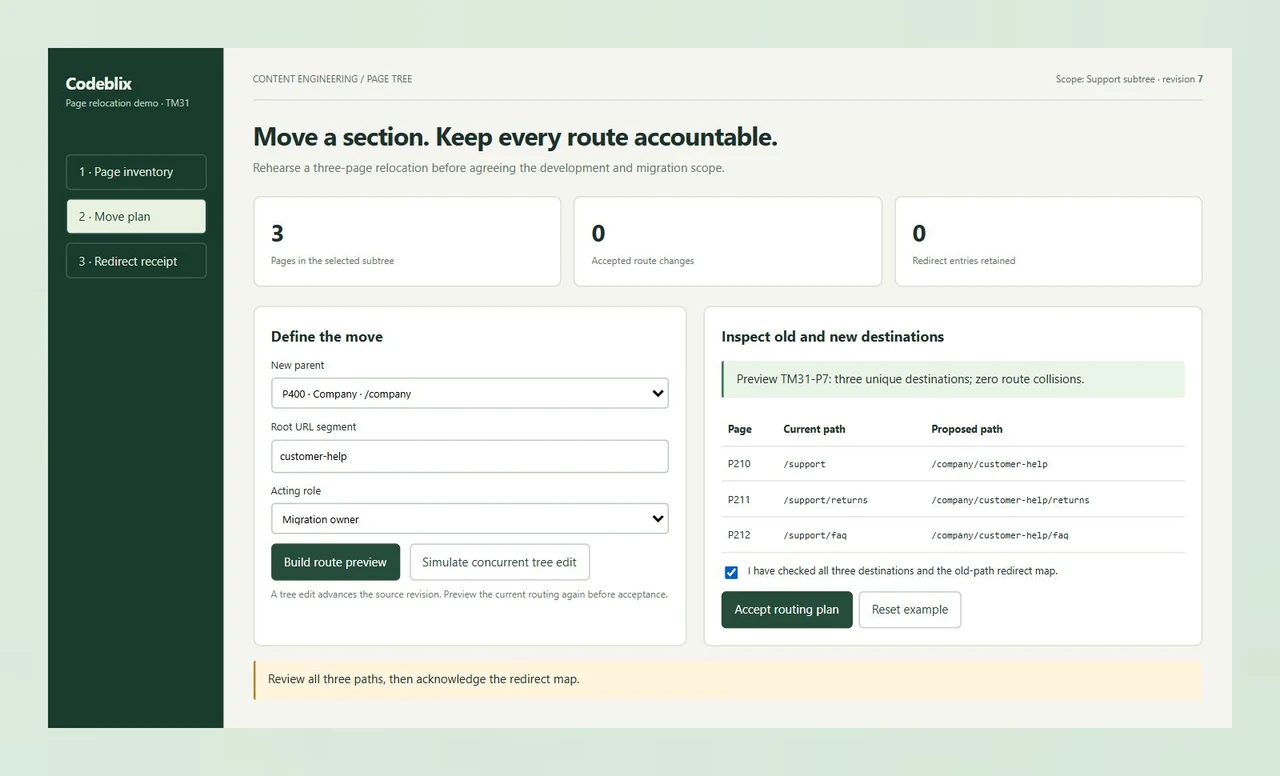
Open the TM31 exercise, preview the initial collision, then change the root segment to customer-help. Review all three destinations and acknowledge the map as Migration owner. Try a concurrent tree edit and repeat acceptance to examine the rejection and retained receipt.
Open the page relocation demoDistinguish a segment from the full page address
Silverstripe's version 6 template reference explains that URLSegment identifies a page's segment while Link provides its usable path. Its parent and level variables reflect the page hierarchy. Establish which APIs and template overrides the installed project uses before defining a relocation rule.
Silverstripe 6 primary reference: links and parent variablesInclude installed route validation in the scope
The version 6 SiteTree API documents URL-segment conflict checks, including conflicts with sibling pages and parent actions. Use that reference to frame the installation review, then test the application's extensions and reserved routes. TM31's acceptance policy is an example to tailor to the commissioned change.
Silverstripe 6 primary reference: SiteTree routing methodsKeep another CMS engagement independently scoped
A Sitefinity publishing request has its own content lifecycle and workflow configuration. Use a separate development brief when commissioning that platform, with its installed version, publishing roles and content revisions.
Request a separate Sitefinity development engagementFrom a development request to an accepted CMS change
Give the engagement a bounded first task, a receiving owner and checks that can be repeated in staging.
Supply the installation and requested change
Send the Silverstripe CMS and PHP versions, relevant Composer packages, repository structure and current hosting arrangement. Identify the module, page type or migration job to commission, with synthetic records and an explicit receiving owner.
Agree the technical and commercial scope
Review extensions, template behavior, access rules and the deployment process before reserving development time. Set the allocation, billing basis, milestones and treatment of additional requests in the quotation.
Map the affected page subtree
For TM31, identify P210 Support and child pages P211 Returns and P212 FAQ. Record their current paths, intended parent and proposed root segment. Keep the content versions attached to those same page IDs throughout the routing exercise.
Rehearse exceptions before acceptance
Try the occupied Company/support path, an invalid URL segment and a move beneath the root's own descendant. Change the source-tree revision after previewing and confirm that the earlier preview cannot be accepted. Check the acting role as well as the destinations.
Validate the commissioned implementation
Run the agreed cases against the actual installation in staging. Inspect final page content, navigation, permissions, HTTP redirects and caches. Reconcile the route inventory before authorising production cutover and retain a recovery plan.
Receive source and continuing responsibilities
Close the accepted delivery with the source revision, configuration notes, URL map and receiving-team instructions. Record any unresolved item, defect-reporting route and ongoing maintenance allocation as part of the handover.
What to include in your Silverstripe request
- Identify the current CMS release, PHP runtime, custom page classes, templates, Composer dependencies and source repository. Describe the business change in one concrete example, including its acceptance owner and the access available for assessment.
- For a page-tree change, supply page IDs, parent IDs, URL segments, current resolved links and expected destinations. Inventory descendants, translated paths, virtual pages and route extensions where present. Agree which parts of the tree and content are allowed to change.
- Specify who may edit content, alter hierarchy, approve routing and authorise release. Include restricted pages and concurrent edits in the acceptance cases. Agree how a change request is re-reviewed when the source inventory changes.
- Request named milestones, an agreed development allocation and review arrangements. Settle repository ownership, dependency licences, delivery of source, deployment assistance and the support period in the commercial agreement.
Migration, connections and deployment decisions
- Rehearse a representative migration before the full transfer. Match stable source identities to destination records, reconcile media and content relationships, and account for public and draft versions. Keep the original URL inventory available for redirect verification.
- Provide the documentation for any CRM, search, asset or content-feed connection requested. Define the data direction, field owner, authentication, failure handling and receiving system. Include implementation and access responsibilities in the estimate rather than assuming a connector is already available.
- Decide how the installed system will validate a routing change on the server, persist its outcome and handle simultaneous requests. TM31 demonstrates the review decisions in a local exercise; the production task must test permission and routing behavior against the actual CMS and deployment configuration.
- Assign responsibility for backups, cutover timing, redirect configuration, cache refresh and recovery. Check both the old URL response and its final content destination. Record production acceptance separately from the agreement for ongoing changes and maintenance.
Six records for a quotable section move
Use these records to describe the routing change and compare proposals against the same acceptance task.
| Record | Example inputs | Required output and control |
|---|---|---|
| Source subtree | P210 Support; P211 Returns; P212 FAQ | Keep each stable identity while evaluating the root and both descendant paths. |
| Destination parent | P400 Company or P500 Knowledge base | Reject P212 as a parent because it belongs inside the selected subtree. |
| Occupied route | P450 Staff support already uses /company/support | Resolve the conflict before accepting any destination in the move. |
| Routing preview | TM31-P7; source tree revision 7; customer-help | Map three old paths to three unique destinations and recheck after a source edit. |
| Acting authority | Migration owner or Content editor; map acknowledgement | Require the accepting role and explicit destination review. |
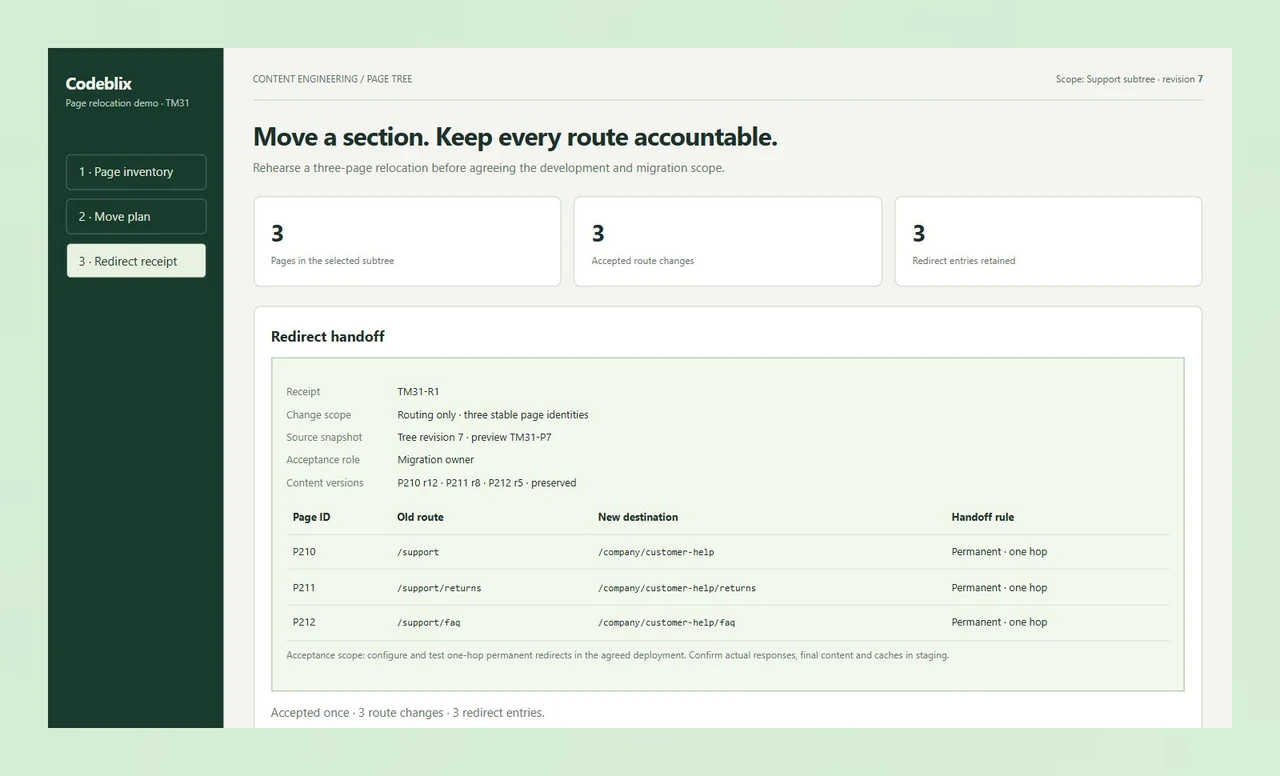
| Handoff receipt | TM31-R1; three old/new route pairs; retained content versions | Preserve the accepted map when the action is repeated. |
Support begins at /support, Returns at /support/returns and FAQ at /support/faq. Moving the root beneath Company with the segment support conflicts with P450. Using customer-help produces /company/customer-help, /company/customer-help/returns and /company/customer-help/faq. Accepting the valid map records three route changes and three redirect entries. Page IDs remain P210, P211 and P212, with content revisions r12, r8 and r5 preserved. A cycle, invalid segment, unacknowledged map, Content editor action or stale preview leaves the accepted count at zero. Repeating a completed acceptance keeps TM31-R1 unchanged.
Give each provider the same task to quote.
Assess the engagement against your installation, required allocation and receiving team's acceptance cases.
| Option | Published focus | Ask in your demo |
|---|---|---|
| ProtonBits | Describes website and module development, upgrades and support, with project, team and hourly engagement options. | Which engagement includes the descendant-route inventory, staging checks and source transfer for our change? |
| DevStudio360 | Offers Silverstripe developer hiring and discusses dedicated monthly allocation and engagement terms. | How will the allocation cover collision handling, acceptance review and the receiving team's deployment work? |
| ManekTech | Presents custom CMS and migration work with dedicated monthly and project delivery models. | Who owns the URL map, final HTTP checks and recovery decisions when the section moves? |
Submit one defined change and request a written scope. Compare allocation, milestones, acceptance evidence, source ownership and release responsibility alongside price. The subtree exercise supplies a concrete common task without assuming that providers use the same delivery process.
Category reference: Silverstripe primary reference: URLSegment, Link and page hierarchy. Carry the old-to-new path map into staging verification and the final redirect handoff. Confirm additional language, virtual-page and extension behavior against the installed project.
Connect your CMS work to a clear software brief.
Explore other Codeblix development engagements and bring each platform's own data, roles and acceptance requirements to the consultation.
Explore marketplace development engagementsPrepare a specific Silverstripe development enquiry
Settle the scope, allocation and receiving responsibilities before commissioning the work.
What should I send when requesting dedicated Silverstripe developers?
Send the installed CMS and PHP versions, custom packages, repository arrangement and a prioritised change request. Include the preferred allocation, review availability and person responsible for acceptance. A synthetic page or module example helps define the technical assessment and quotation.
Can Codeblix scope changes to an existing Silverstripe site?
Yes. Bring the current installation details and the task to commission, such as a custom module, template change or controlled migration. The assessment establishes technical fit, access needs and delivery boundaries before the development scope and commercial terms are agreed.
What does the page relocation exercise let us inspect?
Inspect the Support subtree, select its new parent and preview every affected destination. The exercise rejects an occupied route, a descendant-parent cycle and an invalid segment. It also checks the accepting role, explicit acknowledgement and source-tree revision before retaining a three-entry redirect receipt.
Does moving a parent page require checking its children?
Include descendants in the routing inventory wherever their resolved addresses depend on the parent hierarchy. In TM31, the Returns and FAQ destinations change with Support. Test the installed project's templates, route extensions, translations and virtual pages to determine the actual affected set.
How do we accept a preview after another editor changes the tree?
Agree what changes invalidate the review and how the current inventory is rechecked. TM31 advances its source revision and rejects the older preview until it is rebuilt and acknowledged. The commissioned implementation needs persistent server checks that cover the agreed concurrent-edit cases.
How are rates, availability and the developer allocation agreed?
Request commercial terms after the codebase, backlog and delivery constraints have been assessed. Agree the billing basis, start window, allocation, review points and process for additional work. Include testing, release assistance and continuing support where they are required.
Can we include migration or integration work in the engagement?
Provide the source records, target content model and relevant API documentation with the request. Define field ownership, identity mapping, authentication and reconciliation cases. Quote the migration or connection work with its own staging and cutover responsibilities.
What should the team receive when the work is handed over?
Receive the accepted source revision, dependency and configuration notes, completed checks and deployment instructions. For a routing change, retain the page-ID and old/new URL map with the redirect verification results. Name the owner for recovery, defect reporting and ongoing maintenance.