
Control the change that becomes public.
Treat review status, published content and a newer working copy as separate facts in the delivery specification.
Preserve the live revision during review
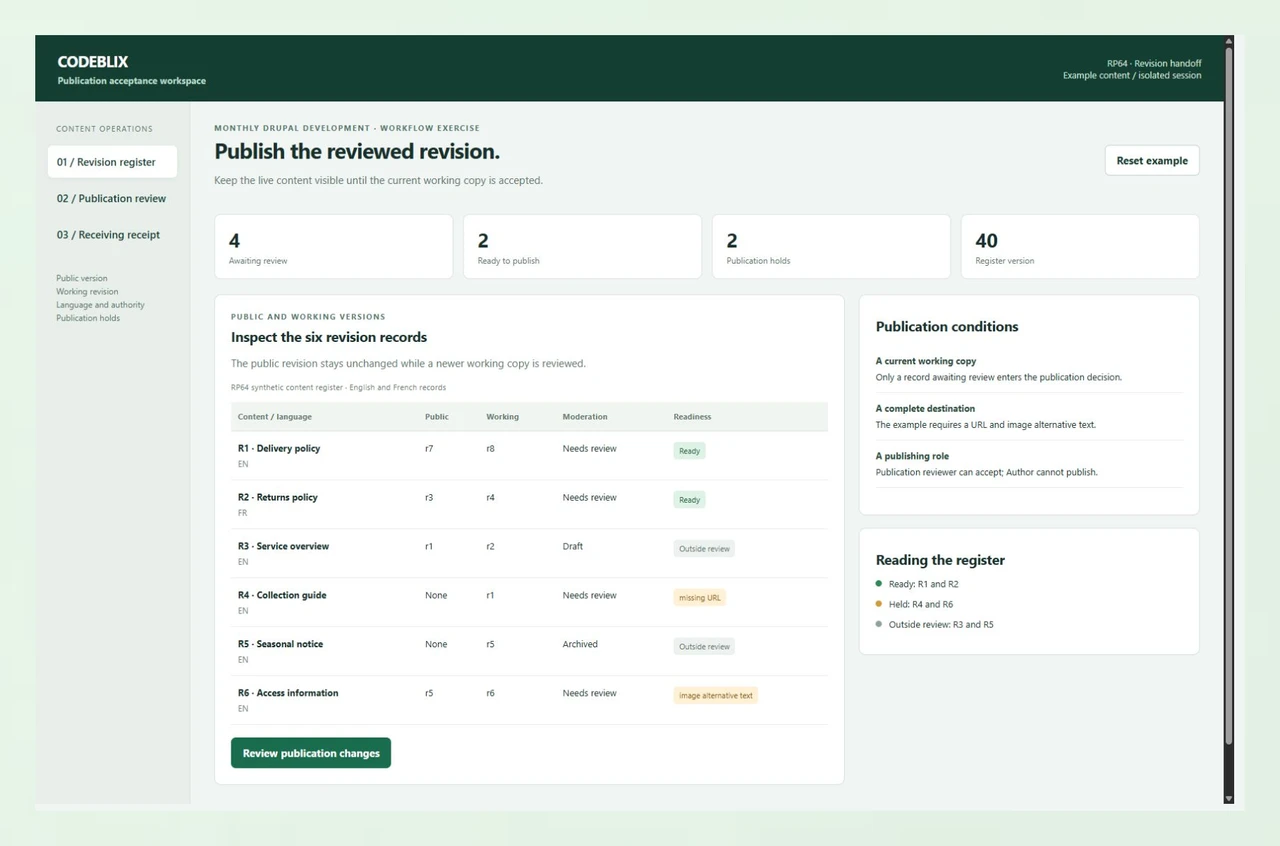
R1 has public revision 7 while revision 8 awaits review. Preparing a batch leaves revision 7 live. Only an accepted publication advances its public pointer to 8. This distinction makes the reviewer’s decision visible and gives the receiving team a precise result to check.
Hold the exact item that cannot be published
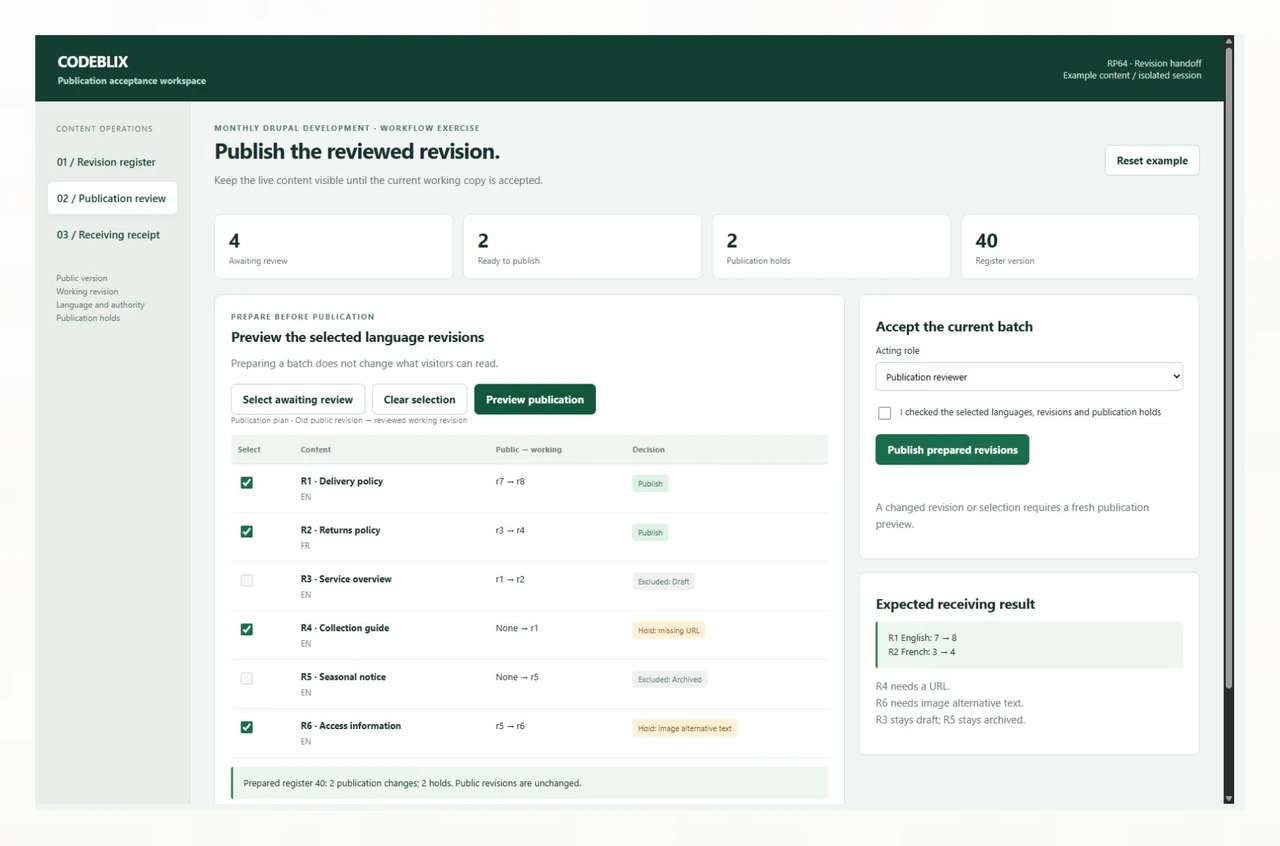
R4 is ready for review but has no URL; R6 has a URL but lacks image alternative text. Both stay in review with their own reason. R2’s French revision is assessed independently from R1’s English revision. A hold should identify the record, language and correction owner.
Reject a plan based on an old working copy
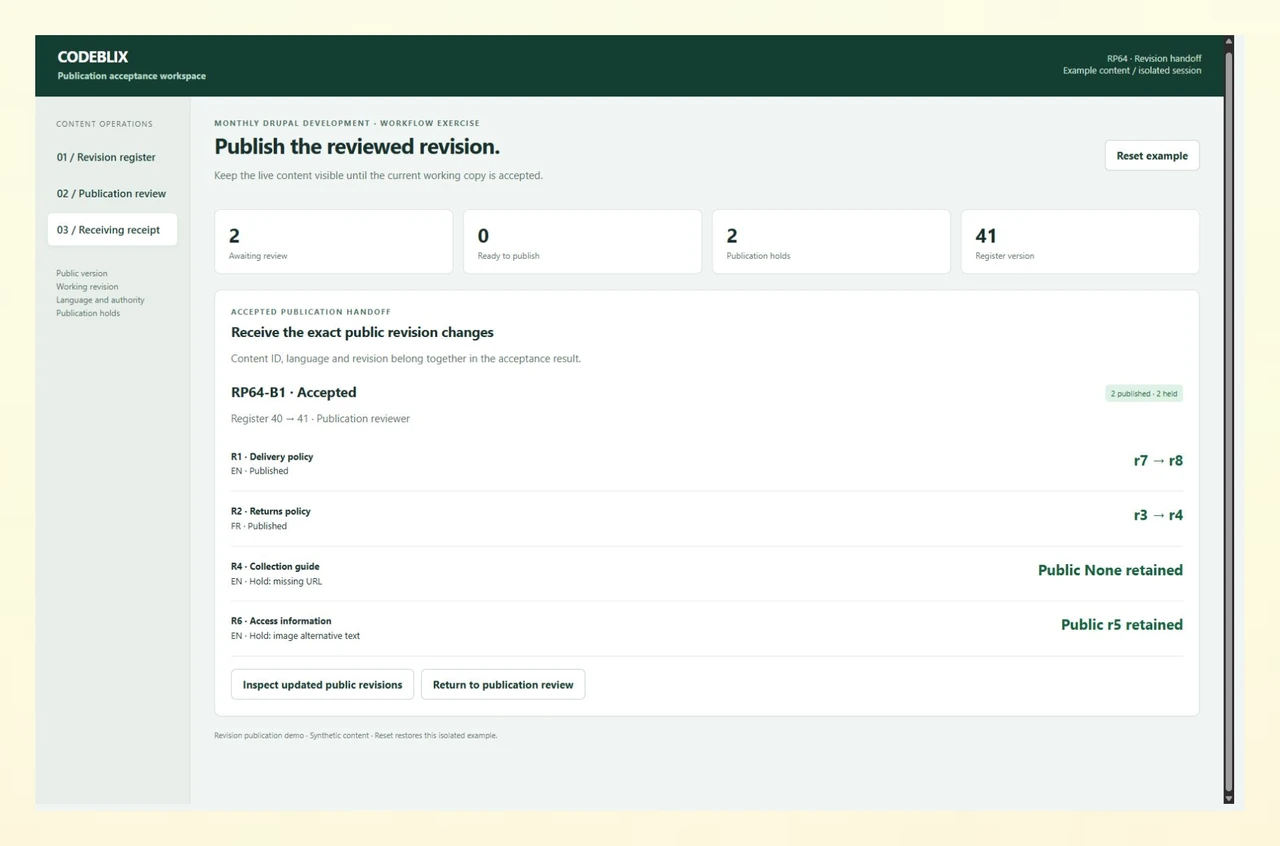
The concurrent-edit example changes R2 after preparation. Applying the earlier batch must be refused, even if the reviewer previously acknowledged it. A new preview reads the current revisions. The accepted receipt retains the old and new public revision numbers for the exact selected items.
Show exactly what your reviewer is publishing.
The RP64 workspace keeps the public and working revisions side by side. R1 in English and R2 in French can advance; R4 needs a URL and R6 needs image alternative text. A draft and an archived record remain outside the publication batch. Preview the changes, check authority and receive a revision receipt.
Give the developer a result your content owner can verify.
Use the live exercise and twenty-case checklist when requesting an allocation. The linked Drupal references explain core moderation concepts; agree the additional publication checks and receipt fields in your own delivery scope.
Exercise the revision publication handoff
Compare public and working revisions, preview a batch and accept it as the reviewer. Switch to Author or simulate a concurrent edit to check the refusal behavior before agreeing your first development milestone.
Open the revision publication demoConfirm core content moderation behavior
Drupal documents a live published revision alongside a separate working copy and explains role permissions and language-specific moderation. Check those concepts against the version and configuration in your installation. Primary reference updated 18 August 2026.
Drupal primary reference: content moderationAgree the states and transitions
Drupal Workflows provides states and transitions that can be configured for the content types involved. Record the allowed transitions and which roles can use them in the development scope. Primary reference updated 21 November 2024.
Drupal primary reference: WorkflowsScope a separate CMS in its own application
If your agency also maintains Umbraco, use an engagement that addresses its content model and development environment. Keep each platform’s source, publication rules and receiving owner explicit.
Explore Umbraco developmentDefine the application, transitions and receiving evidence
A useful monthly backlog connects development time to an accepted change. Start with a small set of content revisions and the actual people allowed to publish them.
Inventory the Drupal installation and the monthly backlog
Provide the core version, Composer lockfile, custom and contributed modules, theme, hosting arrangement and source repository owner. Identify the first change and its content owner. Ask Codeblix to assess dependencies and quote a monthly allocation with delivery priorities, review dates and responsibilities.
Define what each state and revision means
In RP64, R1 is an English delivery policy with public 7 and working 8; R2 is French returns content with public 3 and working 4. Both await review. R3 remains a draft, R4 is a new page without a URL, R5 is archived, and R6 lacks image alternative text. Keep state, language, latest revision and current public revision distinct.
Specify publication prerequisites and authority
The demonstration permits a Publication reviewer to accept a prepared batch after acknowledgement. An Author cannot publish it. URL availability and image alternative text are explicit project checks. Map these responsibilities to the actual Drupal roles, content types and transition permissions before implementation.
Prepare the revision changes without publishing
Select the four records awaiting review and preview their current versions. R1 can advance from 7 to 8 and R2 from 3 to 4. R4 and R6 show separate holds. The register still exposes the old public revisions until the reviewer accepts the plan, so preparation has no public side effect.
Recheck the selected revisions at acceptance
Accept only the current selection and version under the publishing role. If another author edits R2 after preview, the old batch is stale and must be prepared again. Define the real receiving transaction, concurrency check and failure response with the development owner.
Hand over the accepted changes and outstanding corrections
RP64-B1 records R1 English 7→8 and R2 French 3→4, while R4 and R6 remain held. R3 stays draft and R5 archived. Receive the source changes, exported configuration, acceptance evidence and release instructions with the monthly milestone. Assign the unresolved content corrections to a named owner.
Set the allocation and delivery boundaries in the quotation
- State the reserved development allocation, communication hours, monthly priorities and acceptance owner. Identify what happens when a dependency, content decision or access approval is delayed. Agree availability, rates and any minimum engagement directly with Codeblix after assessment.
- List the custom modules, contributed packages, external APIs and authentication owners involved in the first milestone. Identify which behaviors belong to configuration and which need code. Estimate integrations against actual documentation, authorized access and a defined receiving response.
- Name the staging and release owners, backup procedure, rollback point and release window. Supply synthetic content for development and separate test permissions from production access. Include configuration export/import and dependency verification in the handover.
Define content migration, publishing operations and support
- For migrated content, reconcile entity IDs, language codes, revision history, aliases, media references and moderation states. Keep the source-to-target mapping and unresolved items visible before switching public routes. Quote redirects, content cleanup and migration reruns as explicit work.
- For the editorial change, agree whether missing URLs or media descriptions should block publication, who corrects each hold and how language reviews proceed. Determine which preview becomes stale after another edit and where the accepted revision information is retained.
- Receive source code, dependency changes, exported configuration, the completed acceptance checklist and instructions for the publishing team. Specify the defect-support period, operational monitoring owner and the process for requesting later backlog changes.
Six records that make a publication change testable
Define the application baseline, content versions, publication conditions and receiving result before assigning the first monthly milestone.
| Record | Example inputs | Required output and control |
|---|---|---|
| Application baseline | Core version, modules, theme, Composer dependencies, hosting and source owner | Assess the permitted development route and release responsibilities for this installation. |
| Revision identity | Content ID, language, working revision, public revision and moderation state | Keep the current public version independent from an unpublished working copy. |
| Publication prerequisites | R1/R2 ready; R4 missing URL; R6 missing image alternative text | Promote only the ready records and retain specific correction reasons for held items. |
| Review authority | Publication reviewer or Author; explicit acknowledgement | Require the role allowed to publish and a deliberate acceptance of the selected changes. |
| Current publication plan | Selected IDs and expected working versions; concurrent R2 edit | Refuse a stale or changed selection before any public revision is advanced. |
| Receiving receipt | RP64-B1; R1 en 7→8; R2 fr 3→4; R4/R6 held | Reconcile exactly which language revisions became public and which remain outstanding. |
The initial register contains six synthetic content items. Four await review. Preparing those four produces two ready changes and two holds. Acceptance moves the public revisions for R1 and R2 to their working versions without publishing R4 or R6. The accepted receipt carries the same content IDs, languages and revision numbers. An Author cannot accept the batch, and editing R2 after preparation makes the earlier preview stale.
Request an allocation tied to a receiving milestone.
Give each provider the same application inventory and publication case, then ask how its engagement will deliver and verify that change.
| Option | Published focus | Ask in your demo |
|---|---|---|
| Pennine Technolabs | Monthly allocation plans, scope and hour bands, custom modules, themes, migration, integrations, review calls and an enquiry/plan selection path. | Which revision, permission and concurrent-edit cases belong to the first monthly delivery? |
| Skynet Technologies | Monthly dedicated engagement, minimum term, fixed-price and staff augmentation models, module development, migration and quote/hire paths. | How will held content and language-specific publication decisions be accepted at handover? |
| Digis | Staff augmentation, module and theme work, migration, support, developer matching and a direct contact route. | What source, configuration and receiving evidence accompany the development allocation? |
Supply the installed Drupal baseline, authorized source access and first delivery outcome with your enquiry. Request a written allocation, dependency assessment, acceptance method and handover. Use the revision exercise to discuss the implementation with the person who will approve publishing changes.
Category reference: Drupal primary reference: published and working revisions. RP64 is an interactive publication acceptance example. Its URL and media checks, batch preview and receipt format are requirements to agree for your application.
Explore other development engagements
Connect each application change to its own technical baseline and receiving owner.
Browse marketplace solutionsQuestions before commissioning monthly Drupal development
Clarify the allocation, application access and acceptance result with the people responsible for the site.
What should I include in a monthly Drupal development enquiry?
Send the installed version, module inventory, Composer dependencies, theme, hosting arrangement and source owner. Describe the first backlog item with sanitized content, the present behavior and the result your content team needs. Codeblix assesses access and dependencies before quoting the allocation.
How are the monthly allocation and costs agreed?
The quotation defines the time allocation, responsibilities, communication, delivery priorities and review dates. Agree rates, availability, minimum terms and the treatment of additional work directly with Codeblix. A clear first milestone makes the allocation easier to assess and accept.
Can the work be scoped around an existing Drupal site?
Yes. Start with the installed application and authorized source access. Identify the configuration, custom modules or theme behavior involved in the first change. The assessment should establish the implementation route, staging requirements and release responsibilities.
What does the revision publication demo let me check?
It separates working copies from public revisions. Four records await review: two can publish, one needs a URL and one needs image alternative text. Preview the batch, accept it under the reviewer role and inspect the exact revision changes and retained holds.
What happens when another author changes content after preview?
The prepared batch is refused because it describes older working versions. Prepare a new preview using the current records before accepting publication. Specify the corresponding concurrency check and refusal response for your actual Drupal implementation.
Can English and French content follow separate review decisions?
The example identifies each item by content ID and language. Drupal’s primary moderation reference explains that translations are moderated separately. Agree the reviewers, required fields and publication rules for each language in your own content workflow.
What is needed to quote an integration or content migration?
Provide the source and receiving systems, authorized API access owner, field mappings, language and revision expectations, media relationships and failure examples. Reconcile IDs and aliases in a staging sample before agreeing migration scope or an integration delivery.
What should we receive at the end of a monthly milestone?
Receive the agreed code, dependency changes, exported configuration, acceptance results and operating instructions. Identify the accepted revisions and outstanding corrections for a publishing change. Agree the release owner, rollback procedure, defect-support period and priorities for the following milestone.