
Hire a dedicated Umbraco developer for your publishing workflow
Hire a dedicated Umbraco developer through a Codeblix development engagement shaped around your content team's backlog. Bring the installed CMS version, document types and editorial decisions that need changing. Agree paid allocation, delivery milestones and acceptance responsibilities in a project quotation. For multilingual publishing, define exactly which culture changes, which shared fields stay fixed and who authorizes the release.
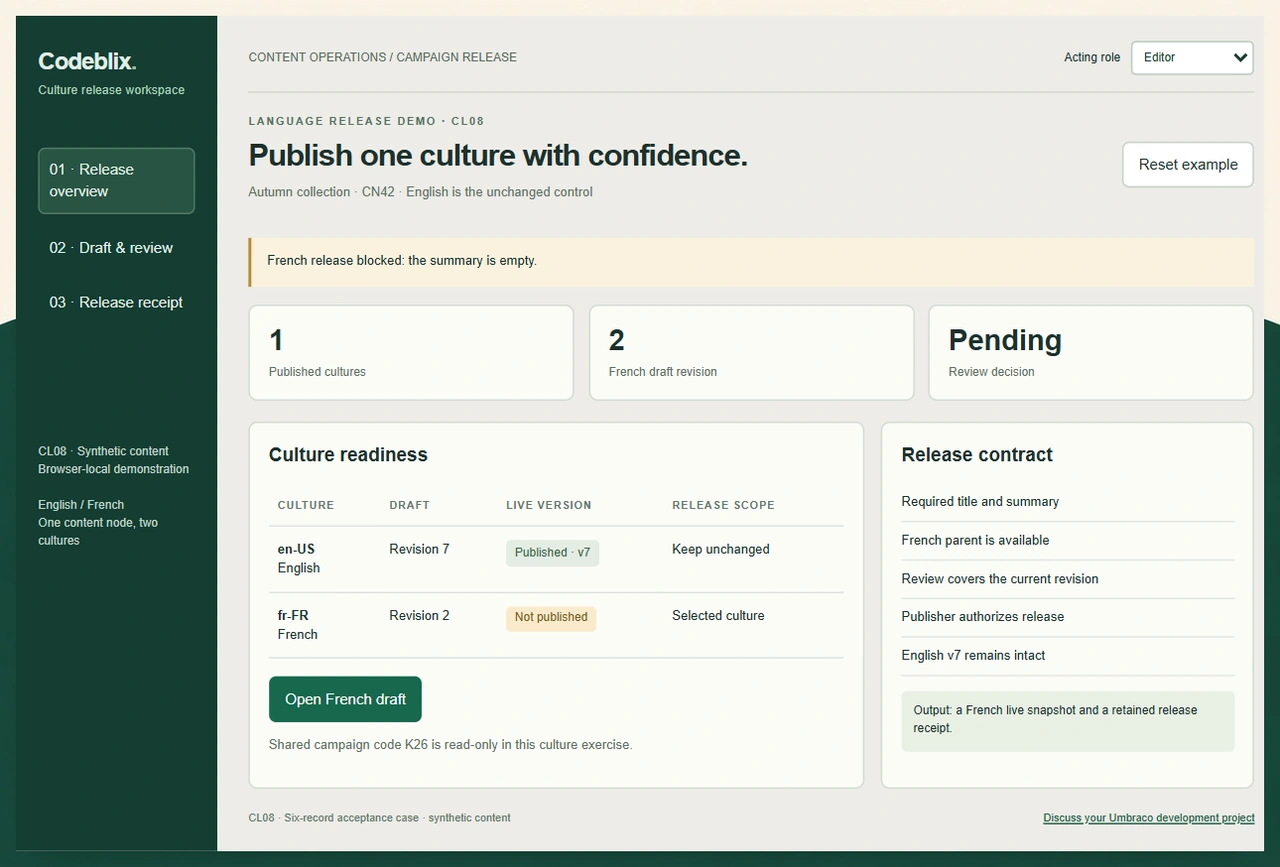
Make the editorial change measurable at acceptance.
A CMS backlog becomes easier to commission when each task names the content model, editor action and resulting public output.
Give document types a clear purpose
Identify the page types and property editors involved in the requested change. Mark each field as shared or language-specific and distinguish a saved draft from the published value. Include relationships, media references and required content in the acceptance sample.
Connect permissions to a real release decision
Name the people who prepare, approve and publish content. Specify language access, parent-page dependencies and what happens after an approved draft changes. Give the developer a reproducible case that exposes an incorrect publication boundary.
Agree how dedicated work reaches production
Set the allocation period, backlog priority owner and review cadence. Include code review, content rehearsal and release assistance in the commercial scope. Decide how production support affects planned development and who accepts a completed milestone.
Follow a French draft through a controlled release.
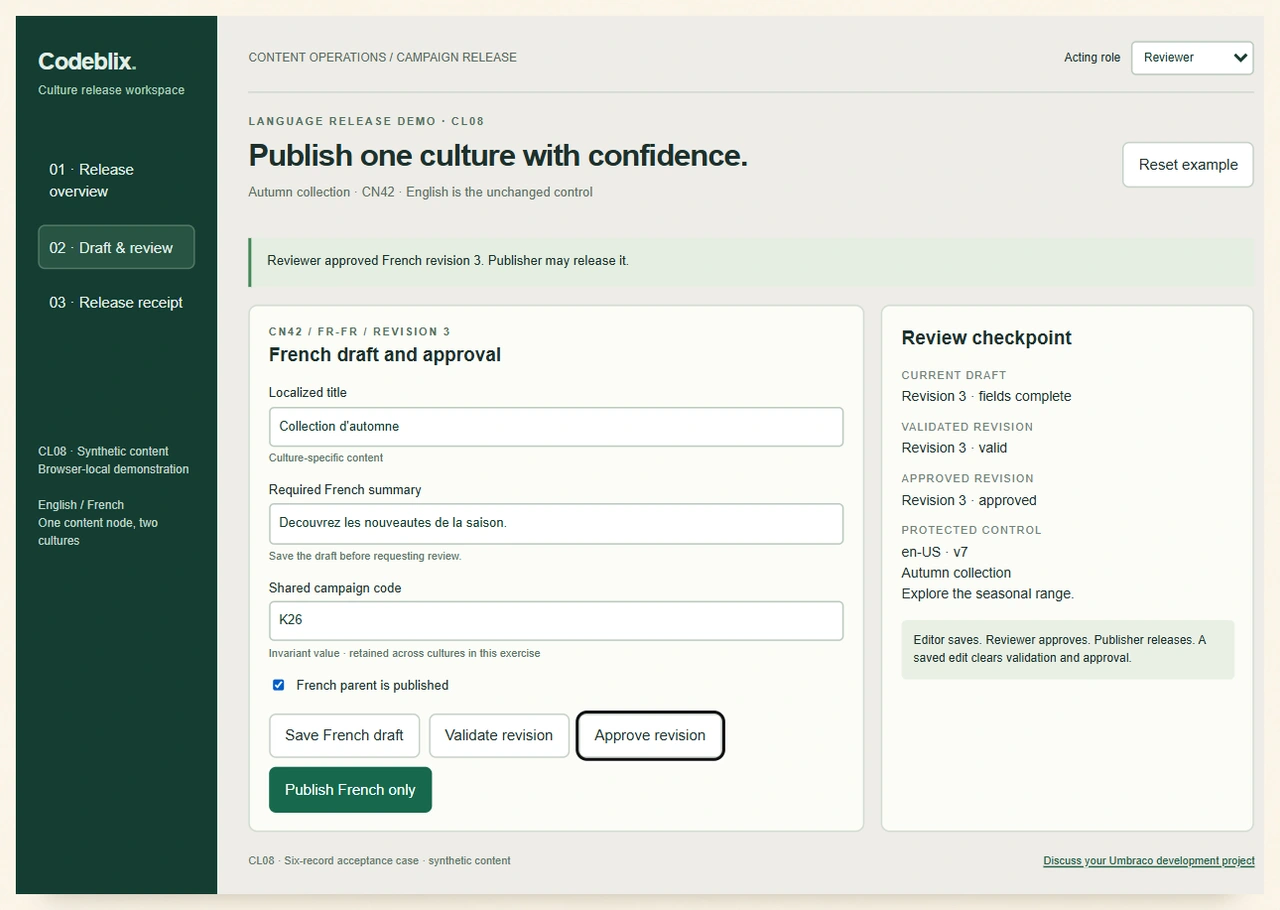
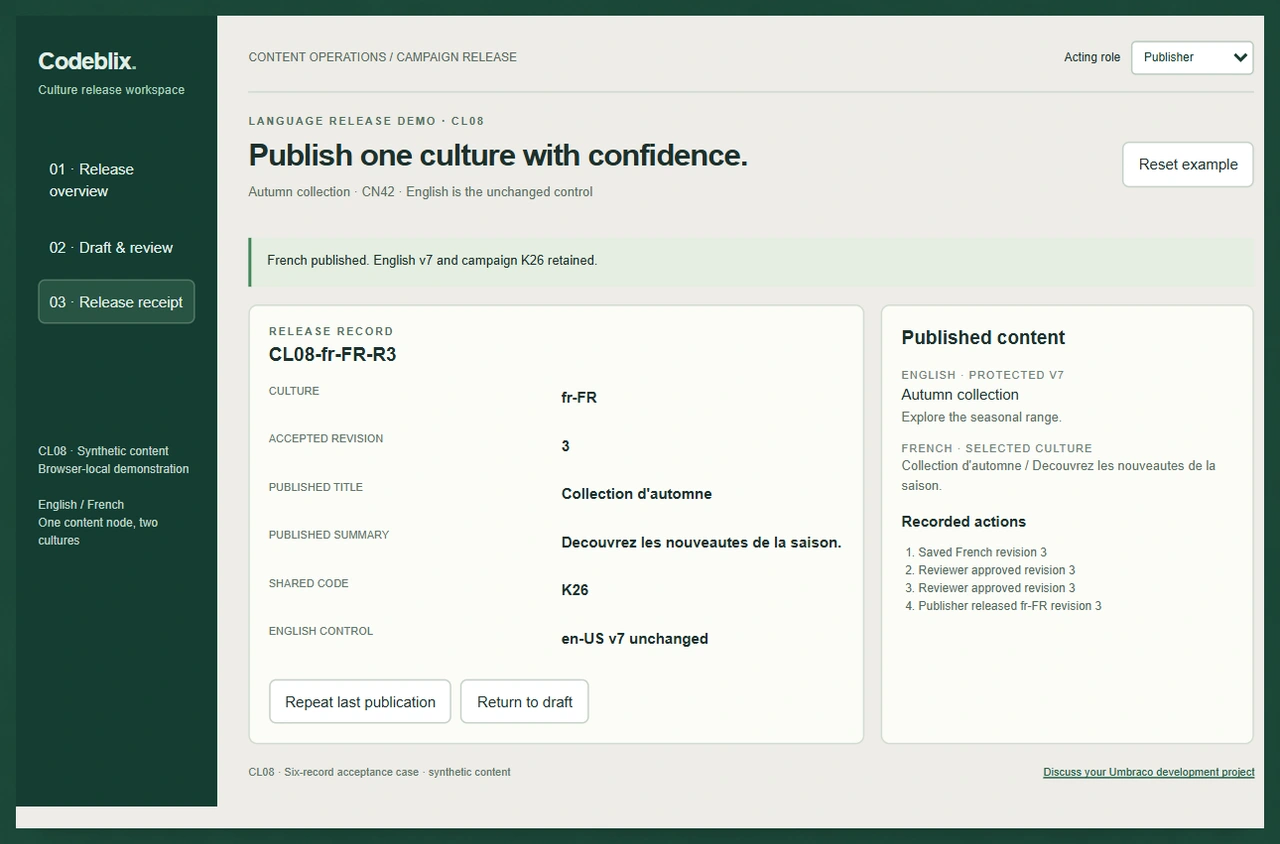
CL08 is a working language-release demo. Complete a required French summary, validate the saved revision and move between editor, reviewer and publisher roles. The release receipt retains the accepted French content while English v7 and shared campaign code K26 remain unchanged.
Run the culture-release acceptance exercise
Open CL08 and try validating the incomplete French draft. Enter the summary, save revision 3 and validate it. Switch to Reviewer for approval, then Publisher for release. Save another edit afterwards and check that it needs a new approval while the earlier receipt stays intact.
Open the working language-release demoConfirm which properties vary by culture
Umbraco's primary language-variant reference distinguishes translated properties from invariant values shared across languages. It also describes language access for user groups. Check the equivalent documentation for your installed version when defining field and permission changes.
Read Umbraco's language-variant referenceInspect language settings and public URLs
The official multilingual setup reference covers default, mandatory and fallback languages and publication choices. Include the current language configuration and culture URL mapping in your brief. Acceptance should check each affected public address and its intended content.
Check the primary multilingual configuration referenceKeep marketplace catalog changes in their own scope
If your wider project also changes a CS-Cart marketplace, give its seller catalogs a separate acceptance model. Content-node cultures and vendor-specific product keys require different controls, even when the same business owner coordinates both engagements.
Scope dedicated CS-Cart developmentSix steps from editorial requirement to supported release
Use the culture-release case to agree the content model, authorized roles, staging evidence and handover for the development allocation.
Describe the publishing decision
Choose a specific content-team task, such as releasing an approved French campaign without changing English. Record the current behaviour, desired public output and the people affected. Supply one complete example and one exception that the implementation must handle.
Inspect the installed CMS and allocation needs
Inventory Umbraco and .NET versions, document types, property editors, packages, custom code and hosting. Agree the developer allocation, communication hours and start conditions after the review. Name the commercial owner and technical reviewer for the engagement.
Define culture and permission boundaries
Map shared properties, translated fields, mandatory languages, domains and parent dependencies. Decide who can save each variant, who can review it and who can publish. Record whether approval covers a specific revision and how later edits invalidate that decision.
Build and demonstrate the change in staging
Use sanitized content to exercise the requested document type and editor controls. Demonstrate missing fields, unavailable parents, unsaved changes and unauthorized actions. Inspect the rendered language URLs as well as the editor's success message.
Rehearse content movement and production release
Map content identifiers, media, culture URLs and any redirects before moving data. Reconcile rehearsal counts and field values. Agree the accepted code revision, content backup, deployment operator and recovery steps for the actual hosting environment.
Hand over the operating and support responsibilities
Retain the release record, content-model decisions and repeatable acceptance cases. Assign responsibility for package compatibility, failed publications and future document-type changes. Set support coverage, escalation arrangements and the approval process for further development.
Prepare a useful Umbraco development brief
- Provide the site version, source repository, package inventory and representative document types. Identify licensed extensions and the party authorized to grant development access.
- Describe the editor journey in terms of saved content, review decision and published output. Include anonymized field values, language settings and the expected result after a failed action.
- State the allocation period, communication needs, launch constraints and priority order. Ask the estimate to separate discovery, implementation, content rehearsal, deployment assistance and maintenance.
- Agree ownership of custom code, content-model documentation and release access in the engagement terms. Confirm the developer's availability and start date with the quotation.
Set migration and integration boundaries
- For content movement, map source IDs, target document types, cultures, media references and historical URLs. Define how incomplete translations and missing media are reported and reconciled.
- For a translation service, CRM or external API, supply its current interface contract and test-access arrangements. Scope authentication, update direction, field authority, retries and failed-message ownership explicitly.
- For an upgrade, inventory packages and direct modifications before choosing the path. Agree staging rehearsals and compatibility checks against the intended Umbraco and .NET versions.
- Specify hosting, environment settings, deployment access and recovery responsibilities. Include content and media backup requirements without assuming that a code rollback reverses editorial changes.
Accept publishing behaviour and ongoing support
- Verify the chosen culture's live fields after release and compare the protected language against its baseline. Check navigation, media and the parent route with the same content sample.
- Demonstrate that unsaved edits cannot inherit approval and that a newly saved revision requires a new review. Keep the accepted revision and the authorized role with the release evidence.
- Clarify how editors report failures, who can retry a release and who authorizes changes to required fields or language rules. Define support hours and escalation contacts in writing.
- Maintain the content-model map and acceptance cases alongside the custom code. Review compatibility when packages, hosting or CMS versions change and estimate new functionality separately.
Six records for a multilingual development acceptance case
CL08 gives the quotation a small content model with one selected culture and a protected published control.
| Record | Example inputs | Required output and control |
|---|---|---|
| Content node | CN42 / Autumn collection / campaign K26 | Keep node identity and the shared campaign value stable during this French release. |
| Culture variants | en-US published v7; fr-FR draft revision 2 | Select French for publication and retain English as the unchanged control. |
| Required localized fields | Collection d'automne; an initially empty French summary | Require the title and summary to be saved before validating the candidate revision. |
| Publication dependencies | French parent availability; language and document-type configuration | Block the exercise when the French parent is unavailable; revalidate after that condition changes. |
| Review decision | Saved French revision 3; Editor, Reviewer and Publisher | Validate the current fields, approve as Reviewer and publish only as Publisher. |
| Release receipt | CL08-fr-FR-R3; campaign K26; en-US v7 unchanged | Retain the accepted content snapshot and return the earlier receipt for a repeated publication request. |
CN42 begins with English v7 showing Autumn collection and Explore the seasonal range. The French draft has title Collection d'automne and an empty summary. Enter Decouvrez les nouveautes de la saison. and save once to create revision 3. With the French parent available, validate revision 3, approve it as Reviewer and publish as Publisher. Receipt CL08-fr-FR-R3 retains those French values; English v7 and shared code K26 remain fixed. Repeating the request returns that receipt. A later saved edit clears the review decision and cannot replace the published French snapshot until the new revision is accepted. These are the explicit acceptance rules exercised by CL08.
Ask providers to demonstrate the same language boundary.
Compare allocation and delivery responsibility alongside the technical acceptance case. Confirm each provider's current commercial terms directly.
| Option | Published focus | Ask in your demo |
|---|---|---|
| Space Stem | Dedicated Umbraco developer hiring with flexible engagement and direct developer communication. | Which content-model, testing and release responsibilities are included in the agreed allocation? |
| Deazy | Matched Umbraco specialists and development teams for flexible project capacity. | Who owns the culture-release acceptance case when an additional developer joins the existing team? |
| ShooraTech | Developer engagements for new sites, upgrades, platform moves and continuing support. | How will the contract assign staging, content rehearsal and ongoing publication support? |
Use CL08 to inspect a concrete result during the quotation: one required translated field, one shared code, a parent dependency, revision-specific approval and an unchanged language control. The retained receipt makes the release outcome inspectable after another draft is saved.
Category reference: Umbraco primary reference: language variants and group access. Use documentation for the installed CMS version. CL08 adds a compact review and receipt model for discussing the publishing behaviour to commission.
Connect your content platform with related software work.
Keep CMS publication, storefront operations and external-system connections separately accountable within a wider development program.
Explore Codeblix development engagementsConfirm the dedicated Umbraco development scope
Agree the allocation, editorial responsibilities and release evidence before work begins.
How do I commission dedicated Umbraco development with Codeblix?
Send the consultation form with the installed version, editorial problem and prioritized changes. Include a representative document type and the output you expect. Codeblix reviews the requirements and confirms development allocation, start arrangements, milestones and commercial terms in the quotation.
What should dedicated allocation include?
Specify the allocation period, communication hours, backlog owner and acceptance reviewer. Agree which time covers investigation, implementation, review, deployment assistance and support. Clarify how priorities change and how additional requirements are estimated and authorized.
Can the work extend our existing document types and packages?
Provide the document-type definitions, property editors, package versions, licenses and custom code for inspection. Identify the editorial behaviour to preserve and the requested change. The estimate should name affected fields, templates, permissions and compatibility checks after that review.
What does the language-release demo let me check?
Complete the French summary and save revision 3, then validate, approve as Reviewer and publish as Publisher. Test the missing-parent and wrong-role paths. Confirm that English v7 and campaign K26 remain unchanged and that another draft edit leaves the earlier receipt intact.
How do we scope translation or business-system connections?
Supply the external interface documentation and identify the system responsible for each field. Agree update direction, authentication, delivery frequency, retries and reconciliation. Translation callbacks, failed updates and permission boundaries should have explicit acceptance examples in the commissioned work.
What information is needed for a content migration or upgrade?
List source and target versions, packages, content types, cultures, media and URL mappings. Include record counts and known exceptions. Agree a staging rehearsal, reconciliation checks and a recovery procedure that considers both editorial data and deployed code.
How are the price and development start confirmed?
The content model, existing customizations, hosting, integration work and acceptance scope determine the estimate. Request an itemized quotation with the allocation and proposed start arrangements. Package licenses, migration assistance and continuing maintenance need explicit commercial terms.
What should we retain after the developer hands over the work?
Keep the accepted code, document-type map, language rules, release instructions and content acceptance examples. Name the operator for publishing failures and the owner of package compatibility checks. Agree ongoing support coverage and the process for commissioning later changes.