
Make an application decision with visible evidence.
A catalogue result includes its address, ordering, page boundaries and data revision. Treat those facts as part of one acceptance case.
Keep a filter change on a valid page
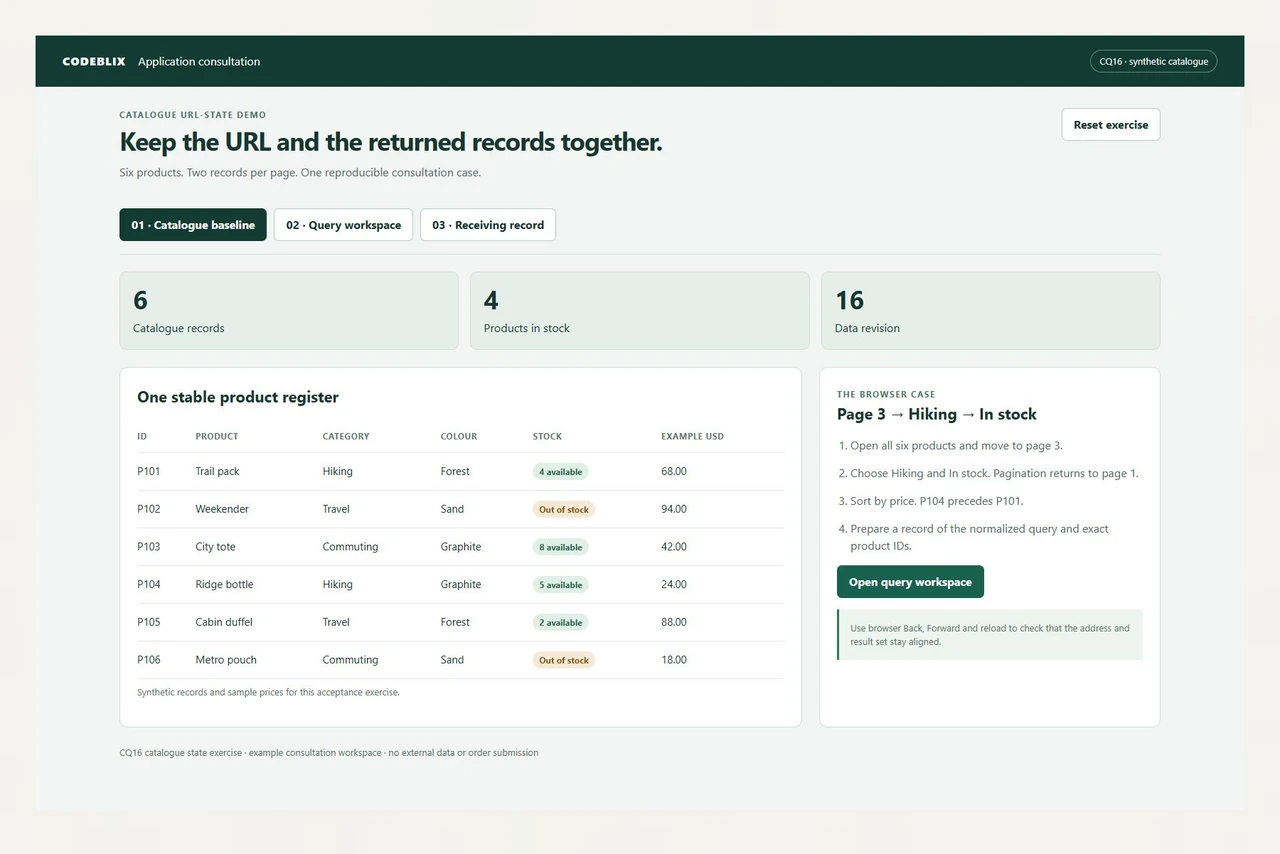
The unfiltered catalogue has three pages. Page 3 contains P105 and P106. Selecting Hiking leaves two products, so the page must reset to 1 rather than showing an empty third page. The example makes this boundary visible before the implementation is estimated.
Share the result through a normalized URL
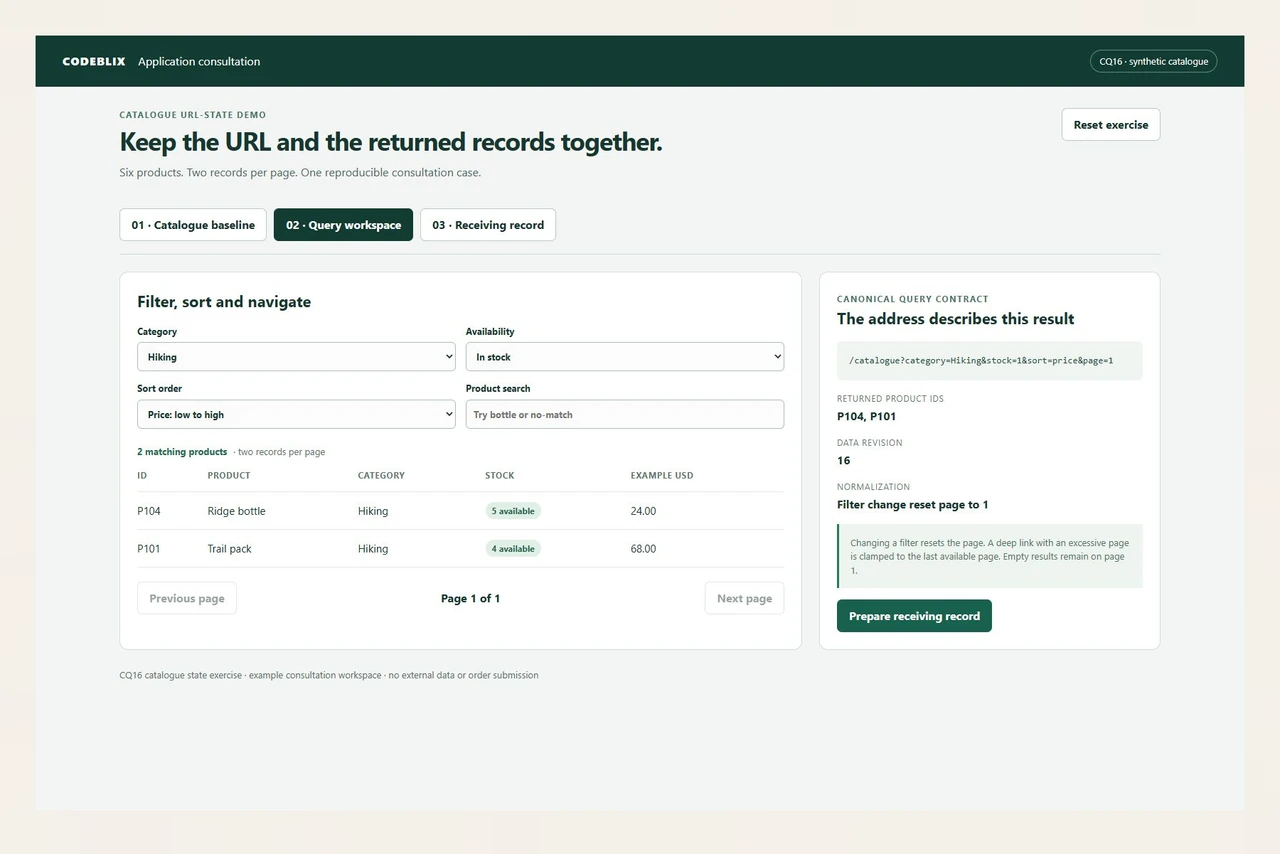
A Hiking, in-stock, price-ascending query returns P104 at 24.00 and P101 at 68.00 in the synthetic catalogue. The browser address carries the same filter and sort values. Reload, Back and Forward should recover the intended result; an excessive page number should resolve to an available page.
Accept a result against the data that was reviewed
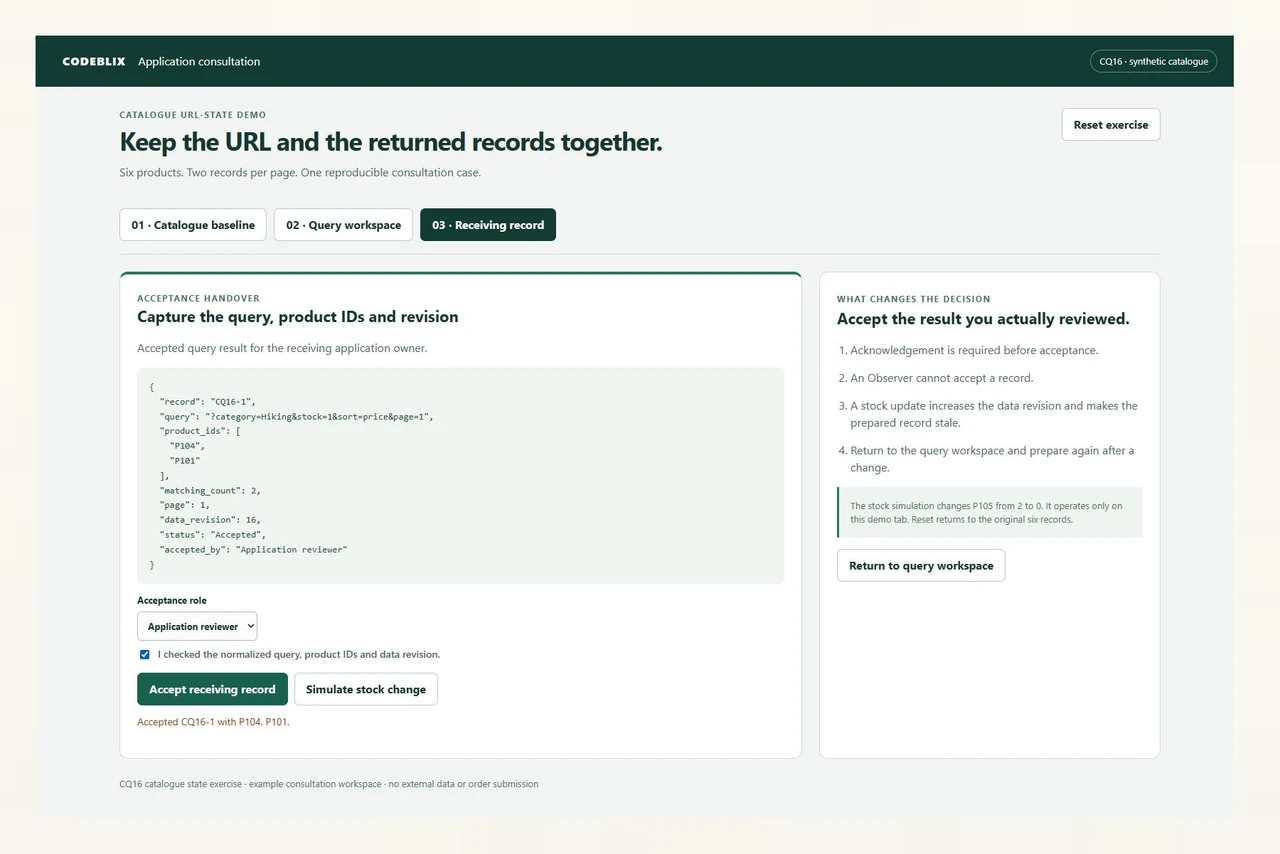
CQ16-1 retains the normalized query, ordered product IDs, matching count, page and revision 16. The reviewer acknowledges those fields before accepting. Simulating a P105 stock change advances the data revision and invalidates the earlier prepared record, giving the receiving owner a clear reason to review again.
Show the application result your team needs.
The CQ16 catalogue contains six products, four in stock. Move to page 3, choose Hiking and In stock, then sort by price. The result returns to page 1 with P104 before P101. A receiving record carries that query, those IDs and data revision 16 into the acceptance discussion.
Bring the route, data and expected browser result.
Use the interactive workspace and twenty-case checklist to describe the change. Apply the checks to the actual Nuxt installation, API contract and deployment arrangement when agreeing the development scope.
Try the catalogue URL-state exercise
Filter the six products, change pages and prepare a receiving record. Check browser history, an empty search, reviewer acknowledgement and a stock update that makes the prepared result stale.
Open the catalogue state demoCheck the route contract against Nuxt
Nuxt exposes query parameters through useRoute and documents timing and hydration considerations. Review the implementation in the version your application actually uses.
Nuxt primary reference: useRouteReview asynchronous data as part of the same change
The Nuxt useAsyncData reference covers reactive keys, request state and shared keyed data. Agree which inputs change the request and what the user sees while data loads or a request fails.
Nuxt primary reference: useAsyncDataKeep a separate content-system engagement explicit
If the frontend reads content from Drupal, supply the actual API contract and ownership details. Scope content-model or publication changes in the Drupal application alongside the frontend acceptance case.
Explore Drupal developmentPut the browser journey and its data contract in the same scope
A consultation is easier to quote when the problem can be repeated. Identify the application baseline, a small representative dataset and the person who will accept the corrected behavior.
Identify the Nuxt application and the decision to make
Provide the installed Nuxt and Vue versions, runtime, lockfile, modules, source repository and hosting owner. Describe the current browser behavior and the intended result with a sanitized reproduction. Request an assessment and quotation for the consultation deliverables and any implementation milestone.
Write the route and product-data contract
Record allowed category, availability, sort and page values, the product identifier and the API response shape. CQ16 uses six product IDs, two records per page and a data revision. Define which values belong in the shareable address and which user or authorization state must remain outside it.
Agree the boundary cases before changing code
Begin on page 3 of the full catalogue. Choosing Hiking must return to page 1 with P101 and P104. Adding In stock retains both records; sorting by ascending price puts P104 first. Specify invalid query values, zero matches and excessive page numbers as explicit acceptance outcomes.
Inspect the installed route and data-loading behavior
Review the relevant page, composables, API request and cache-key inputs against the agreed contract. In the real Nuxt application, assess server rendering, client navigation, hydration and loading/error states with the installed dependencies. Use the official Nuxt references below to frame that review.
Implement and review one bounded change
Agree the code, tests, data fixtures and staging access needed for the milestone. Compare direct navigation, reload and browser history against the same expected IDs and ordering. Keep API changes, authentication work, migration and deployment work visible as separate quotation items when they are required.
Receive the result and the release instructions
The example receiving record identifies the accepted query, P104/P101 ordering and data revision. For your application, receive the implementation changes, completed acceptance evidence, dependency notes and operating instructions. Name the release owner, rollback point and support contact for the agreed delivery.
Define the consultation and implementation boundaries
- Ask for a written consultation scope covering the application inventory, reproduction, technical findings, recommended change and acceptance criteria. Agree the consultation fee, availability, deliverable format and whether implementation is included or quoted separately after assessment.
- Supply authorized source access through an agreed channel, sanitized API responses and the relevant deployment configuration. Identify API limits, authentication ownership and third-party dependencies before estimating integration changes. Keep private credentials and customer records out of the enquiry.
- For a version upgrade or migration, list modules, runtime requirements, route redirects, stored query values and content API changes. Require a staging sample and an agreed switchback plan before committing the production change.
Specify release ownership and ongoing support
- Record the hosting provider, build and release process, environment owner and rollback procedure. Include server-rendered output, client navigation and browser-history checks where relevant to the scoped change. Agree who runs the release and who signs off its result.
- Define failure behavior for unavailable data, invalid filters and changed stock. Distinguish the accepted dataset revision from a later update. Document the evidence that should accompany a failed check so the receiving team can reproduce the problem.
- Receive source changes, dependency notes, completed acceptance cases and operator instructions. Specify the defect-support period, monitoring responsibilities and how later changes are requested. Availability, delivery dates and commercial terms are agreed against your application scope.
Six records for an application consultation handover
Use a compact model to connect the application baseline to a repeatable browser result and a receiving decision.
| Record | Example inputs | Required output and control |
|---|---|---|
| Application baseline | Nuxt/Vue/runtime versions, modules, lockfile, source and hosting owners | Assess the installed application and agree the boundary of the consultation. |
| Query contract | category, stock, sort, search and page; recognized values and defaults | Normalize invalid inputs and keep the address aligned with the visible controls. |
| Catalogue snapshot | P101–P106; category, colour, stock and sample price; revision 16 | Use synthetic records to make the expected result reproducible. |
| Page and ordering result | Two products per page; Hiking/in-stock/price returns P104 then P101 | Reset filters to page 1 and clamp excessive deep-link pages. |
| Acceptance authority | Application reviewer or Observer; explicit acknowledgement | Permit a deliberate receiving decision only for a currently reviewed result. |
| Receiving record | CQ16-1; normalized query, ordered IDs, count, page and data revision | Reject a prepared record after a query or stock revision change. |
The baseline has six synthetic products and four in stock. Page 3 contains P105 and P106. Selecting Hiking and In stock resets pagination to page 1. Ascending price returns P104 followed by P101. Prepare CQ16-1 and accept it as the application reviewer after acknowledging its query and revision 16. If P105 stock is changed from 2 to 0 before acceptance, revision 17 makes the earlier prepared record stale.
Give each provider the same browser case.
Request a consultation scope, implementation boundary and receiving evidence using the application inventory and catalogue case. Confirm current availability and commercial terms directly.
| Option | Published focus | Ask in your demo |
|---|---|---|
| Keith Mifsud | Architecture review, technical leadership and hands-on implementation with a contact and introductory consultation route. | Which route, data-key and browser-history checks will accompany the written consultation findings? |
| Findlay Web Tech | Vue/Nuxt consulting, architecture, performance and migration work, discovery call and written scope with commercial engagement options. | How will the proposed implementation reproduce the page-three filter reset and deep-link behavior? |
| mindtwo | Nuxt SSR/SPA development, requirements, conception, testing, integration, maintenance and a budgeted project-enquiry form. | What query, product-ID and data-revision evidence will the receiving owner use to accept the delivery? |
Request an application-specific assessment with a written result, agreed fee and implementation options. Use the working catalogue case to explain the behavior you need and the evidence your application owner will accept.
Category reference: Nuxt primary reference: route query parameters. CQ16 is a working catalogue state exercise with synthetic products. Apply its query and receiving checks to the application and API contract agreed in your consultation.
Explore application development engagements
Connect each application decision to its own technical baseline and receiving owner.
Browse marketplace solutionsQuestions before commissioning Nuxt application consultation
Agree the application inputs, consultation deliverables and implementation handover before the engagement starts.
What should I send with a Nuxt consultation enquiry?
Describe the installed Nuxt and Vue versions, runtime, modules, source owner and hosting arrangement. Include a sanitized reproduction of the application problem, the current result and the result you need. Codeblix assesses the application inputs before confirming the scope and quotation.
What does the consultation deliver?
Agree a written application assessment, relevant technical findings, recommended work and acceptance criteria in the quotation. The scope should identify dependencies, decisions required from your team and whether implementation and release support are included or quoted separately.
How are the consultation fee and implementation costs agreed?
The application baseline, reproducible case, access requirements and intended deliverables determine the quotation. Ask Codeblix to separate the consultation, implementation, integration, migration and release tasks where they have different dependencies. Confirm availability and commercial terms directly.
Can we start with an existing Nuxt application?
Yes. Provide authorized source access, dependency information and a small repeatable example. Identify the API and hosting owners so that route behavior, data loading and release requirements can be assessed against the installed application.
What can I check in the catalogue demo?
Move through three pages of six synthetic products, then filter Hiking and In stock. The page resets to 1. Sorting by price returns P104 before P101. Reload, Back and Forward retain the normalized query. An empty search and excessive page number have explicit results.
Why does the receiving record include a data revision?
It identifies the catalogue snapshot used for the reviewed result. In the exercise, a simulated P105 stock change advances revision 16 to 17 and makes a prepared record stale. The reviewer prepares again before accepting, so the receiving decision identifies current data.
Can the scope include a CMS or other API integration?
Provide the actual endpoint documentation, authorized access owner, field mapping, authentication method and failure examples. Agree the required response and ownership of changes on each side. Integration work is estimated against those verified inputs and the acceptance result.
What should be included in deployment and support handover?
Receive the agreed source changes, dependency notes, acceptance evidence and release instructions. Name the deployment owner, rollback point and monitoring responsibilities. Agree the defect-support period and the process for requesting subsequent changes in the engagement scope.