
Give the monthly allocation a concrete delivery target.
Tie each increment to an observable client journey and a receiving decision your product owner can make.
Specify the API boundary
Name the route, method, supported content types, required fields and response shape. Record which application component owns the behavior.
Protect the business write
Decide which failures must prevent a write, how duplicates are handled and what callers may retry. Receive the resulting records alongside the response.
Keep the service operable
Include configuration, deployment, recovery and support responsibilities in the same work item so the next developer can maintain it.
Inspect what gets written when a request succeeds or fails.
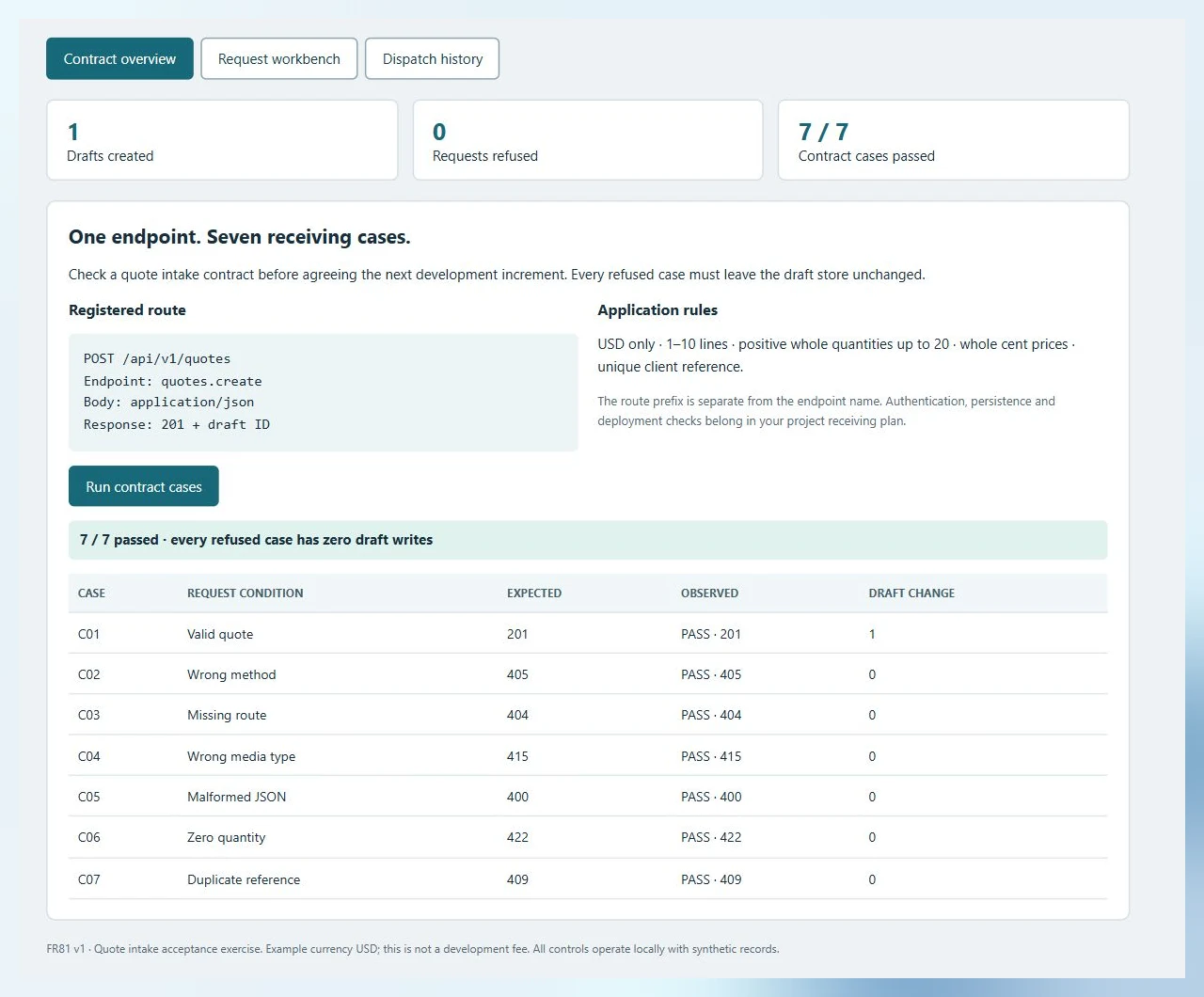
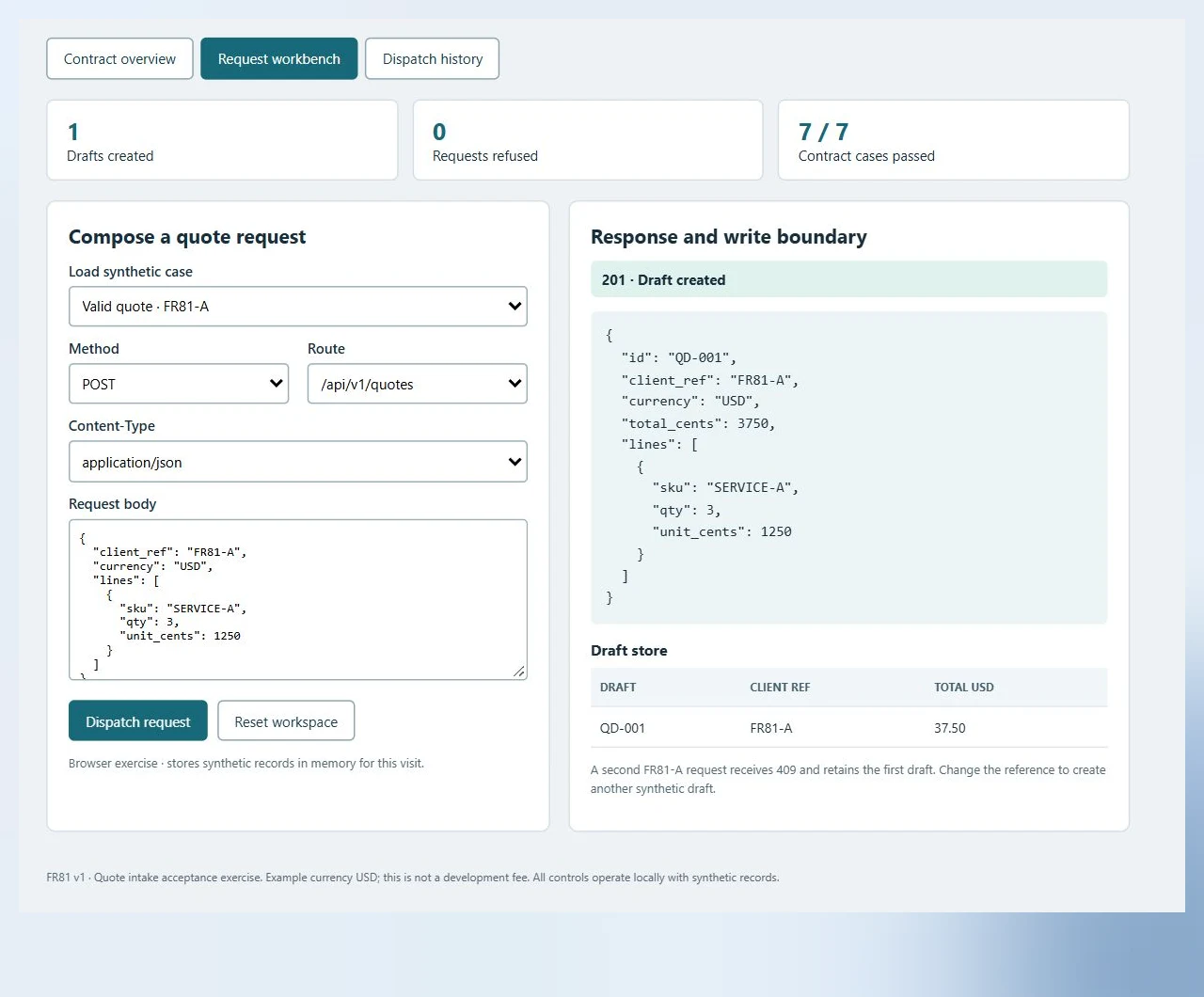
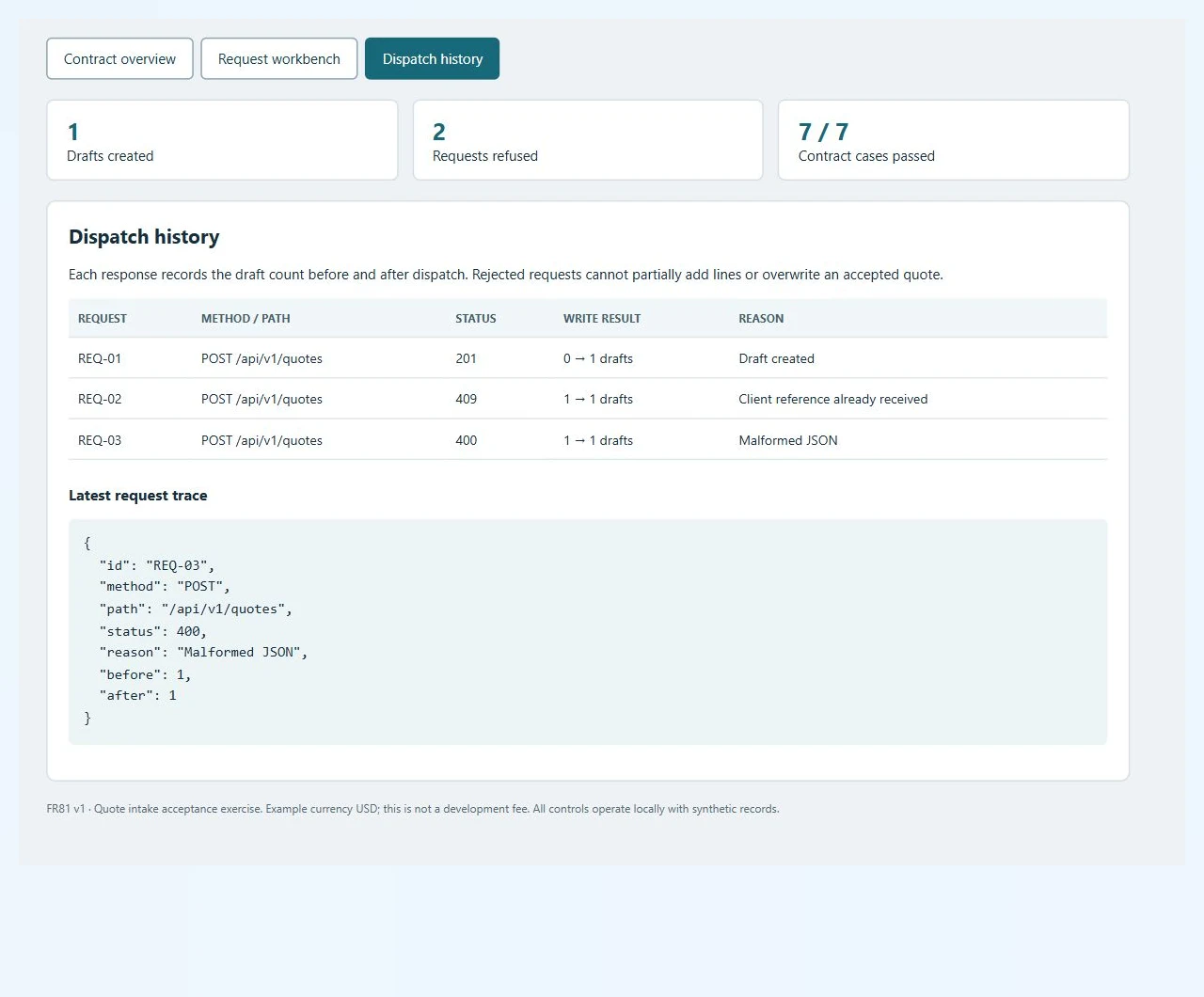
FR81 follows a synthetic quote request from route selection through JSON validation to a draft record. Run the contract cases, edit the body and inspect the dispatch history before defining the behavior you want to commission.
Bring one real integration journey to the scoping call.
A route and a sample record give the technical discussion a useful starting point.
Supply the runtime and calling client
List Python and Flask versions, dependency locks, the repository layout and current deployment command. Identify whether a browser, mobile client, scheduled process or partner system calls the endpoint. Share synthetic request and response examples through the agreed project channel.
Exercise the quote intake contract
Run FR81’s seven cases, then open the workbench. Dispatch FR81-A, resend it and load malformed JSON. Inspect the draft count in the history; the initial accepted quote remains intact after both refusals.
Open the request contract demoSeparate route names from URL placement
Flask blueprints group application operations. The blueprint name prefixes an endpoint name; the registered URL prefix controls the route location. Include both in the delivery brief when reorganizing a service.
Flask documentation: modular applications and blueprintsAgree JSON behavior for the installed release
The Flask request API documents JSON parsing and media-type handling, including a version change to unsupported-media responses. Ask the developer to demonstrate your installed version and chosen error handlers against agreed client cases.
Flask documentation: request JSON parsingKeep adjacent service changes coordinated
When a separate Node service consumes the Flask endpoint, give each side a versioned contract and its own release owner. Include cross-service receiving checks in the joint work plan.
Scope a connected NestJS serviceMove from a bounded request to a maintainable release.
Reserve time for investigation, implementation and owner review when agreeing the monthly allocation.
Choose the client outcome
Select the first endpoint or application journey from the backlog. State its caller, business record and expected result, then nominate the person who can accept that result.
Inspect the application boundary
Review routes, blueprints, authentication hooks, storage and existing error handlers in the supplied environment. Identify runtime or dependency work that must precede the requested change.
Agree allocation and scope
Set the monthly capacity, estimate basis, communication overlap and billing terms in the quotation. Name who may authorize a changed estimate or move another item into the allocation.
Implement and check failures
Develop the agreed increment with reproducible request cases. Verify the response, resulting records and absence of partial writes when validation or a downstream dependency fails.
Receive on staging
Let the product owner exercise the client journey against the identified revision. Record open observations and the deployment conditions before approving the release.
Release and transfer operating knowledge
Use the agreed deployment and recovery procedure. Hand over configuration references, contract examples and support ownership, then prioritize the next increment from the receiving results.
Records, roles and failure ownership
- Map the caller, request envelope, validated command, persisted record and response. Specify identifiers, currency or date rules, nullable fields and any uniqueness requirement at the actual storage boundary.
- Assign the product owner to business acceptance, the developer to implementation evidence and the operator to deployment approval. Real authentication and permission enforcement need server-side cases for the roles involved.
- Define malformed input, unsupported media, unknown routes, wrong methods, duplicate requests and storage failures. Set timeout, retry and reconciliation behavior for each external dependency included in the scope.
Migration and integration boundaries
- Identify existing clients and fields before changing an API. Agree the compatibility window, versioning or coordinated client release, and retain representative accepted and refused requests for regression checks.
- For a data transfer, supply a field map, source population and reconciliation totals. Agree dry-run output, rejected-record handling and recovery steps before any destination cutover.
- List external services individually with their documented API, authorization owner, direction and failure behavior. The estimate should cover the connectors actually commissioned and the access needed to verify them.
Commercial terms, deployment and support
- A monthly quote depends on allocation, application condition, dependencies and the responsibilities requested. Confirm the start date, fee or rate, review cadence, unused-capacity treatment and approval process for extra effort.
- Agree who controls the hosting environment and release pipeline. Include secret configuration, production server choice, dependency locking, backup verification, health checks and rollback authority in the operating plan.
- Set source ownership, documentation and support coverage in writing. Distinguish defect correction within the received increment from new behavior added to the backlog, and define how an urgent incident reaches the responsible operator.
A request-to-record model for your development brief.
FR81 makes an API receiving conversation tangible: the accepted response and the stored draft must tell the same story.
| Record | Example inputs | Required output and control |
|---|---|---|
| Route contract | POST /api/v1/quotes; endpoint quotes.create | Resolve the registered path and method before examining the business body. |
| Request envelope | application/json or an application/*+json media type | Refuse the unsupported content type before attempting JSON parsing. |
| Quote command | client_ref FR81-A; currency USD; SERVICE-A quantity 3 at 1250 cents | Validate the object and line fields before calculating the 3750-cent total. |
| Draft record | QD-001; FR81-A; USD 37.50 | Create one draft only after the complete command passes validation. |
| Refused request | Duplicate reference 409; malformed JSON 400 | Keep the first draft and its lines unchanged while recording the refusal. |
| Receiving evidence | Expected status; response fields; draft count before and after | Confirm every refused case produces zero additional draft writes. |
Dispatching FR81-A creates QD-001 for 3 × 1250 = 3750 cents, shown as USD 37.50. Sending the same reference again returns 409 and leaves one draft. Malformed JSON returns 400 and still leaves one draft. These are the exercise’s agreed application rules; set your actual reference, validation, error and concurrency contract with the developer.
Request a quote against a specific Flask work item.
Ask each provider to state what is included in the monthly arrangement and how the first deliverable will be accepted.
| Option | Published focus | Ask in your demo |
|---|---|---|
| Empiric Infotech | Offers dedicated Flask work with hourly or monthly arrangements and an enquiry path. | Which validation and refused-write cases accompany the first API increment? |
| StarNAVI | Describes Flask hiring, onboarding and hourly, bi-weekly or monthly payments. | Who receives the endpoint contract and approves its release to existing clients? |
| MaybeWorks | Describes Flask API, backend and maintenance work, including weekly or monthly flat-rate engagement. | How are compatibility changes, blocked dependencies and operating handover included in the allocation? |
Use the interactive write-boundary example to specify a receiving case for your own application. Add database transaction, simultaneous duplicate and authentication checks to the installed-system plan.
Category reference: Primary Flask request API reference. Flask’s current stable documentation identifies request JSON handling; application field validation and duplicate policy must be specified by the project.
Coordinate connected application development.
Explore related marketplace services when your Flask project exchanges records with another application.
Explore marketplace development offersSettle the engagement before commissioning monthly Flask work.
Use the written offer to resolve capacity, acceptance and operational responsibility.
Can Codeblix quote monthly development for an existing Flask application?
Send the runtime, codebase overview and the first prioritized work item. Technical assessment establishes the dependencies and a suitable allocation, followed by a quotation for the development and receiving responsibilities.
What determines the monthly fee?
The requested capacity, application condition, dependency work and delivery responsibilities shape the quote. Agree the rate or fee, billing period, working overlap and treatment of blocked or additional work before booking.
What should accompany an API change request?
Include the caller, path, method, synthetic body, expected response and affected business record. Supply a refusal example as well as a successful one, and identify the person who can approve the result.
Can the allocation include browser interfaces as well as API work?
Describe the complete journey and the screens that consume the service. The estimate can then identify interface changes, endpoint changes, permissions and end-to-end receiving checks as explicit deliverables.
How does the FR81 exercise help with receiving?
It lets you edit JSON and inspect route, method, media, validation and duplicate cases. A valid request creates a synthetic draft; refused requests leave that draft intact. Use those observations to write the cases required for your application.
How are existing integrations protected during changes?
Agree representative client requests, compatibility requirements and the release sequence before implementation. Include contract checks on staging and a recovery plan for each affected caller and data boundary.
Can hosting and deployment be included?
Identify the target hosting environment, operator and release pipeline during scoping. Agree the production server configuration, health checks, backup procedure, recovery authority and documentation included in the quotation.
What is handed over when a monthly increment is accepted?
Receive the source revision, request examples, receiving results and configuration instructions agreed for that increment. Record unresolved observations, support ownership and any follow-up behavior entering the next allocation.