
Resolve the behavior at each request boundary.
A successful HTTP response is only one part of an API contract. Make permission failures, rejected fields and retried commands equally explicit.
Separate the caller from the data it supplies
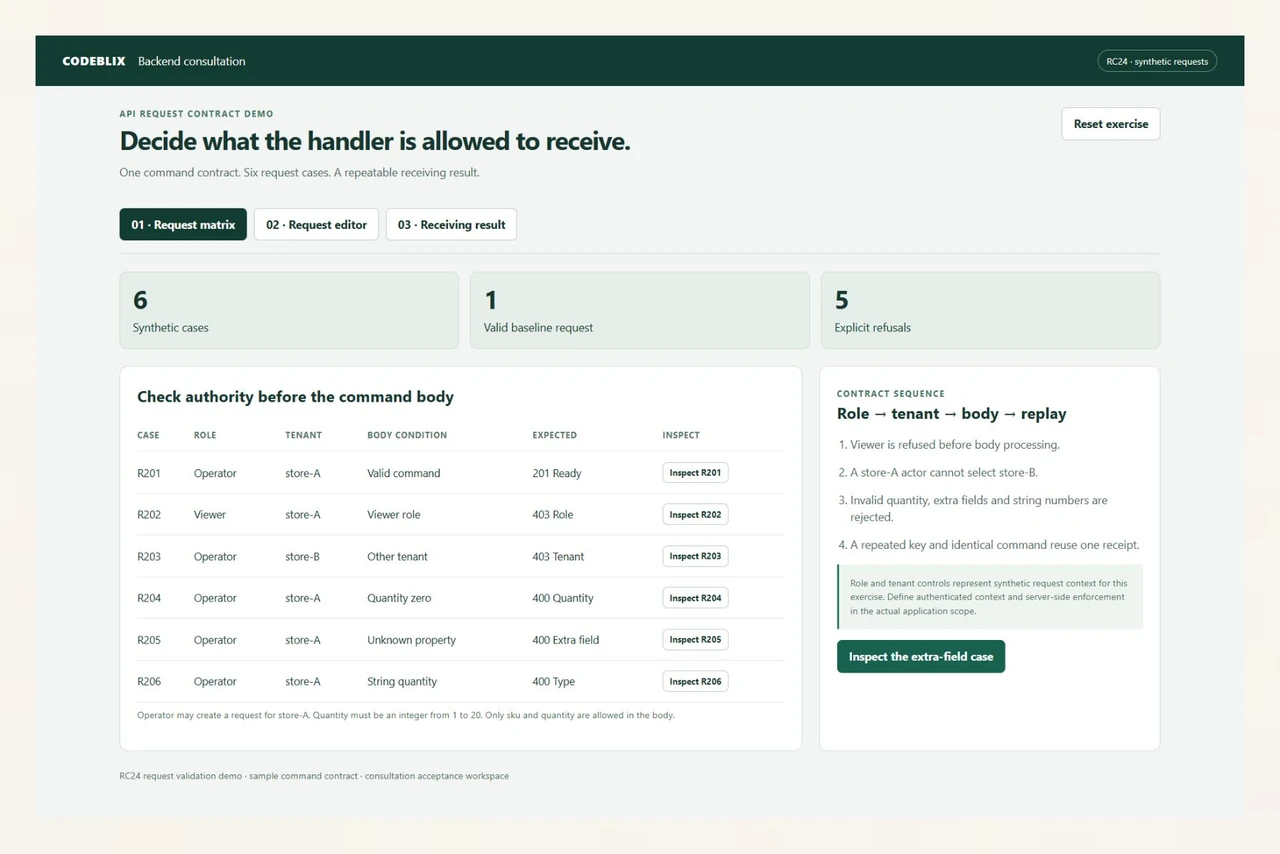
R202 uses Viewer and is refused with 403. R203 uses Operator but asks for store-B while the synthetic actor belongs to store-A. These are different decisions from a malformed body. In your application, establish the trusted identity and tenant source before estimating changes to endpoint access.
Define strict input behavior instead of guessing it
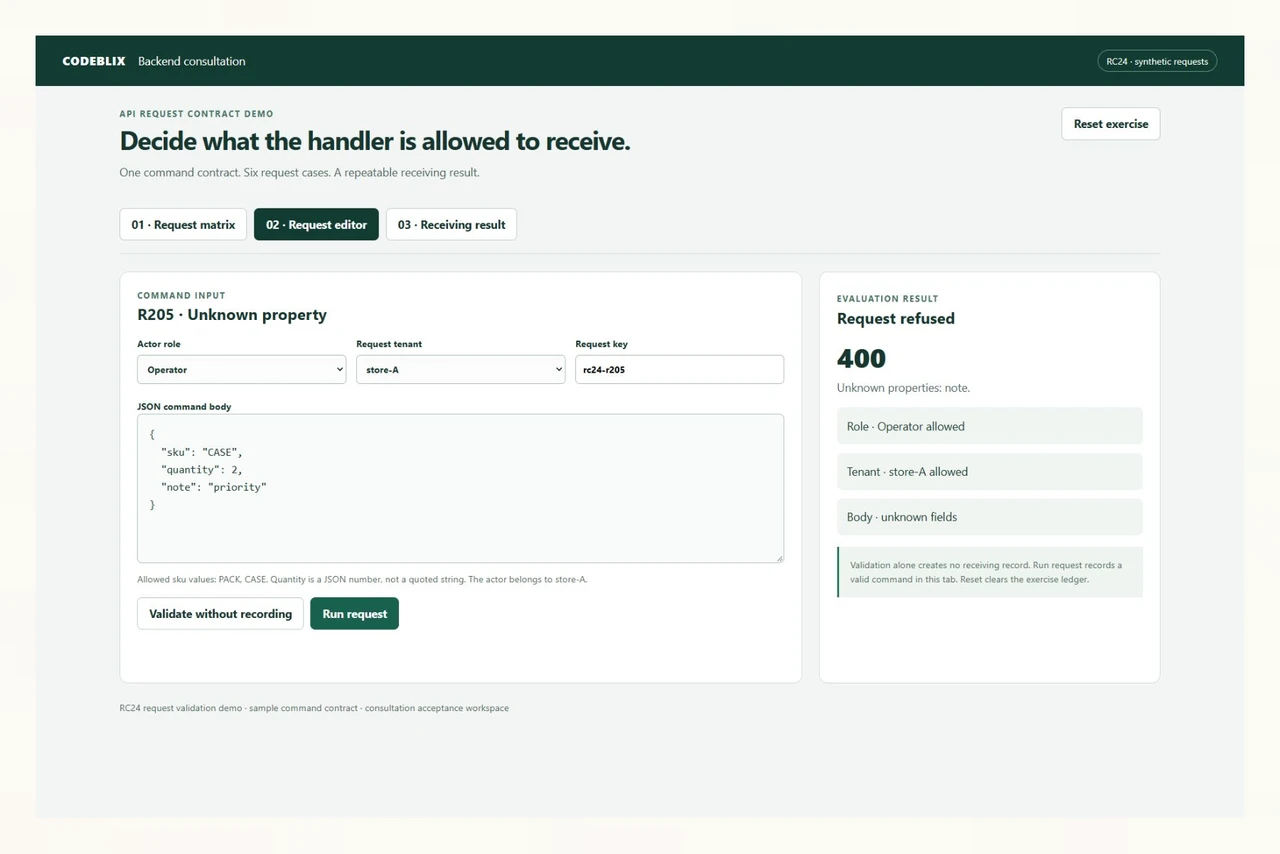
The example accepts PACK or CASE and an integer quantity from 1 to 20. R204 supplies zero, R205 adds note and R206 sends a quoted quantity. Each returns a specific 400 refusal. Removing note from R205 leaves a valid CASE command with quantity 2 and makes the intended correction clear.
Give a repeated command a stable result
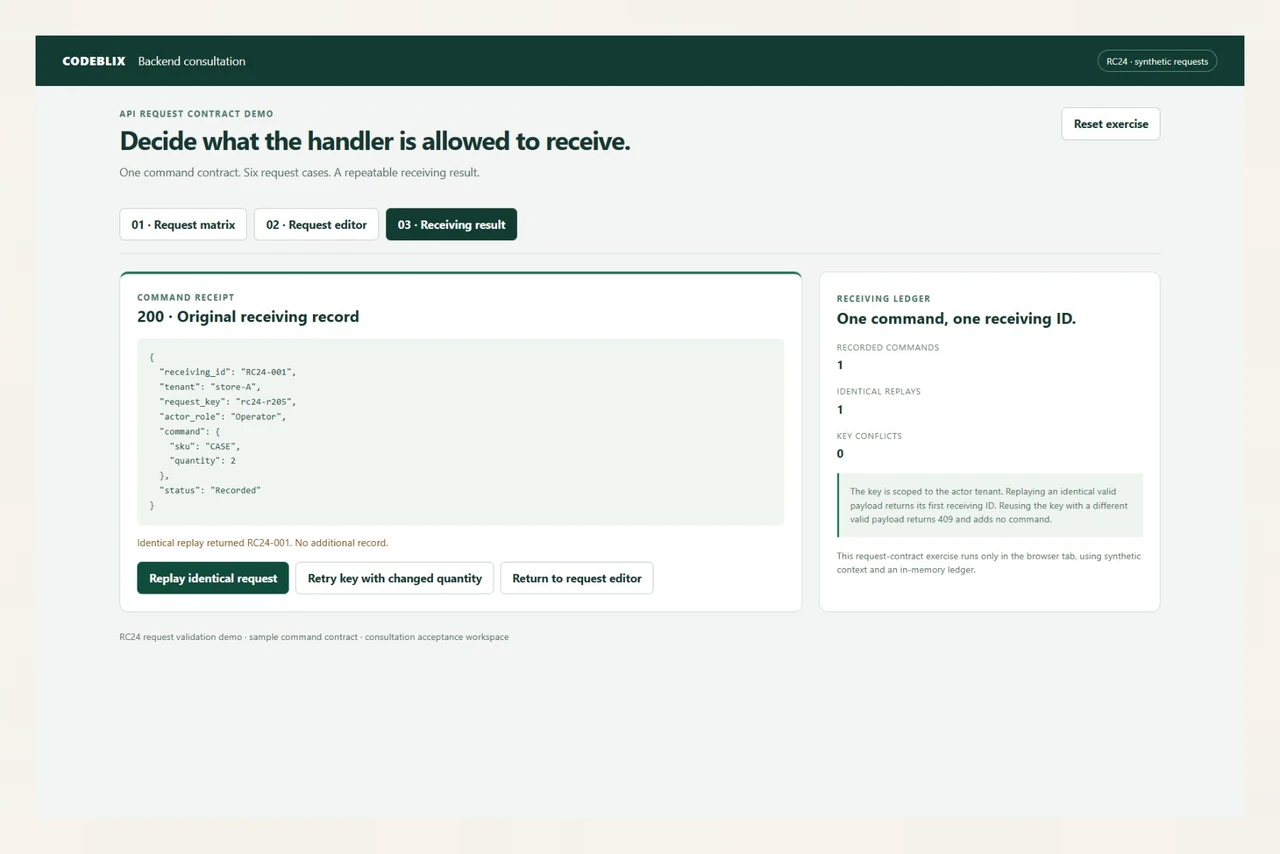
The corrected R205 command records RC24-001 under key rc24-r205 for store-A. An identical retry returns that same receiving ID and leaves the command count at one. A different valid quantity with the same key returns 409. Specify storage, concurrency and retention separately for the real backend implementation.
Make the endpoint contract visible before you commission it.
RC24 starts with six synthetic requests. One is valid, two fail authority checks and three fail body rules. Inspect an extra field, correct the payload, run the command and replay it. The receiving workspace retains one ID when the same key carries the same command.
Turn a backend concern into a reproducible request.
Use the request editor and twenty-case checklist to state the behavior you expect. Agree the installed NestJS implementation, authenticated context, persistence and release checks in the development scope.
Try the request-contract workbench
Inspect all six cases, edit a JSON body and run a valid command. Compare the first receiving result with an identical replay and a changed-payload conflict. Reset clears the tab’s synthetic ledger.
Open the API request demoReview the framework validation boundary
NestJS documents ValidationPipe options for permitted fields, rejection of unknown properties and transformation. Choose the policy appropriate to the installed endpoint and its consumers.
NestJS primary reference: validationCheck permission handling before body processing
NestJS guards determine whether a request can reach a handler and run before pipes. Use the framework reference to review where role and tenant decisions belong in your application.
NestJS primary reference: guardsConnect the backend contract to a separate frontend case
For a Nuxt application consuming the API, define the exact response and the browser state that should use it. Keep frontend route and data-loading acceptance separate from the backend command’s permission and validation rules.
Explore Nuxt application consultationFollow the command through authority, validation and receipt
A useful backend scope identifies the request that should succeed, the requests that should stop and the evidence the receiving application must retain.
Describe the installed backend and the consultation outcome
Provide the NestJS and Node versions, package lockfile, source owner, API consumers, database arrangement and hosting process. Identify one endpoint, its present failure and the required result. Ask for an assessment, written recommendations and a quotation separating consultation from implementation.
Identify authenticated role and tenant ownership
Record where identity, role and tenant membership originate in the application. RC24 uses Operator or Viewer and a store-A actor. Its store-B request must stop before reaching command validation. Map this example to actual authentication and authorization owners, rather than trusting a tenant identifier supplied by the caller.
Agree the command schema and refusal shape
List the allowed properties, required fields, types and bounds. The exercise allows sku and quantity, accepts two SKU values and requires a JSON integer from 1 to 20. Decide whether unknown fields are rejected or removed, whether coercion is allowed and what safe error details API consumers need.
Exercise the failure cases alongside the valid request
Run the Viewer, other-tenant, zero-quantity, extra-property and string-quantity cases. Correct R205 by removing note, leaving CASE and quantity 2. Keep the same request key while checking the correction so the consultation can discuss when a key is reserved and which failures create no receiving record.
Specify duplicate and conflicting retry behavior
Record the first accepted command as RC24-001. Repeat the same key and command to receive the original result. Change the quantity under that key to trigger a conflict, then use a fresh key for a separate command. Agree transaction boundaries, concurrent requests, key expiry and failure recovery for the receiving datastore.
Accept the backend change with its consumer and release owner
Receive the endpoint changes, completed request matrix, response examples and operational notes. Verify actual authentication, data persistence and consumer behavior in staging. Define the deployment window, rollback method, monitoring owner and support period before the application release.
Set the consultation, integration and migration scope
- Request named deliverables: an application assessment, endpoint findings, proposed implementation work and acceptance criteria. Confirm the consultation fee, availability, review format and estimate assumptions directly with Codeblix. Quote implementation separately when the assessment must resolve unknown dependencies.
- List each API consumer, authentication provider and data owner. Supply sanitized request/response examples and authorized documentation. Define the direction of data movement, failure response, rate constraints and responsibility for changes on each side before commissioning an integration.
- For migration or refactoring, identify existing consumers, payload versions, database constraints and rollback requirements. Agree backward compatibility and a staged reconciliation sample. Treat data cleanup, version upgrades and consumer changes as explicit work items.
Specify persistence, deployment and support responsibilities
- The receiving contract needs a durable command identifier, an agreed key scope and an exact rule for comparing repeated payloads. Decide the retention period and behavior after a timeout or concurrent duplicate. Assess these against the actual datastore and transaction boundaries in the implementation.
- Use authorized staging access and synthetic fixtures to verify role and tenant enforcement, schema behavior and response formats. Set log redaction, monitoring ownership and incident handover expectations without collecting sensitive request bodies as routine analytics.
- The release handover should include code, dependency changes, consumer examples and acceptance evidence. Name who deploys, the rollback point, defect-support arrangements and how future API changes are requested. Agree operational service levels against the actual scope.
Six records for a backend consultation brief
Define the application context, trusted caller and receiving behavior before assigning implementation work.
| Record | Example inputs | Required output and control |
|---|---|---|
| Application inventory | NestJS/Node versions, packages, source, consumers, database and hosting owners | Locate the endpoint and establish the assessment and release boundaries. |
| Trusted caller context | Operator or Viewer; actor tenant store-A; request tenant store-A or store-B | Reject insufficient authority or another tenant before body handling. |
| Command body | sku PACK/CASE; integer quantity1–20; no additional properties | Return a precise refusal for missing, invalid, extra or wrongly typed input. |
| Request key | Tenant-scoped key rc24-r205; normalized accepted command | Distinguish an identical replay from a changed-payload conflict. |
| Receiving command | RC24-001; store-A; CASE; quantity2; Operator | Retain the accepted values and original receiving identifier. |
| Consumer acceptance | First result201; identical retry200; changed command409 | Check command count, response identity and failure recovery with the receiving owner. |
The six-request baseline contains one valid command, two authority refusals and three body refusals. Open R205 and remove note while retaining CASE and numeric quantity 2. Running the corrected command creates RC24-001 under rc24-r205. Replay returns the same ID with one recorded command. Changing quantity while keeping that key returns 409 and leaves the ledger unchanged; a fresh key permits a separate valid command.
Ask for a contract your API consumer can verify.
Give each provider the same endpoint inventory, request cases and desired receiving behavior. Request written scope and implementation boundaries rather than assuming that every dependency is included.
| Option | Published focus | Ask in your demo |
|---|---|---|
| NestJS Enterprise | Architecture and code review, technical guidance, performance concerns, upgrade assistance and an enterprise support enquiry. | Which request and permission cases will accompany the architecture review? |
| Stubbs | Backend/API development, technical consultation, code audit, migration, support, cooperation models and quote/consultation booking. | How will the implementation distinguish an invalid body, a role refusal and a duplicate-key conflict? |
| Brights | NestJS development and consulting offer, API implementation and a project-budget enquiry form. | Which consumer examples and receiving evidence will be included in the delivery scope? |
Commission an endpoint assessment with clear inputs, a written result and an agreed implementation decision. The request matrix makes a small backend milestone demonstrable to the technical lead and receiving application owner.
Category reference: NestJS primary reference: request validation. RC24 is an interactive API-contract exercise with synthetic request context. Its tenant rule, receiving ledger and replay policy are project requirements to agree for your backend.
Explore other application consultations
Give the frontend and backend their own acceptance cases while keeping their data contract aligned.
Browse marketplace solutionsQuestions before commissioning NestJS consultation
Clarify the endpoint, application access and receiving contract before accepting the development quotation.
What information belongs in a NestJS consultation enquiry?
Provide the installed NestJS and Node versions, dependency lockfile, source owner, database and hosting arrangement. Describe one endpoint with sanitized requests, its present behavior and the result required by its consumer. Identify the authentication and release owners so the assessment can be scoped.
Can the engagement cover an existing NestJS backend?
Yes. Start with the existing application inventory and authorized source access. The consultation can assess a bounded API concern and define the code, data and consumer work needed for an implementation quotation. Agree the deliverables and dependency assumptions in writing.
What will the consultation and quotation include?
Specify the application assessment, findings, implementation recommendations and acceptance cases. Confirm the fee, availability and review format with Codeblix. The quotation should identify whether implementation, integration, migration, deployment and support are included or separately estimated.
What does the API request demo demonstrate?
It evaluates six synthetic commands against role, tenant and strict body rules. You can edit the payload, correct an extra field and record a valid command. The workspace then shows the original receipt on an identical retry and a conflict when the same key carries different command values.
How should role and tenant access be scoped?
Identify the trusted identity provider, role source and tenant-membership rule in the actual application. Define which operation each role may perform and ensure cross-tenant requests are refused before reaching the business action. The demo’s selectors represent example context for that discussion.
How are extra fields and numeric strings handled?
The example rejects additional body fields and requires quantity to be an actual JSON integer from 1 to 20. Your endpoint may need a different policy. Record permitted fields, type-conversion choices and safe error details explicitly so the consumer and implementation owner agree.
What must be decided about duplicate requests?
Agree the key scope, command comparison, retention period and concurrent-request behavior. Define the response for an identical retry and for a changed payload under the same key. Verify storage and timeout recovery against the receiving datastore before the backend change is accepted.
What should the release and support handover contain?
Receive the agreed source changes, dependency notes, completed request matrix and consumer response examples. Identify the deployment owner, rollback procedure and monitoring responsibilities. Confirm the defect-support period and the process for later endpoint changes in the engagement scope.