
Make the service result explicit.
Use the first monthly development task to define the operation, its record boundary and the evidence needed to accept it.
Receive both lines as one operation
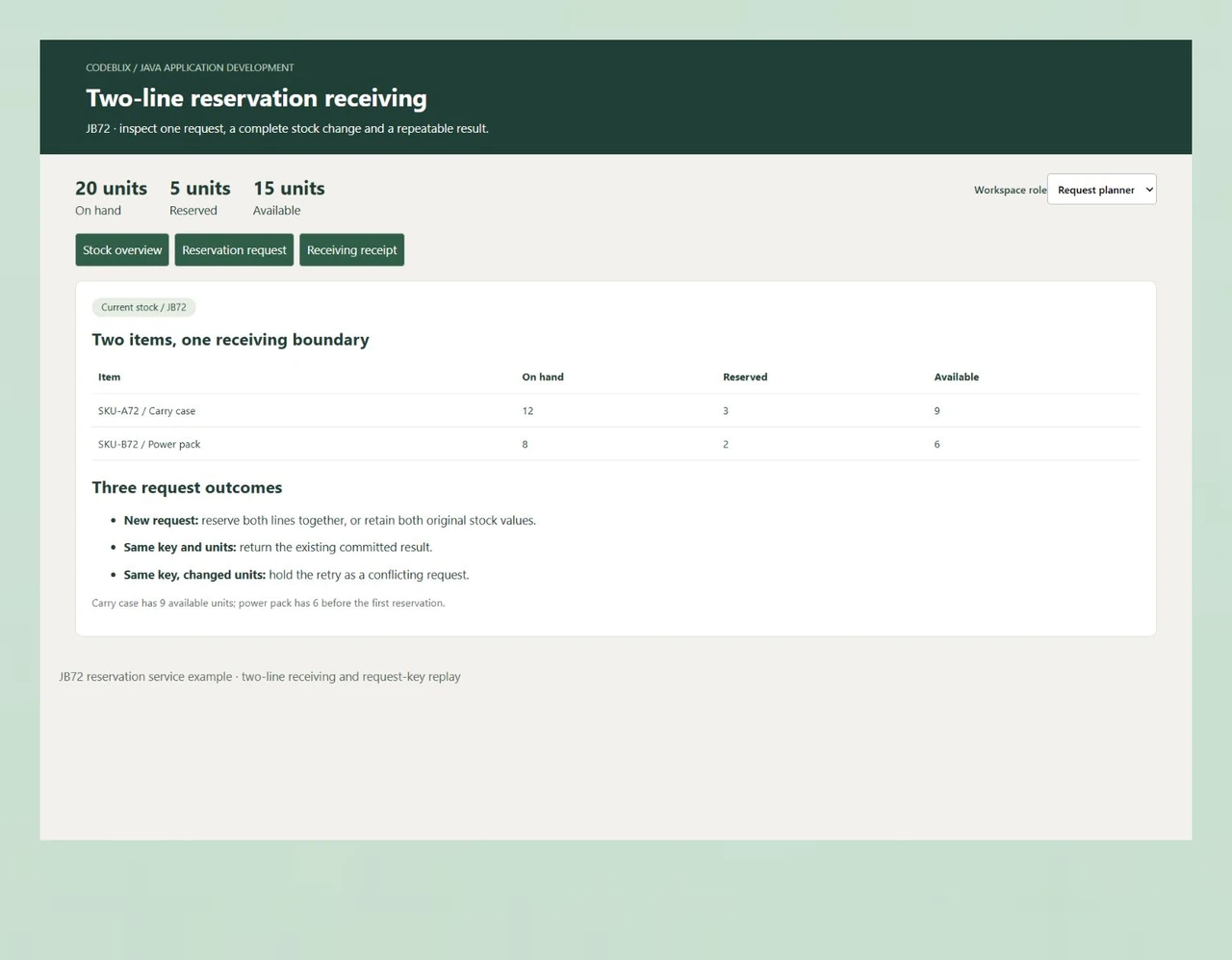
Specify the records that belong to the application change and what should remain when it fails. JB72 starts with two reservation counts and shows a failed staged attempt retaining both original values before a later successful request.
Give retries a defined identity
Agree how the application recognizes a repeated request and which result it should return. Use the same key and unchanged units to inspect a replay, then change the units to verify that the existing key is held as a conflict.
Reconcile the accepted record values
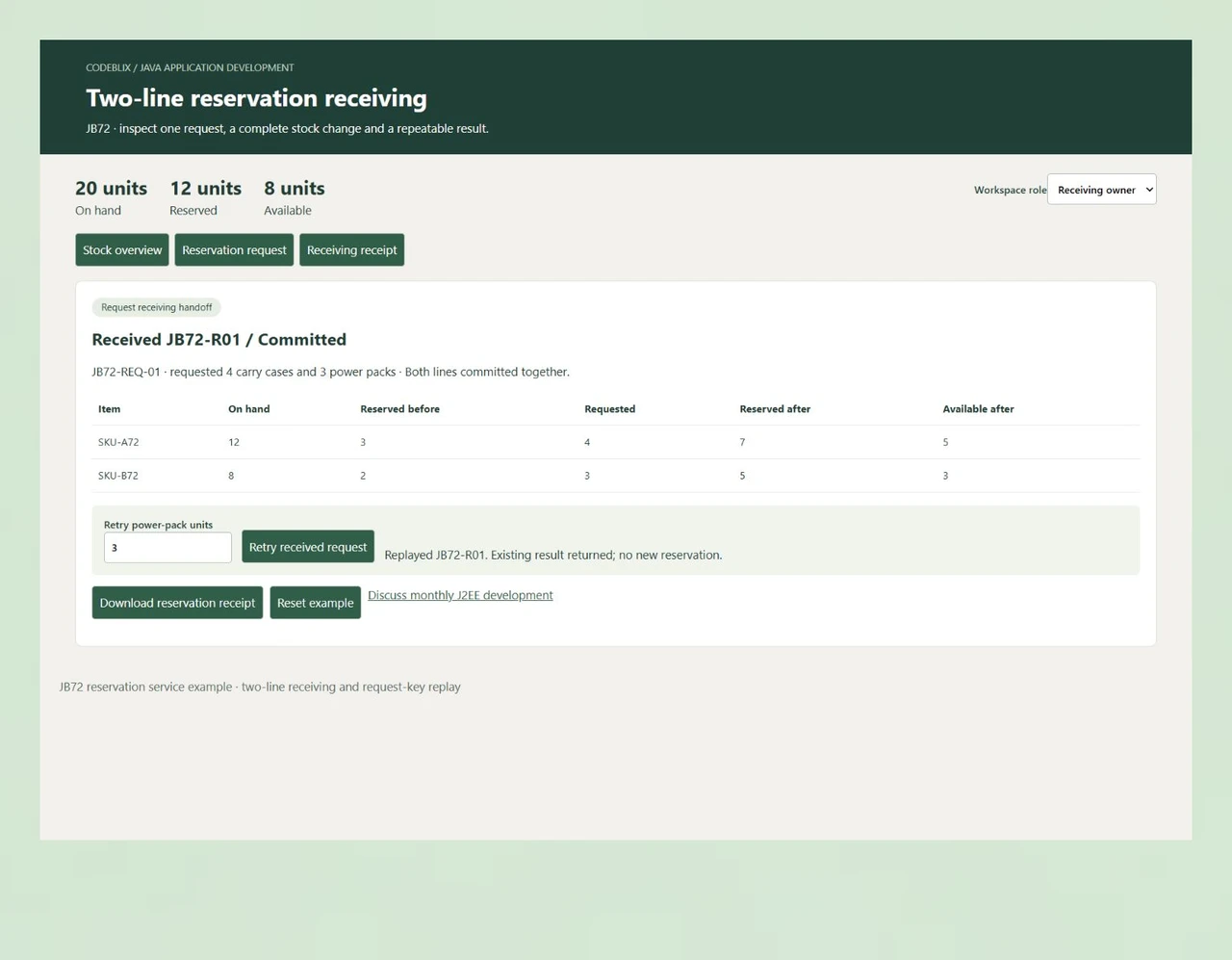
Receive the request key, line quantities and before-and-after counts together. The example adds seven reserved units across two items and retains a two-line receipt, so the receiver can check the result without relying on an acknowledgement alone.
Receive one request and its retry.
JB72 makes the reservation boundary visible: review two item lines, receive the complete change and inspect a retry under the same request key.
Exercise failure and replay.
Use the reservation example and primary platform references to describe the first operation you want commissioned.
Try the reservation receiving exercise
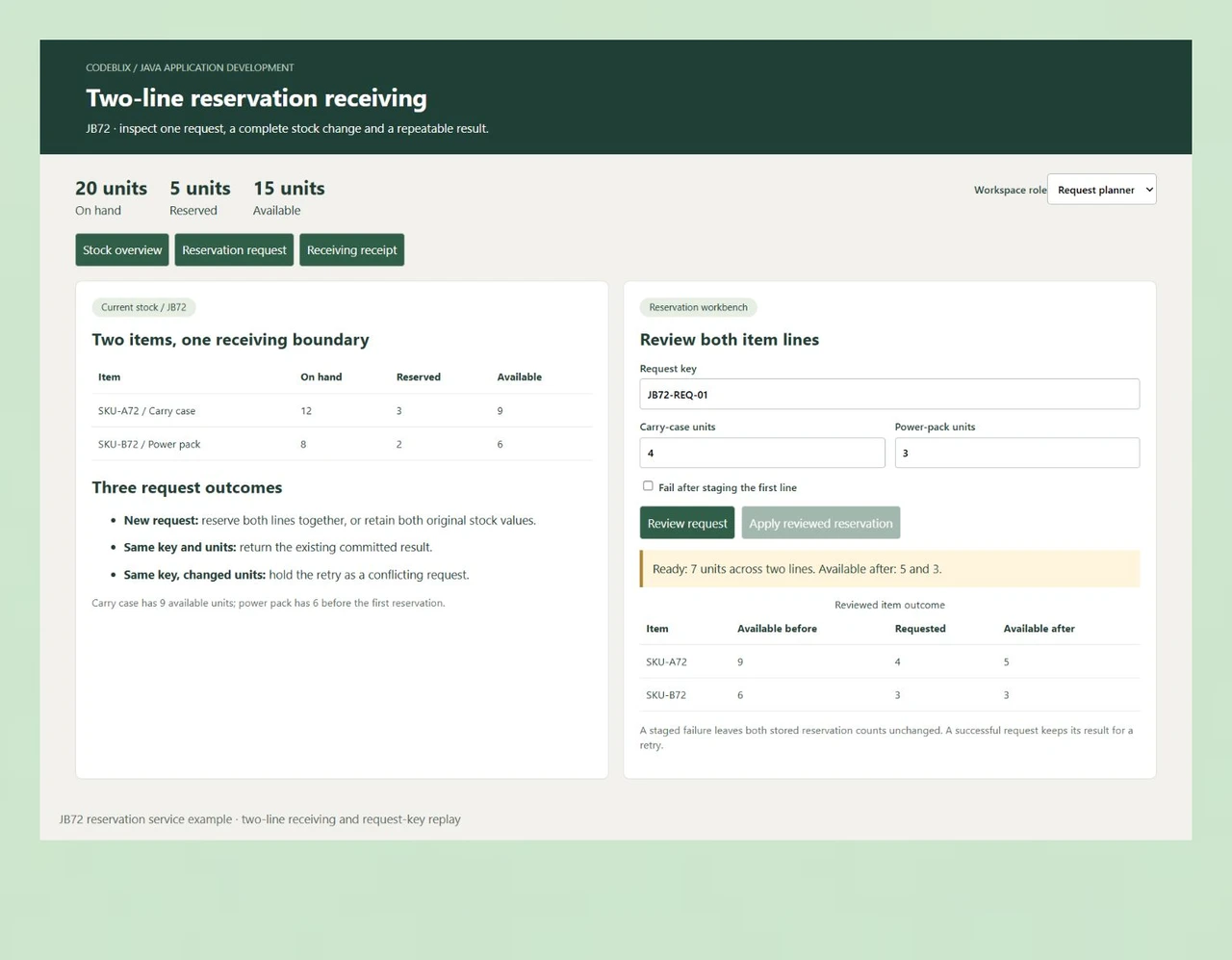
Review four carry cases and three power packs under JB72-REQ-01. The Receiving owner can apply the reviewed request. Inspect the receipt, retry the same units and then retry four power packs to see the key conflict. Use the staged-failure control in a separate exercise to check retained stock.
Open the JB72 reservation demoSpecify the transaction-management context
The Jakarta Transactions UserTransaction API defines explicit transaction-boundary methods, including begin, commit and rollback. Choose the appropriate container-managed or application-managed approach for the actual component, and receive successful, failed and uncertain outcomes in that environment.
Jakarta Transactions 2.0 UserTransaction referencePlan namespace compatibility deliberately
Jakarta EE 9 introduces the jakarta.* namespace and requires application migration work from earlier namespaces. Identify the source imports, dependencies, descriptors and target runtime involved in your upgrade. Include compatibility and regression receiving cases in the quotation.
Jakarta EE 9 compatibility and migration requirementsConnect the command to its stored records
Map the identifiers, preconditions and receiving outputs that belong to the database application. Include approved data corrections and the record consumer in the same brief when those parts are necessary for accepting the service operation.
Scope the supporting database applicationBrief the J2EE development task.
Define a service increment with the actual application branch and a receiving owner who can inspect its records.
Identify the deployed Java application
Provide the JDK, application server, Java EE or Jakarta EE version, framework and dependency manifest. Identify the affected component and whether its APIs use the existing application namespace or a migration target. Name the repository, environment and release owners.
Describe one business command
List the input fields, authenticated caller and intended output for the first task. Identify every record it may change and the preconditions for proceeding. Include a sanitized example that the receiving team can follow from request to stored result.
Choose the operation and retry boundaries
Agree which changes must be received together and how a failed attempt is reported. Define the request-key scope, payload comparison and retained result. Decide what happens when a key is reused with different inputs or when the final outcome needs reconciliation.
Implement and exercise the receiving cases
Receive a successful request and a controlled failure against the actual application component and data source. Inspect the stored values for every affected record. Repeat the same request and submit a conflicting retry, checking the returned receipt and the absence of another reservation.
Include consumers and release dependencies
Identify integrations, notifications and other effects that sit outside the record boundary. Give those handoffs their own receiving and retry rules. Include database changes, compatibility work, authorization and deployment prerequisites only where agreed in the task scope.
Review the monthly work allocation
Prioritize the remaining queue after the initial service increment is accepted. Confirm capacity, commercial terms and collaboration arrangements with Codeblix. Assign the receiving cadence, source delivery, release decisions and ongoing support route for the engagement.
Define the Java application scope
- Supply the application-server and JDK versions, component type, build tooling and dependency manifest. Explain the current source and deployment arrangements. Arrange sanitized staging records through the application owner and identify the component that handles the first request.
- Separate feature development from runtime licensing, infrastructure administration and a platform migration. Identify any service endpoint, user interface, persistence change or external integration included in the allocation, with an owner for each prerequisite.
- For a retryable command, state how the request key is scoped to the operation and caller, how its input is compared and how long the accepted result should remain available. Provide a repeated request and a changed-payload conflict in the receiving sample.
- Confirm the requested monthly capacity, collaboration window and work-priority owner. Discuss review availability and the treatment of changes to scope. Ask Codeblix to confirm the commercial arrangement for the actual backlog and period.
Receive the component and its records
- Choose the transaction-management approach for the deployed component and data source. Receive a success and a failure within the agreed record boundary, examining all affected records. Include the response for a commit whose result requires investigation before another attempt.
- Exercise concurrent and repeated requests in the commissioned implementation. Agree the persistence and uniqueness controls for request identity. Confirm that a matching replay returns the accepted result and that a conflicting payload cannot quietly create another operation.
- Receive authorization in the actual server request path and specify the permissions needed for the stored changes. Identify external messages or integrations separately, with their own completion and recovery evidence where they are part of the task.
- Include changed source, build and environment requirements, accepted cases and operating instructions in the handoff. Agree deployment, rollback and defect ownership, together with the route for later changes and support after the allocation period.
Six records in a service handoff
JB72 connects a two-line command to its stored outcome, failure evidence and repeated-request identity.
| Record | Example inputs | Required output and control |
|---|---|---|
| Stock identity | SKU-A72 / SKU-B72 | Keep on-hand and reserved values distinct for each affected item. |
| Request identity | JB72-REQ-01 with units 4/3 | Retain the normalized input and its accepted result under the agreed request-key scope. |
| Reviewed operation | Two item lines / seven requested units | Validate whole positive quantities and available stock before the receiving action. |
| Failure attempt | JB72-F01 / fail after first-line staging | Retain reservation counts 3/2 when the staged attempt is rolled back. |
| Committed receipt | JB72-R01 / reservation counts 7/5 | Receive both changed records and the remaining available values 5/3. |
| Retry decision | Same key 4/3 replays; same key 4/4 conflicts | Return the original committed result for a matching retry and hold a changed payload. |
Carry case starts with twelve units on hand and three reserved; power pack has eight on hand and two reserved. Review four carry cases and three power packs. A staged failure leaves the reserved counts at three and two and allows a fresh review under the same key. With the failure control cleared, the Receiving owner accepts both lines: reserved counts become seven and five, leaving five and three available. Replaying JB72-REQ-01 with the original quantities keeps that result unchanged. Retrying four power packs under that key produces a conflict. Download the two-line committed receipt and reconcile the original and received counts.
Give the provider one complete command.
Use the same request, affected records and retry cases when discussing a Java programming allocation.
| Option | Published focus | Ask in your demo |
|---|---|---|
| Mobisoft Infotech | Java/JEE development enquiries with flexible developer engagement and monthly billing discussions. | Which component and record outcomes will be received with the first monthly service change? |
| Mavenbird | Java/J2EE application development enquiries with hourly, full-time and part-time monthly options. | How are failure, retry and source handoff cases included in the proposed allocation? |
| Openweb Solutions | Java/J2EE developer quotations with monthly, hourly and fixed-project engagement choices. | Which runtime and persistence prerequisites must be ready before the service increment is accepted? |
Request a defined receiving outcome from the first service increment. Confirm the application branch, developer allocation and ownership of the resulting source and release before expanding the backlog.
Category reference: Primary reference: Jakarta Transactions UserTransaction. Select transaction management and recovery receiving cases for the deployed component, application server and data source.
Connect the command and its records.
Arrange the interface, service component and stored result as one received application increment with clear responsibilities for each handoff.
Explore marketplace development servicesArrange the J2EE development allocation
Set the application boundaries, receiving responsibilities and monthly terms before commissioning the work.
What should we provide for a monthly J2EE development quote?
Share the application server, JDK, framework, dependency information and prioritized work queue. Describe the first component or service operation to change, with sanitized inputs and expected outputs. Identify receiving, staging and release contacts and any access dependencies.
How is the monthly Java programming engagement scoped?
Discuss the requested period, work-priority owner and collaboration arrangements with Codeblix. Confirm the available capacity and commercial terms for the backlog. Establish review points and how new requirements or delayed receiving affect the allocation.
Can the work include a service endpoint and operating screen?
List both outputs in the enquiry when the application operation requires them. Define the authenticated caller, input contract, record boundary and returned result. Receive the interface and stored values together, including denied and invalid requests.
What can our team inspect in the JB72 demonstration?
The workspace reviews a two-line reservation, shows retained stock after a staged failure and receives a complete successful change. A matching request-key retry returns the existing result; changing the power-pack units produces a conflict. The committed CSV contains the two line outcomes.
How should a repeatable service request be accepted?
Agree the request-key scope and input comparison, then exercise the actual endpoint with an initial request, a matching retry and a changed-payload retry. Inspect the retained receipt and all affected records. Include concurrent calls in the commissioned implementation’s receiving cases.
Can the monthly work include a Java EE to Jakarta EE transition?
Identify the current and target platform versions and the affected component dependencies. Jakarta EE 9 introduces the jakarta.* namespace, so agree source, configuration and compatibility changes explicitly. Receive the target deployment and application regression results as part of that scope.
What happens when a commit outcome needs reconciliation?
Include an explicit recovery case in the development brief. Define which operation record and request identity the receiving team will inspect before deciding to retry. Assign ownership of the investigation and any external handoff affected by the uncertain result.
What should be delivered at the end of the allocation?
Receive the changed source, build and runtime prerequisites, acceptance results and operation-recovery instructions. Include the request and record examples used for receiving. Confirm release, rollback, defect handling and ongoing support responsibilities for the resulting application work.