
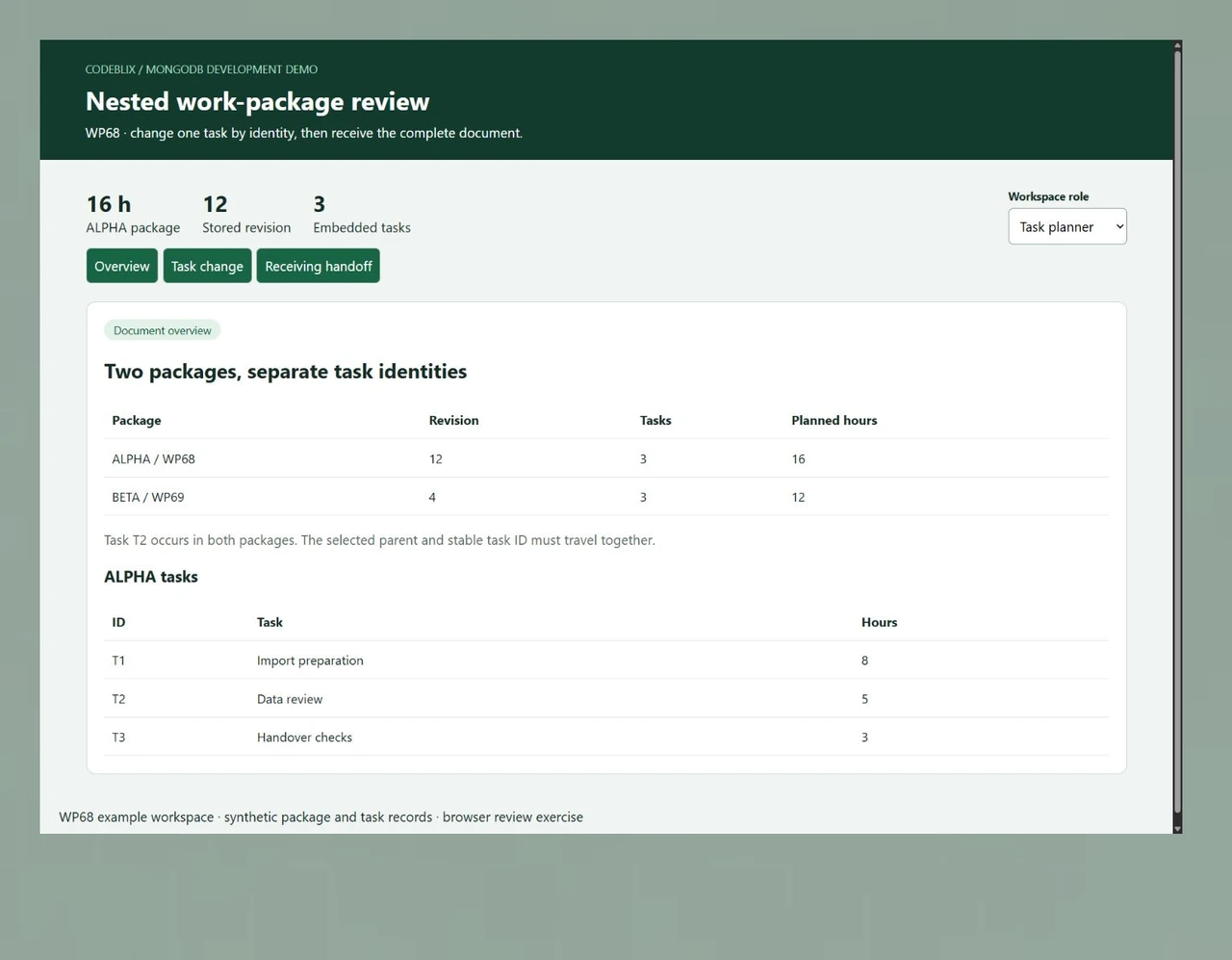
Put an observable result in the development brief.
A useful MongoDB engagement connects document design to the operation the application owner must receive.
Target the intended embedded record
Identify both the parent document and its nested task. A repeated task ID in another package should remain outside the change. Ask the developer to show the exact match and the resulting stored values.
Protect an earlier review from a later write
Agree which revision the editor read and what happens when it no longer matches. Receive the conflict message, refresh path and successful conditional write together in the commissioned application.
Reconcile the whole receiving package
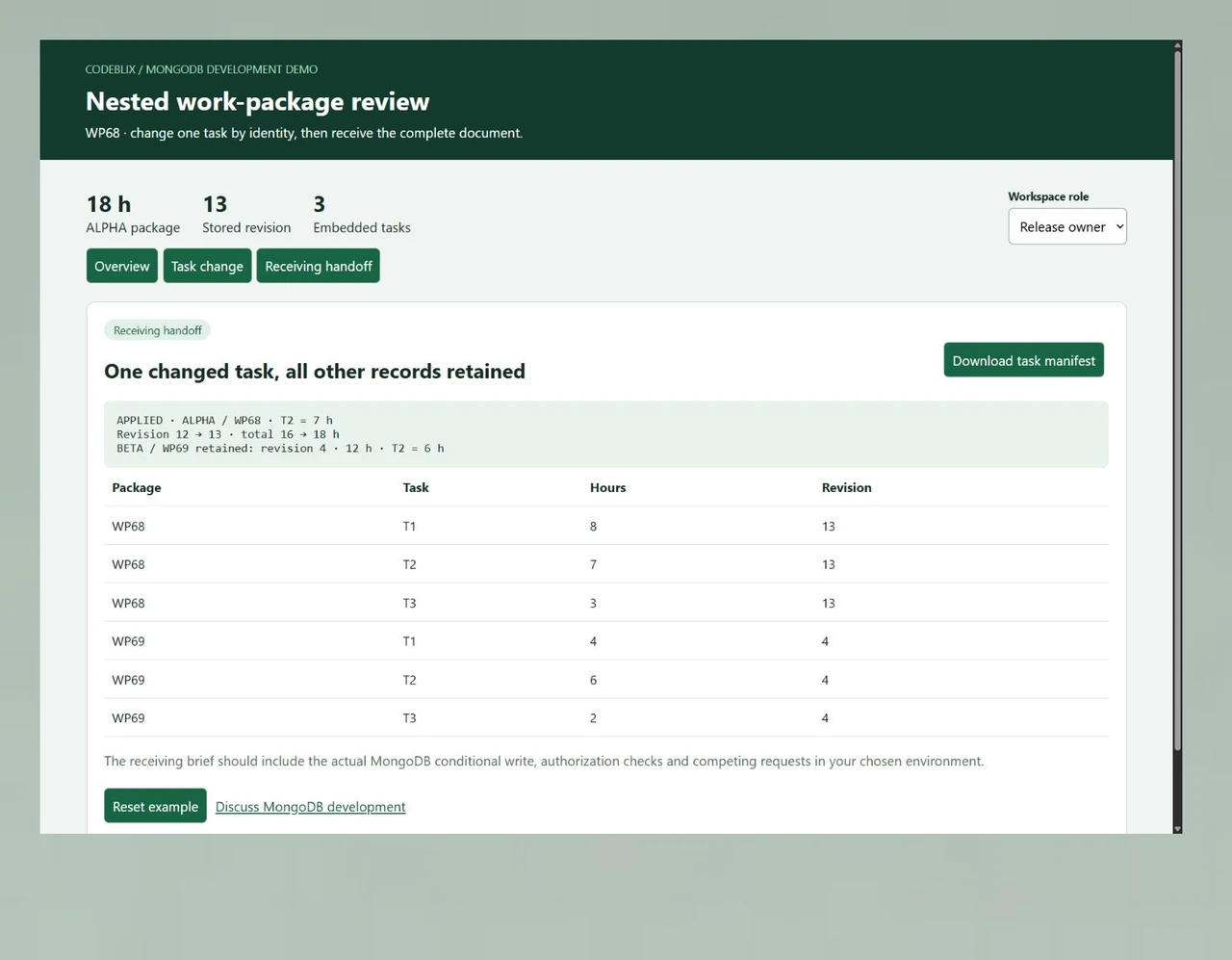
Include unchanged neighbours in the acceptance evidence. The WP68 task manifest makes the changed estimate and retained BETA tasks visible in one six-row handoff.
Follow one task through its receiving decision.
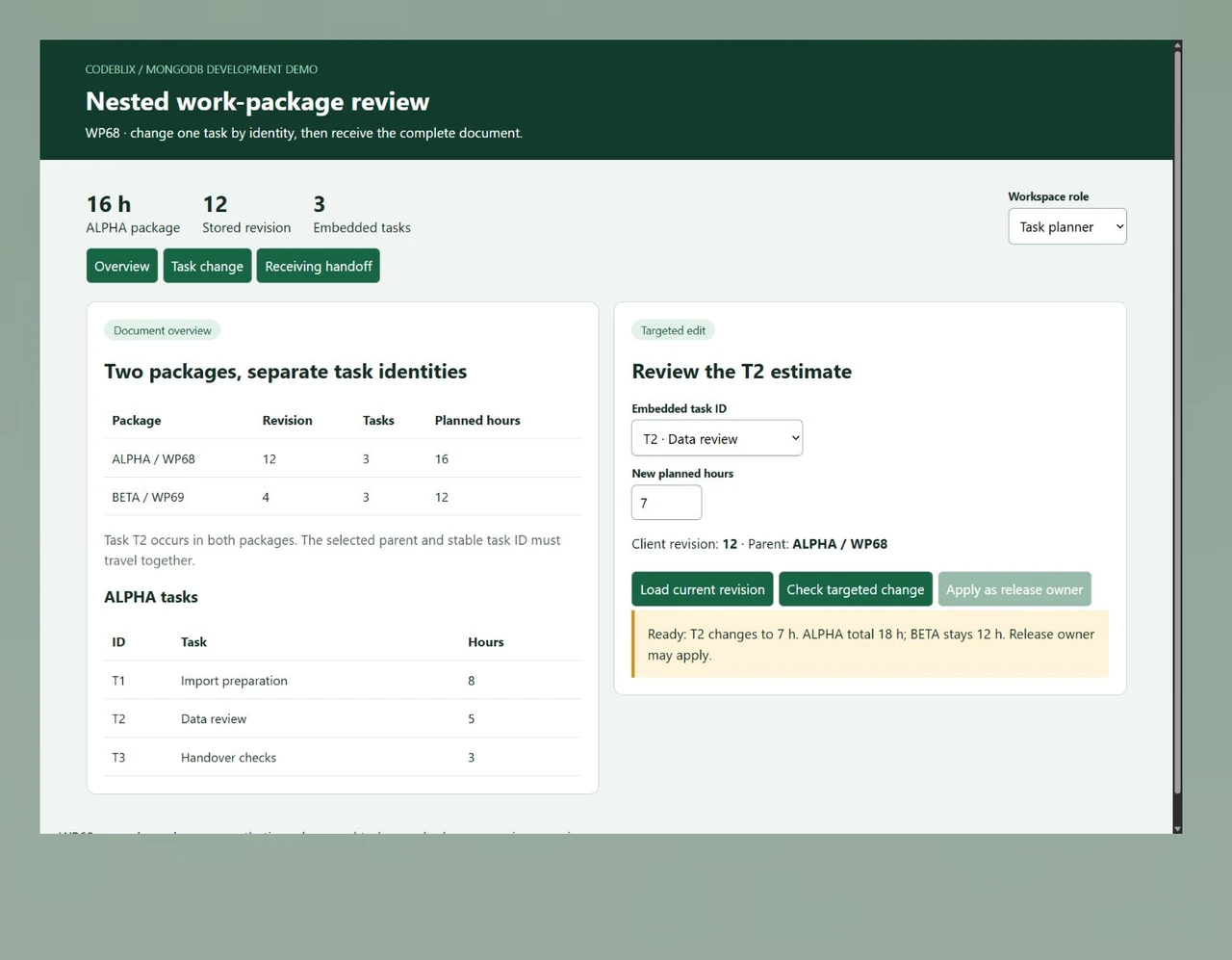
Explore the WP68 demo: identify a nested task, check its proposed estimate, then receive the changed package alongside an untouched neighbour.
Inspect the change before expanding the backlog.
Use the working example and current MongoDB references to make the first development request specific.
Run the nested-task receiving exercise
Open Task change, check the stale client revision, then load revision 12. Review T2 at seven hours, switch to Release owner and apply. The receiving handoff shows ALPHA at 18 hours and BETA still at 12; download all six task rows.
Open the WP68 task-change demoSpecify filtered array targeting
MongoDB’s filtered positional operator identifies array elements through arrayFilters. Have the developer choose the appropriate update shape for your deployed version and identity rules. Include missing and duplicate matches in the implementation receiving cases.
Read MongoDB’s filtered positional operator referenceReceive the conditional write in the database
MongoDB documents single-document atomic writes and the use of an expected current value in the update filter. Agree the document boundary and revision field with the developer. Include competing requests against the actual commissioned database operation.
Consult MongoDB’s atomicity referenceConnect the database task to its interface
Include the editor, receiving queue and downstream record consumer when those parts belong in your project. Identify the team that maintains the data and the team that accepts it so the quotation covers the complete operating handoff.
Scope the supporting database applicationScope the MongoDB development task.
Use the first backlog item to establish the document boundary, access responsibilities and acceptance evidence.
Describe the operation to commission
Provide the screen or API that creates, edits or reads the document. Explain the business owner’s expected result and the failure they need to avoid. Include sanitized records with nested fields and representative repeated identifiers.
Choose the document and task identities
Map the collection, parent key and embedded task key before selecting an update strategy. Decide how missing or duplicate task identifiers are handled. Keep the parent boundary explicit when the same nested ID appears in another document.
Agree revision and permission checks
Specify the revision read by the editor and the condition required to accept its write. Identify who may prepare, review and apply changes. Define the response for a stale revision and the path for loading the current document.
Receive a focused development increment
Ask the developer to implement one targeted update with its API response and operating screen. Exercise a missing task, invalid hours and two competing writes. Inspect the actual stored document alongside the visible acceptance message.
Reconcile migration and dependent outputs
If existing records need reshaping, inventory missing nested IDs and ambiguous duplicates first. Assign correction decisions to the data owner. Compare preserved records, dependent references and exported totals after a representative conversion.
Confirm allocation and release ownership
Review the remaining backlog after receiving the initial increment. For monthly work, agree capacity, collaboration hours and review points. Assign source delivery, deployment, rollback, defect handling and ongoing database operations in the quotation.
Define the MongoDB project boundaries
- Provide the MongoDB server version, driver or ODM, application framework and hosting arrangement. Identify the existing collection design and the exact reads or writes affected by the backlog. Arrange a sanitized staging dataset with the infrastructure owner.
- Separate application development from ongoing database administration. State whether the request includes schema validation, query changes, API endpoints, a user interface, data conversion or deployment support. Confirm the responsible party for each item before agreeing the allocation.
- For nested records, supply a parent key, stable element key, field types and allowed values. Explain whether repeated IDs are valid across parents and how duplicates within one parent should be resolved. Include representative invalid records for the data owner’s decision.
- For a monthly engagement, share the expected task sequence, receiving capacity and collaboration window. Ask Codeblix to confirm the available allocation and commercial terms. Agree how priorities and additional requirements enter the backlog.
Receive the application and stored result together
- Require authorization at the application boundary for each write. Receive denied requests and successful requests using the agreed roles. A visible disabled control is only one interface condition; include the server-side permission decision in the development scope.
- Include the expected document revision in the receiving cases. Run two competing changes against the actual database implementation and inspect which write matched. Confirm how the editor reports an unmatched revision without replacing another user’s accepted change.
- For migrations, retain the old-to-new identity mapping and a record of approved corrections. Reconcile nested element counts and dependent exports, rather than checking document counts alone. Schedule the rollback decision with the release owner.
- Request source changes, environment prerequisites and the completed receiving record at handover. Identify backup and monitoring responsibilities and the support route for a failed write or an unexpected document shape. Price later additions as identifiable backlog items.
Six records behind a targeted nested update
WP68 connects the application edit to a parent, a nested identity, a reviewed value and a receiving owner.
| Record | Example inputs | Required output and control |
|---|---|---|
| Parent document | ALPHA / WP68; BETA / WP69 | Scope the change to the selected work package before resolving a nested task. |
| Embedded task identity | T1 / T2 / T3 in each parent | Keep a stable task key and hold an absent or ambiguous target. |
| Estimate field | T2: 5 → 7 planned hours | Receive an integer between 1 and 40 and recalculate the affected package total. |
| Document revision | Client 11; stored 12; accepted 13 | Refresh an outdated revision before reviewing the change; invalidate a review after an input edit. |
| Applying role | Task planner / Release owner | Allow the reviewed change to proceed through the agreed applying responsibility. |
| Receiving manifest | Six task rows / two work packages | Retain BETA T2 at six hours while ALPHA T2 changes to seven. |
ALPHA starts with task estimates of eight, five and three hours: 16 in total. The editor initially holds revision 11 while the stored example is revision 12. After loading the current revision, review T2 at seven hours. A Task planner cannot apply it. Switch to Release owner and apply once: ALPHA becomes revision 13 with 18 hours. BETA remains revision 4 with estimates four, six and two. Download the manifest and reconcile the two parents and six stable task identities.
Give the provider a result your team can receive.
Use the same sanitized document and exception cases when discussing development capacity.
| Option | Published focus | Ask in your demo |
|---|---|---|
| Binary Studio | MongoDB engineers for database, backend and API work with interviews and onboarding. | What nested-record identity and revision cases will the assigned developer deliver with the first increment? |
| vTeams | MongoDB developer hiring enquiries with part-time and full-time engagement options. | How will the receiving owner reconcile the affected package and an untouched parent after the edit? |
| Lemon.io | Hireable MongoDB developer profiles, availability models and a matching enquiry path. | Which concrete database and application outputs belong to the first agreed development allocation? |
Request the same observable change from each provider and agree how the receiving owner will inspect it. Confirm the developer allocation and responsibilities against those outputs before expanding the project.
Category reference: MongoDB primary reference: Atomicity and Transactions. Choose the update strategy and concurrency receiving cases for the MongoDB version and document boundaries in your project.
Connect the document and workflow.
Arrange the database, editing screen and receiving handoff as one application scope with clear owners for the resulting records.
Explore marketplace development servicesArrange your MongoDB development work
Resolve the scope, allocation and receiving responsibilities before the first increment.
What should we send Codeblix for a MongoDB project quote?
Send the application operation you want changed, the deployed MongoDB version and a sanitized example document. Include the expected result, exceptions, receiving owner and access dependencies. Explain whether the request covers an API, an editor, data conversion or release support.
Can we hire MongoDB programmers on a monthly basis?
Discuss the anticipated backlog, collaboration hours and review cadence with Codeblix. Ask for confirmation of the allocation and commercial terms for the requested period. Agree how receiving work, priority changes and additional scope are handled during the engagement.
Can the scope include an API and a nested-record editor?
Include both in the quotation when your operating task requires them. Identify the authenticated roles, the target document and the expected API result. Receive the interface message and the stored record together, including denied requests and stale revisions.
What does the WP68 demo let our team inspect?
The example holds an outdated client revision, checks a targeted task estimate and lets the Release owner apply an eligible change. ALPHA T2 moves from five to seven hours and its package total becomes 18. BETA remains at 12 hours; the downloaded manifest contains all six tasks.
How should duplicate embedded task IDs be handled?
Give the data owner an inventory of duplicates within each parent. Decide whether they represent invalid records or require a more specific key. Include that decision in the migration and write rules before a targeted update is accepted for the application.
Which concurrency cases belong in the receiving brief?
Include two editors reading the same revision, a successful first write and a second write using the earlier revision. Inspect the actual MongoDB result and the application conflict response. Also receive the refresh path and the behaviour after changing a previously reviewed input.
What affects the development allocation and quotation?
The document condition, application changes, data corrections and integration responsibilities determine the work. Staging access, release ownership and receiving availability also shape the plan. Request clear outputs and review points for the first task, then confirm the remaining allocation.
What should we receive at project handover?
Receive the changed source, environment requirements, identity mappings and the completed acceptance record. Include operating instructions for unmatched writes, invalid document shapes and rollback. Agree who handles defects and how later changes enter the support or development backlog.