
Put a monthly engagement around a deliverable application change.
For product owners and technical leads with an existing Rails application, the first useful commitment is a clear piece of work and a way to receive it.
Define the month’s engineering priority
Bring a small ordered backlog: a customer-facing operation, an administrative task, a slow endpoint or an integration change. Identify the outcome that matters most and the dependencies that could stop it. Agree how new requests enter the queue and which person can change the priority.
Receive behavior alongside code
A merged change needs a business result that somebody can check. For an order-list improvement, keep the same visible orders, customer references, line amounts and permission boundaries. Attach the receiving cases to the backlog item so a reduction in reads cannot conceal a missing record.
Make continuing work transferable
Include reviewed source, configuration instructions, test results and release notes in the engagement. Name the person who controls deployment and the people who handle incidents after release. Keep follow-on maintenance, urgent response and future enhancement capacity explicit in the quotation.
Inspect the records behind an accepted change.
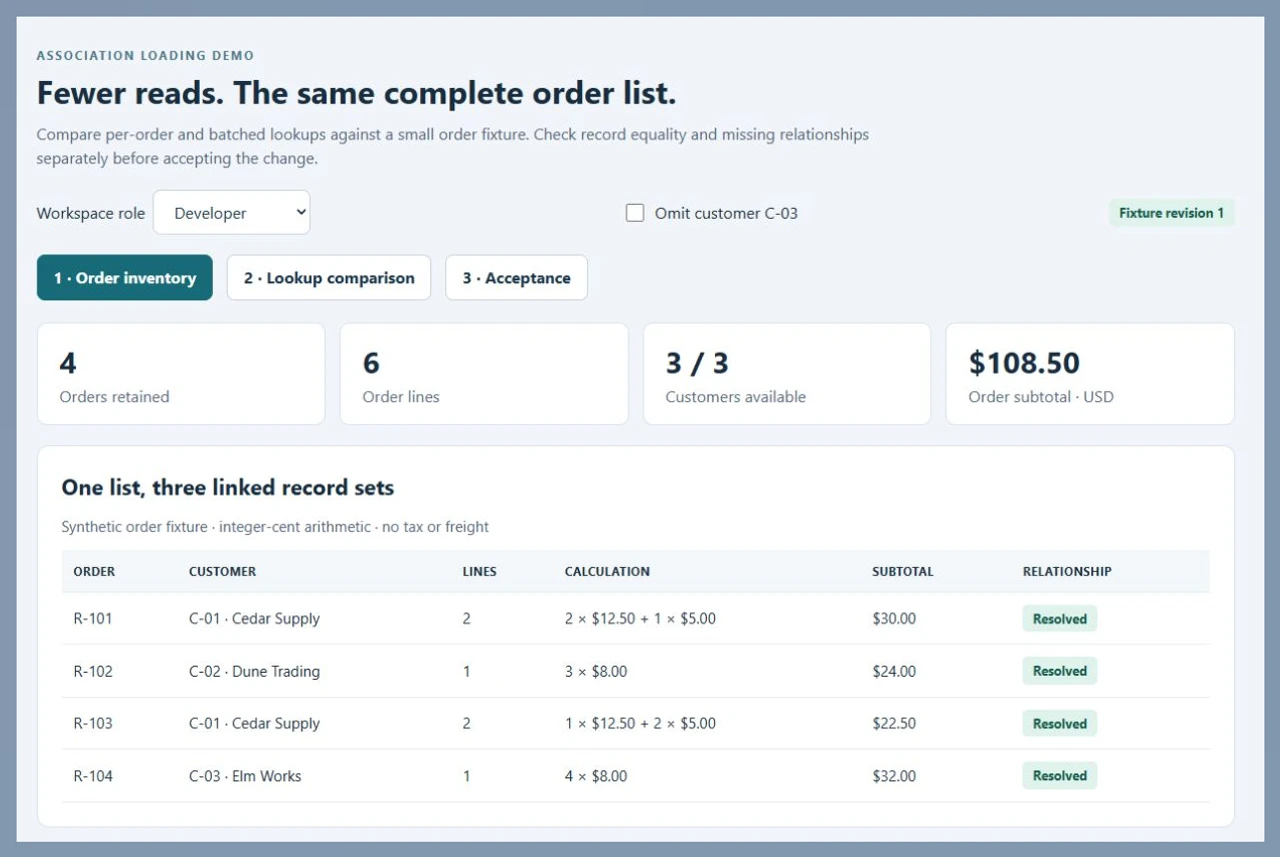
RR78 connects an order inventory, instrumented lookup runs and a receiving decision. Inspect the complete row set as well as the read budget.
Use an association-loading change to brief the work.
Choose a representative endpoint and agree both its output contract and its data-access checks. RR78 gives your team a small receiving exercise to adapt to the application.
Open the RR78 lookup comparison
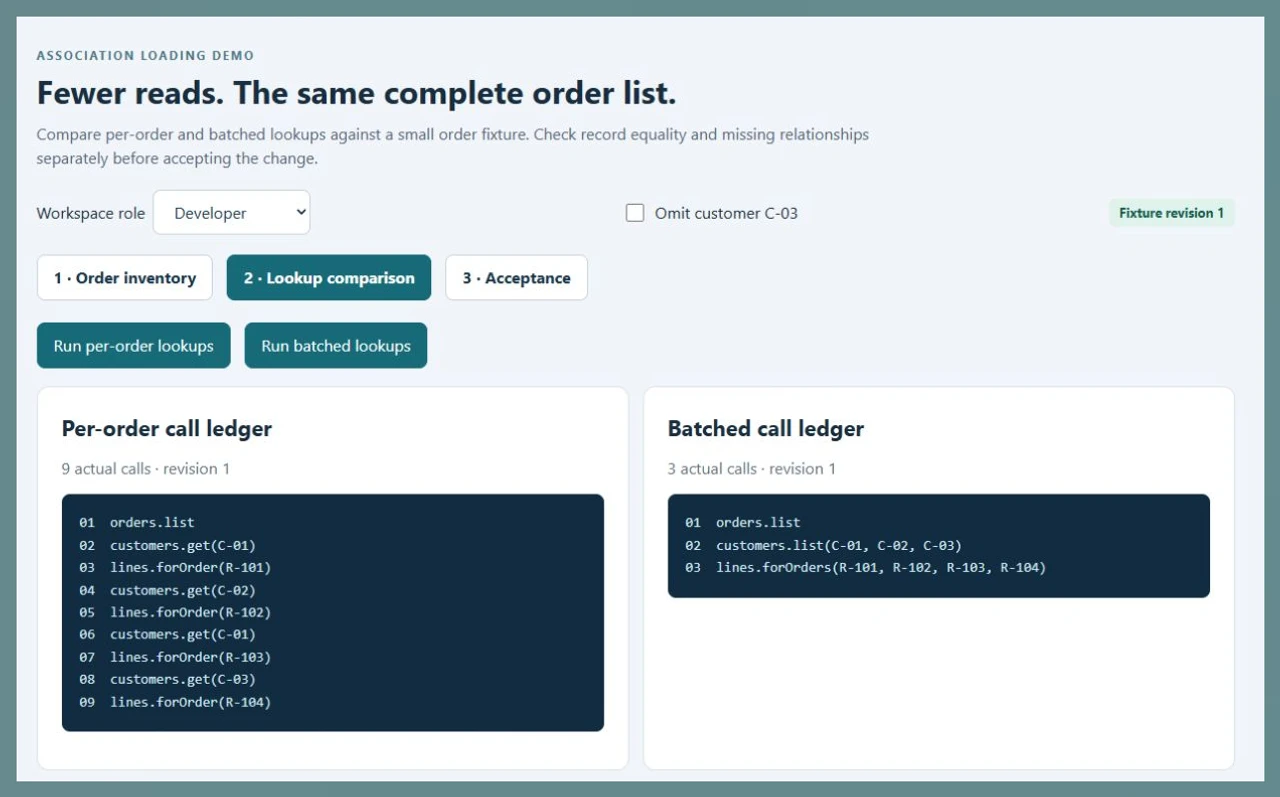
Run the per-order and batched modes. Inspect the nine-call and three-call ledgers and the same four order rows. Omit customer C-03, rerun both modes and observe that equal outputs still hold acceptance when a relationship is missing.
Open the association loading demoSeparate read efficiency from response correctness
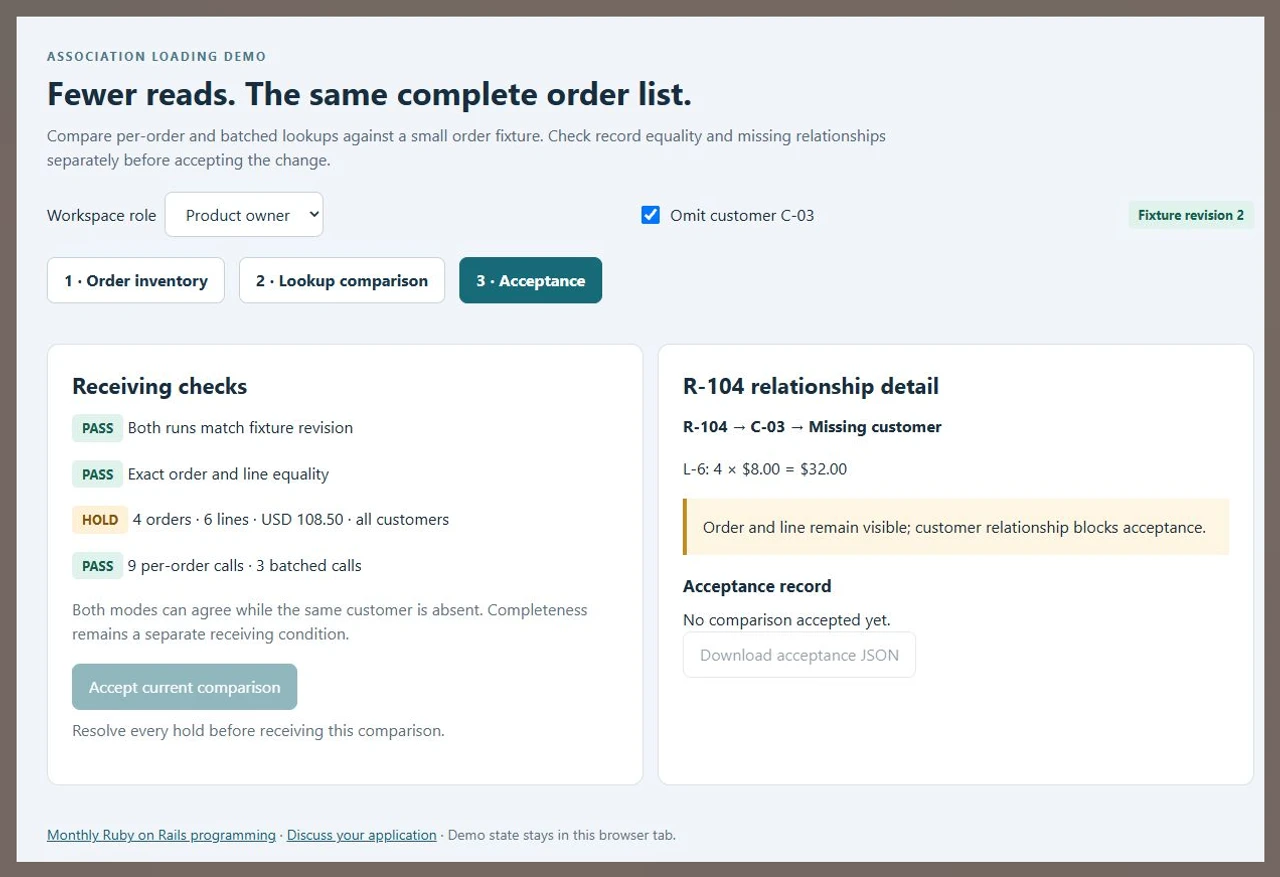
The fixture retains four orders, six lines and USD 108.50 in both modes. R-104 keeps its USD 32.00 line amount even when its customer cannot resolve. Receive the complete set of associations separately from exact output equality; neither a shorter call ledger nor matching incomplete lists is enough.
Agree the Rails-specific evidence
In the actual application, capture the endpoint, filters, sort order, page size and authorization context before changing association loading. Rails documents includes, preload and eager_load as different retrieval strategies. The SQL shape depends on the query and associations. Agree the real trace and regression checks for the application version rather than transferring the browser fixture’s call count as a universal SQL promise.
Connect the application and data scope
A Rails change can expose a database design or migration dependency. Keep responsibility for application behavior, schema changes and operational recovery clear when you commission related database work.
Discuss the database development scopeFrom the first backlog item to a received release.
Agree the monthly allocation and review rhythm around your application. Use a named decision maker at each handoff.
Inspect the application and access boundary
Identify the Ruby and Rails versions, lockfile, database engine, background workers, storage and external services used by the affected journey. Supply an approved repository and a reproducible development setup through the project channel. Use synthetic or deidentified examples; keep production credentials in your controlled access process.
Select work that fits the agreed allocation
Order the backlog with the product owner and distinguish delivery work from discovery. Discuss the developer allocation, working overlap, review availability and dependencies before agreeing the monthly arrangement. Record what happens when an urgent defect displaces a planned enhancement or an external service blocks progress.
Reproduce and implement the change
Capture the current behavior with a repeatable input and expected output. The developer changes the relevant application code and adds regression coverage appropriate to the risk. The reviewer checks data access, permissions, failure handling and any additional dependency before the branch is ready for receiving.
Receive the milestone against named cases
The product owner checks the agreed user journey and edge cases on the candidate release. For association-loading work, compare record identities, amounts, missing relationships and the observed read trace. Record exceptions with an owner; receive the milestone only when the agreed conditions are satisfied.
Release with a responsible operational owner
Agree the deployment window, backup or rollback preparation, configuration changes and post-release observation. Hand over the source revision, test evidence and release instructions. Confirm which support requests remain in the monthly backlog and which require a separate response arrangement.
Codebase and environment
- List the application repositories, Ruby and Rails versions, Gemfile.lock, database version and runtime services. Identify who owns the code and who can approve access, releases and third-party costs.
- Provide setup instructions, representative test fixtures or an approved development dataset, and a reproducible failing or inefficient operation. Explain how the application handles separate organizations, user roles and restricted fields.
- Name external APIs, background processing, email, file storage and scheduled jobs involved in the milestone. An integration depends on its current contract, permissions and a usable test environment.
Capacity, pricing and monthly boundaries
- Request a written quotation for the required allocation and expected work. Agree rate or monthly fee, billing basis, working overlap, start date, review cadence and how unused or additional capacity is handled.
- Confirm availability during scoping. A monthly enquiry should establish the actual delivery arrangement, communication owner and change process before work is booked.
- Distinguish an ongoing backlog engagement from a fixed acceptance milestone. Include discovery time, review effort, maintenance obligations and dependencies in the commercial discussion.
Migration, deployment and continuing support
- If a task needs a schema or data change, commission it with a separate recovery and verification plan. Discuss affected volumes, expected downtime, background backfills, backup ownership and the person authorized to approve execution.
- State whether Codeblix prepares a release for your team or performs agreed deployment work. Hosting administration, subscriptions, access approvals and incident coverage need named owners.
- Receive editable source and documented application changes under the agreed terms. Specify the support period, defect triage, escalation route and how the next month’s work is authorized.
Receive a complete order result with its lookup evidence.
RR78 provides a concrete acceptance model for an association-loading backlog item. Attach your equivalent records and checks when requesting monthly programming.
| Record | Example inputs | Required output and control |
|---|---|---|
| Order identity | R-101 through R-104 / customer ID | Retain each expected order once, in the agreed order and authorization context. |
| Customer association | C-01 Cedar Supply / C-02 Dune Trading / C-03 Elm Works | Flag a missing customer while retaining the parent order for inspection. |
| Order line set | Six lines / quantities / integer-cent unit amounts | Preserve line identities and calculate a total of 10850 cents in USD. |
| Lookup run | Per-order: 9 calls / batched: 3 calls | Record actual browser repository method calls for the same fixture revision. |
| Receiving conditions | Current runs / exact rows / resolved associations / read budget | Hold incomplete output even when the two modes return equal rows. |
| Acceptance receipt | RR78-R01 / revision / both call ledgers and row sets | Keep accepted evidence frozen when a later fixture change invalidates current runs. |
R-101 contains two units at USD 12.50 and one at USD 5.00, totaling USD 30.00. R-102 totals USD 24.00, R-103 USD 22.50 and R-104 USD 32.00. Removing C-03 leaves the four orders and USD 108.50 intact, but holds receiving because R-104 lacks a customer. Restore the customer, rerun both modes, switch to Product owner and accept the complete comparison. Changing the fixture afterwards clears current runs while the downloadable receipt retains the accepted revision.
Ask providers to quote the same monthly working arrangement.
Use the same application context, prioritized work, review responsibilities and receiving cases in each enquiry.
| Option | Published focus | Ask in your demo |
|---|---|---|
| New Wave Devs | Describes monthly and hourly hiring, developer profiles and engagement steps. | How will the assigned capacity, reviewer availability and first accepted backlog item be agreed? |
| Rubyroid Labs | Describes dedicated, part-time and on-demand Rails work, including application performance tasks. | Which endpoint, output checks and observed association-read trace will define the performance milestone? |
| Mindbowser | Describes monthly dedicated engagement and managed delivery alternatives. | Who receives the application change and what source, tests and release evidence accompany it? |
Use RR78 to make one receiving conversation concrete: preserve the required records, expose a missing association, compare the controlled lookup runs and retain accepted evidence. Agree the actual Rails implementation and its application-specific tests during scoping.
Category reference: Rails Guides: eager loading associations. Use the guide matching your application’s Rails version when agreeing the data-access implementation.
Questions before booking monthly programming
Clarify the arrangement, access and receiving responsibilities in the project enquiry.
Can we commission a month of work on our existing Rails application?
Discuss the application, highest-priority backlog and required working arrangement with Codeblix. The quotation should define the allocation, start date, review rhythm and delivery responsibilities after the codebase and dependencies have been scoped.
What do you need to prepare a monthly quotation?
Provide the business goal, ordered backlog, application and database versions, repository inventory and a reproducible example. Identify the product owner, technical reviewer and deployment owner. Share access details through an agreed private project channel.
Is there a published monthly fee or fixed number of hours?
Request a quotation for the allocation and coverage your application needs. Agree the fee or rate, billing basis, review time, additional work and handling of unused capacity in writing before booking the engagement.
Can performance work preserve the existing customer-facing result?
Make the result contract part of acceptance: record identities, filters, sorting, pagination, amounts and access restrictions. For an association-loading task, compare those outputs and the application’s observed data-access trace. Include missing associations and empty results among the receiving cases.
Does the demo measure a running Rails application?
The browser exercise runs controlled repository lookups over synthetic orders, customers and lines. Its nine-call and three-call ledgers make the receiving pattern repeatable. Your Rails endpoint needs its own trace and regression checks, agreed for its version, query and authorization context.
How are changes to priorities handled during the month?
Name one backlog decision maker and agree a review cadence. Record urgent requests, external blockers and work that displaces an existing priority. Confirm any effect on the allocation or quoted scope before treating extra work as committed.
Can the engagement include integrations or a data migration?
Include the affected API contracts, test access, data volumes and service owners in scoping. A migration needs its own verification and recovery plan. Agree whether deployment execution, hosting work and external subscriptions are included in the quotation.
What should our team receive at the end of a milestone?
Agree the source revision, regression results, receiving evidence, configuration changes and release instructions. Identify unresolved issues and their owners. Define ongoing defect response and future enhancement work as part of the monthly support arrangement.