
Hire a TYPO3 developer with a clear CMS delivery brief
Hire a TYPO3 developer through Codeblix to implement a defined website or CMS change. Start with the installation, page tree, site package and editorial task you need delivered. Your project quotation sets out the development allocation, implementation boundary, acceptance evidence and handover responsibilities after a review of the existing setup.
Make development answer to the way your website is published.
A TYPO3 engagement needs an agreed installation boundary and an observable result for both visitors and editors.
Identify the change inside the installation
Locate the affected site configuration, page type, content element, template or extension. Show the editor action and the resulting visitor page together. Name the languages, sites and backend groups that the requested change reaches.
Keep translated content tied to its source
Agree the identity of the default-language record and each translation. Decide which fields are translated, inherited or independently edited, and how missing translations appear. Test URLs and media descriptions in the same language context as the visible content.
Accept the editorial path as well as the page
Ask for an editor to demonstrate draft creation, preview, review and release using the agreed roles. Verify that a later content change cannot be published under an earlier decision. Keep the accepted source revision and operating instructions with the release.
Correct one translation, review its revision and release that locale.
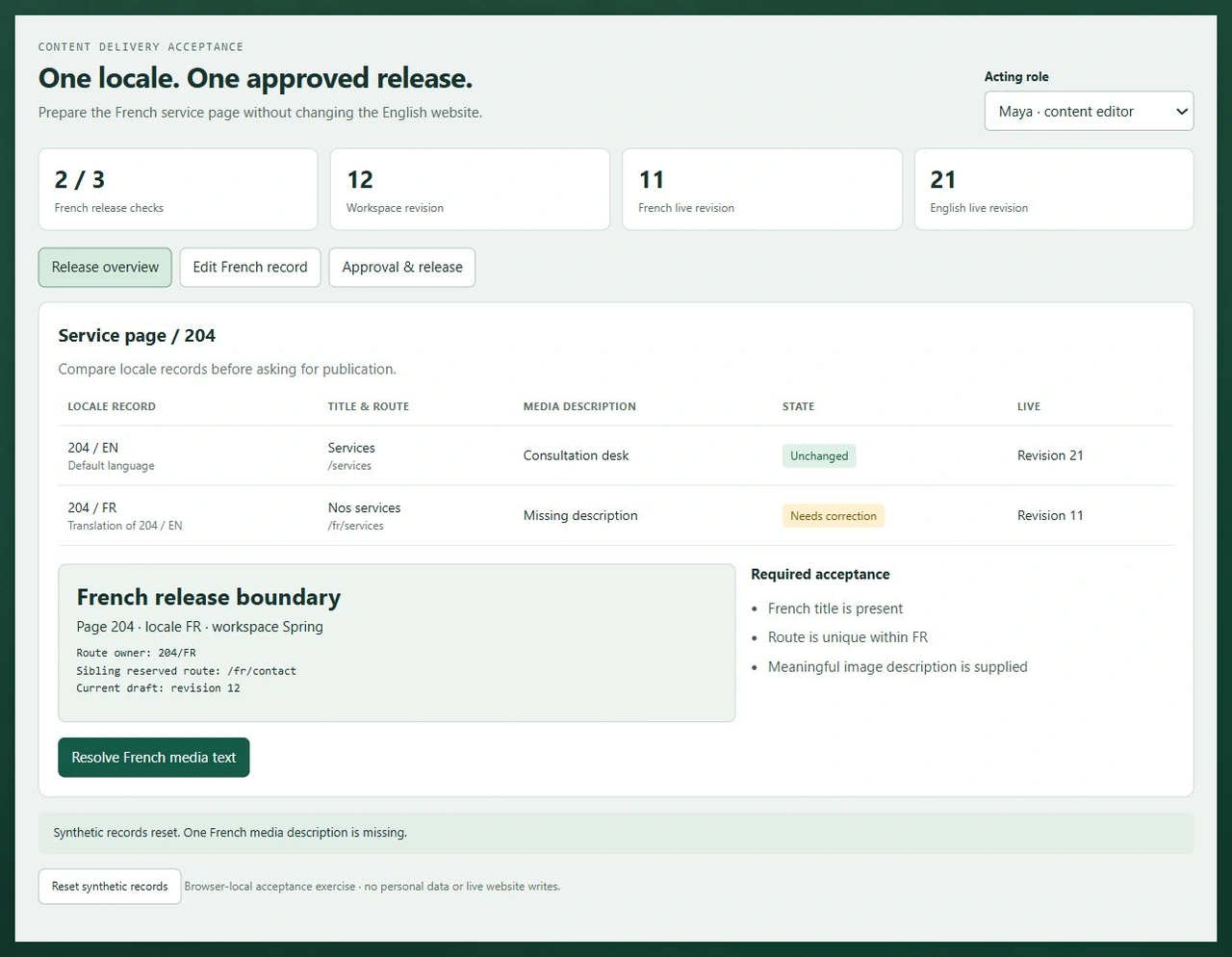
LR03 is a working multilingual release demo. A French service page needs an image description before it can pass review. Exercise the route conflict, stale decision and publishing roles while the English record remains unchanged.
Try a French-only release
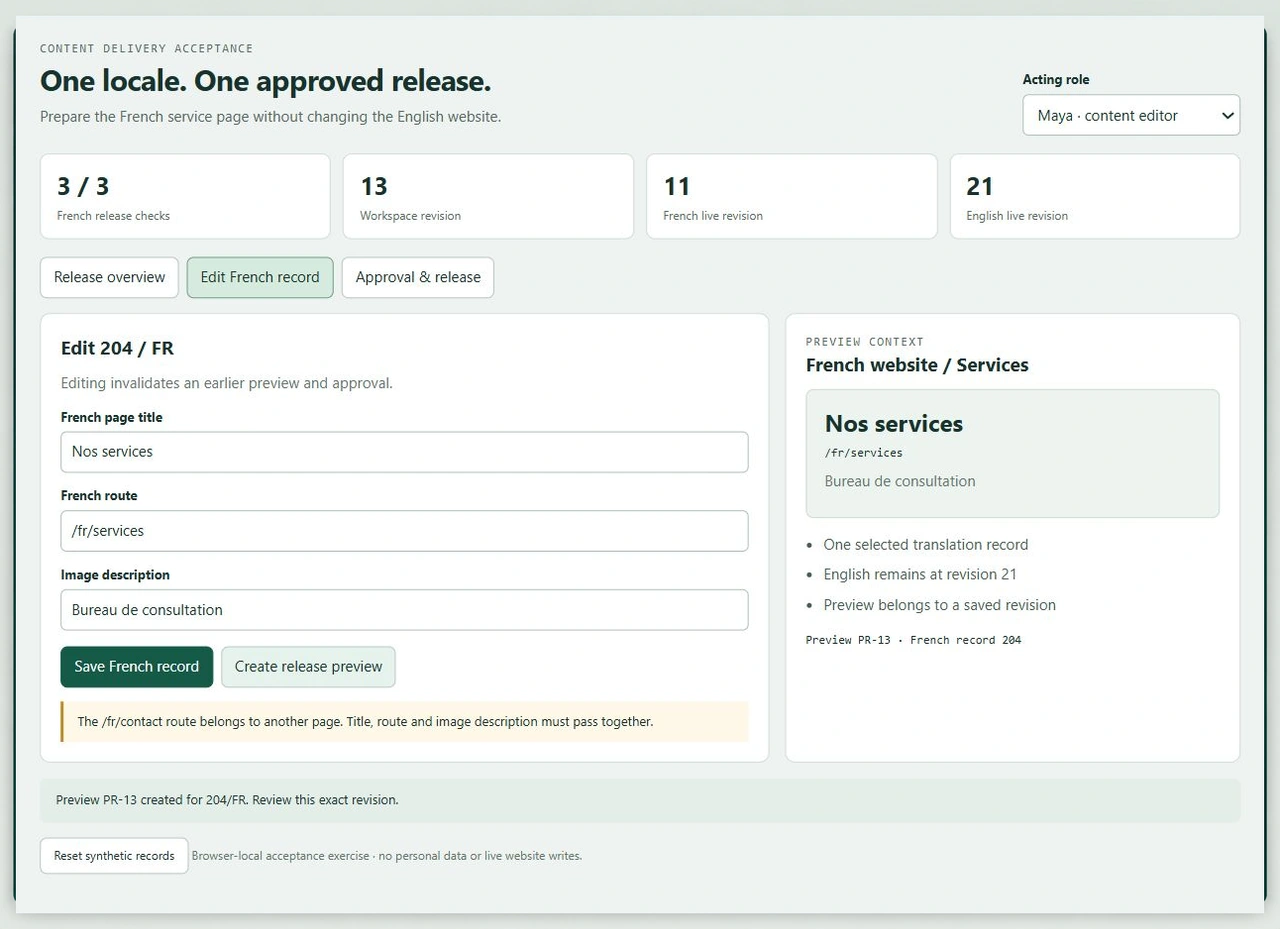
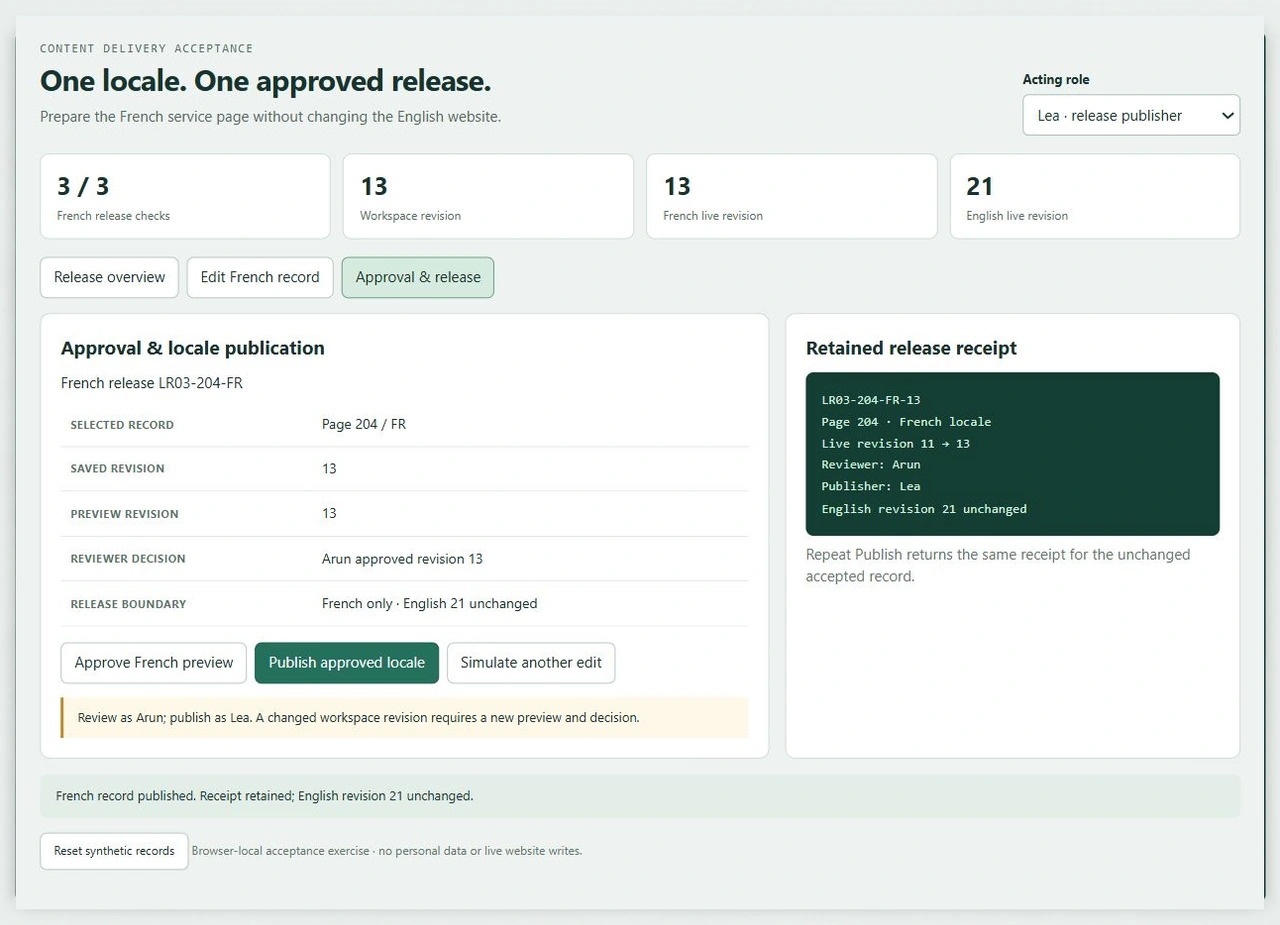
Open LR03 and inspect page 204 in English and French. Supply the missing French image description, save revision 13 and prepare its preview. Review as Arun and publish as Lea. Confirm that the French live revision changes from 11 to 13 while English remains at 21.
Try the multilingual release demoReview workspace behaviour in the actual extension
TYPO3's primary workspace reference explains draft changes, previews and approval before publication. It also identifies extension considerations for previewing records. Include custom extension output in the installation's workspace acceptance cases.
Read the TYPO3 workspace referenceAgree language configuration with the content owners
Use the editor documentation to identify how the installed site manages translations. Decide which language records, fallback behaviour and editor permissions the commissioned work must preserve. Match the documentation to the installation rather than assuming every setup uses the same content policy.
Read TYPO3's language and translation guidanceScope connected data separately
If an extension reads an external catalog or database, give that transfer its own record keys, direction and rejection rules. Agree whether editors control imported values or whether the upstream system remains authoritative.
Specify a connected data development engagementSix steps from installation review to editorial handover
Use real page identities and a repeatable publishing case throughout the engagement.
Describe the visitor and editor outcome
Bring one representative page and the backend task that produces it. Identify the current result, the required result and the affected sites and languages. Separate a site-package change, extension feature, content migration and major-version upgrade into explicit work items.
Review the technical and content estate
Provide the TYPO3 and PHP versions, Composer configuration, site packages, installed extensions and source ownership. Map site roots, language settings, file storage and deployment steps. Agree the delivery contact, development allocation and review cadence once these dependencies are understood.
Specify records and editorial authority
Map page and content-element identifiers to their language relationships. Record who may edit, preview, approve and publish. Agree required fields, slug collision handling, media accessibility text and the behaviour of untranslated material before implementing the workflow.
Implement in a reproducible environment
Develop the agreed site-package, extension or configuration change against a controlled source revision. Include synthetic translations, restricted backend users and representative content types. Verify previews against the intended workspace and language rather than only checking the live default page.
Rehearse publication and recovery
Run the same acceptance case through editor, reviewer and publisher roles. Test conflicting slugs, incomplete content, an intervening edit and a repeated release request. Rehearse any authorized data changes, cache handling and recovery sequence on the agreed environment.
Hand over the accepted CMS change
Release the approved revision through the named operator. Check the visitor URLs, language selector, media and editor permissions after activation. Deliver the changed source, dependency notes, installation steps, acceptance results and the agreed maintenance arrangement.
Materials that determine the quotation
- Share the TYPO3 release, PHP runtime, source repository and Composer lockfile through the agreed project channel. Identify private extensions and changes applied outside the repository.
- Provide a site-root and language inventory with a representative page tree. Include the content types, forms, search and media handling affected by the request.
- Supply synthetic default-language and translated records, plus a backend permission map. Show the editor's present steps and the exact visitor result to accept.
- Name the person who can approve content policy, development scope and release timing. Set out the requested allocation, milestones, commercial terms and dependency access in the quotation.
Extension, migration and deployment boundaries
- For extension development, agree data fields, backend editing, frontend output and workspace or language handling. Identify the TYPO3 extension APIs and installed dependencies that constrain the implementation.
- For content migration, reconcile old and new page identifiers, language links, file references and URLs. Keep a rejected-record list and agree redirect ownership before the cutover.
- Treat a major-version upgrade as its own compatibility exercise. Review extension support, changed configuration and representative editor journeys against the chosen target version.
- Assign deployment, backup, cache operations and post-release checks to named owners. Authorization for schema or content changes belongs in that release scope and recovery plan.
Ongoing responsibility after acceptance
- Retain the accepted commit, site-package or extension source, configuration changes and the installation procedure. The next maintainer should be able to reproduce the reviewed environment.
- Document how editors create translations, obtain approval and report a blocked release. Include which role handles an incomplete record or conflicting URL.
- Agree the maintenance window and response arrangements for updates, compatibility checks and defects. Content entry, hosting operations and additional feature work need explicit coverage.
- Revisit the acceptance cases when the site gains a language, extension or publishing role. A previous release decision applies to its recorded content and dependency state.
Six records for an inspectable multilingual release
LR03 supplies a concrete editorial acceptance exercise for a CMS development brief. Keep the page, language and approved revision attached to every decision.
| Record | Example inputs | Required output and control |
|---|---|---|
| Page-language identity | Page 204 / EN and 204 / FR; French translation of the English source | Limit the release to 204/FR and preserve the English live record. |
| Localized content | Nos services; /fr/services; French image description | Require a title, valid French route and supplied media description together. |
| Route ownership | 204/FR owns /fr/services; another page owns /fr/contact | Reject the reserved contact route instead of creating two owners. |
| Saved preview | Draft revision 12; corrected record 13; preview PR-13 | Save current fields before preview; bind the preview to that saved revision. |
| Review decision | Maya editor; Arun reviewer; current preview revision | Require the reviewer to approve the exact revision; block a stale decision. |
| Publication receipt | Lea publisher; receipt LR03-204-FR-13; French 11 to 13 | Publish only the current approved locale and return the same receipt on repeat. |
Start with French draft 12 and live 11. Maya adds Bureau de consultation as the image description and saves draft 13. Preview PR-13 carries Nos services at /fr/services. Arun approves revision 13; Lea publishes it and retains LR03-204-FR-13. English stays at live revision 21. A second Publish returns the existing receipt. If another edit advances the workspace before publication, the earlier preview and decision no longer authorize the release.
Ask development providers to demonstrate the same editorial case.
Compare the quoted responsibility for implementation, editorial acceptance and continuing operation using your installation materials.
| Option | Published focus | Ask in your demo |
|---|---|---|
| DRC Systems | TYPO3 CMS implementation, extensions, migrations and developer engagement. | Which workspace, translated-record and restricted-editor checks accompany the proposed extension work? |
| Right People Group | TYPO3 contractors, consultants and project-based development capacity. | Who owns the implementation backlog, content-policy decisions and final acceptance when a specialist joins the project? |
| ProtonBits | Website and extension development, upgrades, maintenance and project engagement. | What source, URL-mapping and editorial operating records are included with the accepted website change? |
LR03 gives you a repeatable discussion asset: one missing description, one conflicting route, three distinct roles and one unchanged English record. Ask the provider to translate these requirements into installation-specific delivery evidence.
Category reference: TYPO3 primary reference: versioning and workspaces. Check the documentation branch against the installed TYPO3 version and the behaviour of each custom extension involved in the engagement.
Connect the CMS change with the wider software brief.
Review related software work when the website exchanges records with another business application.
Explore the Codeblix marketplaceAgree what the TYPO3 engagement delivers
Settle the installation boundary, editorial responsibilities and completion evidence before development begins.
What can I commission through a TYPO3 development engagement?
Describe the website, site-package, extension or editorial change you want implemented. Codeblix reviews the installation and dependencies, then agrees the development allocation, delivery contact, milestones and acceptance responsibilities in a project quotation.
What should I send for an existing installation?
Bring the installed versions, source ownership, site-package and extension inventory, site roots and configured languages. Include an anonymised content example and the backend steps that produce it. These materials determine the affected code, content and editorial permissions.
Can the work cover multiple languages and publishing roles?
Include each affected language and the editor, reviewer and publisher responsibilities in the scope. Specify translation relationships, required fields, fallback policy and preview behaviour. Test the resulting visitor pages and the backend decisions using representative restricted users.
What does the multilingual release demo let me verify?
LR03 lets you repair one French record, reject a reserved route, create a saved-revision preview, approve as a separate reviewer and publish as the designated publisher. Its receipt records French revision 11 to 13 while English remains 21. You can also invalidate an approval with another edit and repeat an accepted release safely.
How do we scope an extension that imports external data?
Identify the upstream owner, imported record keys, language mapping and fields that editors may change. Supply the interface documentation and sample rejected records. Agree transfer timing, retry behaviour and reconciliation as explicit connector work within the quotation.
Can a migration or major-version upgrade be included?
Request a separate work item covering compatibility, rehearsal data, identifier mapping and redirects. Define the expected content totals and editorial journeys at the destination. Agree authorized database changes, release ownership and recovery conditions before the production step.
What evidence marks the development task complete?
Keep the accepted source revision, changed configuration, reproducible installation steps and task-specific verification results. For publishing changes, include the page-language records, role decisions and visitor URLs checked. Have the business owner approve that evidence before release.
How are costs, capacity and support confirmed?
The quotation follows the installation and requirement review. Agree investigation, implementation, content reconciliation, release assistance and follow-up coverage with clear owners. Confirm available allocation, start conditions, milestones and payment terms for the defined work.