
Set a monthly receiving standard.
Tie the allocation to observable application behaviour, with a named owner for each accepted increment.
Preserve intentional values
A zero-day notice period and an off preference are valid changes. Specify where empty strings, numeric zero, false and null have different meanings so a form submission does not quietly discard an intended update.
Keep omitted data intact
Decide which fields an operation may change and how it represents omission. A partial update should leave the dispatch code and access note untouched when they are absent from the submitted field set.
Make each allocation inspectable
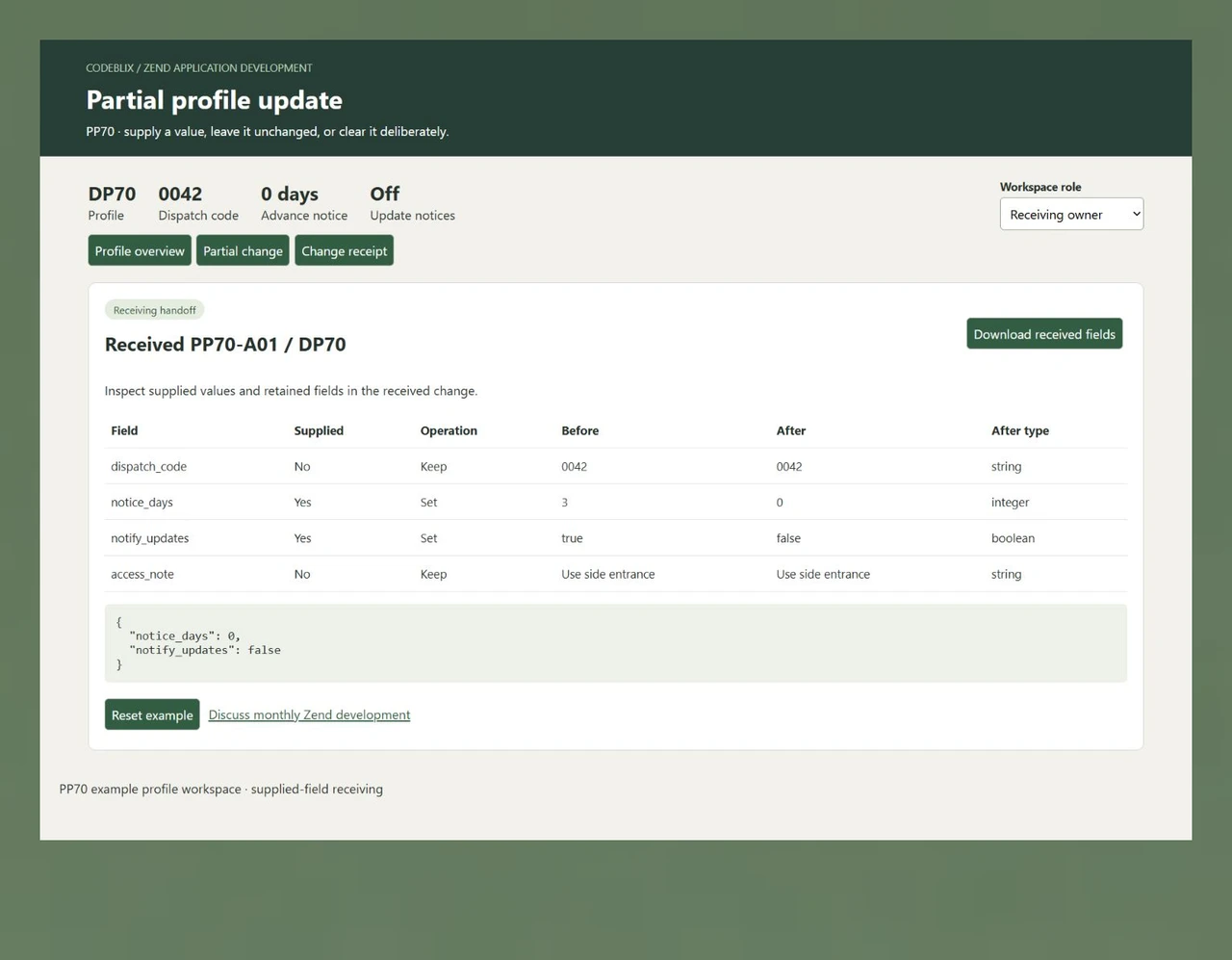
Receive the changed source alongside a before-and-after record. The PP70 example supplies a four-field receipt that identifies the two changed values and the two retained values without relying on a success message alone.
Receive the values you intended to change.
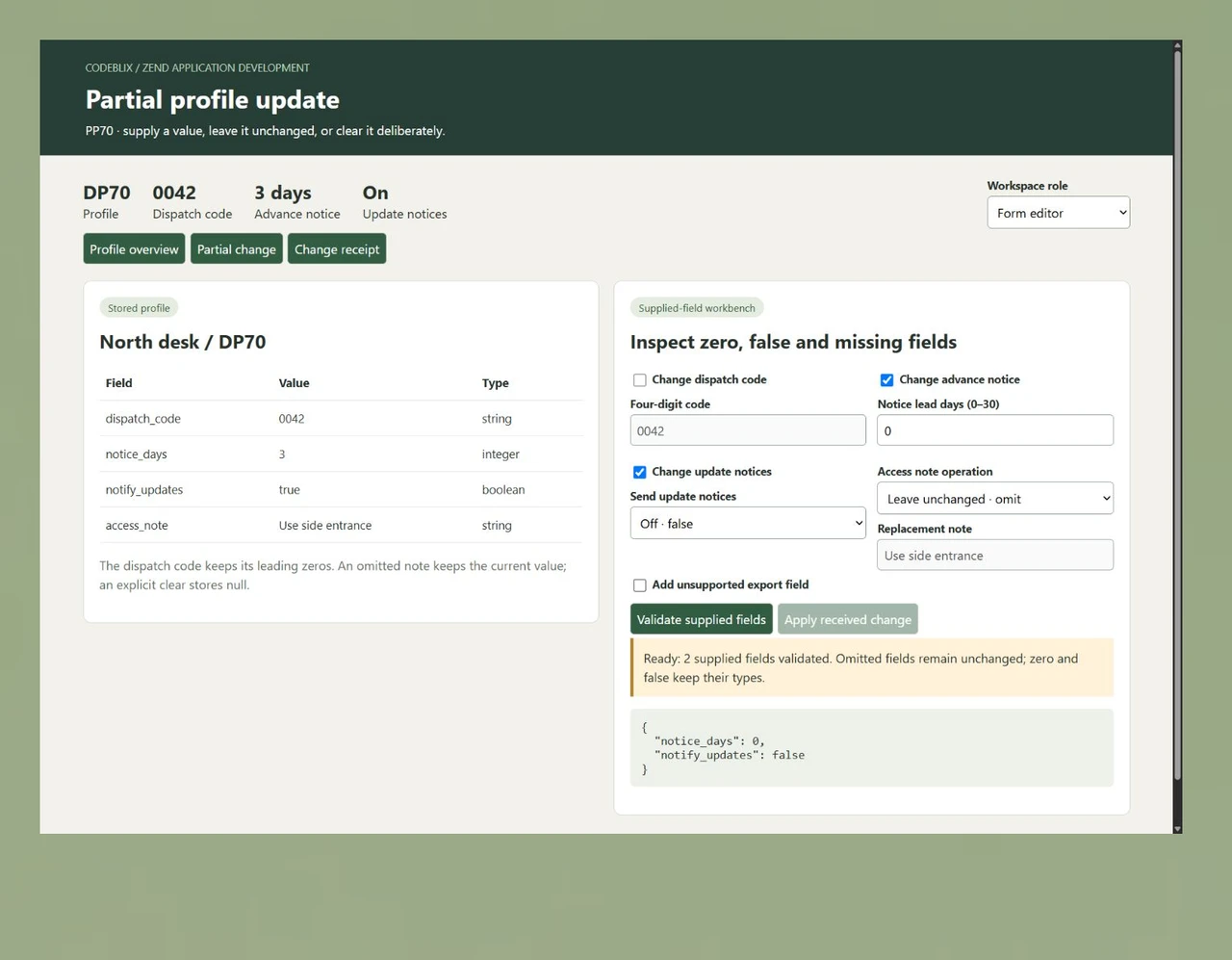
Use the PP70 profile demo to validate two supplied values, preserve two omitted fields and inspect the received field types.
Try the receiving exercise.
Use the working example and primary framework references to make your first development request concrete.
Inspect zero, false and omission
Open Partial change and validate the default request. It supplies zero notice days and false update notices. Switch to Receiving owner, apply once, then open Change receipt. The dispatch code remains 0042 and the access note remains Use side entrance.
Open the PP70 partial-profile demoChoose the input-filter rules explicitly
Laminas InputFilter supports filtering and validating associative input data, including validation groups for selected inputs. Have the developer specify the accepted field set and inspect both raw and filtered values where their distinction affects the operation.
Read the Laminas InputFilter introductionScope a Zend-to-Laminas transition
The official migration tooling covers Zend Framework 2 and 3 among its supported components. Identify your actual application branch and review dependency and source changes against regression receiving cases before including a transition in the monthly allocation.
Consult the official Laminas migration guideConnect the form to its stored record
Include the data model and receiving output when they belong to the application change. Assign responsibility for existing records, approved corrections and the downstream consumer so the quotation covers the complete profile operation.
Arrange the supporting database developmentPlan your Zend allocation.
Begin with one specific change and establish the receiving conditions before filling the monthly backlog.
Identify the application branch
Share the exact Zend Framework version, PHP runtime, dependency lockfile and affected modules. Identify the source owner, hosting operator and staging arrangement. Agree whether the immediate work maintains the existing branch or includes a defined modernization step.
Describe the first monthly task
Choose a form, API endpoint or application workflow with an observable result. Provide sanitized existing values and the intended change. Include who submits the request, who receives it and which neighbouring values must stay intact.
Set the input contract
List the allowed fields, data types and validation rules for the operation. Specify omitted fields separately from explicit clears. Decide how unknown fields, blank replacements and values outside their permitted range are reported to the submitting user.
Receive the implemented behaviour
Have the developer exercise the agreed cases through the application request and its stored result. Include numeric zero, boolean false, leading zeros in identifiers and a deliberate clear. Record the accepted response and the retained fields together.
Reconcile dependencies and release work
Inspect forms, consumers and exports that use the changed record. Define any legacy-data correction with the data owner. Receive permission checks, regression results, deployment prerequisites and rollback responsibilities for the commissioned application change.
Review the remaining monthly allocation
Use the received increment to confirm the next priorities, collaboration window and review cadence. Ask Codeblix to confirm capacity and commercial terms for the requested period. Agree how additional requirements, defects and follow-on support enter the work queue.
Set the application and allocation boundaries
- Provide a prioritized backlog and the exact framework, PHP and dependency versions. Identify the modules that handle forms, authentication, storage and exports. Arrange sanitized examples and staging access through the application owner.
- Separate the requested application changes from hosting administration and ongoing infrastructure operations. State whether the allocation includes API work, interface changes, data correction, release support or a framework transition, and assign an owner to each dependency.
- For each partial form, supply its allowed field list, type rules and clear operation. Explain whether identifiers must retain leading zeros and whether a blank string has a valid meaning. Include representative invalid requests and the user-facing response you expect.
- Discuss the monthly capacity, working window and receiving availability before agreeing commercial terms. Specify the priority decision maker, review points and treatment of additional requirements. Request confirmation of the allocation for your requested period.
Receive source, behaviour and operating handoff
- Require permission checks in the actual application request path. Receive an unauthorized request and an authorized request against the same operation. Include the applying responsibility and the expected result when access is denied.
- Test the commissioned form and endpoint with omitted fields, zero, false and explicit null. Inspect the stored record after each request, together with validation errors and export output. Agree how a change is handled when another accepted update has altered its source values.
- For existing data, inventory ambiguous blank values and type inconsistencies before correction. Let the data owner approve any interpretation that changes meaning. Reconcile dependent forms, reports and consumers after a representative conversion.
- At handover, receive the changed source, dependency requirements and completed acceptance record. Agree deployment and rollback ownership, defect handling and support contact arrangements. Keep future framework or feature work identifiable in the subsequent backlog.
Six records behind a partial profile change
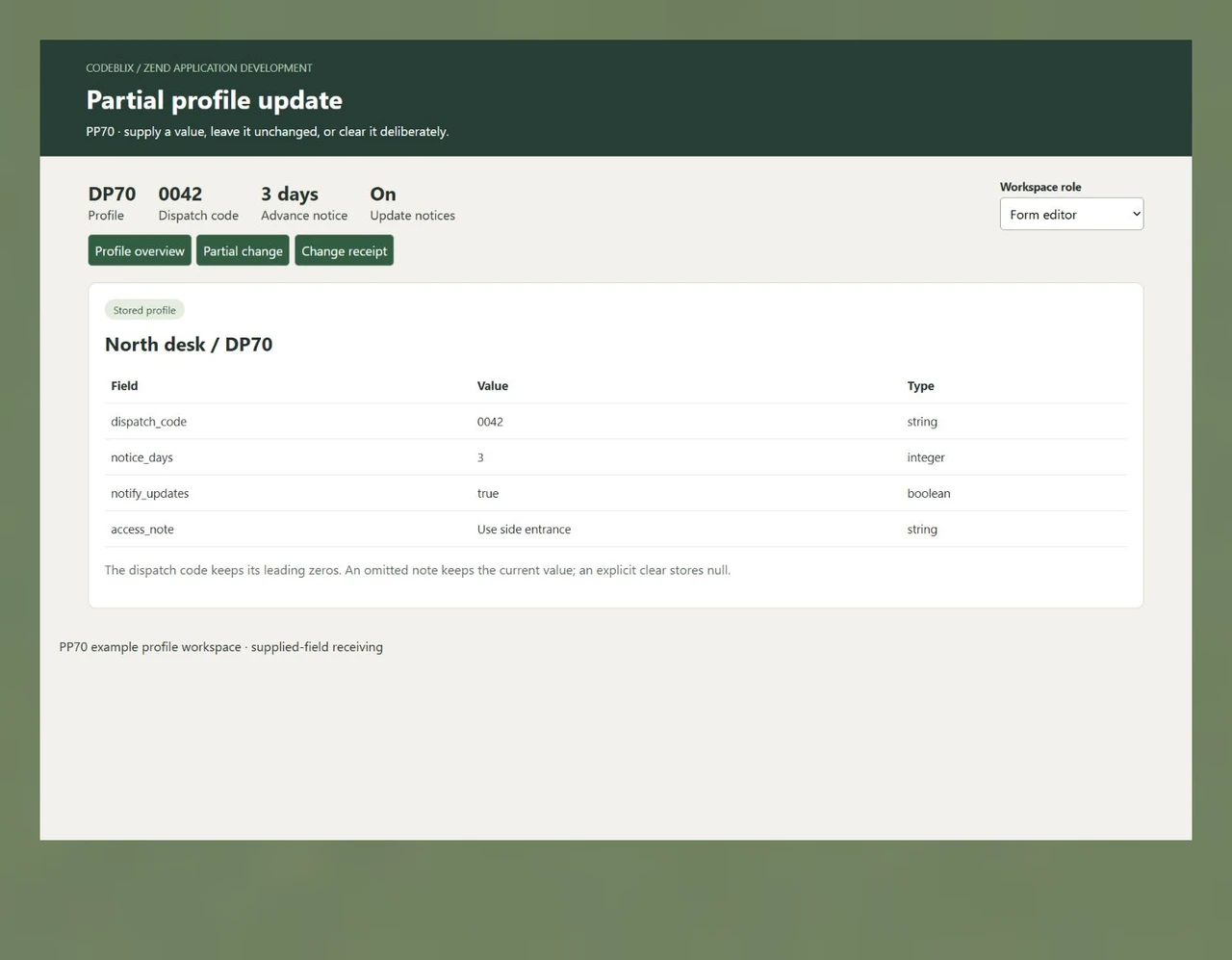
PP70 links a stored profile, a supplied-field request and an applying owner to a four-row receiving receipt.
| Record | Example inputs | Required output and control |
|---|---|---|
| Stored profile | DP70 / North desk | Retain the original four values as the receiving baseline. |
| Allowed field contract | dispatch_code / notice_days / notify_updates / access_note | Reject an unsupported internal_export_id instead of silently accepting it. |
| Supplied values | notice_days: 0; notify_updates: false | Keep the validated integer and boolean types when constructing the partial change. |
| Omission and clear operation | Code and note omitted; explicit note clear uses null | Preserve missing fields and require a deliberate operation to remove the note. |
| Receiving responsibility | Form editor / Receiving owner | Invalidate a review after an input edit and allow the receiving owner to apply it once. |
| Field receipt | PP70-A01 / four rows | Inspect supplied flags, operations, before and after values, and the received types. |
DP70 begins with dispatch code 0042, three notice days, update notices on and the note Use side entrance. Validate the default two-field request: notice_days becomes integer 0 and notify_updates becomes boolean false. A Form editor cannot apply it. Switch to Receiving owner, apply once and open Change receipt. The two omitted fields retain their original strings. Download all four receiving rows. In a separate reset exercise, choose Clear for the note to receive null deliberately.
Give each provider a received application task.
Use one sanitized partial-form request to discuss the monthly allocation and its acceptance responsibilities.
| Option | Published focus | Ask in your demo |
|---|---|---|
| Programmers.ai | Zend development enquiries covering custom application work, maintenance and migration. | Which supplied-field cases and stored outputs will accompany the first monthly task? |
| Webcreta | Zend developer hiring enquiries with monthly and hourly engagement options. | How are priority changes, receiving time and source handover allocated within the engagement? |
| Stellen Infotech | Zend and Laminas development enquiries with framework-version and engagement discussions. | Which existing framework branch will the developer receive, and which regression checks cover a transition? |
Ask each provider to identify the framework branch, first deliverable and receiving evidence. Confirm the allocation against that defined work, including the application and source handoff.
Category reference: Primary reference: Laminas InputFilter introduction. Choose input rules and dependency changes for the actual application branch being commissioned.
Commission the application task.
Connect the form, request handling and stored record with clear responsibilities for the next development increment.
Explore marketplace development servicesArrange your monthly Zend work
Resolve the allocation, application scope and receiving responsibilities before commissioning the first task.
What should we send for a monthly Zend development quote?
Send the prioritized backlog, exact framework and PHP versions, dependency information and a sanitized example of the first application change. Name the receiving owner and explain the expected result, invalid cases, staging dependencies and release responsibilities.
How do we agree the monthly programmer allocation?
Discuss the expected work queue, collaboration hours, priority owner and receiving cadence with Codeblix. Request confirmation of capacity and commercial terms for your period. Agree how new requirements and review delays affect the planned work.
Can the allocation cover maintenance and new form behaviour?
Include both in the enquiry with separate acceptance outcomes. For a form change, specify the allowed fields, validation response and stored result. For maintenance, identify the affected dependency or defect and the regression cases that establish receipt.
What can our team inspect in the PP70 workspace?
The demo validates a partial profile request and distinguishes omission, zero, false and an explicit note clear. The Receiving owner can apply a reviewed change once. Its downloaded receipt contains four fields with supplied flags, before and after values, operations and types.
How should we receive a partial-update form?
Submit the agreed cases through the implemented form and endpoint, then inspect the stored values. Include omitted fields, valid zero and false values, an unsupported field and a deliberate clear. Require errors to explain which supplied value needs correction.
Can monthly work include a Laminas transition?
Request a branch-specific assessment and identify the source and dependencies to change. The official migration guide covers Zend Framework 2 and 3; agree the approach for your actual application version. Include module, form and consumer regression checks in the transition scope.
What determines the quotation and first deliverable?
The framework condition, backlog size, input rules, dependent consumers and release responsibilities shape the work. Access to representative staging data and a receiving owner also matters. Ask for an identifiable first increment and clear allocation terms before adding later tasks.
What should our team receive at handover?
Receive the changed source, dependency prerequisites and completed acceptance cases, including field-level before and after results. Agree deployment, rollback, defect handling and ongoing support responsibilities. Keep subsequent enhancements and framework work visible in the remaining backlog.