
Supplier quality management software for defects, responses and verified follow-through
Supplier quality management software connects supplier-related defects, affected deliveries, corrective responses and follow-up verification in one case history. Codeblix offers custom software development for quality and purchasing teams that need clear supplier responsibilities, controlled evidence and a dependable decision on when an action can close. Explore a working supplier response demo and use the buyer checklist to define your project.
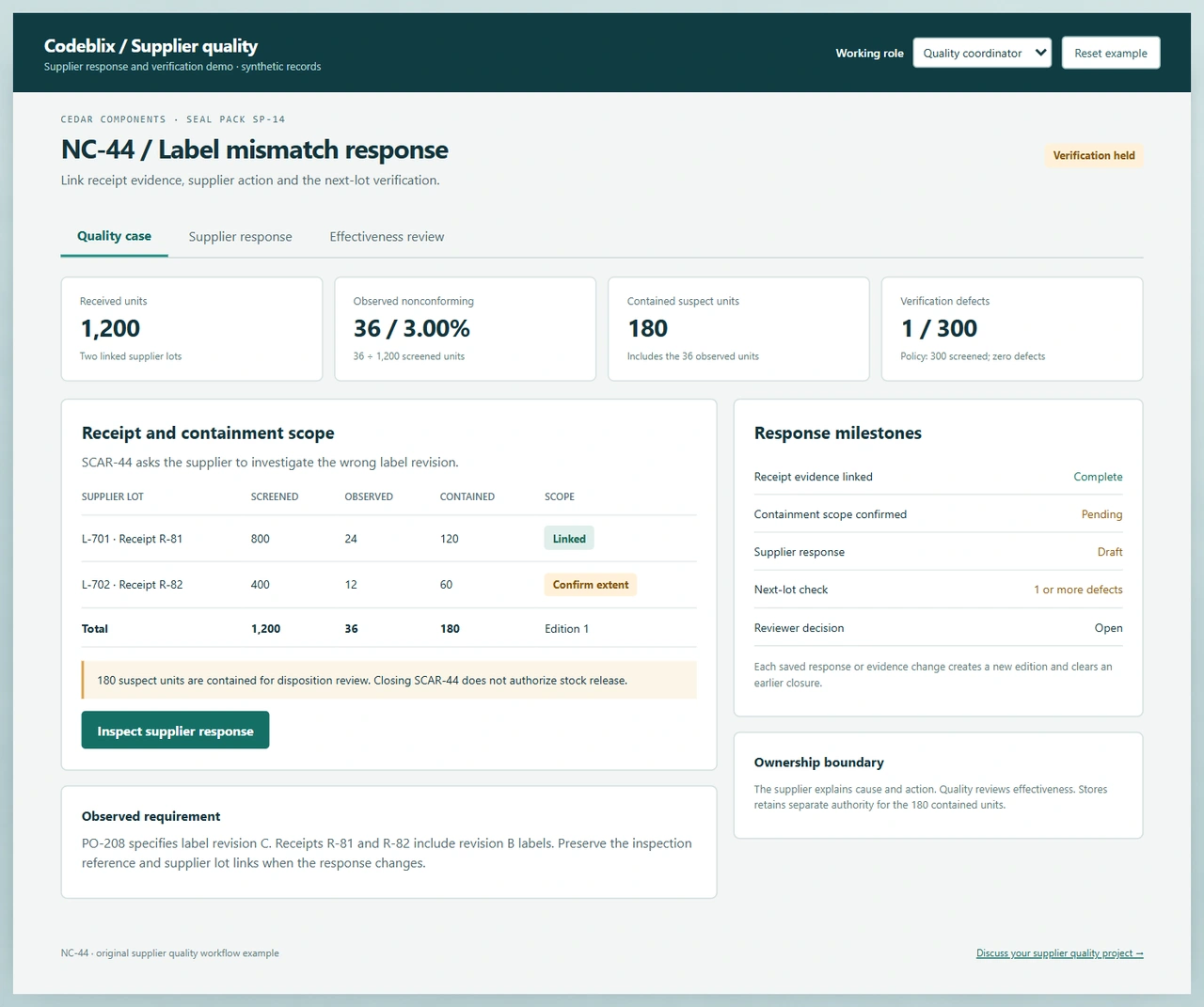
Make a supplier response answerable to the evidence.
A completed response form does not explain whether the affected deliveries are understood or the corrective action worked. Keep those decisions visible throughout the case.
Identify the affected supplier deliveries
Link the observation to supplier, site, purchase requirement and receipt references. Keep screened quantities, observed defects and contained suspect stock separate so the case cannot lose its original extent.
Give each response an accountable owner
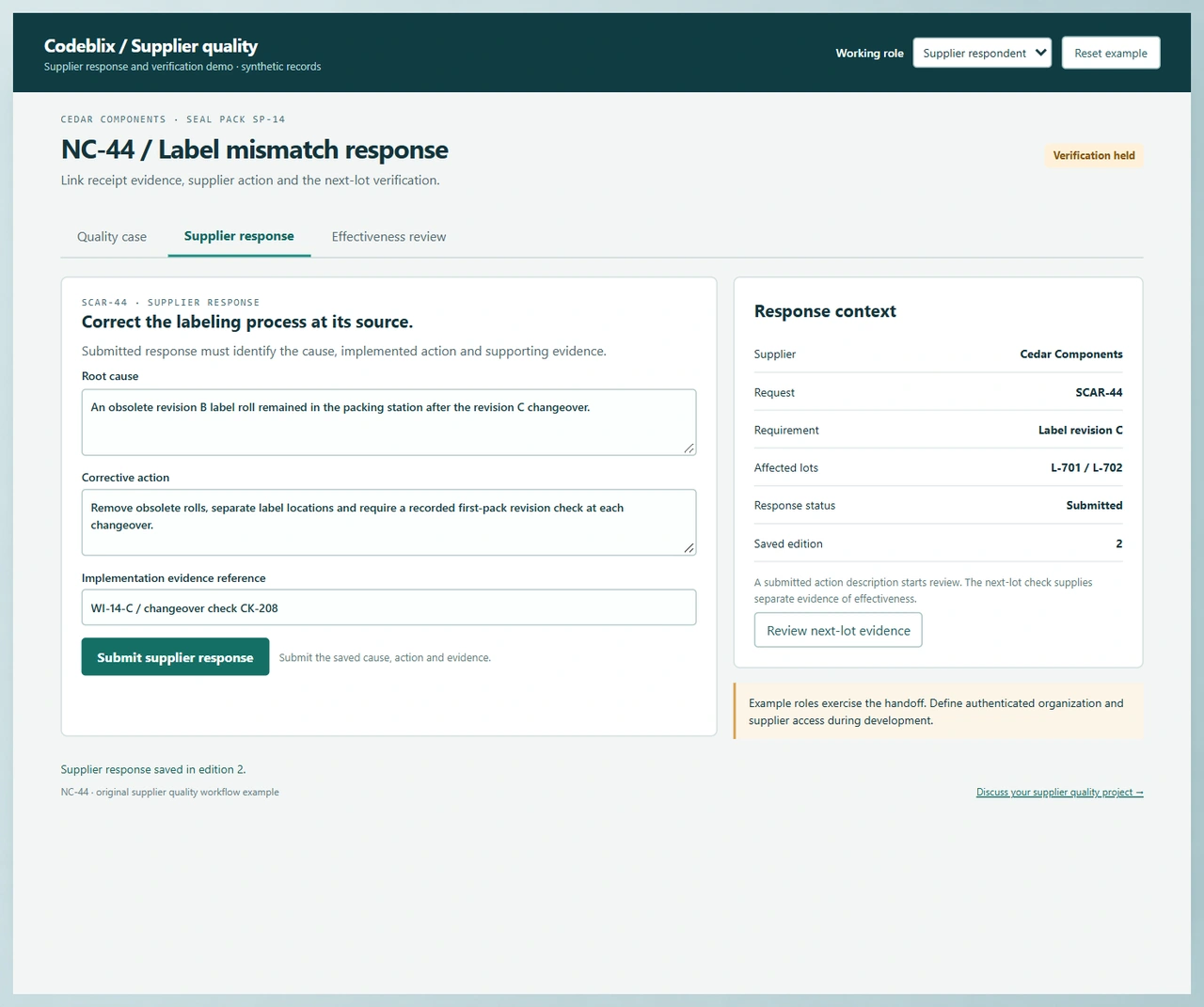
Request a cause explanation, implemented action and evidence reference from the supplier. Distinguish an overdue or returned response from an accepted implementation, and preserve the reason for each return.
Close against an agreed verification rule
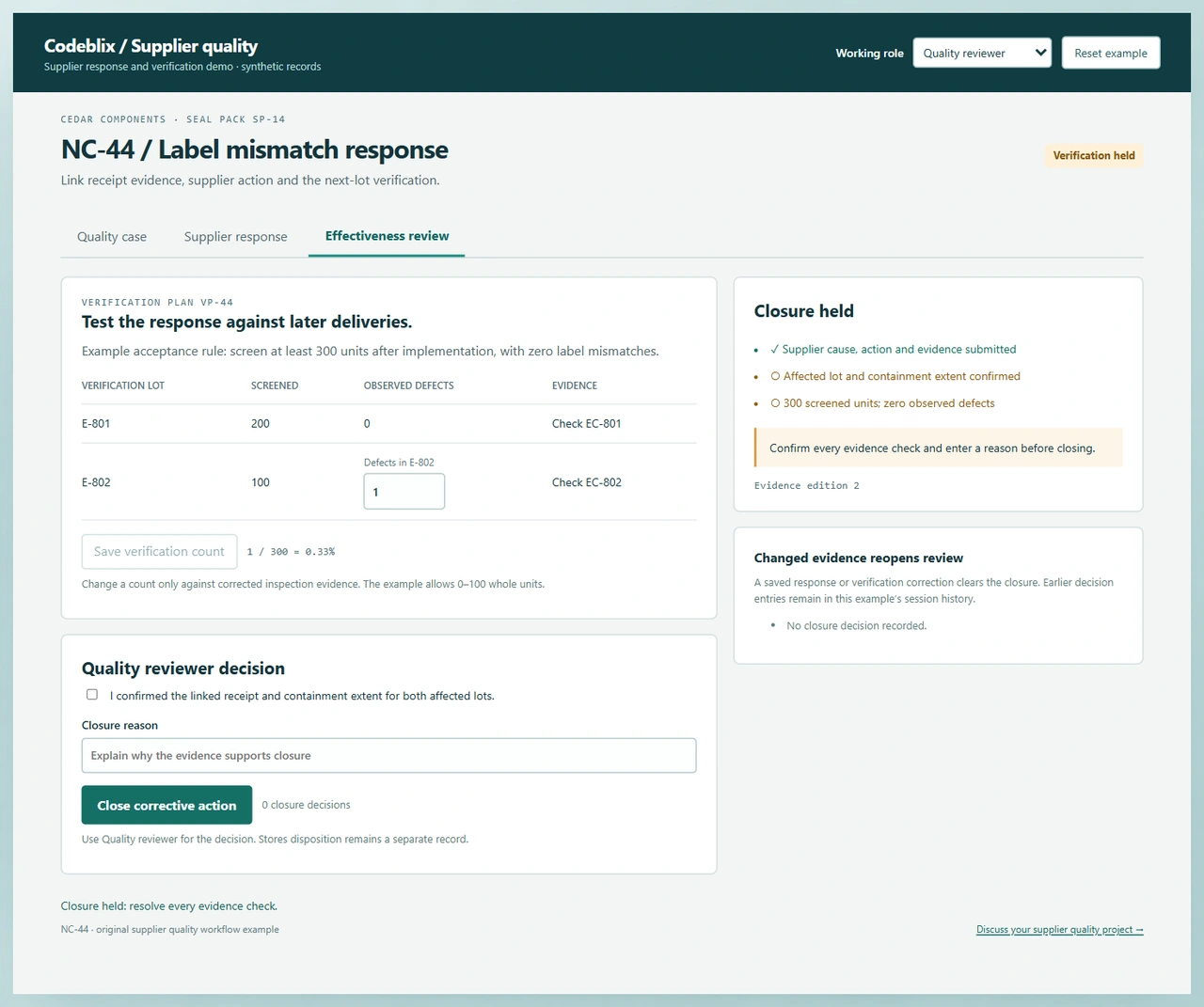
Specify which later deliveries will be checked, how much evidence is sufficient and who decides the result. A corrected verification record should reopen the decision for review while keeping its earlier history.
Follow the same quality issue across three working screens.
The supplier quality demo follows a label mismatch across two received lots. Review the affected quantities, submit the supplier’s response and inspect why a later verification defect holds the corrective action open.
Try the supplier response and closure sequence
Start with the two-lot quality case, switch to the supplier role and submit the prepared cause and action. The quality reviewer encounters a closure hold until the affected extent and verification result satisfy the example rule.
Open the supplier quality demoCarry reviewed case outcomes into scorecards
Supplier scorecards compare performance over a defined period. A quality case investigates a particular problem and its response. Share the agreed outcome and source reference with the scorecard owner without converting an unresolved case into a verified improvement.
Compare supplier performance softwareConnect quality ownership after supplier registration
Once a supplier is registered, ongoing quality cases need their own scope, response participants and review authority. Reuse the approved supplier identity and purchasing scope without treating onboarding approval as acceptance of every subsequent delivery.
Review supplier onboarding requirementsFrom a supplier quality observation to a supported closure
Build a repeatable case route around your actual purchasing and quality responsibilities. Agree the closure rule before the response is judged.
Open a case against the supplied requirement
Capture supplier and supplying site, part or service reference, purchase requirement, receipt identities and the observed mismatch. Attach the original inspection reference. If two teams report the same delivery, link their observations to the case instead of inflating the defect count.
Establish containment and affected extent
Identify received, in-transit and other potentially affected lots using the records available. Assign an owner to each outstanding scope question. Record temporary containment and the authority for stock disposition as distinct decisions; a supplier action closure must not silently release held material.
Request and assess the supplier response
Set a response owner, due date and required sections. Collect the cause investigation, chosen corrective action, implementation date and evidence references. Return an incomplete response with specific questions, keeping each submission edition available for comparison.
Define the effectiveness check
Agree the next deliveries or time window, screened population, defect definition and acceptance rule. Decide who records the observations and who reviews them. An insufficient sample, repeated defect or disputed source opens an exception with a named next action.
Review the complete case and decide
The authorized quality reviewer examines the affected extent, supplier response and verification outcome together. Record the reason for closure, extension or further action against the exact evidence edition. Keep concessions, supplier approval scope and inventory disposition separately authorized.
Reopen changes and hand off recurring issues
Preserve earlier decisions when response evidence or verification counts change. Reassess the affected closure rather than editing history in place. Feed an agreed case outcome into supplier reviews and audit planning while retaining its source identity and measurement period.
Roles and supplier access
- Quality coordinators link observations and verification records. Supplier respondents provide their own cause and action evidence. Quality reviewers decide closure. Receiving and stores teams retain containment and disposition responsibilities. Purchasing owns the commercial relationship and escalation route.
- Define supplier-specific access, site restrictions, attachment permissions and controlled exports. External participants should see the requests and evidence intended for their organization; internal costs, other suppliers and private reviewer notes require separate permissions.
- Agree server-enforced identity, authorization, change history and retention for the delivered application. The working demo uses selectable roles to exercise the sequence with synthetic records; authenticated supplier invitations and persistent histories are project requirements.
Migration and integration decisions
- Begin with anonymized issue logs, current supplier and site identifiers, receipt references and a few completed response packs. Reconcile duplicate cases, inconsistent defect units, missing lot links and disputed closure states before importing history.
- For ERP, receiving, document or QMS interfaces, identify the authoritative records, direction, frequency, permissions and failure owner. Confirm actual API access during discovery and define a controlled file handoff when an interface is outside the pilot.
- A case import should retain its source ID and evidence edition. Replaying a receipt or observation must not multiply quantities. Reconcile accepted, rejected and held records with the source file and preserve corrections rather than replacing the original observation.
Deployment, support and sector requirements
- Pilot one supplier category and a small set of quality cases. Agree the escalation calendar, working days, supplier response limits, returned submissions and rule changes. Capture supplier site changes and repeated defects as explicit scenarios.
- Scope hosting, organization access, backups, restoration, file scanning, export portability and support responsibilities with the development quote. Decide who monitors failed imports and who can change a closure rule after rollout.
- If your operation has regulated quality, validation or electronic-signature obligations, bring those requirements and your quality owner into discovery. Define the necessary controls and acceptance evidence for your sector before selecting or building the system.
Six linked records for a supplier quality decision
Use this original record model to compare an existing supplier QMS, an extension to your current platform or custom Codeblix development. The worked case makes quantity and authority boundaries visible.
| Record | Example inputs | Required output and control |
|---|---|---|
| Supplier and supplied requirement | Cedar Components; supplying site; seal pack SP-14; PO-208 label revision C | Keep the requirement reference and supplier identity attached to every affected receipt. |
| Quality case and linked observations | NC-44; receipts R-81 and R-82; supplier lots L-701 and L-702; inspection references | Retain original observations and link duplicates before calculating affected quantities. |
| Containment and disposition scope | 1,200 screened units; 36 observed nonconforming; 180 contained suspect units | The contained population includes the 36 observed units. Assign scope review and stock disposition independently. |
| Supplier corrective response | SCAR-44; cause; corrective action; WI-14-C and CK-208 evidence; response edition | Require the response sections and implementation evidence before the reviewer evaluates closure. |
| Effectiveness plan and observations | VP-44; later lots E-801 and E-802; 200 plus 100 screened units; observed label defects | Apply the agreed minimum population and acceptance rule to the recorded evidence, with corrections retained. |
| Closure decision and reopened edition | Evidence edition; confirmed scope; reviewer reason; closure history; later changes | Bind closure to the reviewed record set. Changed evidence clears the active closure and preserves the earlier decision. |
The synthetic case contains two supplier lots. L-701 has 800 screened units and 24 observed label mismatches; L-702 has 400 and 12. The combined observed rate is (24 + 12) ÷ (800 + 400) = 3.00%. The 180 contained suspect units include those 36 observations; they are not an extra 180 defects. The supplier submits a cause involving an obsolete label roll and an action involving separated rolls and a first-pack revision check. Later verification covers 200 units from E-801 with zero mismatches and 100 from E-802 with one. That is one observed defect in 300 screened units, or 0.33%. The example rule requires at least 300 screened units with zero mismatches, so closure is held. In the demo, a coordinator can record a corrected E-802 count of zero only against revised evidence. With the supplier response submitted and containment extent confirmed, a quality reviewer can then enter a reason and close the current edition. Changing the verification count afterward reopens review and keeps the earlier decision. Closing the supplier action does not decide the disposition of the 180 contained units.
Ask each provider to show the same supplier response case
The linked primary product pages describe different supplier quality approaches. Use the two-lot example to test the details that matter to your operation.
| Option | Published focus | Ask in your demo |
|---|---|---|
| Qualio | Supplier policies, required documents, risk categories, audit frequencies and approved supplier records within its QMS. | Show how a quality case links back to the affected receipts and how a revised supplier response changes the closure review. |
| MasterControl | Central supplier information, audit findings, supplier corrective action requests and reviewed supplier deviations. | Demonstrate the difference between closing the supplier action and authorizing disposition of the contained material. |
| AssurX | Supplier quality workflows for suppliers, contract manufacturers and service providers within a broader quality management platform. | Show a failed next-lot effectiveness check, a corrected evidence edition and the history when an earlier closure reopens. |
Choose a specialist supplier QMS when its standard workflow, sector controls and implementation approach meet your requirements. Consider extending an existing quality platform when supplier identities and evidence already live there. Discuss custom development when your receipt reconciliation, external response permissions or review route require a tailored application. Compare configuration, migration, validation effort, licensing and ongoing support using the same evidence cases.
Category reference: MasterControl: supplier information and corrective action requests. The NC-44 record model, worked arithmetic and 20-case checklist are original Codeblix buyer resources.
Connect supplier responses to the wider quality operation.
Use shared part, site and receipt references while keeping internal inspection, supplier response and stock disposition decisions clear.
Explore manufacturing software requirementsQuestions to answer before choosing supplier quality management software.
These supplier quality management questions separate a useful software scope from a generic feature list.
What belongs in supplier quality management software?
The useful scope links supplier identity, supplied requirements, observations, affected deliveries, responses, verification and decisions. Some projects also include qualification, audits or scorecards. Define which records already have an authoritative system before choosing the application boundary.
Can Codeblix develop a supplier quality case application?
Yes. Bring your current issue log and an anonymized supplier response pack to a consultation. Codeblix can scope custom software around your case model, supplier participation, evidence checks, review permissions, imports and operational support.
What distinguishes supplier quality cases from supplier scorecards?
A case follows an individual issue, its extent and the action taken. A scorecard summarizes agreed measures for a period. Linking them preserves the evidence behind a quality measure while allowing the case to retain its own investigation and closure history.
Is a supplier’s completed response enough to close the case?
The closure policy should state the required response evidence, affected extent, verification result and decision authority. In the demonstration, a submitted response still leaves the case open because the next-lot check contains a defect and containment scope needs confirmation.
How are defect rates and contained quantities kept consistent?
Use the defined screened population as the denominator and the observed nonconforming population as the numerator. Track suspect contained stock separately and specify whether it includes the observed units. Preserve units, receipt identities and correction history so the totals can be reproduced.
How should later evidence change a closed supplier action?
Retain the earlier decision and route the changed evidence for another review. The demo clears its active closure when a verification count or saved response changes, keeping the previous closure entry in session history. Define persistent history and reopening notifications in the application scope.
Can supplier quality development begin with spreadsheets?
A file-based pilot can establish stable supplier, receipt and case identities before adding interfaces. Agree column definitions, required references and duplicate handling, then reconcile imported records with the source. Any ERP or QMS interface needs its own access and field-ownership review.
Which supplier-quality requirements affect the development quote?
Case volume, supplying sites, supplier access, attachment handling, review routes, data cleanup, reporting and integration scope are major factors. Sector controls, validation work, hosting, restoration and support commitments also affect delivery. Start with representative cases and a small acceptance pack.