
Buy a household companion for your cooking-course business
Acquire RecipeGPT around a participant self-service practice task after the lesson.
A worked purchase case for an existing cooking-course operator buying RecipeGPT beside its own teaching. Inspect confirmed pantry information, guided cooking, leftovers and a next shopping action.
Buy a household cooking application when your existing cooking-course business wants an owned companion for practice after a lesson. RecipeGPT is an available source-and-domain asset with pantry records, expiry-aware meal suggestions, guided cooking, leftovers, weekly planning and shared shopping work. Request the package around what the participant will actually do at home.
This worked case assumes a fictional course operator already provides its own teaching. The course, instructor, participants and lesson material are buyer inputs, not included customer relationships or content rights. RecipeGPT supplies a household product to evaluate alongside that teaching, rather than a learning-management or clinical nutrition service.
Request RecipeGPT for the post-lesson product you want to own
Contact Codeblix to request RecipeGPT's current application and domain acquisition package. Describe the household practice exercise you want a participant to complete and ask for a seller-led walkthrough using fictional pantry information.
The actual sale domain is recipe-gpt.com. The temporary buyer preview is at the RecipeGPT buyer preview; it uses simulated plan selection and server-side blocking of real charging. Evaluate current price, availability, represented financials and agreed transfer terms through the individual Flippa listing.
The authoritative RecipeGPT product page and individual meal-planning acquisition offer explain the software package. This case centres a specific buyer outcome: a self-service household companion for participant practice, with the instructor's teaching and the household's actions clearly separated.
Make the first practice task smaller than the whole course
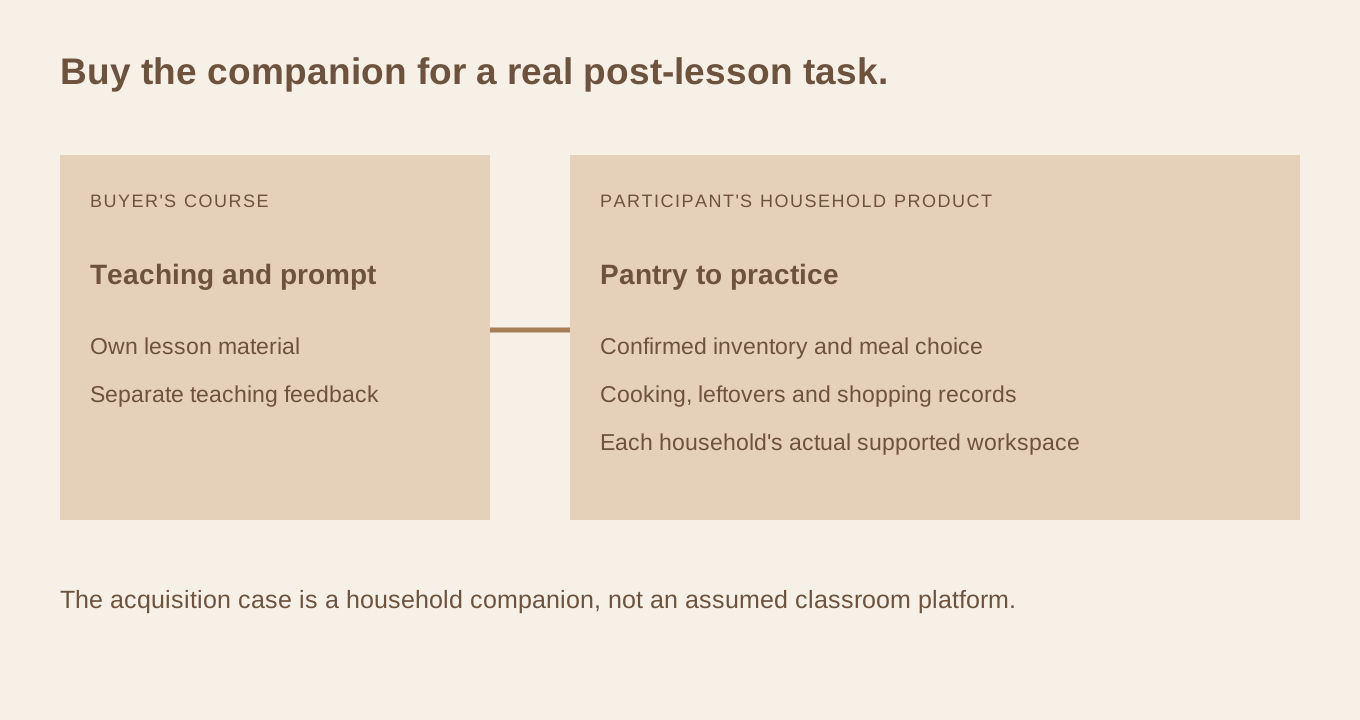
Imagine a fictional instructor who has just taught a lesson about preparing an ordinary meal from available ingredients. Participants leave with the instructor's own material and return to different kitchens. The operator wants to own a product that helps them work with their actual pantry, plan a practical next meal and organize what they still need.
The first task can be modest: record a few items, inspect a meal suggestion, follow a cooking workflow and check the resulting pantry or leftover records. This is an application job to demonstrate. It is different from grading a participant, tracking a cohort or deciding whether someone has mastered the course.
Write that task in the purchase request. The seller can prepare a relevant walkthrough, and the buyer can evaluate the real household work rather than ask whether a generic AI app can somehow become an entire education business.
Let each household begin from its own kitchen
RecipeGPT documents household onboarding with a household name, preferences and a starter-pantry or empty-kitchen path. For the acquisition exercise, create a fictional household and choose a small set of test items. The buyer should see how that household reaches a useful working state.
The empty-kitchen option is useful to inspect because course participants will not all begin with the same ingredients. The household can enter its actual information rather than inherit a fictional pantry as if it were real. The buyer can prepare its own introductory instruction from the demonstrated route.
Keep that instruction simple: create your household, review the information and choose the actual pantry starting point. The instructor can explain the exercise through its existing course communication. The purchase does not automatically create participant accounts or import a class roster into households.
Inspect pantry entry before asking the application for a meal
The household record is the foundation of the practice. RecipeGPT prioritizes food approaching the recorded expiry date and uses current pantry information in its rescue workflow. Use fictional items and dates to inspect the input, the displayed record and an ordinary correction.
For a photo exercise, the product documents editable recognition with explicit confirmation before saving. Ask the seller to show that specific path: the recognized result, the household's edits and the saved pantry record. This is a product-specific confirmation workflow, and the buyer should inspect it as delivered.
The course operator can then explain what participants must check. The household supplies and maintains its real information. A model-assisted recognition result is an entry aid; it becomes useful when the person understands and confirms the inventory they intend to use.
Use one fictional meal to connect the lesson with the product
Suppose the illustrative household records several ordinary ingredients and wants a meal that fits its stored preferences and available time. Ask the seller to generate a structured rescue suggestion from that fictional record. Inspect the servings, time and ingredients the product returns, along with the user's available next actions.
The instructor's lesson can remain a separate reference. The application result should be evaluated for the household job it actually performs, rather than described as a verified reproduction of every course technique. If the buyer wants a specific teaching method embedded in the product, identify that as an additional requirement.
The household decides whether to use a suggestion and how it relates to its real food. Preferences and recorded dates are application inputs, not guarantees of allergy, medical or food-condition suitability. Keep the product promise about household planning and cooking assistance, with appropriate human judgment around the actual meal.

Follow guided cooking into an editable inventory deduction
RecipeGPT's documented cooking loop includes a recipe-backed preparation checklist, step timers, a cooking assistant and editable pantry deduction. Ask the seller to demonstrate the route around the fictional meal. The buyer should see what the household can inspect and change before accepting the relevant inventory update.
This matters to the course companion because participants may use a different quantity or choose a different ingredient in practice. The application record should be understood as a household record they maintain, rather than a teacher's automatic score of what happened in the kitchen.
Finish the meal exercise by checking the resulting pantry and rescue log. The source documents duplicate-safe rescue logging; request the ordinary demonstrated path and the record it creates. A clear before-and-after example gives the buyer a concrete acceptance condition for the companion product.
Give leftovers a useful place in the next household decision
The cooking workflow includes leftover creation and management. For the fictional exercise, inspect a small leftover record produced through the supported route. The household should understand what it recorded and how it can find or change that information later.
This can fit a course operator's post-lesson practice purpose without creating a teaching dashboard. The instructor can ask participants to reflect on their own cooking through the separate course relationship. The application supports the household's records; it does not establish that the instructor can inspect every participant's private kitchen.
Ask the seller to show the actual household and account boundary. If the buyer requires a particular instructor-access or cohort-reporting arrangement, state it explicitly before purchase. The existing self-service household product can be evaluated on its own clear job.
Connect the week's plan with a shared shopping action
RecipeGPT documents week navigation and editable breakfast, lunch and dinner slots, along with repeat, remove and copy-last-week actions. It also includes pantry-aware shopping synchronization. The buyer can request a demonstration of one small weekly plan rather than a large fictional menu.
Choose a meal that needs an additional item in the exercise. Follow the actual route into the categorized shopping list, inspect the quantity and demonstrate the purchased-item review and explicit pantry transfer. These steps make the companion useful beyond a single generated recipe.
The household remains responsible for shopping and the real purchase. The application organizes the record and the supported transfer into inventory. The course operator can describe that practical job without turning the companion into a grocery-delivery business.
Separate the instructor, household and application duties
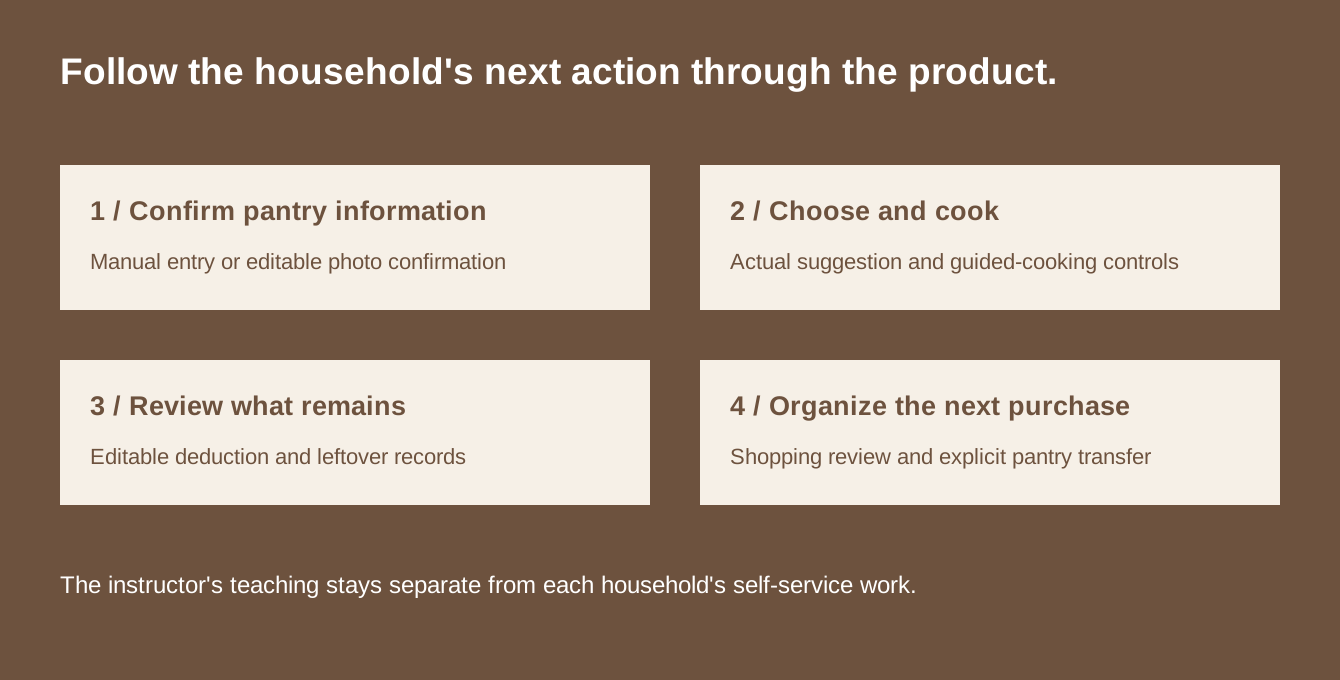
| Participant | Work in the illustrative course-companion case | Evidence to request before buying |
|---|---|---|
| Cooking-course operator. | Its own lesson, participant instructions and separate teaching relationship. | A defined companion offer and the actual operating tasks the buyer accepts. |
| Household member. | Reviews pantry information, chooses the meal and maintains cooking, leftover and shopping records. | The relevant user controls and actual household view. |
| RecipeGPT application. | Supplied pantry, suggestion, guided-cooking, planning and shopping workflows. | A controlled seller walkthrough of one complete exercise. |
| Technical operator. | Required application and model-service configuration after transfer. | The current service inventory, handover scope and relevant failure behaviour. |
The buyer can now say what it is acquiring: an owned household practice product beside its own teaching. The roles stay concrete enough for the seller to demonstrate the software and for the course operator to prepare a realistic first offer.
Choose the companion promise that the current product can serve
What should the participant do after the lesson?
Use the selected outcome to request the relevant evidence. The tool does not assess a participant's cooking or decide which meal is appropriate for a particular person. It helps the buyer choose the actual product job it wants to own.
Rehearse a participant who wants to change the suggestion
For the fictional household, choose a result the person wants to revise or reject. Ask the seller to show the actual next actions and the relevant pantry or recipe state. The buyer should understand how the household keeps control of the record.
Then inspect a controlled unavailable-service or error case where the seller can demonstrate it safely. RecipeGPT's documents describe validated structured generation and actionable retry errors. Record what is actually shown and any essential behaviour that remains unverified.
This helps the course operator prepare a useful first support answer. It can explain the product route and direct a teaching question to the instructor's separate process. It can also identify when a technical question needs the responsible application operator.
Keep shared household work distinct from a class account
RecipeGPT includes owner/member household structure and expiring invitation links. Use a fictional household to inspect the actual invitation, join and member-management flow. A participant may want another household member to help maintain the pantry or shopping list.
The buyer should see how that household relationship works before describing it publicly. A family member helping with a shared shopping list is a different relationship from an instructor administering a whole class. The product's account model should be explained on its own terms.
For the course companion, a focused household release can be an intentional first offer. The instructor supplies the practice prompt through its existing course process, and each participating household uses its own supported workspace. Any broader classroom requirement can be scoped separately.
Bring one evening-practice brief to the seller
For illustration, the fictional instructor's brief is: “Use your own pantry record to choose one meal, prepare it, and update what remains.” The buyer wants a product that can support that household exercise beside the lesson. The brief does not require the application to assess the participant or report a grade to the instructor.
Prepare a small fictional pantry with clearly identified quantities and dates. The seller can use manual entry first so the buyer sees the resulting records, then demonstrate photo recognition and explicit confirmation as a separate input route. The household's final saved information should be understandable before the suggestion step begins.
Now choose a serving or time preference through the actual controls and request a meal. Inspect the structured result and the available actions. The buyer can ask how the product presents an unsuitable or unsuccessful result, then follow the demonstrated route rather than invent an ideal response. The purchase is being evaluated against a concrete household job.
The operator can prepare its first participant instruction from that exercise: where to enter information, what to review and how to reach the next action. This gives the course business an owned product offer it can describe in practical terms, with its separate teaching relationship intact.
Use the deduction review to keep the household record believable
In an illustrative test, suppose a pantry record begins with two units of an ingredient and the household uses one in its meal. Ask the seller to show the application's actual editable deduction route and the resulting quantity. The arithmetic is a test assumption, not a prescribed recipe or a statement about a real participant's kitchen.
The household may have used a different amount from the original suggestion. The buyer should see how the person reviews the deduction and what record is created by the supported cooking completion path. That is why the edit step matters to this companion offer: the household's real practice can differ from a generated plan.
Then inspect the leftover step using the fields the current product provides. A household can record what it intends to track and find it again later. Keep the record separate from any judgment about the actual food's condition. The application organizes information; the user remains responsible for the real kitchen decision.
The instructor can use the separate lesson to encourage reflection on the exercise. The product buyer should nevertheless describe only the household workflow it has inspected. The participant's own records are not an automatic report of course attendance or competence.
Close the exercise with one purchased item reaching the pantry
Choose a fictional planned meal that needs an additional item. Follow the delivered shopping synchronization and inspect the list entry with its relevant quantity. The household then uses the supported purchased review and explicit transfer action after the real item has been obtained.
This final step is useful to the buyer because it joins planning with the next practice. The list is a household tool, the physical purchase belongs to the household and the saved inventory is a record the user confirms. Each action has a clear owner.
Ask another fictional household member to inspect the shared list through the actual invitation and access model. They should understand what is needed and what has already been marked or transferred. This is a small collaboration case that fits a household companion without implying a class-administration feature.
The course operator can now evaluate a complete loop: prepare inventory, choose a meal, cook, review the result and organize the next purchase. Its request to buy the asset has a specific outcome, with the relevant product record at every step.
Make the next week's practice an ordinary household choice
The buyer may want participants to keep using the companion beyond the first exercise. RecipeGPT documents editable weekly slots and repeat or copy-last-week actions. Ask the seller to show one supported action using the fictional plan and then inspect the current pantry-aware shopping result.
The person should be able to adjust their own plan rather than treat the copied week as an instructor assignment automatically issued by the application. The course business can supply a new practice prompt through its own teaching process, while each household makes its own supported choices.
Use this to define the first offer positively. The buyer is acquiring a self-service household product that can sit beside its existing course and help people organize their own practice. It can prepare ordinary product instructions and support from the demonstrated workflow, with any broader classroom integration discussed separately.
Before making the acquisition offer, have a colleague explain that product in one short paragraph. They should be able to name the household job, the instructor's separate role and the actual application steps. That is a useful final check that the purchase purpose remains clear to the people who will operate it.
RecipeGPT also documents private recipe creation and a saved-recipe library with removal. Ask the seller to show a household creating an authorized fictional example, finding it again and using the relevant supported action. This gives the buyer another practical route to inspect when its separate course uses written recipes.
The household supplies material it is entitled to use, while the operator describes the application's actual library workflow. If the buyer wants centralized course-content distribution into every participant account, state that additional requirement explicitly. The delivered household library can be evaluated without turning it into an unverified classroom publishing system.
Make the subscription discussion follow the actual buyer preview boundary
The product contains subscription foundations, but the temporary buyer preview uses simulated plan selection and blocks real charging server-side. Ask the seller to show the relevant plan experience while keeping it separate from live payment acceptance.
For the fictional operator, decide what future companion offer it intends to make and who would be the customer. Inspect the current source and agreed handover for that model. A preview plan state is useful for understanding the product, while real service-account configuration and payment readiness require their own acceptance.
Keep current financial representations on Flippa separate from the course operator's future plans. The school or instructor does not acquire paying households merely by acquiring the application. The buyer brings its own teaching relationship and evaluates whether this product fits the companion offer it wants to launch.
Attach the household exercise to the acquisition offer
Prepare a short seller request with the fictional pantry, the intended practice task and the next shopping or leftover action. Ask for a complete walkthrough, including an ordinary change and a relevant error case. The seller can then demonstrate the product that matters to this buyer.
- Define one self-service task the participant should complete after the lesson.
- Create authorized fictional household information for the exercise.
- Inspect pantry confirmation and the selected meal workflow.
- Follow cooking into the editable inventory and leftover records.
- Check the next shopping action and household access.
- Request the individual source-and-domain package with teaching and payment boundaries explicit.
The buyer can proceed because it wants an owned household product beside its existing teaching, with the actual software job and human responsibilities understood. Any essential additional feature should be stated in the offer rather than inferred from the course-companion idea.
Request RecipeGPT's current acquisition package on Flippa. Compare the available online business collection if another delivered customer job is closer to the product your course business intends to own.
Explore the products discussed
Explore related acquisition offers