
Buy a software business with the AI dependence you want to own
Choose a source-backed customer job with a model-derived result, optional assistance or deterministic rules.
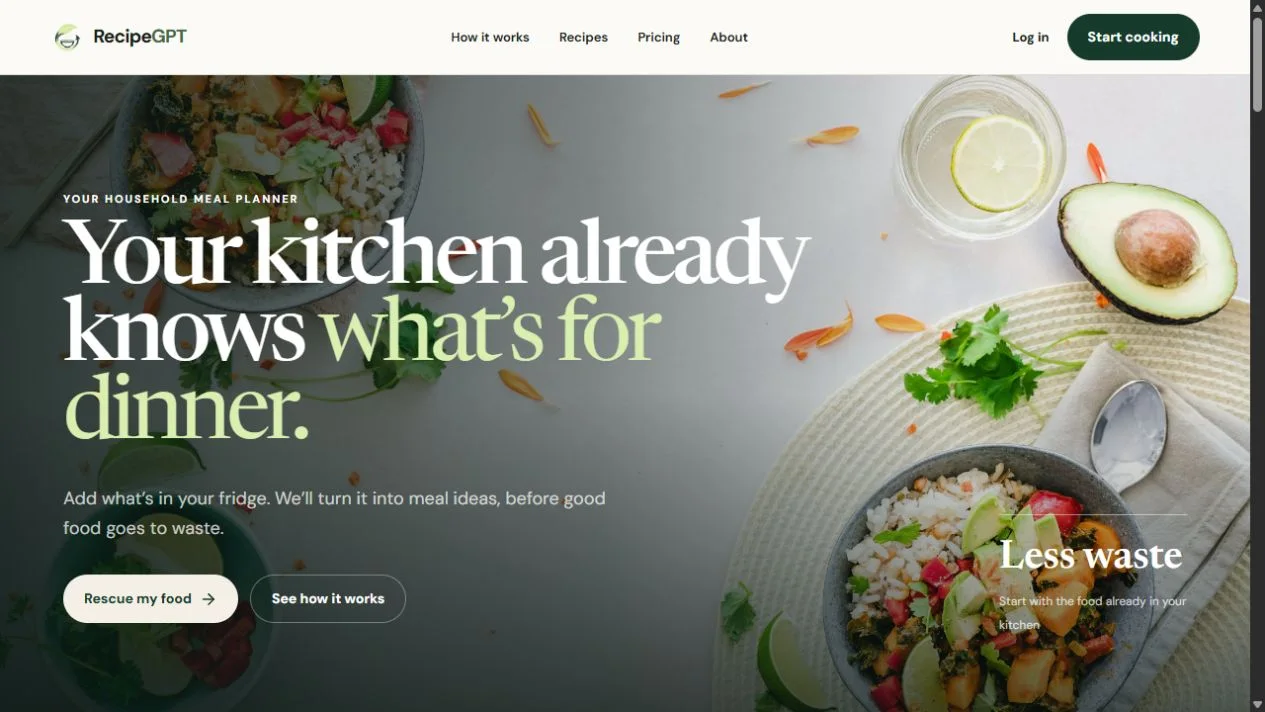
Request an available software asset by its actual model dependence. Compare RecipeGPT, Macro-Manage and FunRideBikes with deterministic MemoSlide and ThatQuis around the customer job you will operate.
Buy a software business with the operating dependence you actually want to own. An AI-assisted feature, a product whose advertised result needs a model response, and a deterministic application create different responsibilities for the buyer. Codeblix offers individual source-and-domain assets in these categories. Choose the customer job first, then request the package whose delivered implementation fits it.
This acquisition case concerns RecipeGPT, Macro-Manage, FunRideBikes, MemoSlide and ThatQuis. It does not classify an entire application as AI-dependent merely because one feature calls a model. Nor does it infer that an application without an AI key has no external services. The purchase decision is about the actual workflow you intend to sell and what must happen for that workflow to finish.
Request the application for the result you want to provide
- Request the RecipeGPT meal-planning application and domain package for a household product involving pantry-aware meal suggestions and shopping work.
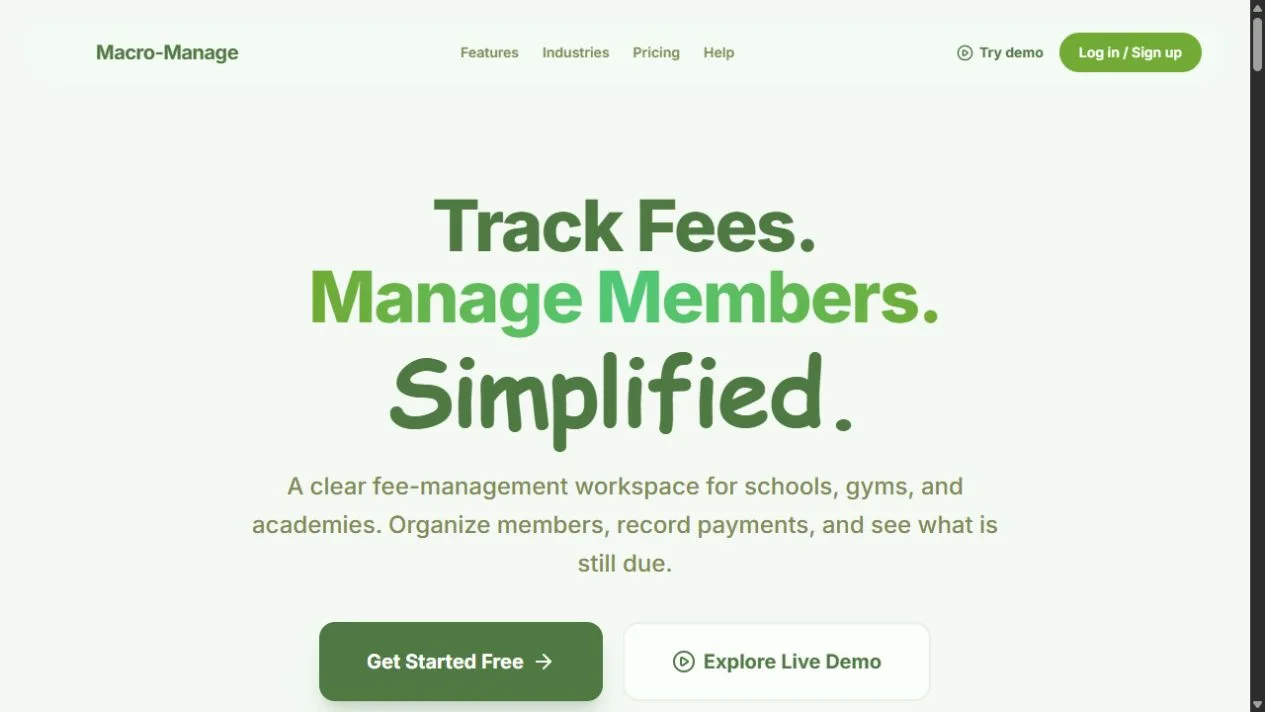
- Contact Codeblix about acquiring Macro-Manage for organization fee records with an optional photo-to-roster assistance path.
- Request the FunRideBikes rental platform offer for a booking product with ordinary search controls and AI-assisted query interpretation.
- Request MemoSlide's deterministic presentation-planning product, or ThatQuis's rules-based quiz application, if their customer jobs fit your intended offer without a required model key.
These are separate acquisitions. Current price, availability, represented financials and agreed rights belong to each Flippa transaction. The comparison below helps you decide which individual offer to request; it does not create a bundle or promise an integration between the applications.
Distinguish a model-derived result from the rest of the application
Start with one user action. What information enters the application? Which step calls a model? What comes back? What does the application persist, and what must a person inspect before acting on it? Those questions are more useful to this purchase than a broad AI label. They expose the operating dependency that the buyer will actually own.
A household may use pantry and shopping records even while a meal suggestion is being reconsidered. An organization may enter a roster manually rather than extract names from a photograph. A renter may use ordinary search controls instead of a natural-language search helper. Those distinctions do not establish that every failure is handled well; they identify which alternative route the buyer should ask the seller to demonstrate.
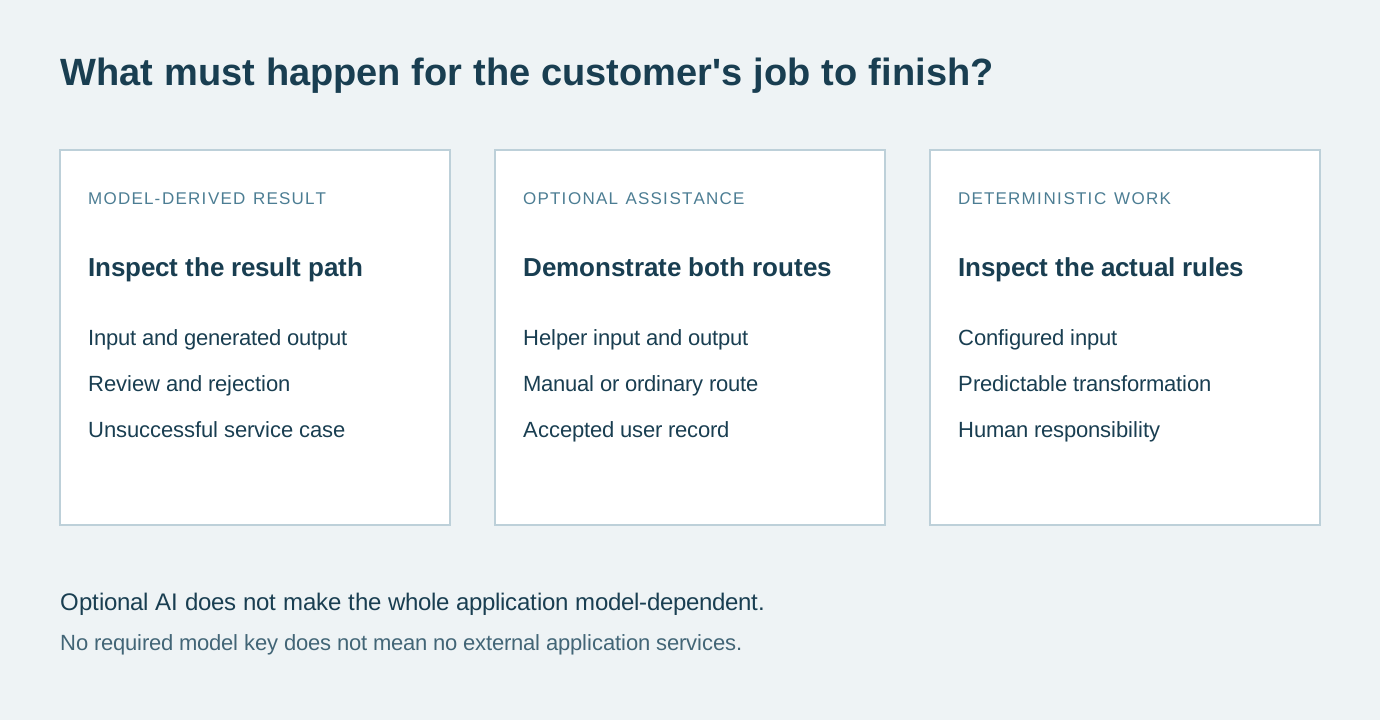
The same discipline applies to deterministic products. MemoSlide's planning does not require an AI key, and ThatQuis's quiz logic is rules-based. Their workflows still depend on their delivered application services and user inputs. “No model key required” is a precise feature boundary, not a claim that hosting, authentication, storage, payment configuration or human judgment disappear.
Compare the delivered jobs before comparing the AI badges
| Available asset | Source-backed customer work | Model relationship to inspect | Buyer must not assume |
|---|---|---|---|
| RecipeGPT | Household pantry, expiry-aware meal suggestions, cooking and shared shopping work. | Meal suggestions include AI. Inspect the chosen suggestion path and the separate record workflows. | Guaranteed dietary suitability, a demonstrated fallback, or reliable suggestions without valid service configuration. |
| Macro-Manage | Organization rosters, fee records, partial payments, history and reporting. | Photo-to-roster AI assistance is optional beside manual roster entry; CSV reporting exports are separate. | That AI extraction makes a roster authoritative or moves fee money. |
| FunRideBikes | Bicycle catalogue discovery, dates, rental listings and booking foundations. | Gemini-assisted search interprets a request into filters; ordinary catalogue controls also exist. | That a language-model response guarantees inventory availability or provider fulfilment. |
| MemoSlide | Written memo to editable presentation plan, review and export. | Deterministic planning; no AI key required for that work. | That the plan independently verifies claims or removes the need for editing. |
| ThatQuis | Quiz creation, branching, outcomes, response records and creator controls. | Rules-based experience rather than a required external model response. | That configured outcomes constitute independent advice or a full CRM. |
This table is a starting map, not a substitute for the source package and current seller demonstration. If a feature is essential to your proposed customer promise, ask to see its exact implementation. A buyer should not make an unavailable result sound guaranteed, and should not describe an optional helper as if the entire business stops without it.
Buy RecipeGPT for a household job with an explicit suggestion boundary
Consider a hypothetical buyer who wants to launch a household product around pantry use and practical meals. They are interested in RecipeGPT because the customer job includes keeping track of food, considering expiry and finding something to cook. The buyer should identify which part of that job they intend to promise as a model-assisted result and which parts concern stored household information.
Request a controlled example using fictional pantry items. Follow the information into the suggestion workflow and inspect the result the user receives. Then look at what the person can change, accept or disregard. The seller should distinguish generated suggestions from the user's own pantry and shopping records. A meal suggestion should not be presented as a verified medical, allergy or nutritional assessment.
Next, ask for an agreed unavailable-service or rejected-output exercise. Does the relevant screen show a useful error? Is the original input retained? Can the user still reach their stored records? What is demonstrated, and what remains untested? Do not fill in these answers from expectation. A good-looking successful response does not establish the behaviour of an unsuccessful one.

The current buyer preview uses simulated plan selection and server-side blocking of real charging; it is not evidence that a real charge has completed. The public domain for the offered product is recipe-gpt.com. Use the RecipeGPT sale page and request the seller's current walkthrough for the exact package. Keep payment acceptance and model-result handling as separate questions rather than claiming one successful screen proves both.
Buy Macro-Manage with optional extraction kept outside the fee truth
Now consider a buyer who wants to offer an organization fee-record product. Macro-Manage's important customer records include people, periods, recorded payments and remaining amounts. The photo-to-roster helper can assist with entering people, but it is not the source of truth about money actually received. That distinction determines how the buyer should operate the feature.
Use a fictional roster photograph with a deliberately ambiguous entry. The current photo import creates valid rows on completion and skips recognised duplicates within the selected enrollment year. Ask the seller to show the created/skipped result, the actual saved roster records and the operator's post-import correction route. The operator checks those records before operational use; the application does not stage them behind a separate approval gate.
Then demonstrate manual roster entry for the same small roster. Inspect CSV reporting exports separately; the current product does not provide a CSV roster importer. The buyer can decide whether photo assistance is a useful optional feature in the offer, rather than making it an essential promise to every organization.
Finally, move into the actual fee workflow. The recorded payment and partial-payment history should be understood on their own terms. Do not imply that reading names from a photo automatically collects, reconciles or verifies fee payments. If a buyer wants a broader accounting or payment operation, that is a separate requirement to discuss before purchase.
Buy FunRideBikes without making search language a booking guarantee
FunRideBikes creates another distinction. The customer may describe what they want in natural language, while the application turns that request into search filters. The source-backed Gemini helper concerns search interpretation. The buyer still needs to understand catalogue results, selected dates and the booking record separately.
Prepare a fictional search request containing a preference and a date constraint. Ask the seller to show which filters are produced and what the user can change through ordinary controls. Compare that result with a direct search using the controls themselves. The buyer can then evaluate the language helper as a discovery convenience rather than an authority on real-world bicycle availability.
Now use an unclear request. Ask what happens when the interpretation is incomplete, unhelpful or unavailable. Can the user inspect and correct the search? Which alternative path is actually demonstrated? Avoid assuming a perfect fallback, but also avoid describing the whole rental application as model-dependent when ordinary catalogue and date controls are present.
The demonstration search includes sample inventory. Its displayed results are not evidence of a transferred fleet, participating provider network or booking history. The buyer still owns the work of operating the selected rental offer and confirming the provider relationships they will rely on. An AI search helper does not supply those relationships.
Buy a deterministic product when that is the customer work you want
MemoSlide and ThatQuis are useful alternatives for buyers whose desired product does not require a model service. That does not make them substitutes for a household meal product or bicycle marketplace. They serve different jobs. The point is to choose the job and its operating model together, rather than buy a random application solely because it carries or avoids an AI label.
For MemoSlide, inspect the relationship between the written input, the resulting presentation plan and the user's edits. The product can structure and check aspects of a plan without independently confirming the truth of every assertion in a memo. The buyer's public promise should make space for the user's judgment, source material and review.
For ThatQuis, inspect a branch and outcome rule that the creator deliberately configures. A predictable rules-based experience can be the desired product. It does not need to be renamed AI, and its outputs should not be advertised as independent expert judgments. The customer or creator is responsible for the meaning of the questions and outcomes they publish.
A deterministic product can also have operational dependencies outside the model category. Ask for the service inventory relevant to the chosen asset and its current billing configuration. The absence of an AI key removes one particular relationship; it does not remove the responsibility to operate and maintain an application.
Trace one rejected result before writing the customer promise
The most informative purchase exercise is not always a successful demonstration. Ask the seller to use a controlled example that a person would reject. A roster name is wrong, a search interpretation misses the intended category, or a meal suggestion is unsuitable for the fictional user's preferences. Observe what the user can do next through the delivered product.
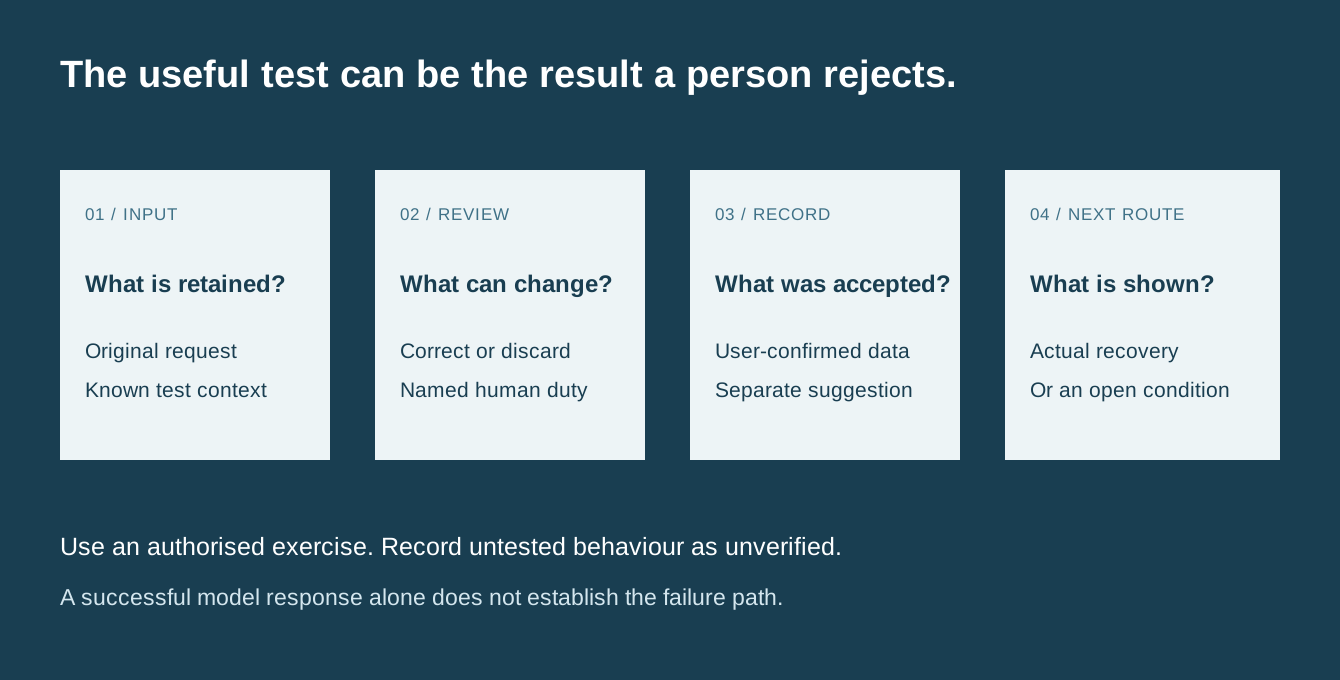
Keep the exercise authorised and limited. Do not alter a production key, real customer data or provider account without the seller's agreement. The goal is to understand the application, not create an outage. Where a safe failure exercise cannot be demonstrated, record the behaviour as unverified instead of inventing a fallback in the sale copy.
Follow the rejected result through four questions. Was the input preserved? Can the user correct or discard the output? Does the application distinguish a suggestion from an accepted record? Can the intended customer finish the promised job by a source-backed route? The answers help determine whether the model step is essential, optional or unsuitable for the buyer's first offer.
Choose the dependence you intend to support after acquisition
Where does the model step sit in your intended customer offer?
This tool classifies your intended promise, not the investment quality of an asset. A buyer can reach different results for different features inside one product. Keep the individual package and demonstrated implementation attached to the decision.
Price your own service assumptions without borrowing a revenue forecast
Ask which external services the chosen product actually requires and which accounts the buyer must control. For a model-dependent feature, inspect its configuration and the relevant provider pricing independently before making an operating commitment. This article does not assert a model price, included call allowance or future number of users.
Use your own quoted or measured service allowance in the calculator below. Enter a separate monthly operating amount for the model feature, if applicable, and the rest of the product services. You can also enter a one-time amount for work you have separately agreed. These are user assumptions, not claims about the asset's present costs or a forecast of what customers will pay.
My twelve-month operating assumptions
This total contains only the assumptions you enter. It excludes the asset purchase price unless you separately account for it, and predicts neither revenue nor profit.
A comparison should use the customer job as well as the numbers. Eliminating a model allowance is not useful if the remaining application does not provide the result you intend to sell. Equally, adding a model expense to every user interaction can misstate a product where the model is only an optional convenience. Inspect the path, then estimate the path you actually plan to operate.
Work through the same buying question in three different offers
An organization buyer can keep the helper outside its first promise
Imagine a buyer who wants to launch Macro-Manage for organizations that already keep a small working roster. Their first offer does not have to depend on extracting every name from a photograph. They can ask for the demonstrated manual-entry path and CSV reporting exports, understand the fee-record work, and decide whether the optional image helper belongs in the initial customer offer at all.
This is a product-scope choice, not a claim that a feature can be removed with a switch. Ask the seller how the delivered interface exposes it and whether the desired public wording or configuration needs separate work. If the buyer intends to operate the helper, the correction and review procedure should be understood. If they do not, their customer promise should not advertise it as the reason to subscribe.
The purchase can then be discussed around an organization recordkeeping job with a known input route. An AI feature remains part of the source-backed product context without being allowed to redefine the whole business or the accuracy of the organization's payment records.
A household buyer should not quietly remove the result people came for
A buyer interested in RecipeGPT may place meal suggestions at the centre of the proposed customer offer. They should not assume that showing pantry records alone establishes the value of that offer. If they want the model-assisted result to be part of the customer job, they need to inspect that path, its service requirements and the demonstrated review or unsuccessful-result behaviour.
The alternative is to choose a different initial offer or a different asset. That may be a legitimate decision, but it should be explicit. The buyer should not purchase an AI-assisted meal product, advertise the meal result, and then treat the model relationship as an irrelevant optional expense. The application contains more than that feature; the business promise may nevertheless depend on it.
Use a fictional household to keep the discussion concrete. What did they ask for, what did they receive, and what should they do when they reject the suggestion? The answer determines the promise the buyer is prepared to support. It does not establish health suitability, future subscriptions or an automatic solution for every pantry.
A presentation buyer can choose structure without promising research
A MemoSlide buyer may deliberately want a deterministic planning product. The intended customer supplies written material and edits the resulting plan. That is different from advertising independently researched presentations or newly verified facts. The buyer should inspect what the application actually transforms and keep the human author responsible for the underlying argument and evidence.
For example, a fictional memo might contain an unclear claim and an uneven structure. Ask the seller to show the plan, the available checks and the editing or export path. The question is whether those tools support the product the buyer wants to offer. The lack of a model key is relevant to operating dependence, but it does not prove the quality or truth of the memo.
This buyer can choose MemoSlide because its job and deterministic approach fit their offer, rather than because every software business should avoid AI. Another buyer can reasonably want a model-assisted result. The acquisition decision should preserve the difference instead of forcing both into one marketing category.
Keep an unverified recovery path out of the agreed feature claim
Suppose the normal model-assisted path works during the seller walkthrough, but a controlled unsuccessful-service case cannot be shown. The buyer has evidence of the successful path and an open question about the other one. State that distinction in the purchase discussion. Do not write an assumed automatic recovery into public copy, and do not infer that every other part of the application has failed.
The importance of that open question depends on the job the buyer chose. It may be central when the promised result requires a model response, or narrower when an optional helper sits beside a demonstrated ordinary route. The buyer can request further evidence, agree separately scoped work or choose a different customer promise. The concrete dependency map makes that decision possible without exaggerating either the feature or its limitation.
Make the offer about delivered behaviour and accepted duties
Tell the seller which customer promise determines your purchase. For example: “I want to acquire an organization fee-record product where photo extraction is optional and operators can use the demonstrated manual roster-entry route.” Another buyer might ask for the current household meal-suggestion implementation and evidence of its user-review and error behaviour. Those are distinct offers, even if both mention AI.
The acquisition notes should identify any essential behaviour that remains unverified. Do not convert it into delivered functionality just to make the package sound complete. Agree configuration or changes explicitly where needed. The buyer can choose an existing product with a clear boundary; there is no need to promise that the application handles every possible prompt, output or service interruption.
Keep the current financial representation on Flippa separate from this operating decision. A well-understood model dependency does not establish subscribers, bookings or profitable usage. It makes the buyer's intended offer and duties more concrete, which is the reason to investigate it before acquiring the software.
Request the individual package for the job you want to own through the current Flippa actions above. The online business collection and each product's authoritative page provide further sale context. Buy the application for its demonstrated customer work, with the model relationship and human responsibility stated accurately.
Explore the products discussed
Explore related acquisition offers