
Buy a food creator software business asset
Separate digital asset offers for a defined operator purchase.
Acquire a food-related software asset for your audience. Choose digital recipe commerce, household subscriptions or a grocery storefront with explicit fulfilment scope.
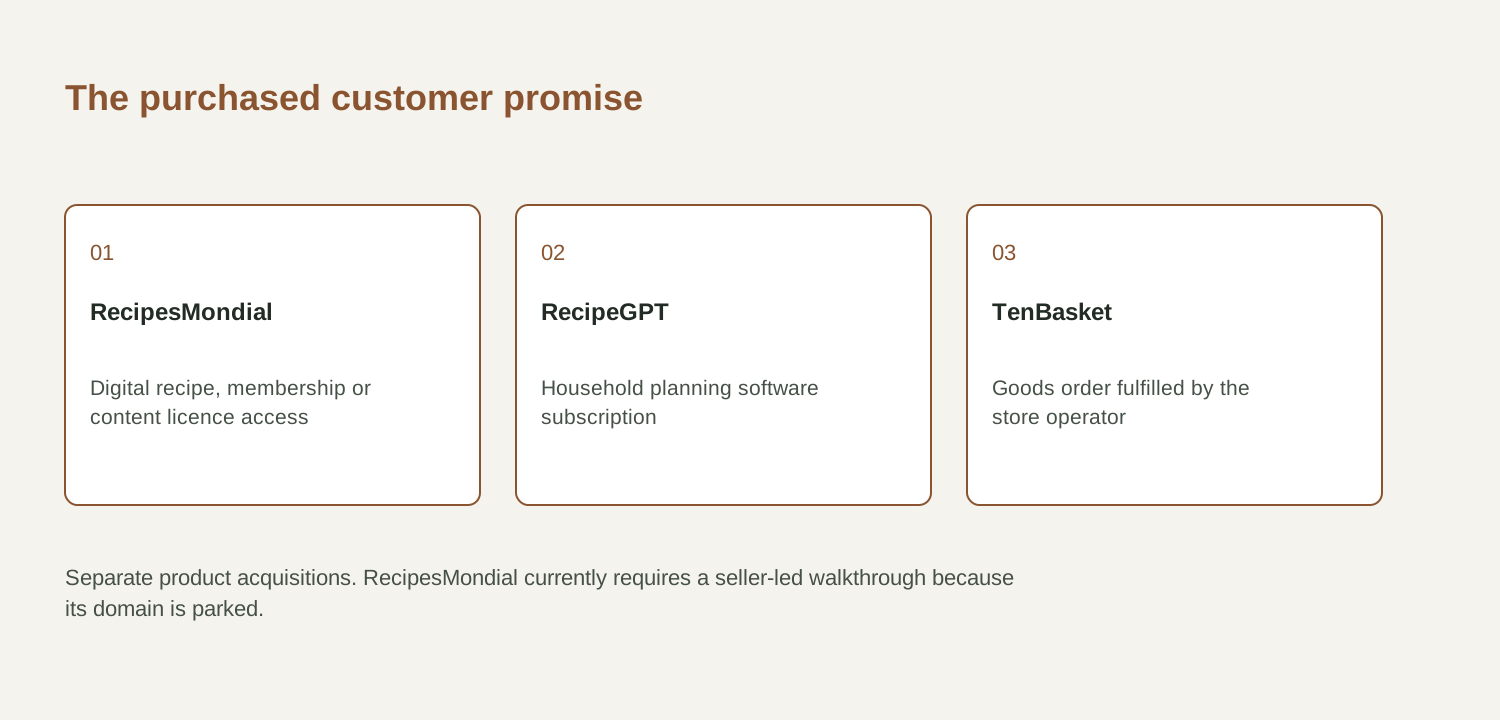
Acquire one food-related software business that fits the purchase your audience is ready to make. RecipesMondial offers digital recipe commerce and content entitlements. RecipeGPT offers household planning subscriptions. TenBasket offers a grocery storefront whose operator must supply and fulfil the goods. Each is a separate asset with its own listing and transfer terms; this is not a combined business package.
Discuss the relevant acquisition through RecipesMondial, RecipeGPT or TenBasket on Flippa. Confirm current availability and asking terms before making an offer. The buyer acquires the agreed application, domain and digital rights, not automatic ownership of a creator audience, food inventory or a guaranteed income stream.
This brief is for an existing food creator choosing a software asset to operate for its audience. All three products are presented as starter assets without represented verified revenue. RecipesMondial's public domain is currently parked, so require a working seller-led walkthrough. RecipeGPT's preview blocks real charges. TenBasket's product records do not establish a supplied or staffed grocery business.
The customer purchase attached to the chosen asset
Write one sentence describing what a customer will receive after paying. Access to recipe content, access to household software and delivery of grocery goods are different promises. The acquisition should identify which promise the selected application supports and what the buyer must supply beyond the code. A food-related brand does not make these mechanisms interchangeable.
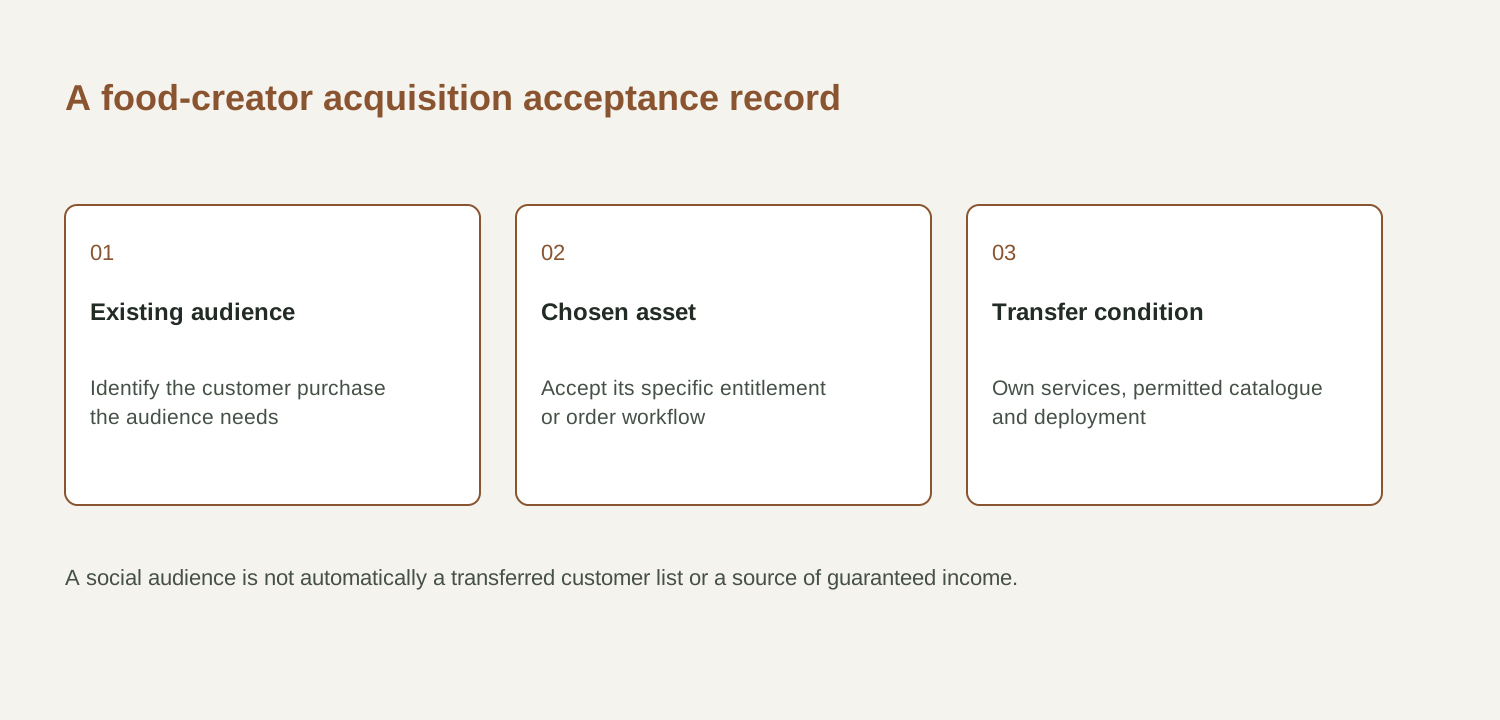
For a creator with an existing audience, this is an ownership decision as well as a product decision. The creator may have content rights and an audience relationship, while the software seller provides an application foundation. Those assets should remain separate in the transaction record. A social following is not a transferred customer database or evidence that its members will buy the new offer.
Keep the acquisition focused on one selected product. If additional assets are purchased, each needs its own price, rights inventory and acceptance conditions. The options shown here support a defined purchasing conversation; they do not represent a bundle, shared operating accounts or a pre-integrated group of businesses.
RecipesMondial for a creator-content acquisition
RecipesMondial's documented application supports creator storefronts, paid recipes, collections, memberships and commercial content licences. A customer discovers and purchases digital content, then receives the relevant library or membership access. The platform owner manages creator plans, sale-fee settings and marketplace administration. This is digital commerce rather than food delivery.
An existing creator could assess this asset around the content it already has rights to offer. The purchase still needs a supported rights inventory for the application and its included material. The buyer's own recipes and images are separate from demonstration creator records supplied with a software package.
Read the RecipesMondial asset scope and technical handover document. The public domain does not currently provide a working demo. Request a current walkthrough and make deployment and domain acceptance explicit before treating the product as ready to trade.
RecipeGPT for a household-software acquisition
RecipeGPT connects household pantry and fridge records with meal suggestions, guided cooking, leftovers, plans and shopping lists. Its intended owner model is household subscriptions. The buyer acquires a planning application foundation, not a paid recipe-licensing marketplace and not a service that prepares or delivers food.
For a creator, the accepted offer could centre on an ongoing software task rather than selling another content item. The application still needs suitable buyer-owned identity, backend, AI and payment configuration. Its public buyer preview uses simulated plan selection and server-side payment blocking, so preview plan activity cannot be represented as subscription revenue.
Inspect the RecipeGPT package and technical documentation. Accept the household and meal workflows with sample data and record the current validated-result and actionable-error behaviour. Additional content licences or creator commerce would be separately scoped changes.
TenBasket for a creator's goods-store acquisition
TenBasket is an online grocery storefront with discovery, cart and checkout, accounts, rewards, order tracking and an owner dashboard. The commercial customer promise is a goods order. The operator must supply products, define the delivery area, arrange fulfilment and handle service questions. Those physical operations do not transfer merely because the buyer receives the software.
A food creator considering this asset should identify the permitted catalogue and fulfilment capacity it already controls. Product photos and demonstration records cannot establish stock or supplier agreements. Any genuine inventory or supply relationship included in a transaction needs to be separately identified and evidenced.
Review the TenBasket asset entry and technical handover guide. Ask for a sample order trace and the delivered payment options. Do not add recipe-content access or household planning promises unless those functions have actually been agreed and accepted as additional work.
Application rights and the creator's own content
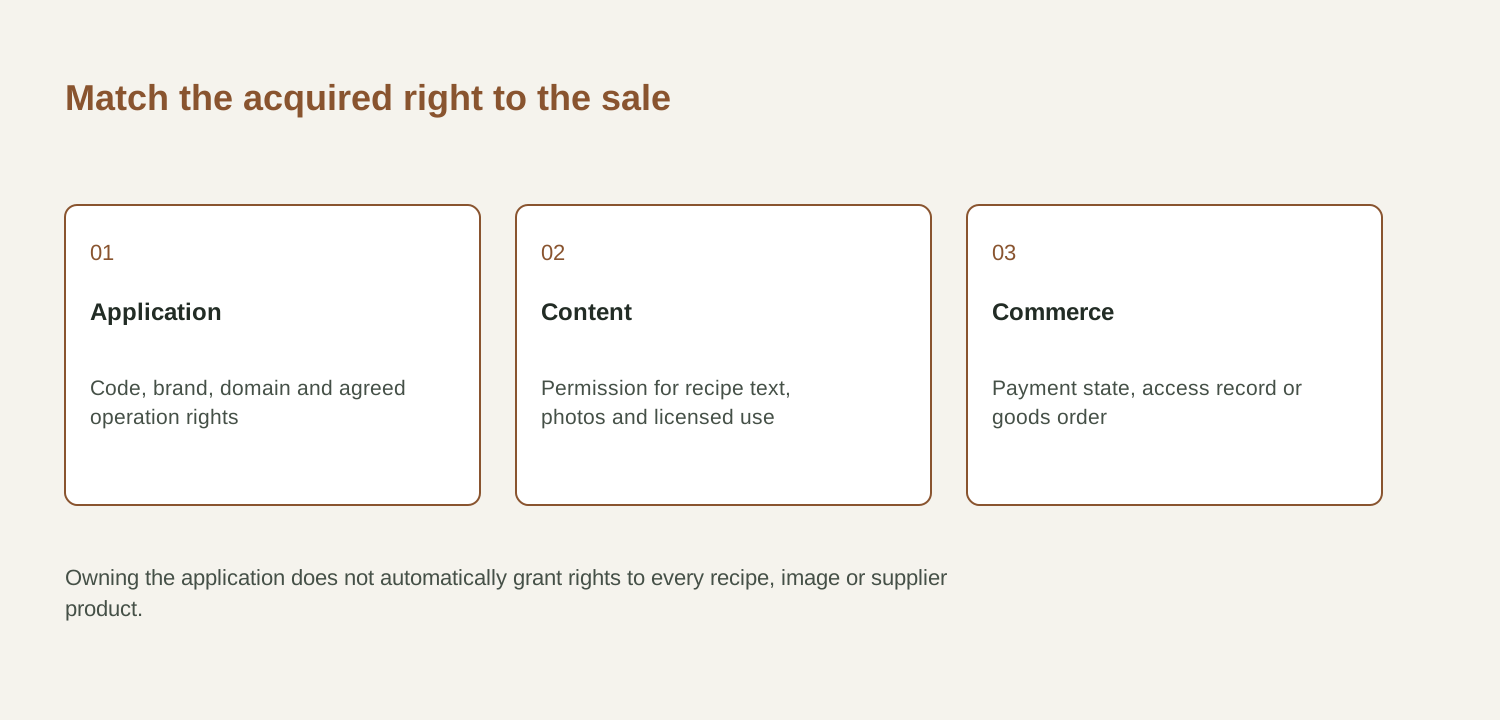
List what the software seller transfers: source, domain, current design, documentation and agreed rights to operate the application. Then list the creator's separately owned recipes, images, videos and brand material. Keeping these inventories separate avoids the assumption that the application purchase automatically grants rights to every piece of food content stored in its sample database.
For any supplied third-party material, request the relevant inclusion and permitted-use statement. Identify what can remain public and what should be replaced before launch. The same discipline applies to fonts, icons and demonstration photographs. A complete-looking page is not itself evidence of commercial reuse rights.
If the creator intends to allow other contributors, their content permissions are future operating agreements. The software may provide publishing and licensing fields, while the operator remains responsible for defining the actual offer and checking its authority to make it. Obtain suitable advice for the commercial terms rather than treating a licence screen as independent proof of rights.
Digital access acceptance for the content route
For RecipesMondial, choose a fictional recipe or collection and follow it into an authorised test purchase. Inspect the customer's library after checkout, after a refresh and through a second account without that purchase. The buyer needs a traceable link between the product and the entitlement granted.
Memberships and commercial licences require additional acceptance examples. A membership may change access after cancellation; a licence needs an identifiable statement of the use purchased. Record the current application behaviour for each included product type. Do not infer every content-selling mechanism from one visible purchase button.
The parked-domain condition remains part of this route. A seller-led environment can demonstrate the source product, while the transaction must separately agree the address, configuration and release required for the buyer's public deployment. No live public preview is represented until that state is independently verified.
Household access acceptance for the planning route
For RecipeGPT, create two fictional households and inspect the owner and member boundaries. Save different pantry records, generate a meal from a known context and return through the shopping and planning views. The acquired service depends on recurring use of private household records rather than a one-off content download.
Record photo-recognition confirmation, approximate cooking updates and correction paths. Current implementation evidence describes validated structured AI results and actionable errors or retries, rather than invented fallback meals. The buyer should accept that behaviour explicitly and use its own AI account when configuring the operating product.
Test subscription-related access separately from the public preview. A simulated plan selection is not merchant readiness. Agree the buyer-owned payment setup and suitable tests for success, cancellation and failure before charging a genuine household. The purchase should describe which checks are complete and which remain launch conditions.
Goods-order acceptance for the storefront route
For TenBasket, trace a sample product, quantity, checkout and order record. Inspect the owner dashboard and customer order history using the same example. The buyer should see how a paid or cash-on-delivery order is represented and who can update its state. A storefront image does not establish that physical fulfilment has occurred.
Use the creator's proposed goods only as a requirement until the rights and supply arrangement are confirmed. Record pack units, available quantity and the operator responsible for dispatch. If substitutions, delivery scheduling or another important process is not included, define the manual policy or a bounded change instead of assuming it from a grocery theme.
The application does not create a supplier contract or delivery workforce. The buyer should identify the resources needed to honour a goods order and include them in the launch plan. This is a different acquisition commitment from granting a digital recipe entitlement or operating household software access.
| Selected asset | Customer purchase | Acceptance unit | Buyer supplies |
|---|---|---|---|
| RecipesMondial | Digital recipe, collection, membership or licence | Product purchase linked to the correct content access | Permitted content and accepted deployment |
| RecipeGPT | Household planning subscription | Isolated household records and accepted subscription access | Owned AI and operating accounts |
| TenBasket | Grocery goods | Checked checkout amount and a fulfilment-ready order | Stock, supply and delivery operation |
Keep customer audience claims out of the asset inventory
An existing creator may have followers, email subscribers or community members. Those relationships do not automatically become customers of the acquired software. The acquisition offer should identify the application being sold without turning the creator's future marketing plan into seller revenue evidence.
Likewise, sample users in the software do not establish a transferable audience. Request separate support for any genuine customer relationship represented in the transaction, including its scope and normal transfer requirements. Avoid treating a demonstration account count as demand or an accepted subscription base.
For the buyer's own launch, define the customer promise clearly before inviting the audience to pay. Recipe access, software use and goods delivery have different obligations. The asset should be accepted against that defined promise so future promotion describes a product and service the new owner can actually provide.
The operating team attached to the acquisition
The creator may already produce content, while a software business also needs account support and application maintenance. Identify who will handle each responsibility after transfer. For content commerce, that includes access questions and creator records. For household software, it includes private account problems and AI-service configuration. For goods, it includes stock and fulfilment.
The application can support these tasks without providing a staffed business. A source and domain purchase should not imply that the seller will operate customer service indefinitely. Agree the technical handover scope and any additional services explicitly, with their duration and completion conditions.
Choose a launch scope that fits the team available. A limited permitted catalogue or a carefully defined household offer can be accepted concretely. A broad promise of automated food income would not describe the operating work involved. Keep that work visible in the purchase budget rather than hiding it behind the brand's audience size.
Payment accounts and different revenue records
RecipesMondial separates creator content receipts, creator software plans and platform sale fees. RecipeGPT's model is household software subscriptions. TenBasket's model is direct goods sales. Record the relevant payer, charge trigger and money destination for the chosen product. None of these records should be substituted for another when assessing the application.
Use suitable test accounts and follow the backend event into the product record or access state. The buyer must separately configure owned payment services and complete external approval requirements. A seller's demonstration checkout cannot prove a real bank payout or that the buyer's merchant account is ready.
Keep historical income claims supported and separate. The starter descriptions do not represent verified commercial trading history. Future prices and audience conversion remain planning assumptions. Completed product work can be valued without assigning an invented financial result to its sample data.
Catalogue preparation and migration in the offer
Decide which of the creator's existing material will enter the selected application. Use a small representative sample rather than accepting a bulk count as proof of a finished migration. For content commerce, check the text, images, product grouping and rights. For goods, check units and stock. For household software, check whether any offered recipe material fits the actual product workflow.
Ask which import tools are currently delivered and what must be entered manually. A codebase with a sample catalogue does not establish a bulk migration service. Record the dataset, fields and correction process required before agreeing any additional work.
The accepted sample becomes a practical finish point for that part of the transaction. It should be understandable to the buyer and seller without relying on a promotional claim about how many records can be moved. Retain permission information beside the data so publishing readiness and application installation are not confused.
Domain and brand transition for a creator buyer
Each product has a separate domain and brand arrangement. The buyer should confirm what transfers and whether it plans to retain or change the identity. An existing creator brand does not automatically make a source package or temporary preview address part of its own business. Record the actual purchased domain rights and the intended deployment.
RecipesMondial requires explicit attention to its parked public domain. RecipeGPT has a temporary Codeblix preview distinct from its sale domain. TenBasket's storefront address belongs to its own asset scope. These differences affect the delivery acceptance and should not be hidden inside a generic domain-transfer statement.
If a brand change is included, specify its visible scope and account configuration. A new logo, domain connection and billing descriptor are different tasks. Agree the work to be delivered and test it in the intended environment before presenting the acquisition as a completed public launch.
Technical support terms for the selected food asset
Use the selected listing and guides to agree the current support period, start date and included setup help. Source transfer, payment configuration and domain deployment may finish at different times. The agreement should identify the acceptance state that starts or completes each responsibility.
Additional content imports, brand work or new product types should have their own scope. Name the account role, record and visible result required. This avoids expanding a digital asset purchase into an undefined promise to operate every part of the creator's future business.
Retain the release reference, account inventory and accepted workflow record with the transaction. If a correction changes an entitlement or order rule, repeat that affected test. The result is a purchase with an observable finish point rather than a claim that a large audience makes launch outcomes automatic.
One audience, separate acquired customer accounts
An existing food audience may encounter the new application through the creator's current channels, but its members still need a defined account and purchase journey. Inspect that journey in the selected product. Record the identity service, the information collected and the point where a customer obtains a content entitlement, software access or goods order.
Do not assume that an existing newsletter login or social account automatically works with the acquired application. An integration needs an accepted implementation and suitable account permissions. If the first launch uses a separate sign-in, describe that choice plainly in the customer journey and the buyer's acceptance sheet.
The audience relationship remains the creator's asset, while the software package provides a product surface. Keep those facts separate in the sale record. The seller does not supply proof that the audience will convert, and the buyer should not attach a forecast to the asset as though it were historical income.
Versioned food content and the purchased customer promise
For a content-commerce purchase, ask what happens when a creator updates a recipe after a customer buys it. The transaction should leave an understandable record of the purchased product and any licence terms. Inspect the current behaviour in RecipesMondial rather than assuming an immutable content history or every versioning feature is included.
For household software, a saved recipe and a new AI suggestion are different records. Accept what RecipeGPT preserves and the corrections a household can make. For goods, a changed product page should not silently redefine a completed TenBasket order. Each selected asset needs its own demonstrated rule for the customer promise after purchase.
These conditions are commercially relevant when an existing creator reuses content across several channels. The application rights, public description and paid customer record should remain understandable. Any additional version or archive requirement belongs in a bounded development scope with a clear acceptance example.
Exceptions in the creator's chosen revenue mechanism
Choose one exception appropriate to the selected asset: a content-access complaint, a cancelled household subscription or a grocery order that cannot be fulfilled. Ask the seller to show the available application records and actions. Record who can respond and whether any payment operation happens manually through the service provider.
A common brand or audience does not make these exceptions identical. A content entitlement may require an access correction, while a physical order requires a goods remedy. The buyer should assign the responsibility that matches the actual product, without promising automatic refunds or support functions that have not been demonstrated.
Retain this example with the offer scope. It gives the future operating team a concrete starting point and helps establish the work included in the handover. The acquisition can close on a focused product with clearly assigned manual work, provided the public offer accurately describes that boundary.
Food-creator acquisition offer schedule
- Select one separate application and confirm its current sale status and terms.
- State the customer promise: digital content, household software or goods.
- Identify application rights separately from the creator's content and audience.
- Accept the relevant entitlement, subscription or goods-order trace.
- Agree deployment, domain, buyer-owned accounts and permitted catalogue work.
- Record the operating team and support scope needed after transfer.
Food software purchase acceptance checklist
Tick the evidence for the one product chosen for the transaction.
Choose the named asset and submit its offer
Prepare an offer that identifies the selected product, included digital rights and domain, buyer-controlled configuration and acceptance conditions. The other applications remain independent offers. No shared customer base, content licence, grocery supply or combined business is included by association.
Continue through the relevant Flippa listing for RecipesMondial, RecipeGPT or TenBasket. Confirm current availability and retain the written scope with that purchase.
Explore the products discussed
Explore related acquisition offers