
Recipe website for sale: acquire RecipesMondial
Digital asset purchase, included software and agreed transfer.
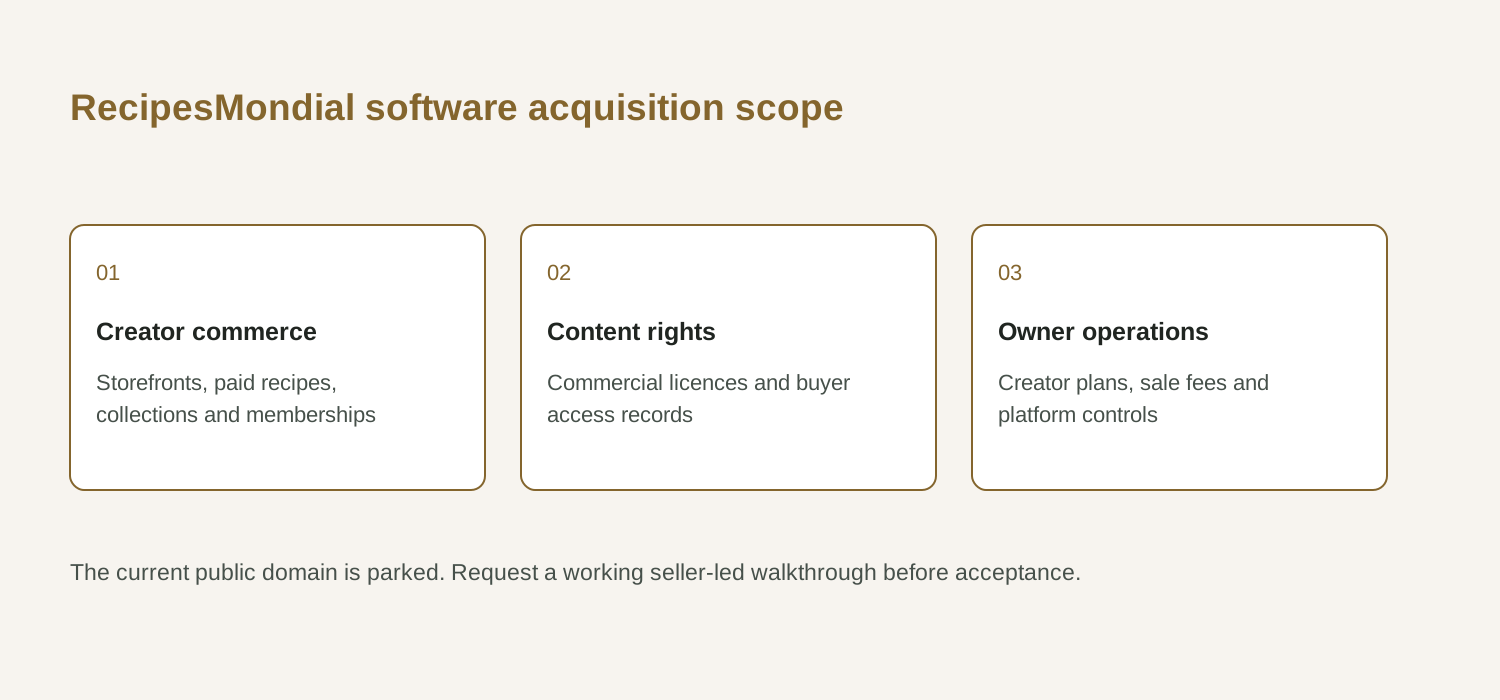
Acquire RecipesMondial recipe-commerce software. Request creator storefronts, memberships, content licences, payment foundations and the required deployment package.
Acquire RecipesMondial as recipe-commerce software for creators, memberships and licensed digital content. The package combines creator storefronts, paid recipes and collections, customer libraries, creator software plans and platform sale-fee controls. It is a digital product acquisition. Food preparation, grocery stock, restaurant delivery and a contracted creator audience are separate assets or services and are not implied by the application.
View the RecipesMondial sale and discuss an acquisition offer on Flippa. Read the current asset scope, user guide and technical handover document when preparing the transaction.
The public RecipesMondial domain currently returns a parked redirect, and no working public demo is represented here. Request a current seller-led application walkthrough before acceptance and agree the deployment and domain work explicitly. Stored product records describe a starter asset without verified traffic, paying customers or completed commercial transactions. Sample creators and purchases are demonstration material, not trading results.
The recipe-commerce application offered for purchase
The software's documented focus is creator commerce. Creators publish recipes and digital products through branded storefronts. Customers discover material, purchase eligible content or memberships, and access it through a private library. The platform owner manages creators, plans, fees, content and transaction records. Those connected workflows define the digital product being acquired.
A recipe website can mean a content blog, a personal recipe organiser or an online store. This particular sale concerns a creator marketplace application with commerce and entitlement foundations. The purchase should name that application and the delivered source, domain, design and documentation rather than rely on the broad phrase recipe website alone.
Any genuine customer list, creator agreement, licensed catalogue or operating revenue represented in a sale needs separate evidence. Demonstration data cannot establish those assets. A buyer can still value the completed product work while keeping its commercial assessment tied to the current documented package and the remaining launch work.

The parked-domain condition in the transaction
The public-domain check did not show the expected application. That condition must remain visible in the offer and acceptance plan. Do not treat a source repository or an earlier deployment description as proof that the current domain is serving the product. The buyer needs a working demonstration and an agreed route to the intended operating address.
Ask the seller to identify the application release, the environment used for a walkthrough and the current domain arrangement. Agree which domain rights transfer and which configuration steps are included. If the domain requires correction, renewal or new deployment work, record its owner and acceptance condition before agreeing that part of the purchase.
A seller-led walkthrough can use an authorised environment with fictional records. It should show the creator, customer and owner journeys described in the documentation. Retain the release reference and the demonstrated record identifiers. The public product page should continue to avoid a live-demo claim until a working public deployment is actually verified.
Creator storefront deliverables to inspect
The documented product provides creator storefronts for free and premium recipes, collections and other digital content. Ask a sample creator to edit its storefront details, publish a representative product and inspect the public result. Record which actions belong to the creator and which require the platform owner's approval or configuration.
Use more than a single prepared account. A second creator should have its own catalogue, settings and relevant commercial records. Check that one cannot alter the other's material. This establishes a concrete marketplace ownership boundary without requiring private genuine creator data during the transaction review.
Also identify the content fields that matter to the intended launch. The buyer may need recipe descriptions, images, collection details and licence wording. Inspect what is currently available and specify any required additions. The ability to change source code after acquisition is not evidence that every desired storefront field is already part of the delivered application.
Digital products and the included selling mechanisms
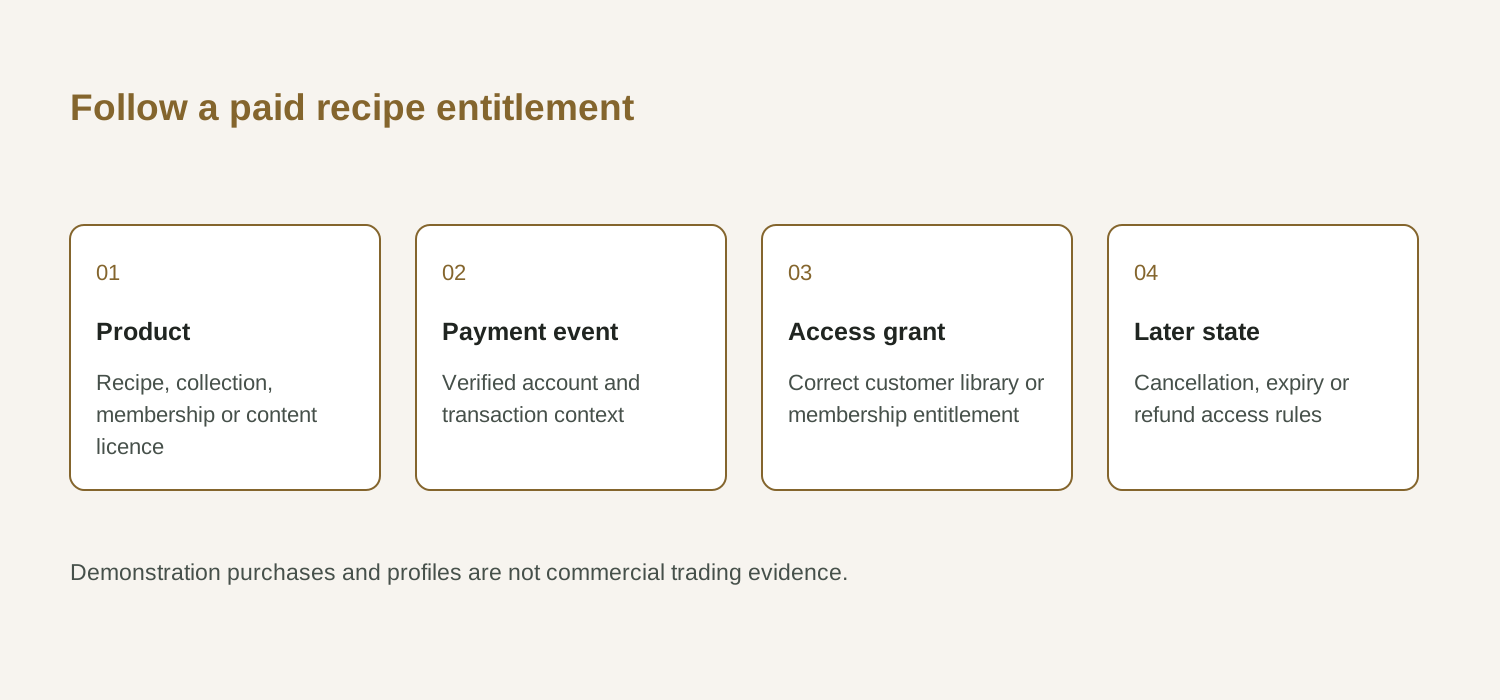
RecipesMondial's stored description includes individual recipes, collections, memberships and commercial content licences. Each has a different access promise. A recipe purchase may grant access to an item; a membership may depend on its current subscription state; a licence requires a clear statement of permitted use. Accept these product types separately.
Ask the seller to prepare one fictional example of each mechanism represented as included. Record the product, customer, price context and intended access. Follow the same example through payment testing and the customer's library. A product card is not sufficient evidence that the resulting entitlement is handled correctly.
Additional types of content or bespoke commercial agreements should be named requirements. A buyer should not infer every possible digital-product sale from the availability of a creator storefront. The purchase can close against a clear set of supported mechanisms, while later development remains separately priced and accepted.
| Product type | Purchase promise to identify | Record to inspect |
|---|---|---|
| Individual paid recipe | Which item becomes accessible | Payment-linked item entitlement in the customer library |
| Recipe collection | Which recipes belong to the purchased product | Collection membership and resulting access |
| Creator membership | Access while the subscription is eligible | Membership state and content visibility |
| Commercial content licence | Permitted use and any applicable limits | Licence details and the customer's purchase record |
| Free creator material | Public or account-based access rule | Published state without an invented paid transaction |
The customer library and paid-access record
The customer library is central to the acquired commerce product. It should connect a verified purchase or eligible membership with the content a customer may access. Use the same sample account throughout the demonstration, then sign out and return through normal navigation to inspect the retained access.
Ask the seller to distinguish the product catalogue from the entitlement record. An item can remain publicly listed while its full content is restricted. The buyer needs to observe both states and understand which backend condition grants access. This is more useful acceptance evidence than a screenshot taken while an administrator is already able to see everything.
Test a separate customer without the purchase. It should receive only the access intended for that state. Use fictional content and accounts so the test is easy to trace. If an access exception requires correction, put the expected result and affected product types into the agreement before the application is accepted for real sales.
Commercial licence terms included with content
A commercial content licence should state the use a buyer is purchasing. The software can store and present licence information, while the rights to grant that use depend on the creator and the agreed content terms. A licence screen does not independently establish authorship or permission for every recipe or image displayed.
Request a walkthrough of the current licence configuration and purchase record. Ask which fields the creator can change and what the customer retains after buying. If the proposed launch needs extra limits, versions or approval steps, specify those requirements and seek appropriate advice on the actual terms before offering them commercially.
The application acquisition should separately identify rights to the included demonstration content and rights to operate the software. Purchasing the code does not automatically transfer every creator's future recipe licence. The asset schedule should make these distinctions understandable to the buyer, seller and any creators later joining the platform.
Creator memberships and recurring access
Memberships require acceptance beyond the successful first payment. Ask what content a current member can open, what happens after cancellation and how failed-payment states affect access. The delivered application should be inspected against its documented policy rather than assumed to behave like another subscription product.
Use an authorised test environment and a sample membership to trace these states. Record the payment event, membership record and resulting customer access. Refresh the library and inspect a separate non-member account. This identifies the current boundary of the feature and gives any required correction a specific acceptance condition.
A configured recurring product does not establish a paying member base. For this starter asset, future membership income remains a proposed operating model. Independently supported transaction history would be separate sale evidence. Keep those facts distinct when assessing the asking price or preparing a purchase offer.
Creator receipts and platform-owner income
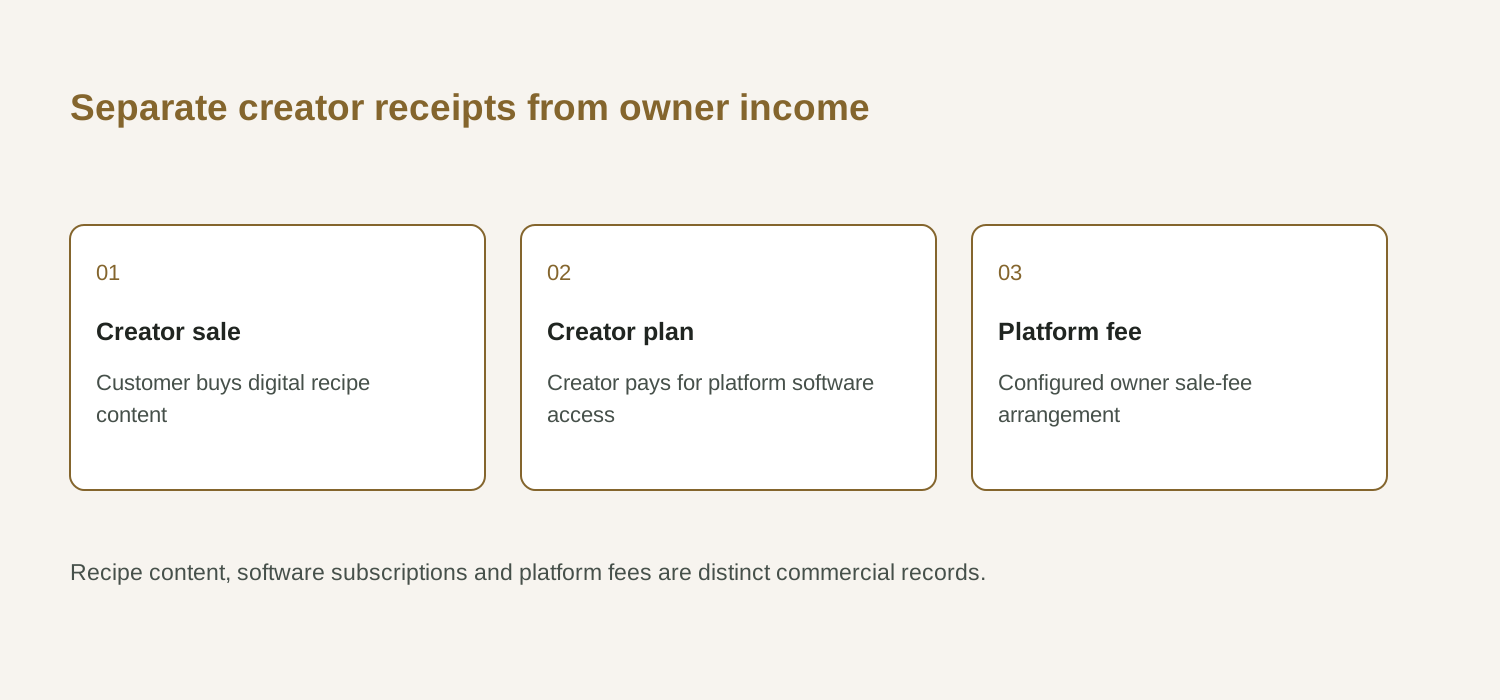
The documented model includes creator software plans and sale-fee controls alongside creator content purchases. These are different commercial records. The customer may buy a creator's product, while the creator may pay for platform access and the owner may retain a configured fee. Do not treat the whole value of a creator sale as platform profit.
Ask the seller to show the current configuration and payment path for a representative transaction. Identify the creator destination, any owner fee and the application records used to reflect the event. Where a charge is configurable, record its actual demonstrated value separately from the future commercial policy the buyer intends to set.
Test creator software billing separately from customer content checkout. A successful plan purchase cannot prove that digital-content entitlements or creator payouts work, and a customer purchase cannot prove the creator plan lifecycle. The buyer should accept both paths within the actual scope offered.
Connected creator payment readiness
The application includes connected-account commerce foundations. A creator's account must reach the required payment-provider state before the intended transaction can proceed. The source documentation describes readiness checks that fail closed until the relevant account is ready. Request a demonstration of the current behaviour rather than relying on an account identifier stored in a sample profile.
The buyer must use appropriate owned payment services and complete the provider's approval requirements. Use suitable test details to inspect the account and transaction states. Record what is demonstrated and what remains an external approval or live settlement check. A test checkout does not prove a bank payout.
International website access does not establish that every creator country or currency is configured. Identify the markets intended for launch and check their actual account arrangement. Limit the public offer to the supported and accepted operating scope, with further payment expansion treated as additional work.
Creator catalogue ownership and moderation
The owner controls creators, content and marketplace administration. Ask the seller to demonstrate a publishing decision and the result for a creator's product. Record the available controls for withdrawing content, handling reports and correcting public information. A buyer needs those actions to support the commerce promise after transfer.
Also ask what remains visible to a customer who previously purchased content that is no longer publicly promoted. That question connects moderation with entitlement and customer support. Inspect the current application behaviour; if the intended policy differs, define a bounded change and the product types affected.
Content complaints and rights disputes still need an operator. The software can provide records and controls, but the buyer must define the review process and response responsibility. Do not infer a staffed moderation service from the presence of an administration page. Include the operating work in the launch plan.
Exports, reporting and support evidence
Identify the transaction, membership, creator and licence information that can currently be retrieved through the application. Ask which reports are available and which require a technical operation. The buyer should know what evidence it can provide when a customer asks about access or a creator asks about a payment record.
Use the sample purchase to inspect the available details. A report containing a total is less useful than a traceable record with the relevant product, customer and payment state. If a needed export is absent, define its fields and authorised role in the additional scope. Ownership of the source does not mean every desired report already exists.
Retain the acceptance evidence without presenting sample totals as financial results. Demonstration transactions explain the system. Genuine income, customer activity and creator agreements need separate support. This distinction is especially important while the public domain is not serving a verified application.
Repository, domain and service-account transfer
The purchase schedule should identify the source repository, domain rights, current design and user and technical guides. Review the installation instructions and request a reproducible application build. The domain condition must have its own acceptance point, because a transfer of code alone does not establish a functioning public deployment.
List the hosting, identity, backend, payment and other services required. Agree which accounts transfer through supported provider processes and which are created under buyer control. Rotate private credentials and verify administrative access during handover. Confidential account details belong in the private transfer material, not the public website.
Accept the resulting environment by opening the public catalogue, creator account, customer library and owner area. Repeat the relevant payment and entitlement tests under buyer-controlled configuration. Retain the release and deployment reference so later maintenance starts from the application actually delivered.
Content rights inventory for the software sale
Ask for the origin and permitted use of the material included with the application: brand assets, photographs, recipe text and demonstration creator content. Determine what can remain public, what has separate terms and what should be replaced before trading. A visually complete sample catalogue cannot establish commercial rights on its own.
Any genuine creator catalogue included in the transaction should have a supported rights and transfer statement. The buyer should not assume that ownership of the software permits resale of every item stored in its database. The agreed package needs to distinguish application rights, demonstration material and independently licensed creator products.
Prepare a permitted initial catalogue as a launch task. Record who approves each creator and who checks the content information offered to customers. These responsibilities are part of operating the acquired marketplace. They should be budgeted separately from the source and domain purchase.
Acquisition costs and the deployment condition
Separate the current asking price from deployment correction, service accounts, content preparation, accepted development and creator recruitment. The parked-domain condition means the buyer needs an explicit environment and domain plan rather than an assumed ready-to-trade public site. Obtain actual service requirements from the documentation before estimating operating charges.
A proposed creator plan or platform fee is a future pricing input until actual customers accept it. Do not turn demonstration purchases into an earnings forecast. The product's value can be assessed through its delivered commerce work and the cost of completing the agreed operating environment.
The sale material describes up to thirty days of reasonable technical handover support. Confirm the current written scope, dates and included deployment help through the transaction channel. Additional features and content migration should have specific acceptance conditions so both parties know what completes the purchase.
RecipesMondial offer preparation sequence
- Confirm current availability and the application, domain and documentation included in the sale.
- Request a working seller-led walkthrough; do not rely on the parked public domain as a demo.
- Accept a paid recipe, collection, membership and content-licence example with the correct access records.
- Separate creator content payments, creator software plans and configured owner fees.
- Agree content rights, buyer-owned account setup, domain deployment and support responsibilities.
- Complete the agreed source and domain transfer against the recorded release and acceptance results.
Each step should produce an identifiable record or a written condition. A broad statement that the platform is ready is less useful than a defined creator account, sample product, test payment and customer entitlement that the buyer has seen. Keep any unresolved item visible in the offer.
Customer access after a product changes
Use a purchased sample recipe to inspect what happens when the creator edits its description, changes its public status or places it in a different collection. Ask the seller to identify the current rule for existing purchasers. The buyer needs to know which record describes the original purchase and which content remains available afterward.
Do the same with a membership product using fictional accounts. A current member, a cancelled member and a customer with a separate item purchase may have different access. Record each demonstrated state and any policy decision that requires additional development. Do not assume that one successful login establishes every entitlement combination.
This acceptance work is particularly important for the commercial-licence path. A customer should be able to identify the licence purchased, even if the public product description later changes. Ask what the current application retains and specify any required version record. A requested improvement is a legitimate scope item, while an undocumented assumption cannot serve as purchase evidence.
The domain delivery condition and support clock
Write down the state that must be reached for domain-related work to be accepted: the intended address serves the agreed application release, relevant public routes open and the buyer controls its configuration. The current parked redirect does not meet that description. Identify the person responsible for each remaining step through the transaction process.
Also agree when the technical support period starts in relation to the source transfer and deployment acceptance. The buyer and seller should not have to infer that timing from the day a repository invitation was sent. A specific schedule makes the deployment condition and the support promise practical deliverables in the same purchase.
RecipesMondial acquisition evidence checklist
Tick an item when evidence is accepted or a precise condition is recorded in the agreement.
Retain the agreed conditions with the current listing, delivered guides and walkthrough record. They identify the digital package being purchased and prevent sample content or an earlier deployment description from becoming an unsupported transaction promise.
Send a defined RecipesMondial purchase offer
Base an offer on the digital product demonstrated, the assets and rights included, the domain work accepted and the accounts the buyer will control. Keep the remaining catalogue and launch tasks separate. A specific package gives the transfer an observable completion point without inventing an operating creator network.
Open RecipesMondial on Flippa to discuss the current acquisition terms. Use the linked documentation and a working seller-led walkthrough to resolve the scope. No public live-demo claim, food-delivery operation or verified trading history is represented by this software offer.
Explore the products discussed
Explore related acquisition offers