
Customer referral software that connects introductions to earned rewards.
Customer referral program software connects an introduction to the customer action that qualifies for a reward. Codeblix develops tailored referral applications for teams that need their own attribution rules, approval responsibilities and reward handoffs. Test a qualifying purchase and its refund adjustment in the working example, then use the checklist to compare a subscription with custom development.
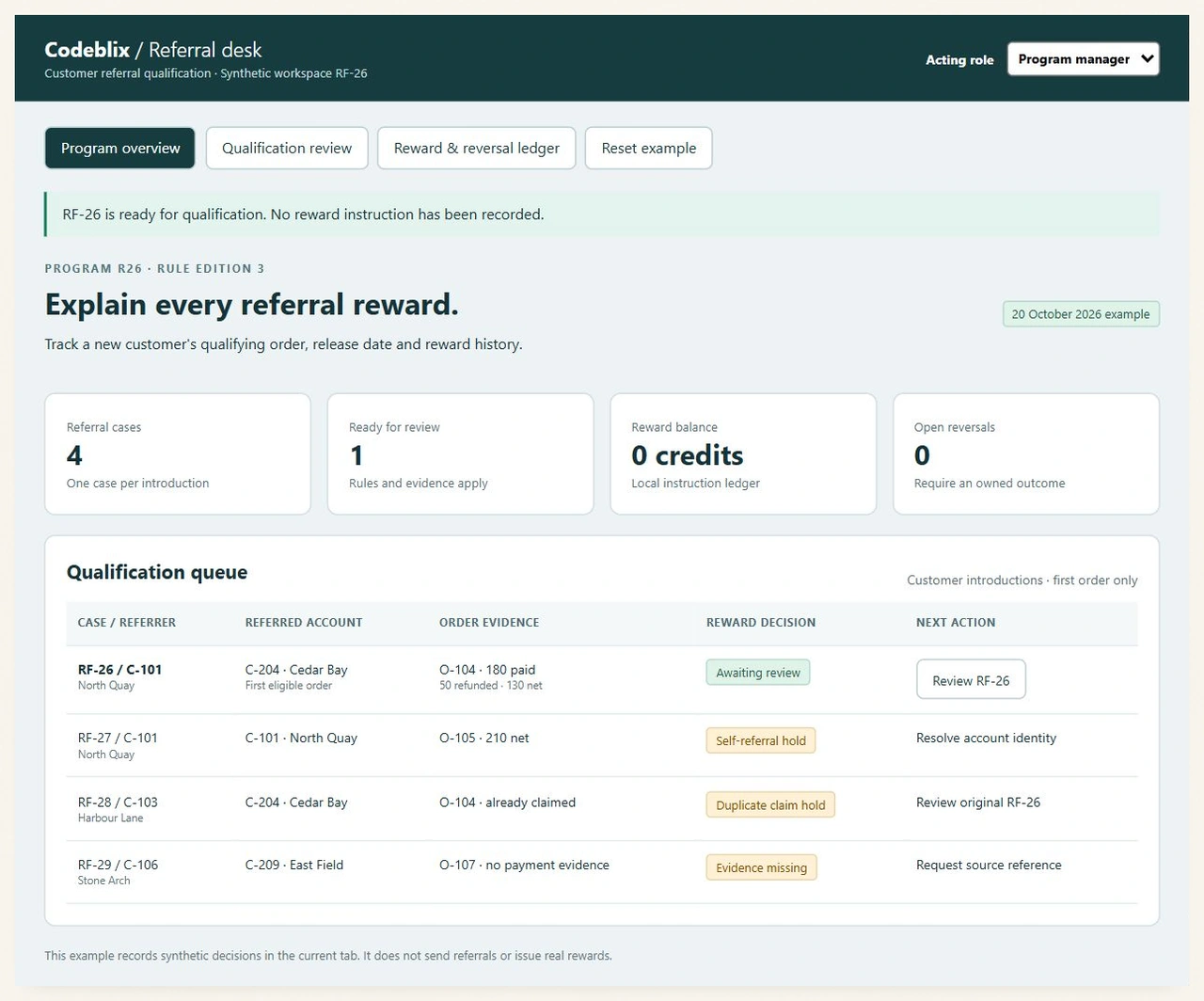
Make the reward decision explainable.
A referral link identifies a possible introduction. Your operating rules still need to determine whether a new customer qualified, which reward became due and what happens when the purchase changes.
Give each introduction a clear owner
Keep the referrer, referred account, program and attribution evidence together. Resolve competing claims before accepting a conversion. A repeated order reference should lead back to the original case rather than create another reward.
Qualify the action you actually value
Define the paid purchase, completed service or accepted sales milestone behind the offer. Specify first-customer status, minimum net value, holding period and exclusions. Keep missing evidence separate from a rejected referral.
Retain the adjustment after a refund
Separate qualification, reward instruction and delivery outcome. A refund may cancel a pending reward or require a later adjustment. Preserve the original instruction, its correction and the person responsible for resolving delivery.
Follow a referral beyond the first conversion.
These screens show the referral qualification demonstration. Inspect four synthetic cases, approve one qualifying order and follow a later refund into a recorded reward reversal.
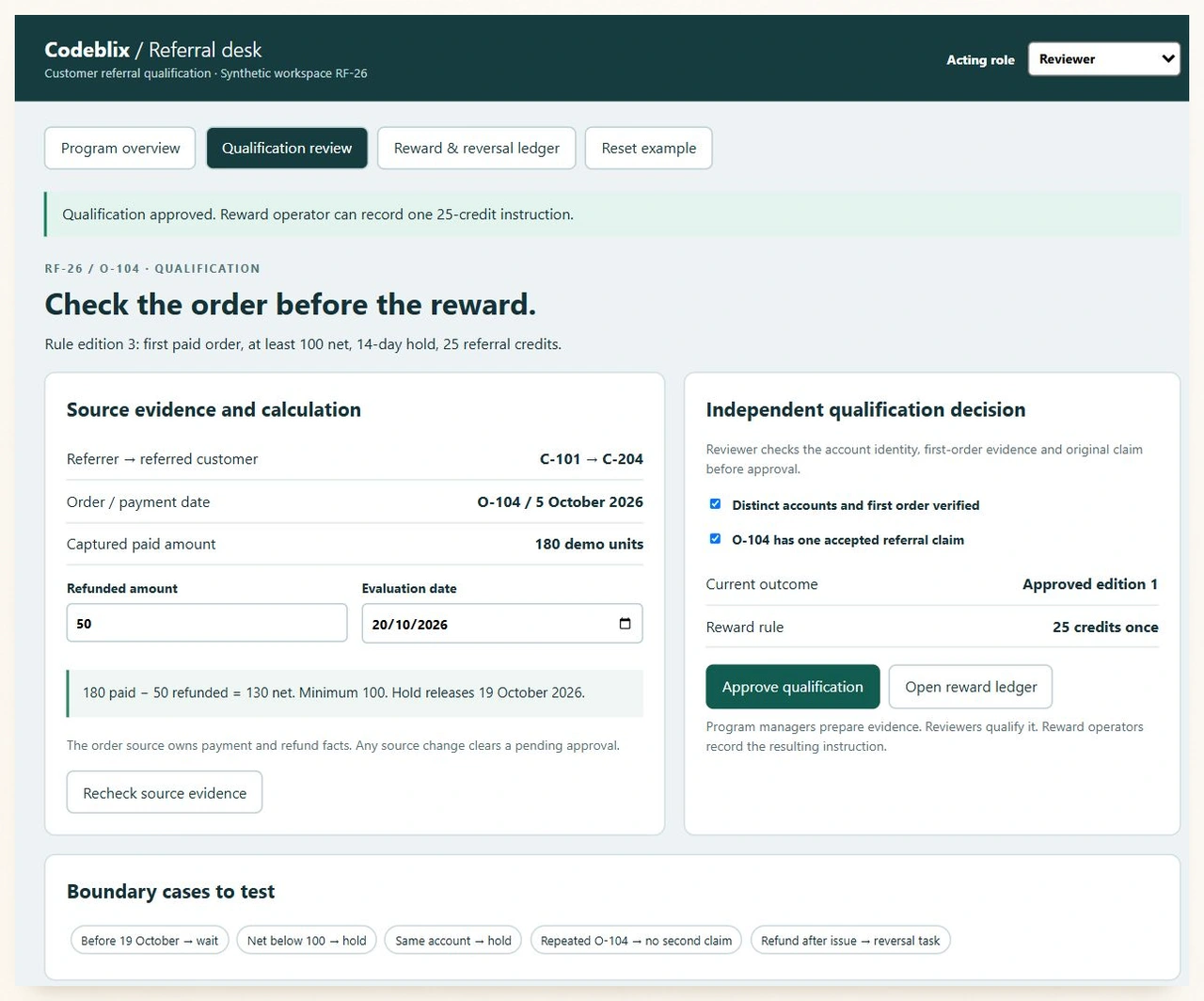
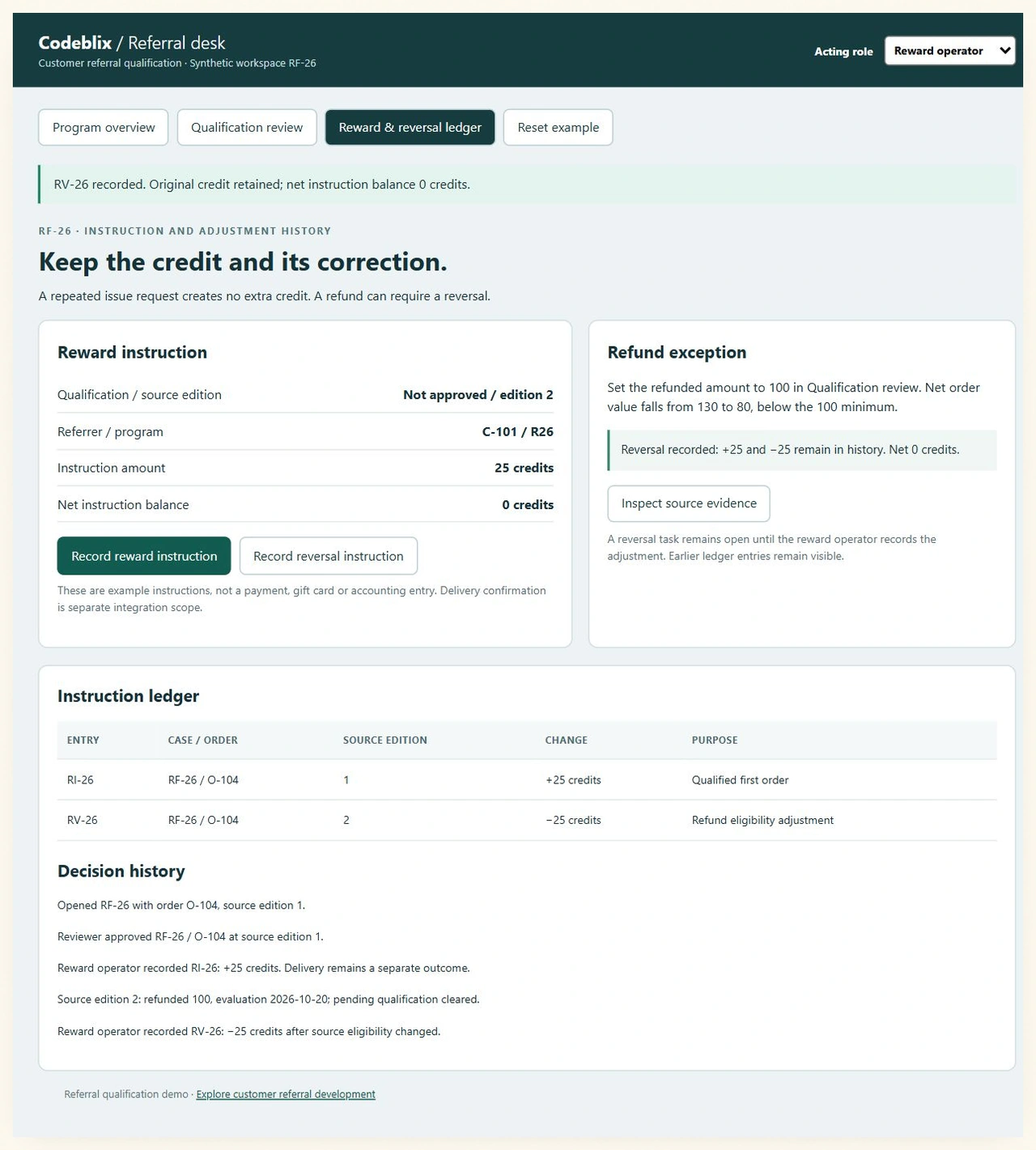
Try the qualifying-order and reversal case
Open RF-26, select Reviewer, complete the account and original-claim checks, then approve qualification. As Reward operator, record the 25-credit instruction. Change the refunded amount from 50 to 100 and inspect the reversal task. Record the adjustment and compare the two retained ledger entries. All example interactions stay in the current browser tab.
Open the working referral qualification workspaceChoose attribution rules before promising rewards
Decide whether the program accepts the first valid introduction, the last eligible code or a reviewed offline claim. Specify what happens when two customers refer the same account. Shared devices or matching contact fields are review signals; a software flag alone should not become a fraud finding.
Keep referrals distinct from advocacy participation
An advocacy activity may recognize a contribution without bringing in a new customer. A referral program attaches a specific introduction to a qualifying conversion. Share participant identity where useful while retaining each program’s terms, evidence and reward rules.
Compare customer advocacy program workflowsSeparate customer introductions from reference calls
A reference request matches a prospective buyer with an experienced customer for a conversation. Referral tracking instead determines which introduction qualifies under a program. Avoid awarding a referral incentive merely because a customer accepted a reference call.
Explore customer reference request managementEvaluate a service before commissioning a build
Established referral platforms can fit a standard offer and supported storefront. Custom development is useful when offline attribution, multiple brands, unusual qualifying milestones or internal review responsibilities shape the program. Compare the same refund, duplicate-event and export cases across the available routes.
An introduction-to-reward workflow with a refund path
Choose the qualifying event and reward rules before connecting a form, storefront or CRM. These six stages give a program manager, reviewer and reward operator different responsibilities.
Publish one program rule edition
Name the eligible participants, qualifying action, reward unit, claim window and dispute process. Record effective dates and exclusions. New terms create another edition so earlier referrals retain the conditions that applied when they entered.
Capture the introduction and attribution
Collect a referral code, link event or reviewed offline introduction. Match stable account identifiers without relying only on an email spelling. Record competing claims, self-referral questions and missing sources for review.
Match a source conversion
Attach the paid order, service completion or accepted milestone reference. Distinguish an observed click from the qualifying business event. Reconcile repeated callbacks and order changes against one source identity.
Evaluate eligibility after the hold
Apply the rule edition to first-order status, payment evidence, net value and release date. A reviewer confirms the identity and original claim. Changing source facts clears a pending approval rather than silently inheriting it.
Record a reward instruction once
Create the approved instruction with a stable case and conversion key. The reward operator owns this handoff. Keep requested, delivered, failed and confirmed outcomes distinct when connecting a credit, coupon or reward provider.
Reconcile refunds and disputes
Re-evaluate a changed purchase against the accepted rule. Cancel an unissued instruction or open an adjustment task for an issued reward. Retain earlier entries, record the outcome and give unresolved delivery exceptions an owner.
Inputs, responsibilities and outputs
- Program managers own rule editions and participant eligibility. Reviewers inspect account identity, claim evidence and the qualifying conversion. Reward operators manage instructions and delivery exceptions; administrators control access, retention and exports.
- Required inputs include the referrer and referred account keys, introduction time, attribution source, program edition, conversion reference, payment or completion evidence and adjustments. Useful outputs include the hold queue, approved instructions, delivery exceptions, dispute history and unreconciled refunds.
- Measure accepted introductions, qualified conversions, rewards requested, rewards confirmed and adjustments separately. Referral-associated sales describe attribution under your rules; they do not prove that the program caused an incremental sale.
Migration and integration requirements
- Inventory old referral codes, participant IDs, reward promises and unresolved balances. Import opening instructions separately from new earned rewards. Reconcile the source totals and hold ambiguous account matches instead of assigning benefits from incomplete history.
- Review the actual CRM, storefront, order and reward interfaces during discovery. Agree authorization, event identifiers, timing, retries and source ownership. Late refunds and out-of-order events need explicit reconciliation rules. A connector is included only after its technical scope is agreed.
- Specify browser tracking and consent behavior, offline introduction evidence, export access and retention. Collect the minimum participant information required for the program. Ask the appropriate adviser to settle promotional terms, disclosures and reward obligations for your market.
Development estimate, deployment and support
- Estimate rule configuration, participant experience, attribution capture, conversion matching, review queues and reward delivery separately. Additional brands, currencies, reward providers and historical migration change the effort; bring anonymized examples for a useful quote.
- Include server authorization, durable storage, concurrent claim handling and immutable instruction identifiers in acceptance. The working demonstration exercises local decisions; the deployed application scope should also specify authentication, recovery, monitoring and failed-delivery reconciliation.
- Start with one program and one qualifying event. Agree hosting and data ownership, backup and restore checks, incident responsibilities and the export format. Support should cover rule changes and unresolved reward tasks as well as the customer-facing form.
Six records behind a reliable referral decision
Use this original model to test the purchase, approval and adjustment path before choosing software. Each record has a different source of truth and a specific operating owner.
| Record | Example inputs | Required output and control |
|---|---|---|
| Program rule edition | R26 / edition 3; first paid order; minimum 100 net; 14-day hold; 25 credits | Retain the applicable terms and effective period. Changing a future offer must not rewrite an earlier accepted case. |
| Participant identities | C-101 North Quay refers C-204 Cedar Bay; distinct account keys | Separate the two parties. Resolve self-referral and uncertain identity matches before qualification. |
| Introduction and claim | RF-26; source evidence; original claim for O-104 | Retain competing claims and their decision. The same accepted conversion cannot produce a second customer-referral reward. |
| Qualifying conversion | O-104; paid 180 on 5 October; refunded 50; net 130 | The order source owns payment and refund facts. Recalculate the net value when source evidence changes. |
| Qualification decision | Source edition 1; evaluation 20 October; Reviewer; two evidence checks | Require the holding period, account check and original-claim check. Bind the decision to the reviewed source edition. |
| Instruction and adjustment | RI-26 +25 credits; source change to net 80; RV-26 −25 credits | Retain both entries, prevent repeated instructions and reconcile delivery outcomes outside the local example. |
RF-26 uses synthetic amounts and fixed program rules, not a suggested reward price. Order O-104 has 180 paid and 50 refunded: net value is 130, above the 100 minimum. Its 14-day hold from 5 October releases on 19 October. On 20 October, a Reviewer confirms distinct accounts and the original claim, then approves source edition 1. The Reward operator records RI-26 for 25 credits. A repeated request adds no entry. Increasing refunds to 100 reduces the order to 80 and creates source edition 2. Qualification is cleared and one reversal task opens. Recording RV-26 retains +25 and −25, leaving a zero instruction balance. RF-27 shows a self-referral hold, RF-28 a competing claim on O-104 and RF-29 missing payment evidence. Real reward delivery, concurrency and permanent history belong in the implementation acceptance scope.
Compare referral products with your own exception cases
The following vendors appeared in the localized referral search research. Their primary pages describe different program and reward approaches. Test the exact source-change and delivery behavior needed by your business.
| Option | Published focus | Ask in your demo |
|---|---|---|
| Referral Factory | Branded referral programs, conversion qualification, reward options and CRM or payment connections. | Show one competing claim and a refund received after an instruction was issued. Which history and delivery exceptions remain visible? |
| ReferralCandy | Ecommerce referral and affiliate programs, reward management, storefront placement and fraud checks. | Demonstrate partial refunds, repeated order events and reward adjustments using the specific commerce platform you operate. |
| Referral Rock | Customer and partner referral programs, sharing experiences, referral tracking and reward administration. | Trace an offline introduction through a reviewed qualifying milestone, its hold period and an export of the resulting reward history. |
Choose a referral subscription when its program rules, supported interfaces and operating costs fit. Extend an existing application when it owns the conversion source and can safely retain reward history. Discuss custom development for distinctive attribution, approval or adjustment requirements. Compare implementation, provider fees, migration, hosting and support together.
Category reference: Referral Factory’s program, qualification and reward overview. The RF-26 record model, synthetic transaction example and downloadable acceptance cases are original Codeblix resources. Vendor pages describe their own offers; ask each provider to demonstrate your exact exceptions.
Connect referral operations to the customer relationship.
Give sales, service and program teams a shared introduction reference while keeping conversion evidence and reward decisions owned by the responsible team.
Explore professional service workflowsQuestions to settle before launching a referral application
Define the qualifying conversion, participant promise and reward operating responsibility together.
What should customer referral program software track?
It should connect the introduction, referrer, referred customer, applicable offer and qualifying conversion. Add the reward holding period, independent decision, instruction and delivery outcome. Keep duplicate claims, disputes and later order changes visible so the program can explain why a reward became due.
Can Codeblix build referral software for our own rules?
Codeblix provides custom software development and consultation. Start with the qualifying action, anonymized source records and reward terms. The demonstration and acceptance CSV help scope the participant journey, attribution, review, delivery interfaces, migration and support.
Does a referral click qualify a customer for a reward?
Only when that is the explicitly agreed program rule. Many programs qualify a paid first order, completed service or accepted milestone instead. Record a click separately from the conversion evidence and state which source confirms eligibility.
How should partial refunds affect a reward?
Define the net-value test and adjustment policy in the program terms. In the example, 180 paid minus 50 refunded leaves 130, above the minimum of 100. A refund total of 100 leaves 80 and requires adjustment of an issued instruction. Other programs can use different agreed rules.
How do we prevent repeated rewards for one order?
Use a stable program, accepted claim and conversion identity. Repeated callbacks should resolve to the existing instruction. Agree database uniqueness, concurrency and retry handling for the implementation, and test competing claims as well as repeated requests from the same customer.
Can the scope include referral links and offline introductions?
Yes. Define the link or code capture, attribution window, consent behavior and supported customer journey. For offline introductions, require a source reference and reviewer path. Resolve conflicts consistently before matching the qualifying conversion.
Is this the same as an affiliate or loyalty program?
A customer referral offer rewards an eligible introduction and conversion. Affiliate programs commonly involve ongoing publisher commissions, while loyalty programs can reward repeat customer activity. Shared records may help, but each program needs its own terms and eligibility model.
What determines the development and support cost?
The number of programs, interfaces, reward methods, brands and attribution paths affects scope. Include migration, participant access, exception queues, hosting, backups and delivery reconciliation. A useful quote separates the referral workflow from the external provider and operating costs.