
Customer reference management software for the right introduction, with permission and capacity
Customer reference management software helps sales teams find suitable customers for buyer conversations, request participation and track each introduction against permission and availability. Codeblix develops custom reference applications for teams that need a controlled route from a buyer’s question to an approved peer call, with clear ownership, contact limits and outcome records. Try the working reference workspace and use its acceptance checklist to prepare a development quote.
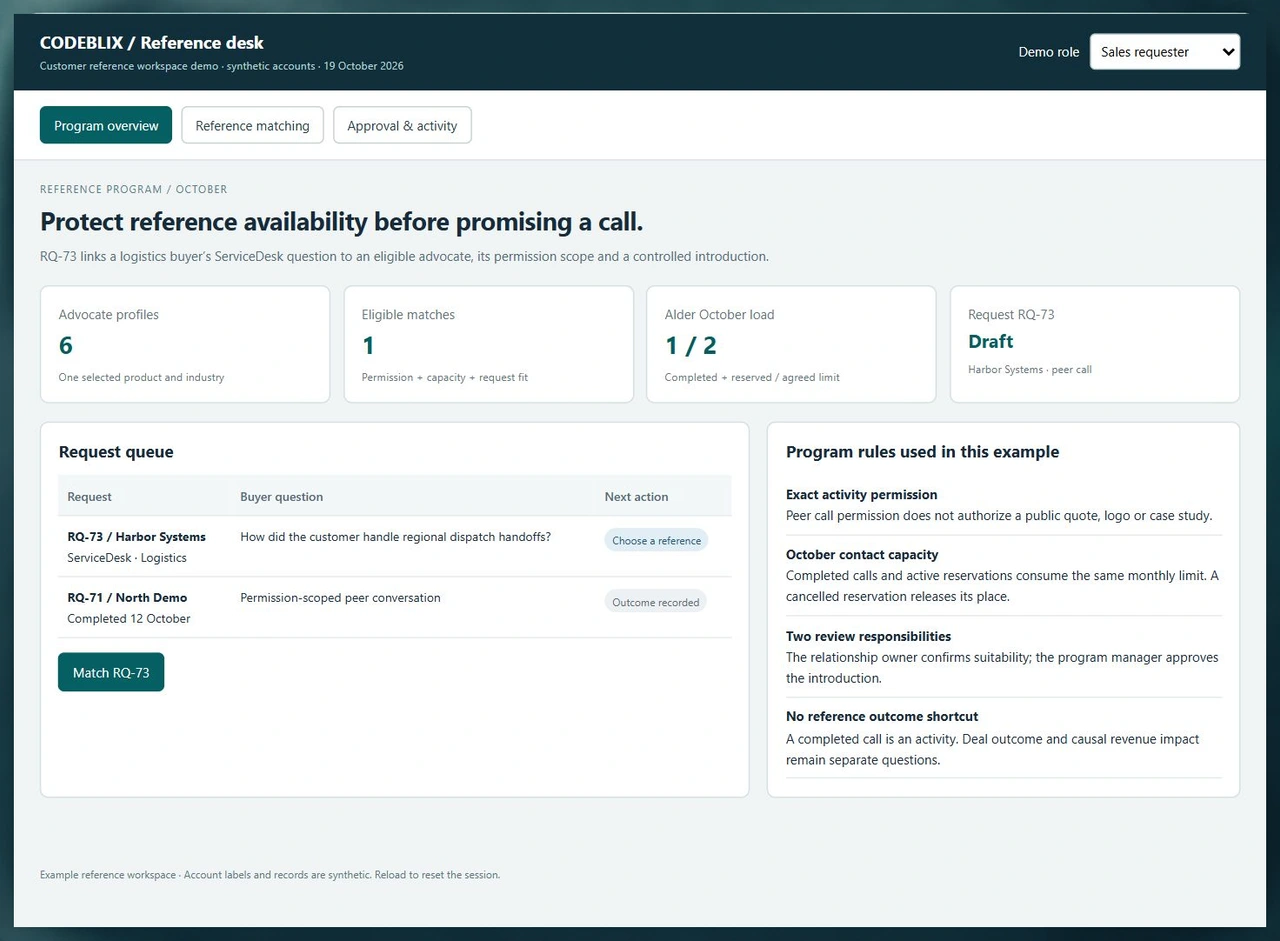
A good reference is relevant, willing and available.
A name on a customer list cannot answer all three questions. Build the reference program around the specific activity, buyer question and relationship context.
Find experience that answers the buyer’s question
Describe the prospect’s product, industry, operating situation and discussion topic. Match those needs against the advocate’s verified experience, then show why a candidate qualifies or needs another conversation.
Protect the customer’s participation choices
Keep private calls, public quotes, logos, case studies and speaking activities separately permitted. Carry the source, scope, expiry and withdrawal state into every request instead of treating a broad referenceable flag as unlimited approval.
Keep reference use within an agreed capacity
Count completed activities and active reservations against the program’s contact policy. Cancellation releases a reservation; it does not erase an earlier completed call. Keep customer willingness and sales demand visible to the program owner.
Follow one buyer request through three working screens.
The reference workspace demo follows Harbor Systems’ request for a private ServiceDesk peer call. Compare six advocate profiles, inspect the matching exclusions and reserve an introduction after the relationship owner confirms suitability.
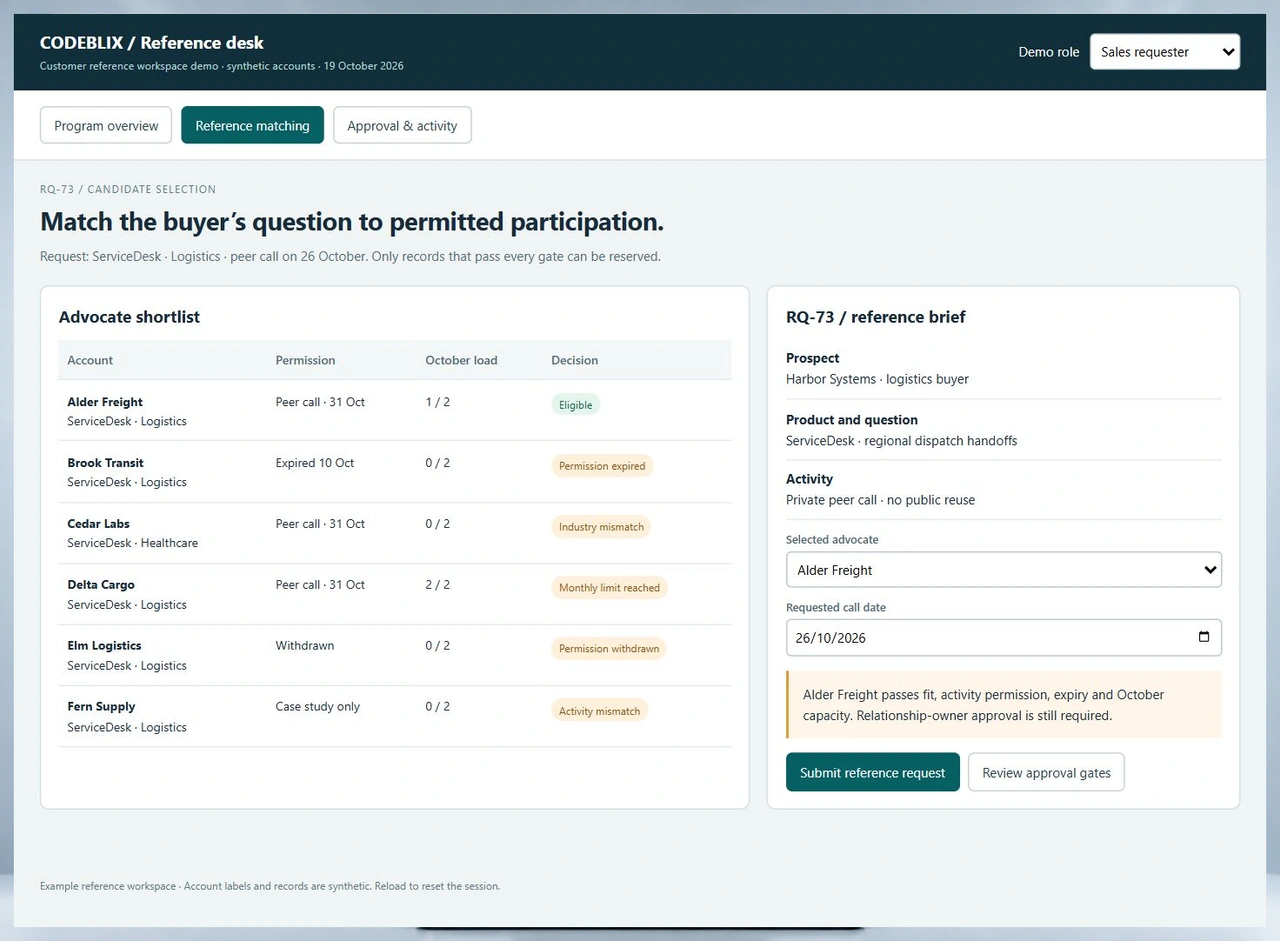
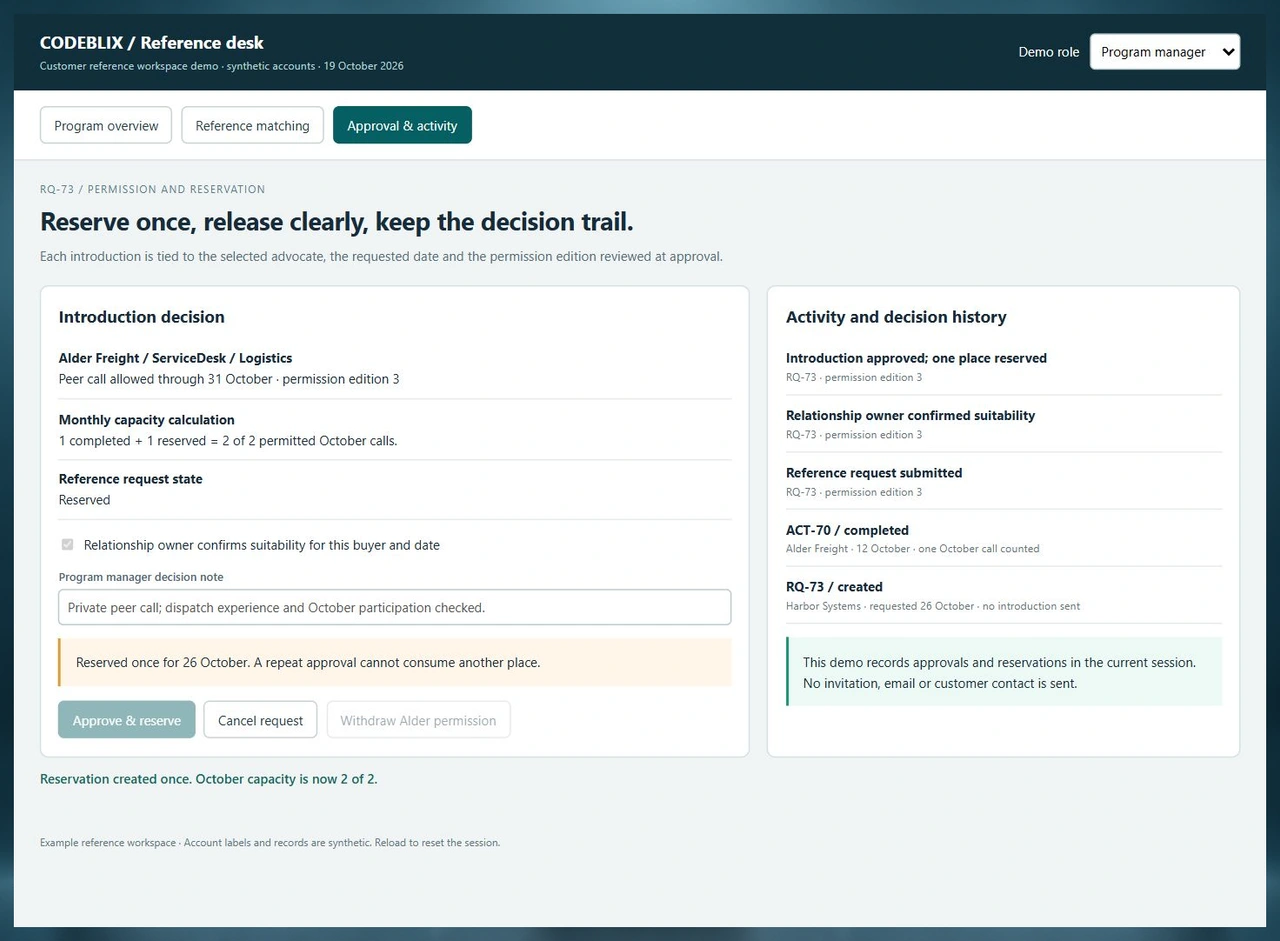
Try the request, owner confirmation and reservation sequence
Select an expired or capacity-limited candidate to see why the request is held. Then submit Alder Freight, confirm suitability as the relationship owner and reserve once as the program manager. Withdraw permission to see the active reservation clear while its earlier decision remains visible.
Open the reference workspace demoKeep opportunity actions connected to the reference request
A seller’s reference request supports a particular buyer conversation. Carry its request identity and agreed outcome back to the opportunity action while the reference program retains permission and participation authority.
Explore sales action and handoff requirementsUse the account plan to explain the buyer context
An account team can identify the buying group, adoption question and next commitment that make a reference useful. Pass that concise context into the reference request, then return the conversation outcome to the account owner.
Review account planning softwareFrom the buyer’s question to a recorded reference activity
Agree these stages with sales, customer marketing and the people responsible for the customer relationship. Each handoff needs an owner and a clear outcome.
Recruit and describe the reference experience
Record the advocate account, nominated participant, relationship owner, products used, industry and topics they can discuss. Keep an evidence source and review date for those attributes. Confirm willingness for the requested activity before making the profile available to sellers.
Capture the request and its permitted purpose
Link the request to a prospect or opportunity, the buyer’s question, activity type, desired date and sales requester. Distinguish a private introduction from publishing a quote. Minimize personal details and tell the relationship owner what information the introduction would share.
Build an explainable shortlist
Check product and industry fit, relevant experience, current activity permission, expiry and remaining contact capacity. Expose exclusion reasons such as withdrawn permission or a full contact period. A seller can suggest a candidate; a match alone does not authorize outreach.
Review suitability and reserve the introduction
Ask the relationship owner to confirm the customer context, then route the request to the program manager. Bind approval to the participant, activity, requested date and permission edition. Reserve one contact place with a stable request identity so repeated actions cannot consume additional capacity.
Coordinate the activity and collect the result
Agree who contacts the advocate, confirms attendance and shares the approved brief. Record completed, declined, cancelled or rescheduled separately. Capture useful feedback and the buyer’s next step without treating an invitation send as a completed conversation.
Refresh permissions and preserve changed decisions
When a customer withdraws permission or their relationship changes, stop new introductions and resolve pending reservations. Retain the earlier activity and decision history under the agreed retention policy. Review coverage gaps by topic and industry while keeping program activity separate from causal revenue claims.
Roles, information access and program policy
- Sales requesters search approved profiles and explain the buyer need. Relationship owners confirm suitability and maintain participation preferences. Program managers decide introductions, manage exceptions and oversee contact capacity. Customers control the activities they agree to undertake.
- Separate searchable experience tags from private contact details, account-health notes and internal review comments. Define who may view, export, update or withdraw each field. Use server-enforced identity and account permissions for the delivered application; the demo’s selectable roles exercise the sequence with synthetic accounts.
- Define the contact period, time zone, reservation expiry, rescheduling rules, coverage arrangements and approval delegation. Agree how permission changes affect an approved introduction that has not yet happened. Program permission is an operational record; legal wording and retention rules need your organization’s review.
Migration and CRM integration boundaries
- Bring a small anonymized reference spreadsheet, request queue, permission examples and activity log. Reconcile duplicate participants, stale experience tags, ambiguous referenceable flags and completed calls stored as open tasks. Preserve each source identity and keep unknown permission states out of automatic matching.
- Decide where accounts, contacts, opportunities and permission records are authoritative. For a CRM or customer-success interface, confirm actual API access, field ownership, synchronization direction, retry behavior and deletion handling during discovery. A controlled file exchange can establish the first pilot’s boundaries.
- Stable request IDs and import IDs should prevent duplicate reservations and activity counts. Include held rows, source corrections and reconciliation totals in the import handoff. Review contact data and sharing permissions before moving a historic email archive or attachments into the application.
Deployment, operating support and development cost
- Start with one reference activity and a limited advocate group. Test candidate exclusions, approval cover, cancellation, withdrawal after reservation and two simultaneous requests competing for the last contact place. Persistent authentication, concurrency and durable change history belong in the delivered application’s acceptance scope.
- The development quote should identify users, advocate volume, permission rules, request routing, CRM interfaces, reporting, data preparation and notification needs. Add portals, calendars, multilingual participation or offline work only where the program requires them; each expands delivery and support responsibilities.
- Agree hosting ownership, backups, restoration tests, export portability, monitoring and the response to failed imports or notifications. Name the person who can change contact limits and the person who reviews permission wording. Roll out with a reconciliation checkpoint for pending requests and reservations.
Six records that make a reference introduction reviewable
Use this original model to evaluate a specialist reference platform, an extension to your current CRM or custom Codeblix development. It makes the matching and contact-capacity rules concrete before procurement.
| Record | Example inputs | Required output and control |
|---|---|---|
| Advocate experience profile | Alder Freight; ServiceDesk; Logistics; dispatch handoffs; relationship owner | Search verified experience tags while restricting contact details and internal relationship notes. |
| Activity permission edition | Private peer call; allowed through 31 October; permission edition 3; source reference | Check the exact activity and date. A later withdrawal creates a new state and stops pending use. |
| Buyer reference request | RQ-73; Harbor Systems; logistics buyer; regional dispatch question; 26 October | Give the request one identity and retain the selected participant, purpose and requested date. |
| Contact-period capacity | Alder Freight; October limit 2; completed ACT-70 count 1; active reservations 0 | Available places = limit minus completed activities minus active reservations. Do not count a cancelled reservation twice. |
| Suitability and introduction decision | Relationship-owner confirmation; program-manager note; permission edition; reserved place | Approve only after every gate passes. Repeat approval keeps one reservation; changes require a fresh decision. |
| Activity result and revision history | Completed, cancelled or declined; feedback; permission withdrawal; released reservation | Keep earlier completed activity and decisions while correcting the current request and future availability. |
In the synthetic demonstration, Harbor Systems asks for a ServiceDesk reference from a logistics customer on 26 October. Six profiles produce one eligible match: Alder Freight. Brook Transit’s permission expired; Cedar Labs has a different industry; Delta Cargo has used its two October places; Elm Logistics withdrew permission; Fern Supply permits a case study rather than a private call. Alder permits peer calls through 31 October and has one completed call against a limit of two. Its starting availability is 2 − 1 − 0 = 1. Submission requires relationship-owner confirmation before a program manager can approve. Approval creates one reservation, so the load becomes 1 completed + 1 reserved = 2 of 2. Repeated approval is disabled. Cancellation releases the reserved place. Withdrawing permission after approval clears that reservation and moves the request to a permission hold, while the completed call and earlier approval remain in history. The demo stores the sequence in the current session and sends no invitations.
Give each provider the same permission-and-capacity case
The primary pages below describe different reference-management approaches. Ask each provider to run the six-profile example and show the approval, withdrawal and cancellation details that your program needs.
| Option | Published focus | Ask in your demo |
|---|---|---|
| Influitive | Advocate recruitment, reference groups, experience-based matching and Salesforce-linked request workflows within an advocacy platform. | Show how activity-specific permission and a full contact period affect the shortlist and an already pending request. |
| SlapFive | Advocate preferences, permissions, limits and activity records, with automation for requesting, approving and scheduling references. | Demonstrate two requests seeking the last available place, then cancel one without losing completed activity history. |
| Base | Customer reference matching and request orchestration, with approval routing and context for sales teams. | Withdraw permission after an introduction is approved and show the pending reservation, relationship-owner alert and retained decision. |
A specialist platform may suit a program that needs established advocacy, community and content capabilities. An extension can fit when your CRM already owns the required profiles and permission records. Custom development is useful when the introduction route, contact policy or information boundaries need a tailored application. Compare configuration, licensing, migration, interfaces, reporting and ongoing administration using the same exception cases.
Category reference: Influitive’s reference program and matching overview. The RQ-73 record model, six-profile example and downloadable acceptance cases are original Codeblix buyer resources. Linked vendor pages describe their published approaches; confirm implementation details directly in demonstrations.
Connect reference participation to the wider customer relationship.
Use customer and opportunity context to make relevant introductions while the program retains participation choices and contact capacity.
Explore professional services software requirementsQuestions to settle before choosing customer reference software
Use these answers to prepare a realistic program scope and a useful vendor or development conversation.
What does customer reference management software manage?
It connects advocate experience, participation permission, buyer requests, introduction approvals and activity outcomes. The useful unit is a particular customer participating in a particular activity for an agreed purpose and date. A customer directory alone does not manage that sequence.
Can Codeblix develop a reference workspace around our program?
Codeblix offers custom application development and consultation. Bring anonymized request and permission examples, contact-limit rules and the systems that own customer identities. The working demo and buyer checks provide a concrete starting point for defining the application and requesting a quote.
How should reference matching protect customers from overuse?
Agree a contact period and count completed activities plus active reservations against the participant’s limit. Define cancellation, rescheduling and exception rules. Matching should explain why a candidate is unavailable, and final approval should check capacity again when the reservation is created.
Does a private reference call permit a public testimonial?
Record each activity’s permission separately. In this model a private peer call does not authorize a quote, logo or case study. Your organization should review participation wording, sharing and retention requirements and define how changed or withdrawn permission affects pending activities.
What happens when permission changes after approval?
Hold pending use, notify the responsible program owner and reconcile any reserved contact place. Preserve the earlier decision and activity history according to your retention policy. The demo clears its active reservation and shows a permission hold while retaining the previous approval entry.
Can our CRM supply the advocate and opportunity records?
The project can assess that interface after confirming your CRM’s API access, permissions and authoritative fields. Specify direction, refresh timing, retries, deletion handling and who resolves conflicts. A reviewed file handoff can support a smaller initial pilot without assuming a finished connector.
Which reports help assess a reference program?
Review request fulfilment, response time, exclusion reasons, advocate coverage and contact load. Relate activities to opportunities only with a clear attribution definition. An introduction or a later won deal does not by itself prove the reference caused the revenue.
What determines a custom reference application quote?
Advocate and user volumes, permission complexity, approval routes, CRM interfaces, notifications, migration and reporting affect scope. Include hosting, backups, restoration, training and operating support. Start with one activity type and representative exception cases so providers can quote the same work.