
Customer advocacy software for relevant campaigns, accepted contributions and fair recognition
Customer advocacy software organizes voluntary customer participation across feedback, community, speaking and other program activities. It connects the right member to a relevant campaign, records their contribution and follows through on recognition. Codeblix builds custom advocacy applications for teams whose participation rules, evidence reviews and operating handoffs need a tailored workflow. Explore the working campaign demo, compare platform options and prepare a practical development quote.
Give willing customers a clear reason to participate.
A campaign needs more than a broadcast list. Define who it serves, what a useful contribution looks like and how the program acknowledges the effort.
Build a relevant participation cohort
Use product experience, interests and current program opt-in to select members for a particular activity. Explain exclusions and let customers pause participation. A customer account can remain active while its advocacy membership is paused.
Review the contribution against a clear brief
Give each activity an evidence requirement and a named reviewer. Separate submitted from accepted, retain revision requests and bind the decision to the edition that was actually inspected. Constructive criticism can satisfy a feedback brief.
Make recognition traceable
Record why points or recognition were earned, which contribution created the entry and what happens when that contribution is withdrawn. Reconcile the balance from entries rather than allowing unexplained manual totals.
See one feedback campaign through three software screens.
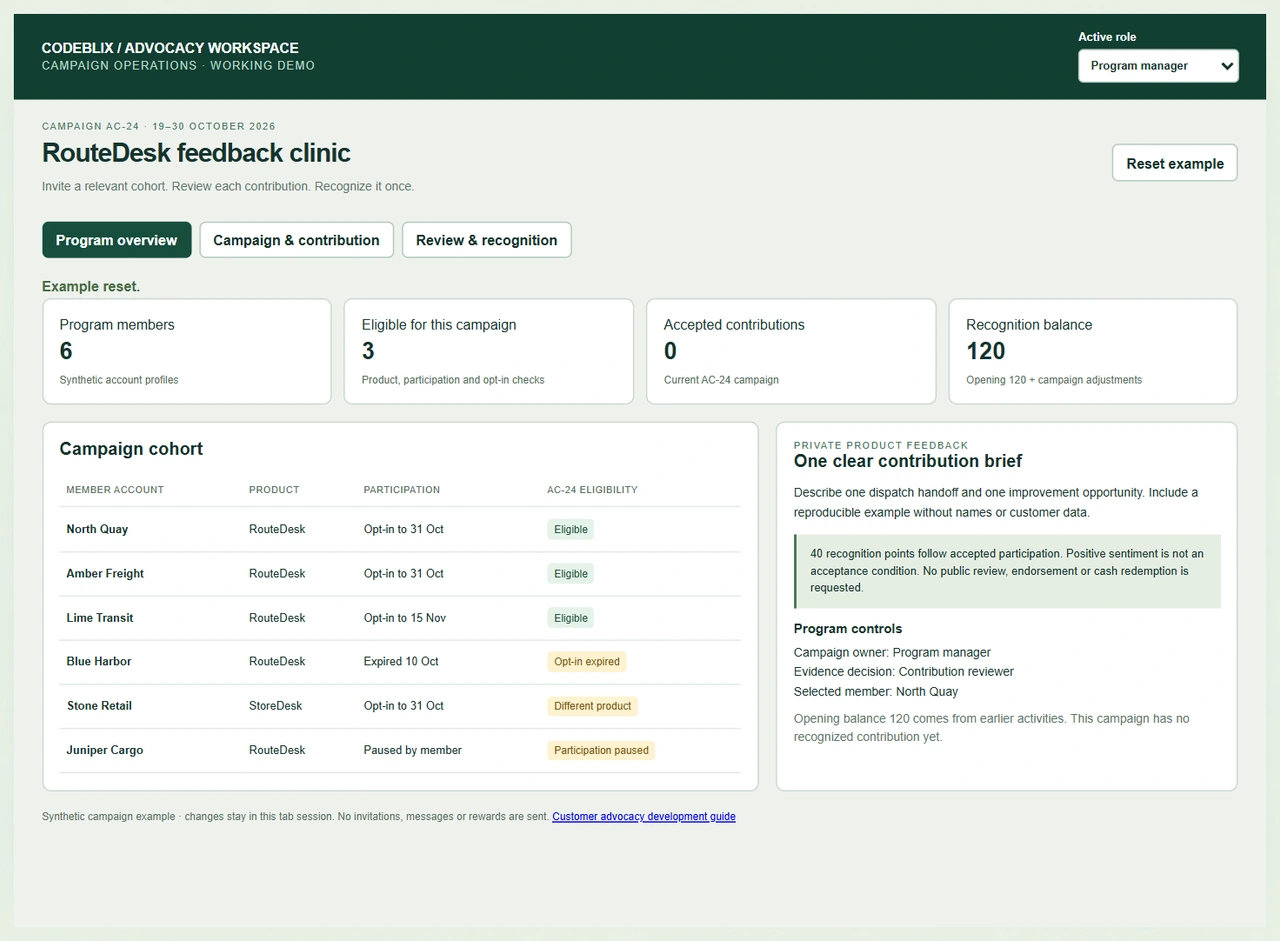
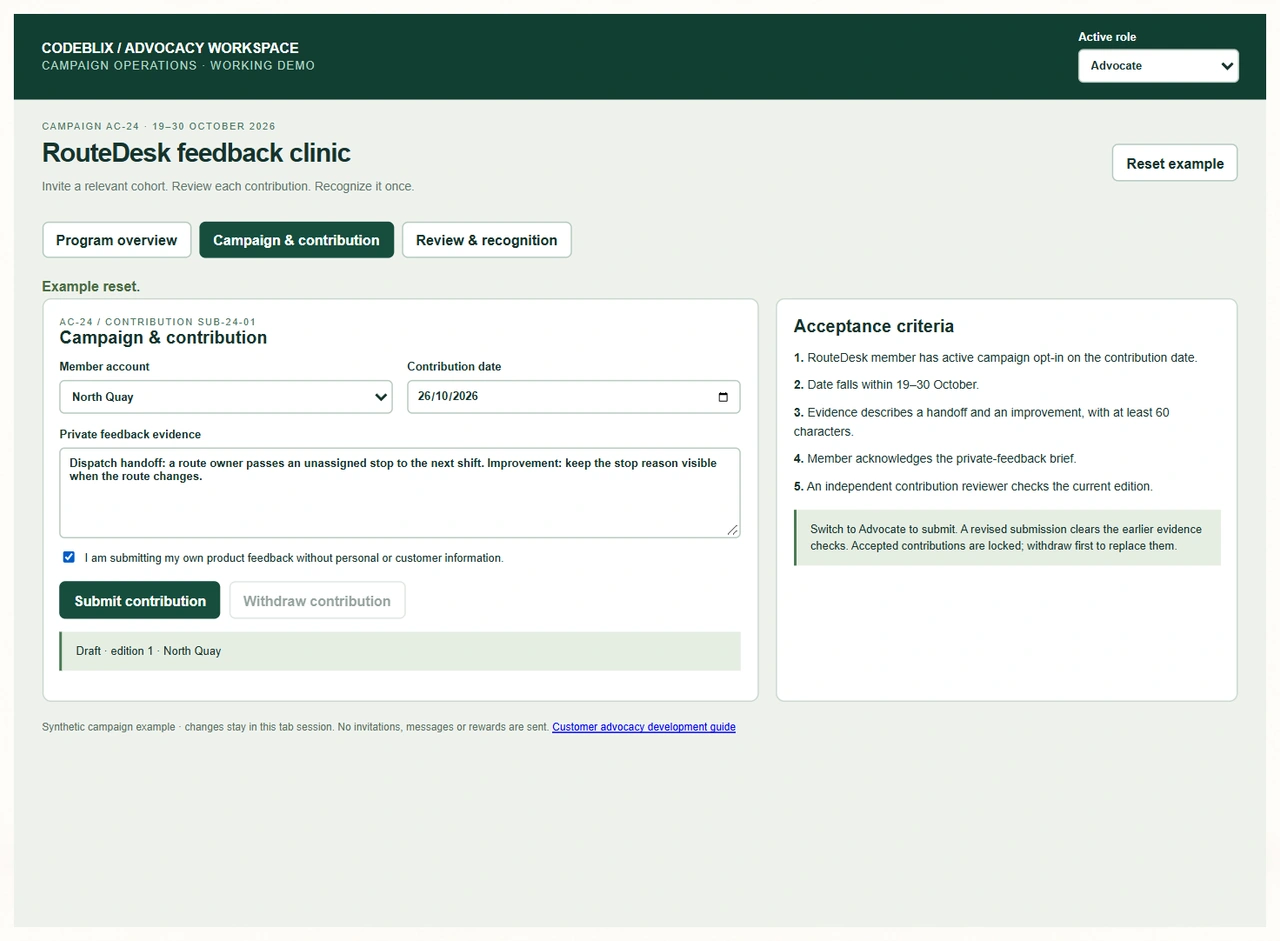
The advocacy demo follows campaign AC-24, a private RouteDesk feedback clinic. Inspect six member accounts, contribute a specific handoff improvement and accept it with one recognition entry.
Try an eligible contribution and its recognition reversal
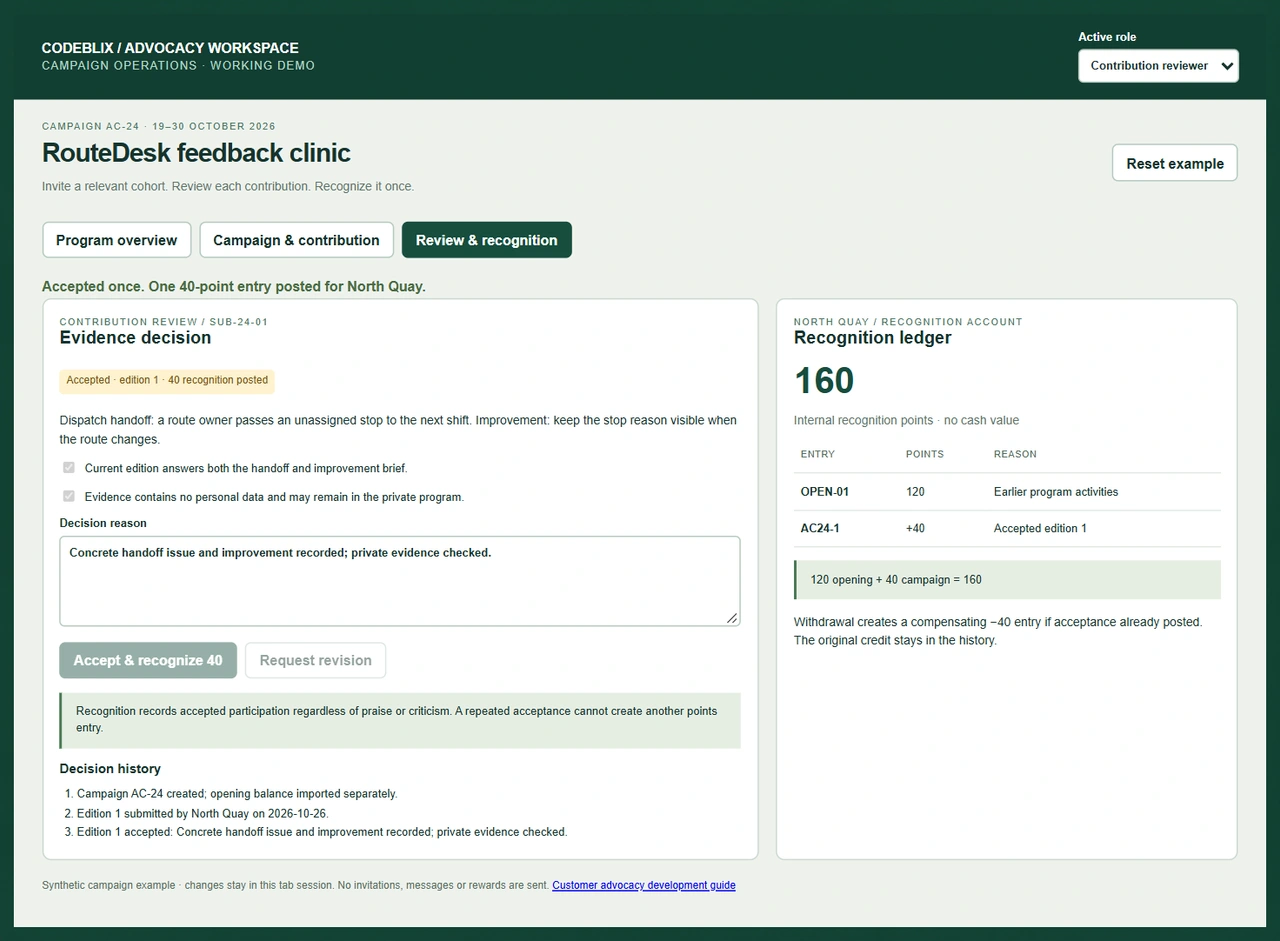
Open the campaign demo, switch to Advocate and submit North Quay’s feedback. As Contribution reviewer, check both evidence conditions and accept with a reason. Return as Advocate and withdraw the contribution to inspect the separate reversal and retained history.
Open the advocacy campaign demoKeep a buyer reference request in its own workflow
A request to introduce one customer to a prospect needs experience matching, relationship-owner confirmation and a contact reservation. Connect that activity to the advocacy membership while preserving the reference program’s introduction controls.
Compare customer reference management requirementsReturn useful commitments to the account team
A product-feedback campaign can reveal an adoption question or an agreed follow-up. Share the permitted outcome with the account owner, retaining the campaign evidence and participation decision in the advocacy application.
See account planning and customer commitmentsFrom an advocate invitation to a reconciled campaign result
Use these six stages to specify a customer advocacy application. Decide who owns each action before choosing notifications, badges or integrations.
Create the membership and participation preferences
Link each advocate to a customer account and record product experience, interests, preferred activities, opt-in source and participation state. Keep invitation, acceptance and withdrawal distinct. Restrict private account context to the people who need it.
Publish a campaign brief and eligibility rule
Name the campaign owner, activity purpose, opening and closing dates, target cohort and expected contribution. Decide the acceptance criteria and recognition policy before collecting responses. Keep private product feedback separate from permission to publish a story or quote.
Invite the cohort and capture a contribution
Check membership and campaign fit, then track invitation, response and submission separately. Give a contribution a stable identity, member, campaign and edition. Describe evidence requirements in the form so the participant can complete a useful response without repeated follow-up.
Moderate the current evidence edition
A reviewer checks completeness, relevant experience and information-sharing boundaries. Accept, request a revision or close the contribution with a reason. Editing a submitted response opens another edition and clears its earlier checks; an accepted edition stays locked until withdrawal.
Post recognition once and retain corrections
Create a recognition entry only when its acceptance condition is met. Repeated clicks, imports or callbacks must reference the same contribution identity. If an accepted contribution is withdrawn, create a linked compensating adjustment while preserving the original decision and credit.
Close the campaign and review program health
Reconcile invited, participating, submitted, accepted and withdrawn counts. Review contribution coverage, member workload, unresolved revisions and recognition adjustments. Keep influenced opportunities separate from proven revenue attribution and use the results to improve the next campaign.
Member access, moderation and recognition policy
- Advocates manage their own participation and responses. Program managers define campaign cohorts and briefs. Contribution reviewers assess evidence; a program administrator maintains recognition rules and resolves adjustments. Define cover and delegation without making a member the approver of their own contribution.
- Specify whether a campaign uses recognition points, access to learning sessions, badges or another acknowledgement. Keep acceptance independent of positive sentiment. Public review campaigns, published endorsements and anything with redeemable value need their own channel, disclosure, permission and policy review before inclusion.
- Enforce account and member permissions on the server in the delivered application. The selectable roles in the demo illustrate the handoffs with synthetic records. Decide who may export member data, inspect private feedback, change campaign criteria or correct a recognition entry.
Migration, CRM data and communication interfaces
- Start with a sample membership list, two campaign briefs, a contribution archive and the existing recognition record. Reconcile duplicate contacts, unclear participation states, unverified historical points and contributions without an acceptance decision. Keep the import source and unresolved rows visible.
- Customer identities may belong to your CRM while preferences and contribution evidence belong to the advocacy application. Confirm the actual API, allowed fields, update direction, refresh interval and conflict owner. Review opt-out propagation, deletion, retries and failed-delivery handling before connecting a messaging provider.
- Use a controlled file exchange where it makes the first release easier to reconcile. Imported balances need a dated opening entry and an agreed cutover point so historic activities cannot earn recognition twice. Define support ownership for interface failures and source corrections.
Pilot delivery, hosting and a comparable quote
- Begin with one voluntary activity, a small member cohort and one review policy. Exercise expired opt-in, irrelevant membership, revision after submission, repeated acceptance and withdrawal after recognition. Add durable identity, simultaneous updates, recovery and monitoring to the application acceptance plan.
- A development quote should separate member portal work, campaign administration, moderation, recognition, reporting and interfaces. Member volumes, language choices, permission complexity and data cleanup affect scope. Price reward fulfilment and external communication services separately when the program needs them.
- Agree the hosting account, backup schedule, restore checks, export format and support response. Assign a campaign owner and a recognition-adjustment owner. Roll out with an opening-balance reconciliation and a review of pending contributions so staff can trust the first campaign report.
Six records behind a controlled advocacy campaign
Use this original campaign model to compare a specialist platform, an extension to your customer system or a custom Codeblix application. The records expose where participation, evidence and recognition can become disconnected.
| Record | Example inputs | Required output and control |
|---|---|---|
| Advocacy membership | North Quay; RouteDesk; feedback interest; active opt-in through 31 October | Evaluate the campaign against the member’s experience and participation choice, including paused or expired membership. |
| Campaign brief and cohort | AC-24; private feedback clinic; 19–30 October; six profiles, three eligible | Fix the activity purpose, qualifying cohort, evidence brief and recognition rule before accepting contributions. |
| Contribution and evidence edition | SUB-24-01; North Quay; 26 October; dispatch handoff and improvement; edition 1 | Retain a stable contribution identity. A revised submission replaces the reviewable edition without silently inheriting its checks. |
| Moderation decision | Contribution reviewer; two evidence checks; decision reason; accepted edition | Require the current evidence and a separate reviewer before posting recognition. Preserve revision and withdrawal decisions. |
| Recognition account entries | OPEN-01: 120; AC24-1: +40; withdrawal adjustment REV-1: −40 | Reconstruct the balance from entries. Acceptance posts once; a correction references the original credit instead of deleting it. |
| Campaign outcome and program review | Eligible members; submitted and accepted counts; revision reasons; withdrawn contributions | Separate engagement stages and recognition totals. Share only permitted outcomes with account teams and other systems. |
The synthetic AC-24 feedback clinic has six profiles: North Quay, Amber Freight and Lime Transit qualify; Blue Harbor’s opt-in expired, Stone Retail uses a different product and Juniper Cargo paused participation. North Quay contributes a dispatch handoff issue and improvement on 26 October. The submission must meet the brief and include the participant’s acknowledgement. A contribution reviewer checks the current edition and records a useful reason. Acceptance posts 40 recognition points once: 120 opening + 40 campaign = 160. Repeated acceptance is disabled. Withdrawal adds −40 as a separate entry, returning the balance to 120 while retaining the original credit and decision. Revising a submitted contribution clears its old evidence checks. The demo keeps these actions within its current tab session.
Ask providers to demonstrate the same contribution lifecycle
These primary product pages describe advocacy approaches observed in the localized search results. Bring the AC-24 example into each demonstration and ask how the product handles an edited or withdrawn contribution.
| Option | Published focus | Ask in your demo |
|---|---|---|
| Influitive | Targeted advocate engagement, gamification, recognition, community capabilities and program reporting. | Show the acceptance criteria for private feedback, the entry that recognizes participation and the correction when a contribution is withdrawn. |
| Base | Customer signals, readiness, automated advocacy requests and cross-team reporting across the customer journey. | Demonstrate how a changed participation preference stops an unsuitable campaign ask and how the resulting contribution returns to its source account. |
| SlapFive | Advocate preferences and activities, community-driven participation, recognition mechanics and program-health reporting. | Edit evidence after submission and show whether the prior review clears, then repeat acceptance and inspect the recognition history. |
Choose an established advocacy platform when its engagement, community and program administration fit your operating model. Extend an existing application when member identity and campaign data already have a reliable owner. Custom development suits distinctive contribution reviews, information boundaries or recognition reconciliation. Compare total operating effort, licensing, data migration, interfaces and support using the same campaign cases.
Category reference: Influitive’s advocacy engagement and recognition overview. Codeblix’s campaign record model, synthetic contribution example and acceptance cases are original buyer resources. Vendor links provide primary descriptions of their approaches; confirm the detailed behavior in a product demonstration.
Connect the advocacy program to a useful customer relationship.
Carry permitted campaign outcomes into account follow-ups while keeping membership preferences, contributions and recognition properly owned.
Explore software for professional service operationsCustomer advocacy software buying questions
Settle the program rules, system boundaries and delivery scope before comparing a subscription with a custom application.
What should customer advocacy software help a program manage?
It should connect voluntary membership, relevant campaign opportunities, contributions, evidence decisions and recognition. Useful reporting distinguishes invitation, response, submission and acceptance. The exact activity mix depends on whether your program prioritizes feedback, community contribution, speaking or other customer participation.
Can Codeblix build an application for our advocacy program?
Codeblix provides custom software development and consultation. Use a real campaign brief, anonymized member records and recognition examples to define the workflow. The working demonstration and acceptance CSV help turn program rules into a scope that can be estimated and reviewed.
How does advocacy software differ from reference management?
Advocacy organizes a continuing program of membership and activities. Reference management handles a specific introduction requested by a seller, including experience matching, suitability and contact availability. Link the records where needed, while retaining the separate approval and reporting responsibilities.
Should contribution approval depend on positive feedback?
Define acceptance by the activity brief and evidence quality. In the example, a constructive product improvement can qualify for recognition. The campaign asks for private feedback; publishing a customer quote or running a public review activity needs its own permissions and channel rules.
What happens to recognition after a withdrawal?
Agree the policy before launch. The example adds a compensating minus-40 entry and preserves the original acceptance and credit, bringing the balance from 160 back to 120. Define how badges, redeemed benefits or downstream exports would be reconciled if they are included in your program.
Can it connect to our CRM or community platform?
Assess the actual APIs and access during discovery. Identify the authoritative member identity, preference fields, contribution destination and synchronization direction. Include opt-out propagation, failed requests and reconciliation in the interface scope rather than assuming records will always agree.
Which measures are useful for advocacy program reporting?
Track eligible and active members, participation by activity, accepted contributions, revision queues, withdrawals and recognition adjustments. Examine concentration of asks across members. Associate activity with opportunities using a stated method; participation counts alone do not prove additional revenue.
What should a custom advocacy software quote include?
Include user roles, member volume, activity types, moderation rules, recognition logic, migration, interfaces and reports. Specify hosting, export ownership, backups, recovery and support. Add a member portal, communication delivery, multiple languages or reward fulfilment as explicit work packages when required.