
Hire a CakePHP programmer for a defined application task
Hire a CakePHP programmer through a scoped Codeblix development engagement. Bring the feature or operating workflow you need, the existing application and the records it must preserve. Agree the code review, implementation, request and database checks, and source handover in a project quotation.
Commission an application change with a clear record of completion.
For an existing CakePHP application, the development brief needs to connect the requested behaviour to the codebase, stored records and people who approve the result.
Review the application before fixing the scope
Identify the CakePHP and PHP versions, Composer lockfile, configured database and installed plugins. Trace the affected routes, controllers, table classes, entities and templates. This review establishes where the requested work belongs and which existing behaviour must be preserved.
Separate valid input from a valid business action
A quantity can be a valid whole number and still exceed available capacity. Specify field validation separately from rules that depend on stored records or application state. Include the acting user, workspace and permitted transition in the acceptance case.
Accept the implemented task and its handover
Name the source revision, request and database evidence, business approver and release operator. Keep the accepted records, configuration instructions and follow-up arrangement with the application owner’s project materials.
Show the programmer which requests should succeed and which must stop.
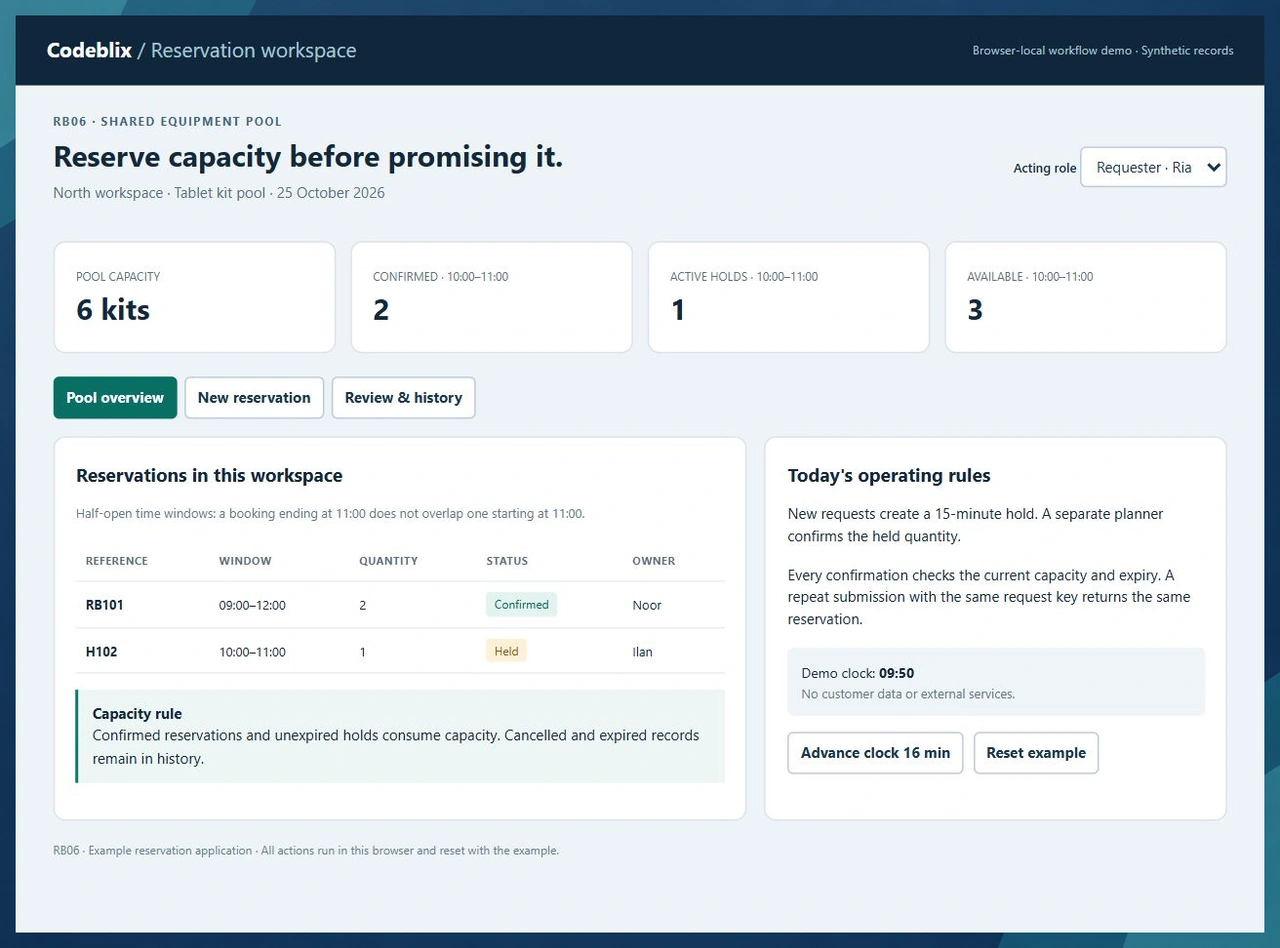
RB06 is a working reservation requirements exercise. Inspect the resource records, reject an over-capacity request and retain the planner’s confirmation. Use its precise outcomes to define your application task.
Exercise the task and its rejection path
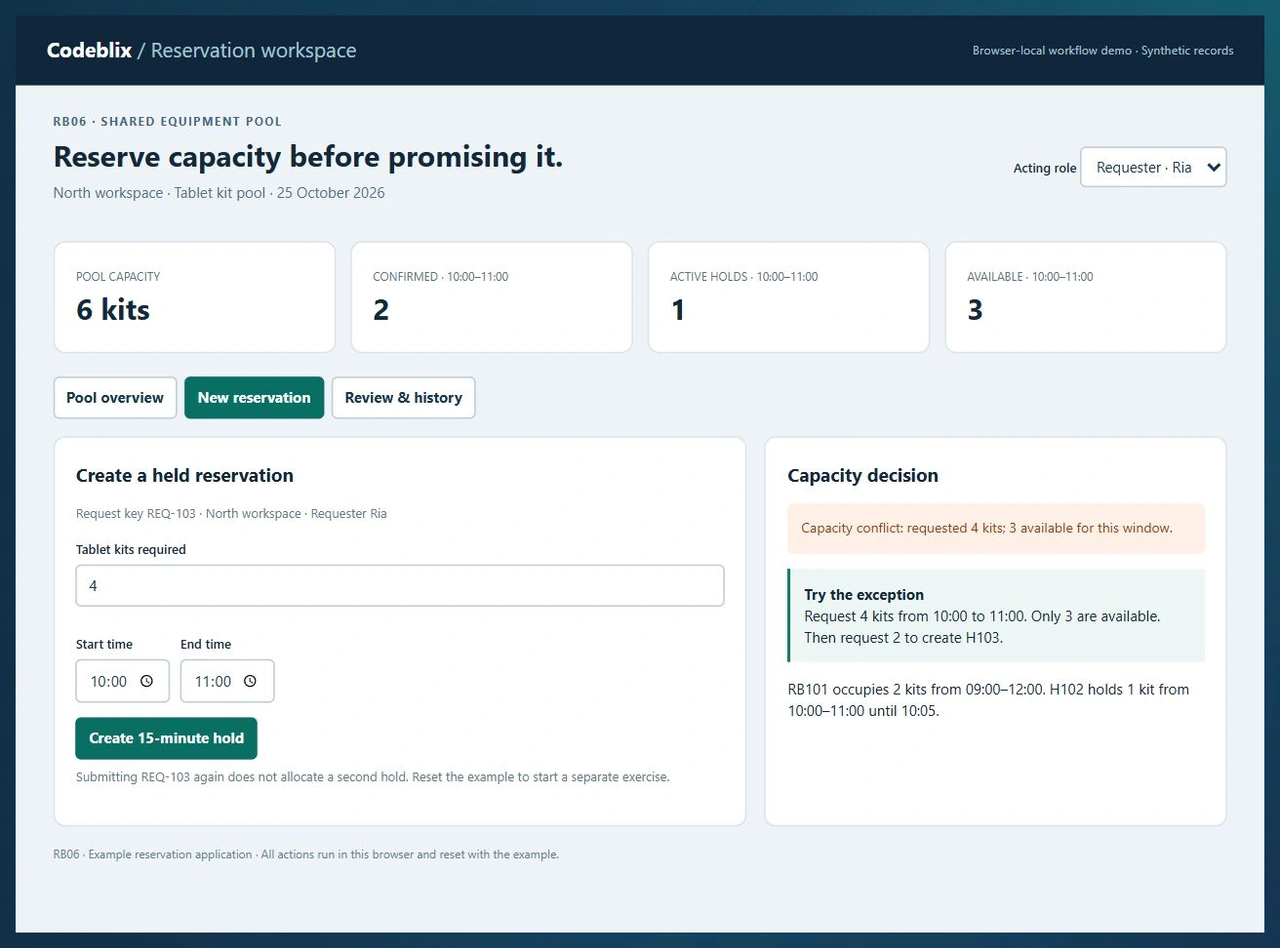
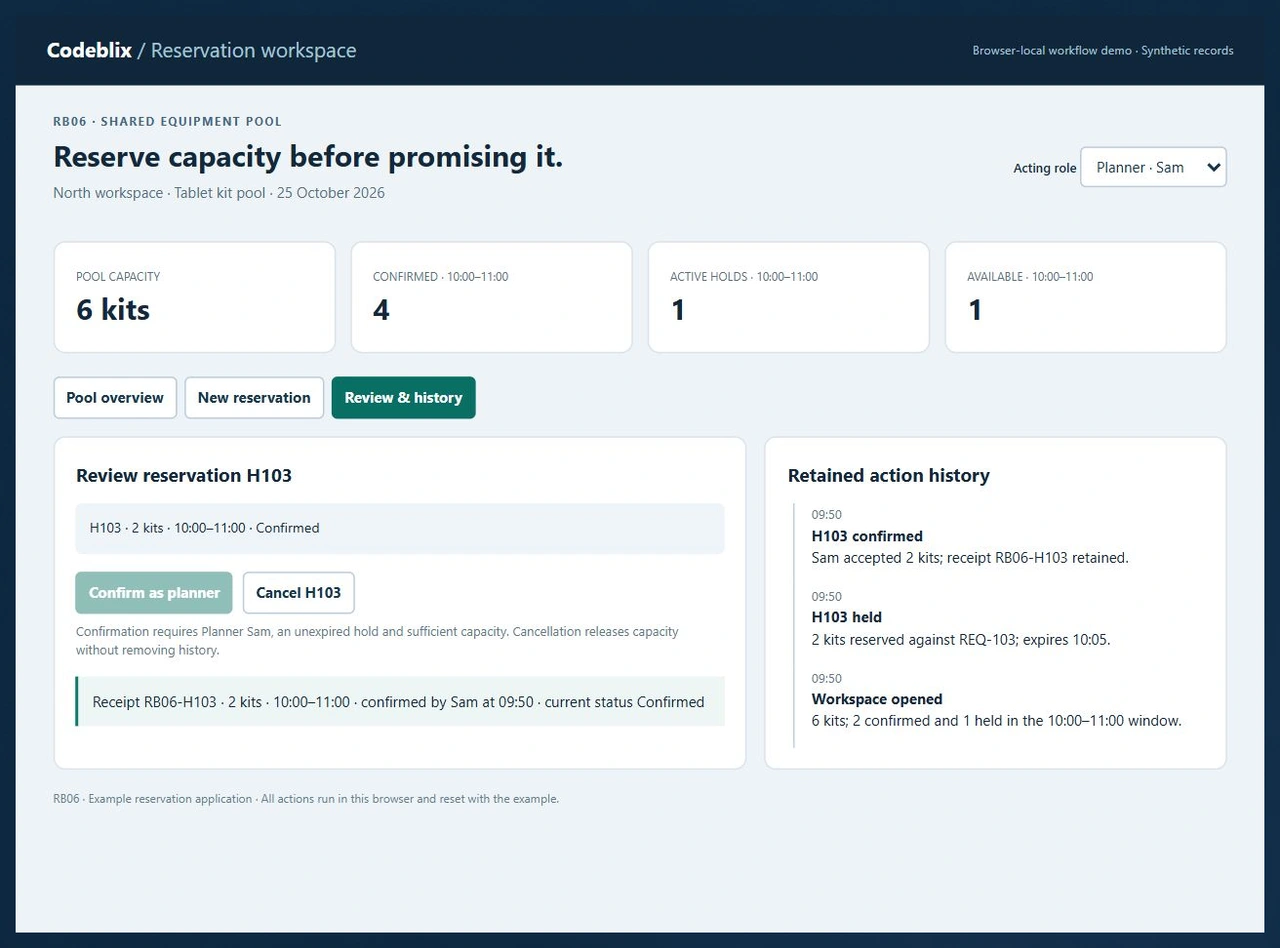
In RB06, request four kits from 10:00 to 11:00 and inspect the capacity conflict. Change the quantity to two and create H103. Repeat the same request key, then switch to Planner Sam to confirm the held quantity. Cancel it and check that capacity returns while the receipt remains.
Try the working reservation requirements exerciseUse the application’s record rules
CakePHP documents validation and application rules within its record-saving workflow. Use the documentation matching the application’s major version when agreeing how invalid fields, failed business rules and persistence errors should be returned.
Read CakePHP’s saving-data documentationRequest evidence at the application boundary
The CakePHP testing documentation covers application request tests alongside smaller checks. Ask for the permitted action, denied request and stored result to be exercised in the project’s test environment, with the accepted source revision identified.
Read CakePHP’s application testing guidanceSeparate a Laravel repair engagement
If the existing application uses Laravel and a particular business action is broken, bring that failure to the Laravel repair service. Keep the actual framework, repository and corrective scope explicit when requesting the quotation.
Request a scoped Laravel repairPlan wider data work explicitly
A new relational model, import process or database application needs its own record and reconciliation scope. Include that work in the project discussion when the requested CakePHP task crosses the existing data boundary.
Review database application requirementsSix stages for engaging a CakePHP programmer
Keep the quotation, implementation and handover tied to the same application task.
Describe the application task
Show the current screen or route, the desired action and a small input/output example. Distinguish a new feature from a defect, framework upgrade, data correction or continuing support request. Identify the person who owns the source and may approve the engagement.
Inspect the CakePHP codebase
Review Composer dependencies, runtime, database schema, migrations and plugin configuration. Locate the controllers, tables, entities and templates involved in the task. Record the local setup and existing checks so the developer can reproduce the relevant workflow.
Agree records, rules and permissions
Name each record and transition, including the request key, state and acting role. Decide which input fields may be accepted, which rules depend on stored data and how rejected requests are returned. Include ownership and direct endpoint access in the server-side scope.
Implement the bounded change
Develop the request handling, persistence and interface together in a reviewable source branch. Preserve the application’s conventions and required neighbouring behaviour. Keep an explicit record of any dependency, configuration or database changes requiring separate approval.
Exercise the accepted cases
Check the successful request, invalid input, denied actor, repeat submission, expired state and cancellation. Verify the persisted result and error response using the project’s CakePHP test setup. Include simultaneous-request checks wherever a shared quantity or one-time action is involved.
Hand over the tested revision
Approve the current change with its results, deployment instructions and recovery reference. Reconcile any authorised data change and verify the business action after release. Set the follow-up window and route for reporting a recurring issue or requesting another task.
Send a useful CakePHP development brief
- Supply the application and PHP versions, Composer lockfile, plugin list and local setup instructions. Identify the repository owner and the environment in which the task should be reproduced.
- Describe the affected route, screen, acting role and record. Provide anonymised inputs, the expected result and any current error or missing behaviour.
- List the tables, associations and records that the task touches. Identify protected fields, workspace ownership and the actions each role may perform.
- Agree whether the first engagement covers a review, a bounded implementation or a larger application change. Confirm allocation, price, timing and acceptance responsibilities in the quotation.
Define persistence and integration boundaries
- Distinguish field validation from rules depending on existing records, quantities or state. Check failed saves and returned errors rather than relying on a successful form message.
- For a shared resource, define the exact concurrency requirement and verify it against the selected database and persistence implementation. A repeated request must have an agreed identity and outcome.
- For APIs, background work or imports, supply the message format, direction, authentication owner and acknowledgement. Include retry, duplicate and reconciliation behaviour in the task.
- Approve schema or data corrections separately with backup, rehearsal and recovery instructions. Confirm plugin and dependency changes before they enter the release.
Agree delivery, review and continuing ownership
- Request an estimate identifying review, implementation, verification and release assistance. Name the approver, development responsibilities, agreed availability and change process.
- Keep source changes and verification evidence accessible in the project repository. Include any revised environment settings, migration instructions and operating notes.
- Accept a specific revision against the current cases. Record outstanding work, the deployment operator and the condition that requires recovery.
- Define follow-up coverage and the process for another task. Agree monitoring, dependency review and continuing support separately where the application needs them.
Six records that make the programmer’s task verifiable
RB06 connects a reservation request to the rules and retained result a programmer would need to implement. Carry this level of detail into the CakePHP task brief.
| Record | Example inputs | Required output and control |
|---|---|---|
| Resource pool | North workspace; tablet kits; capacity 6 | Keep the capacity and workspace scope attached to every allocation decision. |
| Reservation window | Start 10:00; end 11:00; quantity 2 | Count overlapping commitments; adjacent end/start times do not overlap. |
| Submission key | REQ-103 maps to H103 | A repeat request returns the same reservation instead of consuming capacity twice. |
| Capacity hold | H103; Held; expires 10:05 | An active hold consumes capacity until confirmation, cancellation or expiry. |
| Planner decision | Requester Ria; Planner Sam; current hold | The requester cannot confirm their own hold; approval checks the current state. |
| Action receipt | RB06-H103; quantity; window; actor; decision time | Retain the accepted allocation and later cancellation in history. |
At 09:50, six kits minus two confirmed and one held leaves three available for 10:00–11:00. A four-kit request is rejected without creating a reservation. A two-kit request creates H103 and leaves one available. Submitting REQ-103 again returns H103. Planner Sam confirms the two kits, changing confirmed capacity to four while one existing hold remains. Cancelling H103 restores three available kits and retains its receipt. Advancing the reset example by sixteen minutes expires H102 and any unconfirmed H103 hold.
Discuss the delivery evidence as well as the engagement model.
These hiring destinations describe different ways to engage CakePHP development work. Ask each provider to quote the same application task and acceptance outcomes.
| Option | Published focus | Ask in your demo |
|---|---|---|
| Uplers | Role definition, candidate evaluation and hiring or onboarding arrangements. | Who owns the application task, source review and business acceptance after the developer is engaged? |
| Silicon Valley | Full-time, part-time and hourly CakePHP development engagement options. | Which implementation, verification and handover deliverables are included in the agreed allocation? |
| Webandcrafts | CakePHP application and plugin work with developer experience levels and project engagement options. | How will the requested record rules, denied actions and accepted source revision be demonstrated? |
RB06 contributes an inspectable input/state/output contract: a four-kit rejection, a two-kit hold, one request identity, separate approval, expiry and retained cancellation. Use that contract to obtain a task-specific development quote.
Category reference: CakePHP documentation: saving data. The linked primary reference describes CakePHP 5.x. Confirm the actual application version and use its matching documentation when defining validation, application rules and persistence checks.
Connect the application to the people doing the work.
Include the staff and customer handoffs that give the software a clear operating purpose.
Review service-business workflow requirementsQuestions to settle before commissioning CakePHP work
Agree the codebase boundary, development deliverables and evidence needed for acceptance.
What information should I send to hire a CakePHP programmer for a task?
Send the application version, Composer lockfile, plugin list, repository ownership and local setup details. Describe the route or screen, required behaviour, acting role and a small anonymised record example. Include acceptance outcomes and the person authorised to approve the quotation.
Can the engagement extend an existing CakePHP application?
Start with the available source, runtime, database and deployment instructions. The review identifies the affected controllers, tables, entities, templates and dependencies. Agree the extension boundary and the existing paths and records that must continue to work.
How are field validation and business rules specified?
Write the valid input shape separately from rules involving current records or state. For example, two kits can be a valid quantity while a request for four exceeds capacity. Ask for the invalid input, failed rule and persisted result to be exercised against the application’s own version and test setup.
What does the reservation exercise let me test?
RB06 executes browser-local rules on synthetic records. It blocks a four-kit conflict, creates a two-kit hold, returns the same reservation on repeat submission, separates requester and planner approval, expires holds and retains cancellation history. Use those outcomes to define the CakePHP request, database and concurrent-write acceptance work.
How should access to records and fields be handled?
Name the permitted actions, workspace boundaries and fields that may be accepted from each request. Include direct endpoint requests and another workspace’s record identifier in the server-side checks. Agree ownership and authorization behaviour alongside the interface controls.
Can the task include a plugin or external connection?
Include the actual plugin version or interface contract, access ownership, message direction and sample data in the review. Quote the required implementation and its rejection, retry and reconciliation cases. Agree dependency or account changes explicitly as part of the scope.
What should the source and release handover contain?
Retain the accepted revision, relevant tests and operating instructions. Identify configuration or authorised database changes, the release operator, recovery reference and post-release business-action check. Keep those records accessible to the application owner.
How are cost, availability and support agreed?
Confirm them after the codebase and task have been reviewed. Separate investigation, implementation, verification and release assistance in the quotation. Agree development allocation, milestones, review cadence and follow-up coverage, with new tasks or changed requirements estimated explicitly.