
Parking management software
Parking management software coordinates bays, vehicle permissions, protected reservation periods and arrival records. Codeblix builds custom parking applications for organisations with specific allocation and access workflows. Use the working bay-allocation demo, supplier comparison and acceptance checklist to decide what your site needs before requesting a development quote.
Make every parking decision explainable.
Facilities operators, workplace teams and gate staff need consistent answers about entitlement, reserved capacity and recorded presence.
Reserve capacity with the right permission
Keep each bay’s pool, opening hours and maintenance status with its identifier. Check the vehicle permit and full requested interval before protecting a space. Separate staff, visitor, accessible and EV rules so a free-looking bay is not assigned to the wrong request.
Keep allocation and arrival evidence distinct
A booking establishes a claim for a period. An arrival records a different event with its own time and evidence source. Define what happens when a visitor is early, a vehicle arrives twice or a camera event cannot be matched to a valid claim.
Recover from changes without erasing the trail
Retain cancellations, rejected requests and corrected gate decisions. Decide whether a reservation can be cancelled while a vehicle is still recorded inside. Give maintenance closures, unconfirmed exits and disputed permissions a named operational owner.
A reservation does not prove a vehicle has arrived.
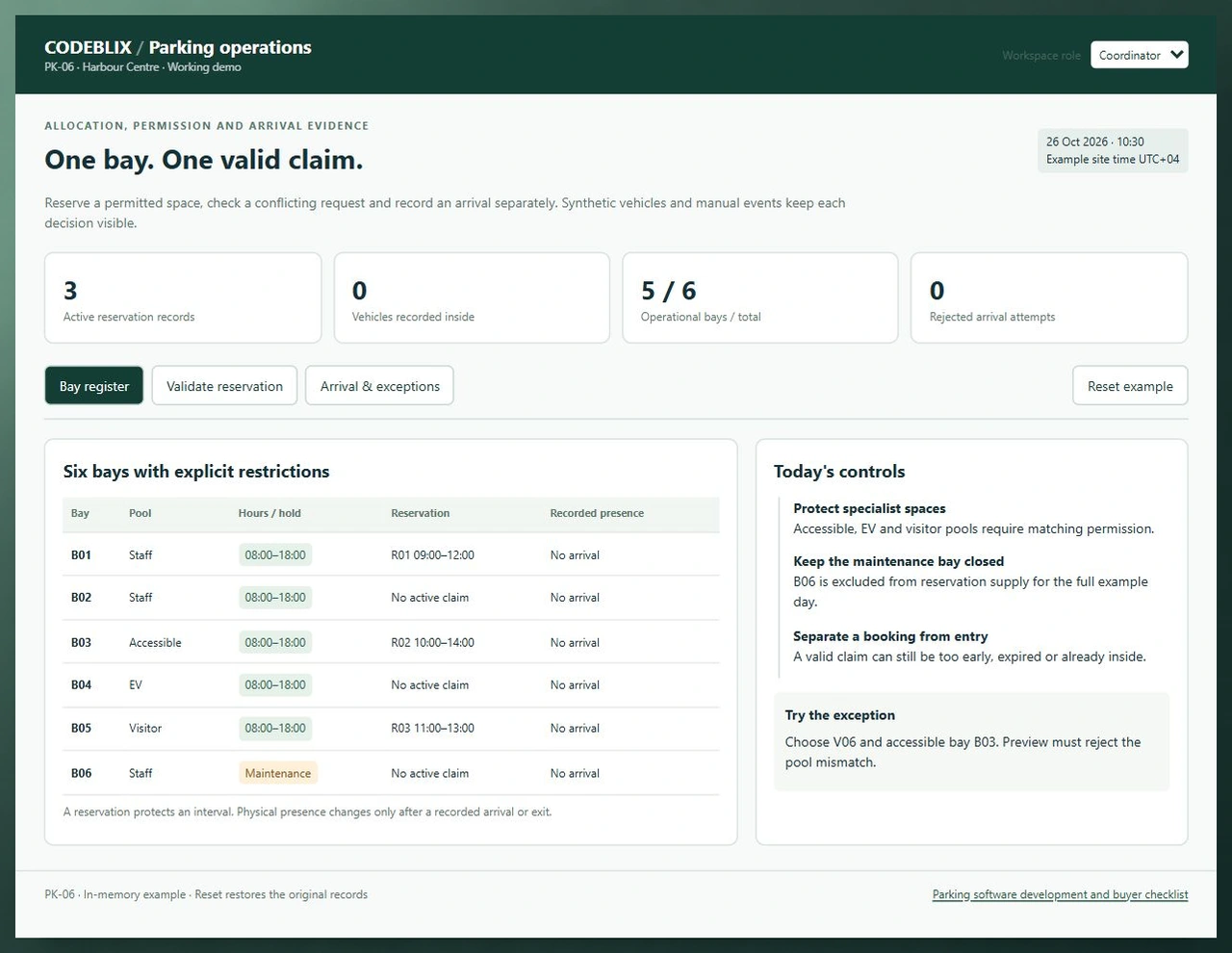
PK-06 follows six bays at Harbour Centre. Inspect the restricted pools, reject an unsuitable request and record arrival exceptions without inflating physical presence.
Exercise PK-06 before writing the specification
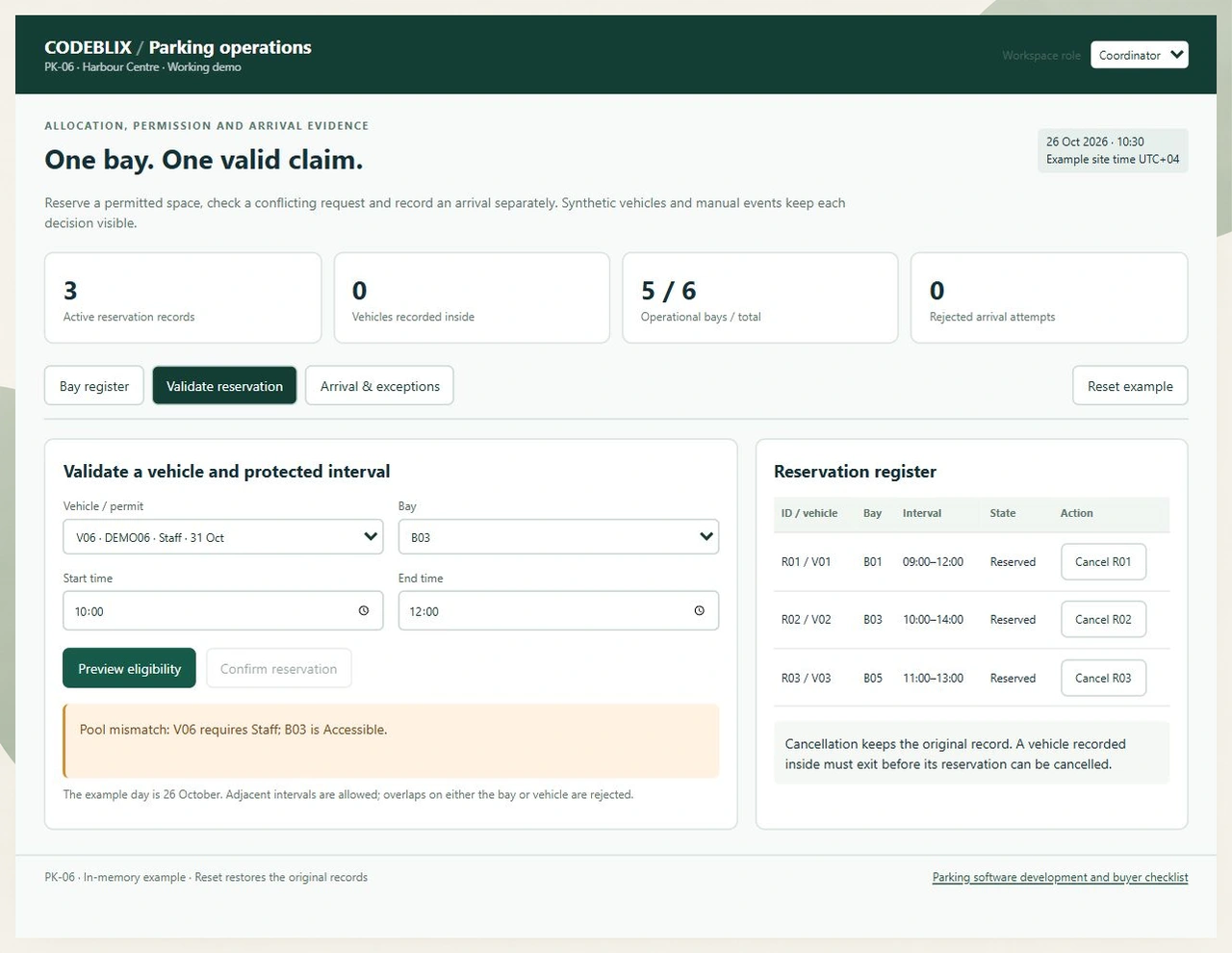
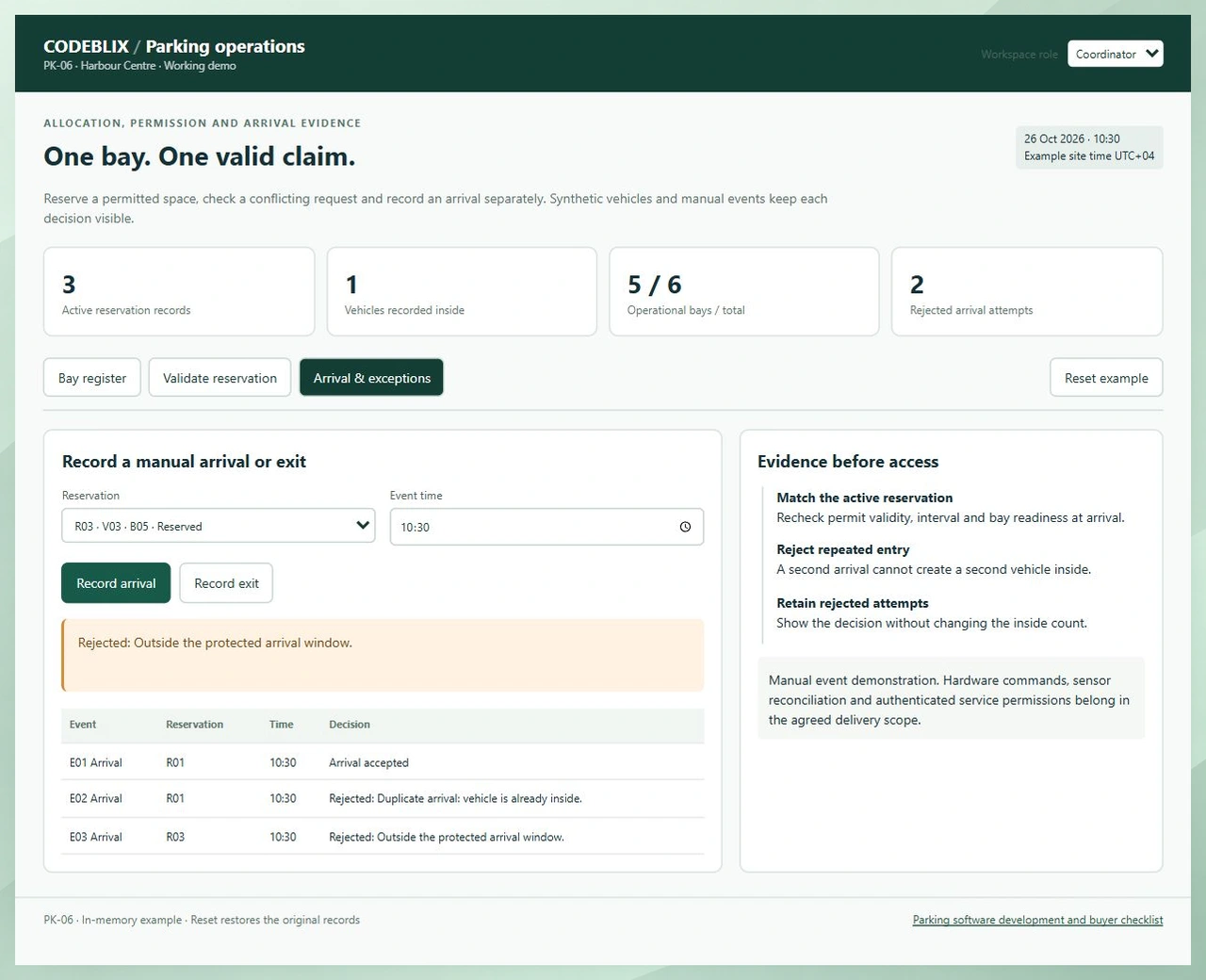
Preview V06 against B03 to see the accessible-pool rejection. Reserve V04 in EV bay B04 for 10:00–12:00, then cancel R04. Record R01’s arrival at 10:30 twice and try R03 before 11:00: only one vehicle should be recorded inside.
Open the parking decisions demoJoin visitor identity to the parking handoff
Reception may supply a host and visit period, while parking owns the permitted vehicle and bay. Link those records through an explicit handoff so a reception sign-in cannot silently become evidence of a vehicle entering.
Compare visitor reception workflowsCoordinate workplace bookings with separate inventories
An employee may reserve a workstation and request parking for the same day. Keep their identity and site references consistent, while applying the correct overlap, cancellation and arrival rules to each resource.
Review workplace desk allocationFrom bay inventory to a reconciled parking visit
Specify the decisions shared by parking administration, reception and the access-system owner before connecting the first entrance.
Survey the site and identify the supply
Create a bay register with stable IDs, site time zone, opening intervals, pool restrictions and closures. Confirm which capacity is individually allocated and which is a shared pool. Match the import to the physical layout rather than assuming the spreadsheet is complete.
Establish the vehicle entitlement
Link the vehicle reference to an authorised person or hosted visit. Record permit dates, permitted pools and approval authority. Decide how replacements, temporary visitors and expired permissions are reviewed without exposing unnecessary personal details to gate staff.
Protect an eligible reservation interval
Validate bay readiness, entitlement and conflicting claims on both the vehicle and bay. Set the boundary rule for adjacent periods. Require atomic service-side confirmation in the delivered application so simultaneous requests cannot acquire the same capacity.
Make the arrival decision from current evidence
At arrival, resolve the reservation and recheck its current state, validity window and site restrictions. Record the decision and evidence source once. A permission record, successful barrier command and confirmed passage need their own identifiers and timestamps.
Close the visit and handle exceptions
Record the departure against the active visit, then reconcile missing or contradictory evidence. Define the queue for early arrivals, duplicate reads, plate changes and offline entrances. Retain rejected attempts while keeping them outside the count of confirmed vehicles inside.
Review capacity and operating responsibility
Report reservations, arrivals, active visits and closed bays with their separate denominators. Agree exception ownership, retention, backup recovery and support escalation. Compare the reservation register with physical observations before using it to make occupancy decisions.
Permissions and access to vehicle information
- Separate permit administration, reservation coordination, gate decisions and read-only reporting. Apply authenticated service permissions to every change.
- Limit ordinary gate views to the vehicle and visit details required for the decision. Define authorised access, export rights and record retention during discovery.
- Keep barrier credentials, device secrets and infrastructure administration outside the reservation register.
- Give manual overrides a reason, actor and expiry. Agree who can reconcile an uncertain exit or restore a closed bay.
Connections, migration and the first entrance
- Inventory existing barrier controllers, cameras, identity sources and reception systems by exact product and interface version. Review each connection before including it in the quote.
- Specify direction, delivery frequency, event IDs, retries and acknowledgement behaviour. Handle a delayed message without opening twice or counting two arrivals.
- Clean duplicate vehicles, conflicting permits and stale bay labels before cutover. Keep a reconciliation list for claims that cannot be imported confidently.
- Pilot a bounded site or entrance with agreed manual fallback, access recovery and rollback responsibilities. Rehearse device outage and backup restoration.
Compare development scope and ongoing operating costs
- Use the same entitlement, reservation, gate-exception and reporting cases when comparing a configured platform with custom software development.
- Request separate estimates for application delivery, hardware assessment, installation, data cleanup, hosting, identity work and continuing support.
- Define acceptance ownership for concurrent bookings, late events, closures and disputed access. Hardware behaviour needs verification on the selected equipment.
- Agree application and data ownership, maintenance responsibilities, support coverage and the process for changing site rules after launch.
Six records that make parking proposals comparable
Start with a concrete site model. These records connect reservation decisions to permission and passage evidence without turning a booking total into an occupancy claim.
| Record | Example inputs | Required output and control |
|---|---|---|
| Bay and pool | B01–B06; Staff, Accessible, EV and Visitor; B06 maintenance | Five operational bays; specialist pools require a matching vehicle entitlement. |
| Vehicle and permit | V01–V06; synthetic DEMO identifiers, pool and valid-through date | V05 expired on 25 October; a regular staff permit cannot reserve B03. |
| Reservation | R01 B01 09:00–12:00; R02 B03 10:00–14:00; R03 B05 11:00–13:00 | Block vehicle and bay overlaps; retain a cancelled R04 rather than deleting it. |
| Arrival and exit | Reservation ID, event time, manual or device source and decision | R01 at 10:30 can arrive once. R03 at 10:30 is early and must be rejected. |
| Access acknowledgement | Command identifier, entrance, acknowledgement and passage event | Verify the selected controller interface and distinguish a command response from passage. |
| Exception and reconciliation | Rejected decision, operator, reason, correction and visit reference | A repeated arrival leaves the inside count unchanged; an exit closes the recorded presence. |
PK-06 starts with three active reservations, five operational bays and zero recorded vehicles inside. V06 fails the accessible-pool check for B03. V04 can reserve B04 from 10:00–12:00 as R04, taking active reservations to four; cancelling it restores three and preserves R04. At 10:30, R01’s first arrival makes the inside count one. A repeated R01 arrival and an early R03 arrival create two rejected arrival attempts without changing that count. Recording R01’s exit brings recorded presence back to zero. Reservations and manual presence events describe different facts; neither establishes sensor-measured utilisation.
Compare parking platforms against the same site cases
These suppliers appear in the localized parking research. Their primary pages describe different platform and hardware emphases; use the questions to test the edition and deployment you are considering.
| Option | Published focus | Ask in your demo |
|---|---|---|
| Parkable | Workplace and commercial-property parking, including permits, sharing, visitor parking, access and connected systems. | Show how a reservation, access command and passage event are reconciled after a repeated arrival or an offline entrance. |
| Cloudbooking | Employee and visitor bay reservations, configurable parking types, maps, permissions and space release. | Run the same restricted-pool, adjacent-period and visitor-arrival cases, then explain the occupancy evidence source. |
| Fresh USA | Windows-based vehicle permissions, parking zones, entry/exit activity, event history and configurable connected deployments. | Demonstrate an expired permission, duplicate event and failed acknowledgement using the intended controller and database topology. |
The comparison questions are validation requests, not claims that a supplier lacks a feature. PK-06 supplies an original six-bay dataset, reproducible count transitions and expected exception outcomes for evaluating proposals.
Category reference: Cloudbooking’s primary car park management overview. The PK-06 demonstration, record model, worked arrival sequence and downloadable acceptance cases are original Codeblix buyer resources.
Connect parking decisions with the wider site operation.
Coordinate reception, workplace resources and facilities support with an explicit owner for each handoff.
Explore software for service organisationsParking application questions to settle before a quote
Resolve the site rules and evidence boundaries before choosing interfaces or planning a rollout.
Which problem should a parking management application solve first?
Choose the operating responsibility: reserving scarce spaces, administering permits, handling employee and visitor parking, controlling access, or reconciling passage events. Those jobs can share records, but they need different decisions and evidence. Start the specification with the site’s most costly exceptions.
Can Codeblix develop parking software for our site rules?
Yes. Codeblix provides custom software development for parking allocation, permissions and operational handoffs. A scoped review establishes the sites, user roles, reservation policies, device interfaces and pilot acceptance criteria before implementation is priced.
Are parking bookings and vehicle occupancy the same measure?
No. A reservation protects capacity during a defined interval. Recorded presence depends on an arrival and departure source, which may be a manual decision or a verified device event. Report the source and unresolved exceptions instead of describing bookings as measured occupancy.
How do staff, visitor, accessible and EV spaces differ?
Define a separate entitlement and allocation policy for each pool. Visitors may need a host and visit period; specialist spaces need the relevant permission. Confirm the operational and local requirements with the site owner, and test that an unsuitable request cannot take restricted capacity.
Can current barriers and plate-recognition cameras be connected?
Assess the exact controller, camera, firmware and supported interface during discovery. The connection scope should define commands, acknowledgements, passage events, retries and offline recovery. The project quote follows that review rather than assuming compatibility with an unnamed device.
What should happen when an arrival is duplicated or too early?
Record a clear exception without creating another active vehicle inside. Recheck the reservation state and permission window, then route any authorised override to an accountable operator. In PK-06, the repeated R01 arrival and early R03 attempt are retained while the inside count remains one.
What data is needed to migrate an existing parking register?
Prepare bay identifiers and pools, opening hours, closures, vehicle references, permit dates and live reservations. Reconcile duplicate vehicles, stale permissions and overlapping claims. Agree the authoritative record for each field and keep unresolved cases visible during the pilot.
How should a parking development estimate be compared?
Ask for the same example dataset, exception checks and deployment boundaries in each proposal. Separate application work from hardware, installation, migration, hosting and support. Include data ownership, concurrent-reservation controls, outage recovery and the responsibilities for operating the entrance.