
Testimonial management software that connects approved quotes to every placement
Testimonial management software collects customer statements, preserves their source and permission, and helps teams publish the right approved wording. Codeblix develops custom testimonial applications for businesses that need their own review responsibilities, channel restrictions and publication handoffs. Use the working quote workspace to test an approval, a changed edition and a permission withdrawal before preparing your development requirements.
Make customer proof useful without losing its context.
A testimonial library should explain what was said, which use was allowed and where the approved material went. Those answers matter when a quote changes or a customer asks for its removal.
Preserve the original statement
Keep the submitted wording or recording beside the account, product context and attribution. An edited excerpt should point back to its source, with a separate edition for the text a reviewer inspected.
Match approval to the intended use
Record the permitted channel, attribution and date range. Approval of a website quote does not automatically cover an advertisement, presentation, logo or photograph. Give reviewers the specific use they are authorizing.
Know which placements need attention
Maintain a destination ledger for each published edition. When wording is superseded or permission is withdrawn, assign removal work, confirm the destination outcome and retain the earlier publication history.
Follow one testimonial from review to removal.
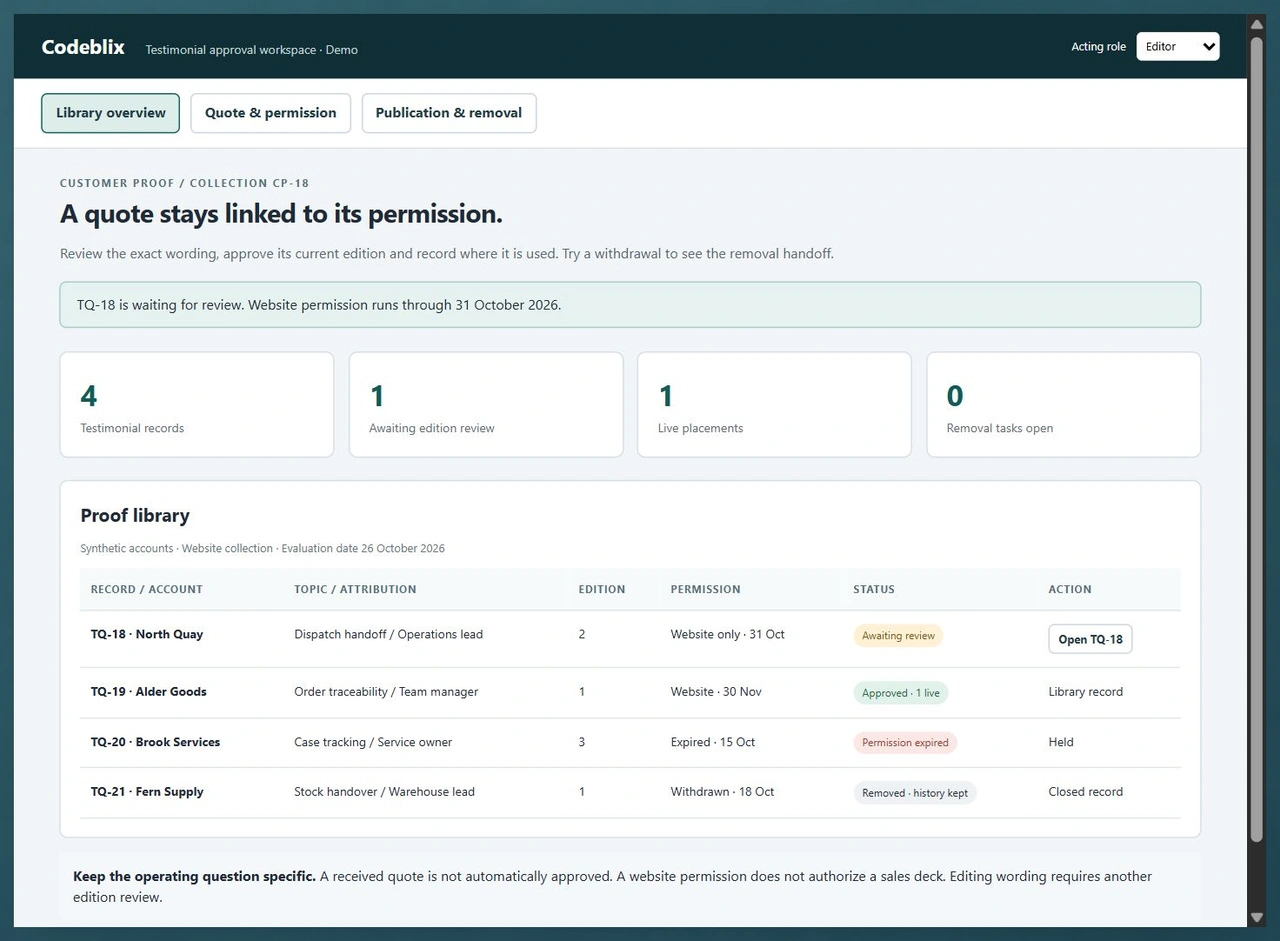
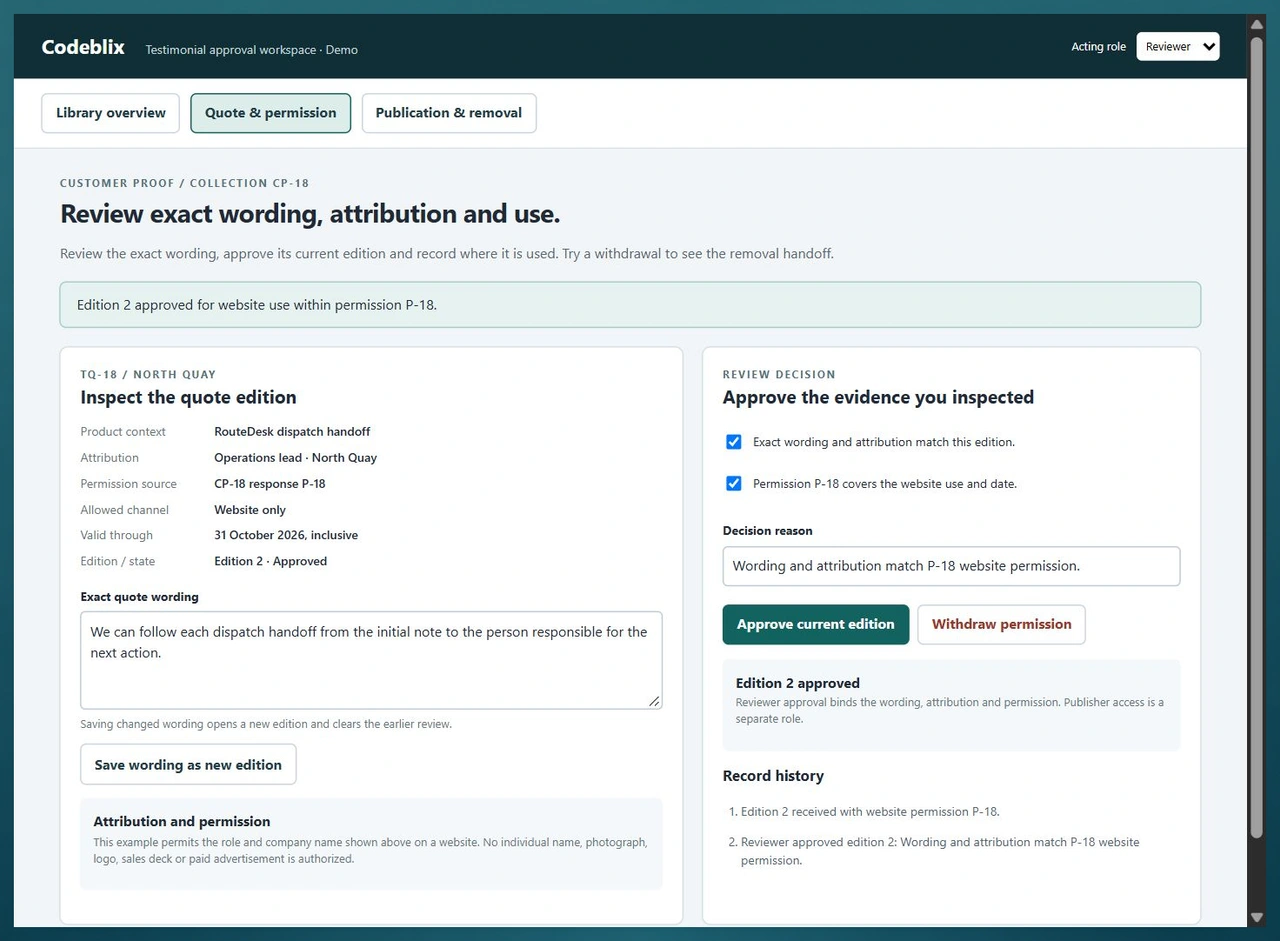
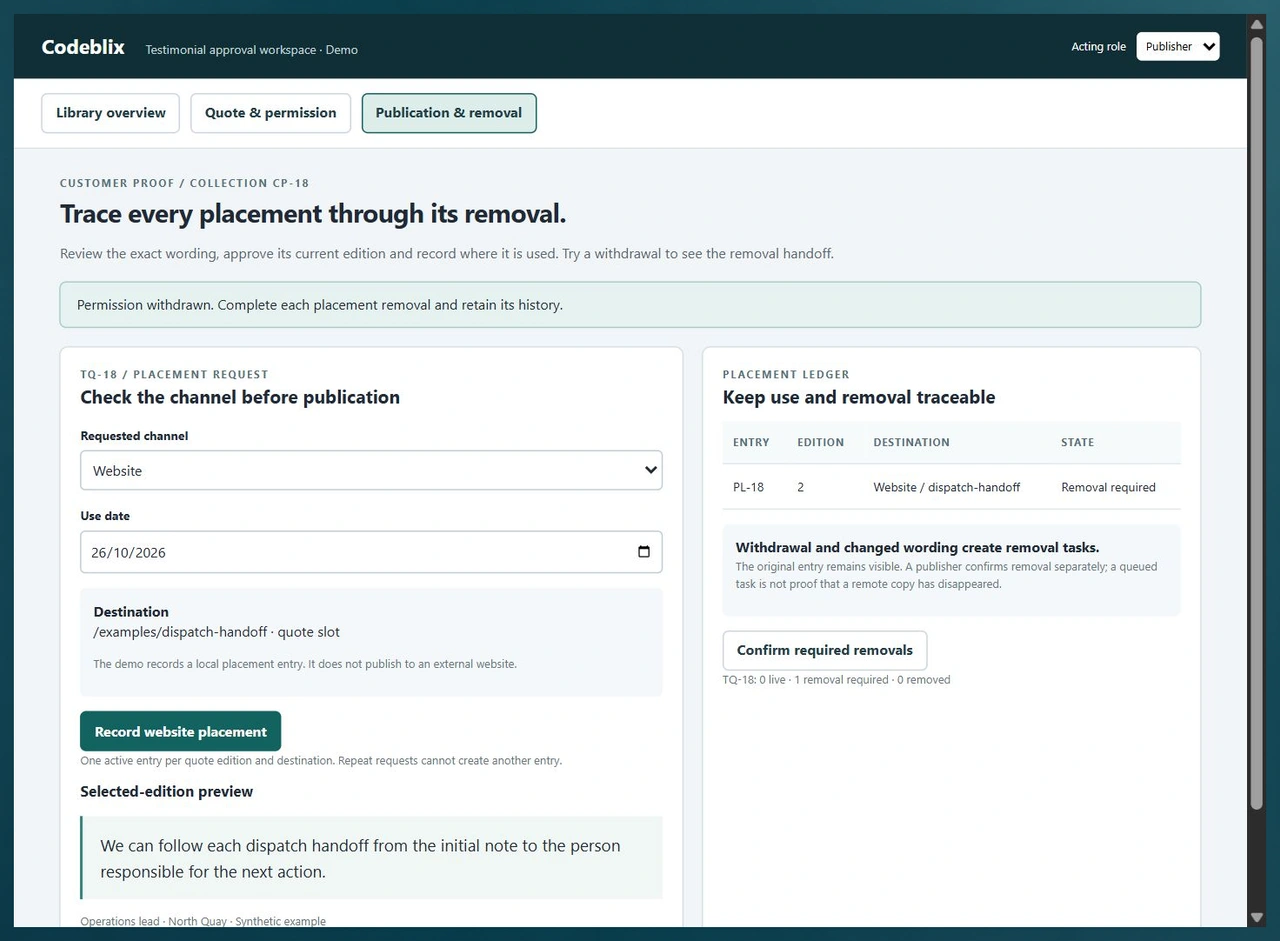
These screens show the testimonial workspace demonstration. Inspect four synthetic records, approve TQ-18 for a permitted website use and trace the removal task after permission changes.
Try the approval and removal workspace
Open TQ-18 and switch the acting role from Editor to Reviewer. Check the exact wording and website permission, enter a decision reason, then approve edition 2. As Publisher, record the website placement. Return to Reviewer to withdraw permission and inspect the resulting removal task. The interactive example runs with synthetic records in the current browser tab.
Open the working testimonial workspaceAn edited excerpt needs its own review
Shortening a quote can change its meaning. Keep the original response, the selected excerpt and the surrounding product context. In the demonstration, saving revised wording creates edition 3, clears the decision and marks an older live placement for removal. Unsaved wording also blocks publication. Agree equivalent rules for translated text, subtitles and edited video clips.
Collection software and publishing controls solve connected jobs
A simple collection page and an embeddable testimonial wall may satisfy your team. A tailored application becomes useful when several brands, agencies or approval groups share material, or when individual destinations require traceable change handoffs. Ask whether search, tags and widgets already fit before commissioning additional workflow.
Keep testimonial publishing distinct from reference introductions
A quote placed beside an offer is a reusable editorial asset. A reference introduction arranges a specific conversation between a prospect and an experienced customer. Model the shared account identity where helpful while retaining each activity’s separate permissions, availability and owners.
Compare customer reference request workflowsSeparate campaign participation from publishing rights
A customer may join an advocacy activity or provide private feedback without permitting public quotation. Keep the testimonial record tied to a specific publishing permission. Avoid inferring publicity rights from membership, a completed survey or an accepted program contribution.
Explore customer advocacy program developmentA collection-to-publication workflow with a visible removal path
Specify the request, evidence and publishing responsibility together. The six stages below help compare a testimonial subscription with an application tailored to your organization.
Ask for a specific customer experience
Define the product, experience and question behind the request. Explain the intended use before collecting a response. Capture the source response and its collection reference rather than treating a copied quote as a complete testimonial record.
Create an attributed quote or media edition
Link the statement to an account and agreed attribution. Store an exact text excerpt, or identify the source recording and approved clip range for a video scope. Keep editorial changes visible instead of silently replacing the submitted material.
Record permission for the channel and dates
Identify the permission evidence, permitted wording and attribution, allowed channels, effective period and withdrawal contact. Your organization should settle its required wording and retention policy. Put incomplete or expired permission into a review queue.
Review the current edition independently
A reviewer checks wording, context, attribution and the requested use, then records a decision and reason. Changed text opens another edition and clears earlier review checks. The editor prepares the content; the publisher acts on the approved edition.
Publish with a stable placement reference
Record the quote edition, destination, channel, use date and publishing owner. Validate current approval and permission before creating the placement. Design duplicate handling around the same edition and destination so repeated requests do not create unexplained copies.
Resolve expiry, edits and withdrawal
Find affected placements when an edition changes or permission ends. Assign the destination owner a removal or replacement task. Record completion evidence separately from the request, including offline copies that require a manual handoff.
Roles, collection inputs and useful outputs
- Editors organize source responses, select excerpts and prepare attribution. Reviewers decide whether the current edition and requested use satisfy the recorded evidence. Publishers own placement and removal outcomes; administrators manage access and retention.
- Useful inputs include the collection reference, source material, product topic, account attribution, allowed channels and permission dates. Useful outputs include an approved-edition queue, searchable quote library, destination ledger and unresolved removal list.
- Report submissions, review backlog, approved editions, placed quotes, expiring permissions and overdue removal tasks separately. A published testimonial or widget click does not establish an incremental conversion result.
Migration, media and interface scope
- Inventory spreadsheets, shared folders, collection forms and embedded quotes before migration. Assign stable source and placement identifiers. Hold records with missing permission evidence for review, and reconcile imported destinations against what is actually visible.
- Assess the specific CRM, content system and media-hosting interfaces during discovery. Define source ownership, synchronization direction, authorization, retry behavior and deletion propagation. Agree how a failed website update becomes an owned exception.
- Treat video collection, recording uploads, transcoding, subtitles, clip editing and media delivery as explicit scope items. Specify file limits, accessibility requirements, storage location and export format. The quote demonstration focuses on text approval and placement decisions.
Deployment, project cost and operating support
- A useful estimate separates collection, editorial review, permission records, placement tracking, media processing, migration and integrations. Record volumes, brand boundaries, languages, approval groups and destination types determine the work involved.
- Agree hosting ownership, access controls, backup and restore checks, monitoring and support responsibilities. Include a reconciliation report for pending publications and removals after recovery. Confirm how your team obtains source files, permissions and publication history when exporting.
- Start with a small collection and one publishing destination. Validate the review cases and withdrawal handoff before increasing the number of websites or adding media processing. Include server authorization, concurrency and durable event history in the application acceptance scope.
Six records that keep a testimonial traceable
This original record model turns a quote collection into an evaluable publishing workflow. Use it with the demonstration and CSV cases when comparing tools or scoping development.
| Record | Example inputs | Required output and control |
|---|---|---|
| Source response | CP-18 response; North Quay; RouteDesk dispatch handoff; source statement | Retain the submitted material and its context. Identify the product experience without inventing a result or changing the original meaning. |
| Quote or media edition | TQ-18; edition 2; exact excerpt; Operations lead attribution | Store the specific wording and attribution to be reviewed. Editing creates another edition and cannot inherit the earlier decision. |
| Use permission | P-18; website only; 19–31 October 2026; role and company attribution | Check the requested channel and use date. Track expiry and withdrawal independently of whether the text has been approved. |
| Edition review decision | Reviewer; wording check; permission check; reason; approved edition 2 | Bind the reviewer’s decision to the inspected edition and evidence. Separate preparation, review and publication responsibility. |
| Publication placement | PL-18; edition 2; website /examples/dispatch-handoff; 26 October | Track one active use of an edition at its destination. Reject another identical active request and keep earlier entries after changes. |
| Removal task and outcome | Permission withdrawal; affected PL-18; Publisher; removal confirmation | A task records work still required. Confirm the actual destination outcome and retain the original placement and decision history. |
The synthetic collection contains four testimonial records. TQ-18 awaits edition review; TQ-19 has one approved live placement; TQ-20 has expired permission; TQ-21 was withdrawn and removed. For TQ-18, website permission covers 19–31 October 2026. A Reviewer completes two checks and approves edition 2. A Publisher records PL-18 on 26 October: the library then has two live placements. A repeated request adds none. Sales deck use or a 1 November date is blocked. Withdrawing P-18 changes PL-18 to removal required, leaving one live placement elsewhere in the library and one open removal task. Confirming removal closes that task while preserving the entry. An alternative edit path creates edition 3 and requires another review. All interactions are local to the demonstration tab.
Compare providers using the same quote lifecycle
These primary product pages appeared in the country-specific search results. They explain collection and reuse approaches; use the edition and withdrawal cases to examine your own operating requirements in a product demonstration.
| Option | Published focus | Ask in your demo |
|---|---|---|
| Senja | Text and video collection, imported testimonials, tagging, search and reusable website or social proof formats. | Show how an edited excerpt is linked to its source and how your team locates every destination using the earlier wording. |
| Testimonial | Branded collection pages, a testimonial inbox, approval, social imports, video analytics and embeddable testimonial displays. | Demonstrate approval for one allowed channel, then withdraw the permission and show the website and export handoffs. |
| Clientalio | Branded requests, response review, product or campaign organization and publication of approved customer stories. | Retain a source response, edit the public excerpt and identify the exact edition that each reviewer and publisher acted on. |
Compare an established testimonial service when collection forms, media handling and publishing formats already meet your needs. Extend a content system when it owns the destinations and can support the required record history. Discuss custom development for distinctive approval boundaries, permission checks or multi-destination reconciliation. Compare the same migration, operating and support costs across each route.
Category reference: Clientalio’s collection, review and publishing overview. The quote edition model, synthetic workflow and downloadable acceptance cases are original Codeblix buyer resources. The linked vendor pages describe their own products; detailed exception behavior should be verified during selection.
Connect customer proof to the service it explains.
Keep approved material discoverable by topic and customer context so an account or editorial team can find a suitable quote without losing its use conditions.
Explore professional service software workflowsQuestions to settle before choosing testimonial software
Use the answers to define what the application must collect, approve, publish and recover.
What does testimonial management software organize?
It connects collected customer statements to their source material, attribution, review status and permitted uses. A useful publishing workflow also records which edition appeared at each destination and who handles a change or removal. Collection volume alone does not show whether that history is complete.
Can Codeblix develop a tailored testimonial workflow?
Codeblix offers custom application development and consultation. Bring an example quote, anonymized permission fields, reviewer roles and destination requirements. The working workspace and acceptance CSV help define an estimate for collection, approvals, publishing handoffs, migration and support.
Does a positive survey response authorize public quotation?
Treat the survey response and permission to publish as separate records. Specify the wording, attribution, channel and use period your organization requires. A private feedback response, program membership or reference call should not silently become a website testimonial.
What should happen when an approved quote is edited?
Preserve the source and create another editorial edition. Require a decision on the new wording and attribution rather than reusing the earlier approval. Locate older placements and decide whether to replace or remove them. The demo also blocks publication while changed wording is still unsaved.
How should permission withdrawal affect published testimonials?
Block additional use and identify affected destinations. Give the publishing owner a removal task with an outcome and evidence. A queued request does not prove a remote copy has disappeared. Include downloaded presentations, partner pages and other manually managed destinations in your operating procedure.
Can the project include video testimonial collection?
Yes, video can be scoped as a development work package. Define recording or upload requirements, source storage, clip selection, subtitles, processing limits and delivery. The working text example helps evaluate permission and edition decisions; video processing and external media services need their own technical review.
How is testimonial software different from review management?
Testimonial software focuses on customer statements selected for permitted reuse beside your offer. Review management often monitors and responds to ratings on external platforms. Confirm the actual collection and publishing job before combining them, and review each external platform interface separately.
What affects the cost of a testimonial application?
The number of approval groups, brands, destinations, languages and media types changes the scope. Include record cleanup, permission migration, interfaces, hosting and recovery checks in the estimate. A quote should name the collection, editorial, publishing and support work rather than assume all destinations behave alike.