
Wholesale website for sale: acquire the FlowerWax platform
Software asset acquisition, included scope and transaction acceptance.

Acquire FlowerWax, a botanical ingredient marketplace software asset. Confirm supplier setup fees, checkout, source ownership and the agreed transfer scope.
Acquire FlowerWax as a botanical ingredient marketplace software asset. The product foundation includes supplier storefronts, ingredient catalogues, a single-supplier cart, order records and payment integration code. The documented owner charge is a configurable one-time supplier setup fee. Monthly seller subscriptions are additional development, rather than an included recurring revenue feature.
See the FlowerWax asking terms and submit an acquisition offer on Flippa. The marketplace asset entry and technical handover document describe the package to include in the transaction.
The current Flippa listing controls availability, asking terms and the seller's transaction disclosures. FlowerWax is offered as a starter asset with no represented paying customers, revenue or completed commercial marketplace sales. This purchase concerns the website and software package; physical ingredients and contracted suppliers must be expressly identified if included in a separate agreement.
Use the following acquisition scope, order acceptance record and handover checklist to decide what to include in an offer. The objective is a specific software transfer with observable acceptance conditions and a clear owner for remaining launch tasks.
The order workflow included in the acquisition
Imagine a small skincare brand selecting a botanical butter from a supplier's catalogue. It needs to understand the product, pack quantity, price, seller and delivery arrangement before paying. The supplier needs a usable order record and a way to update fulfilment. The platform owner needs to know whether its own charge relates to supplier onboarding, the order or a separate service.
That is a direct catalogue transaction. It differs from a buyer sending a specification to several suppliers and comparing negotiated quotes. It also differs from a distributor buying stock and reselling it under its own terms. All three models can use the phrase B2B ecommerce. Their software needs, margins and operating responsibilities differ substantially.
Describe your intended order in plain language and use it throughout the purchase review. If the seller demonstrates a different transaction, ask to trace your example or explain the difference. This simple discipline prevents buying a multi-page product whose main commercial mechanism does not fit the business you want to run.
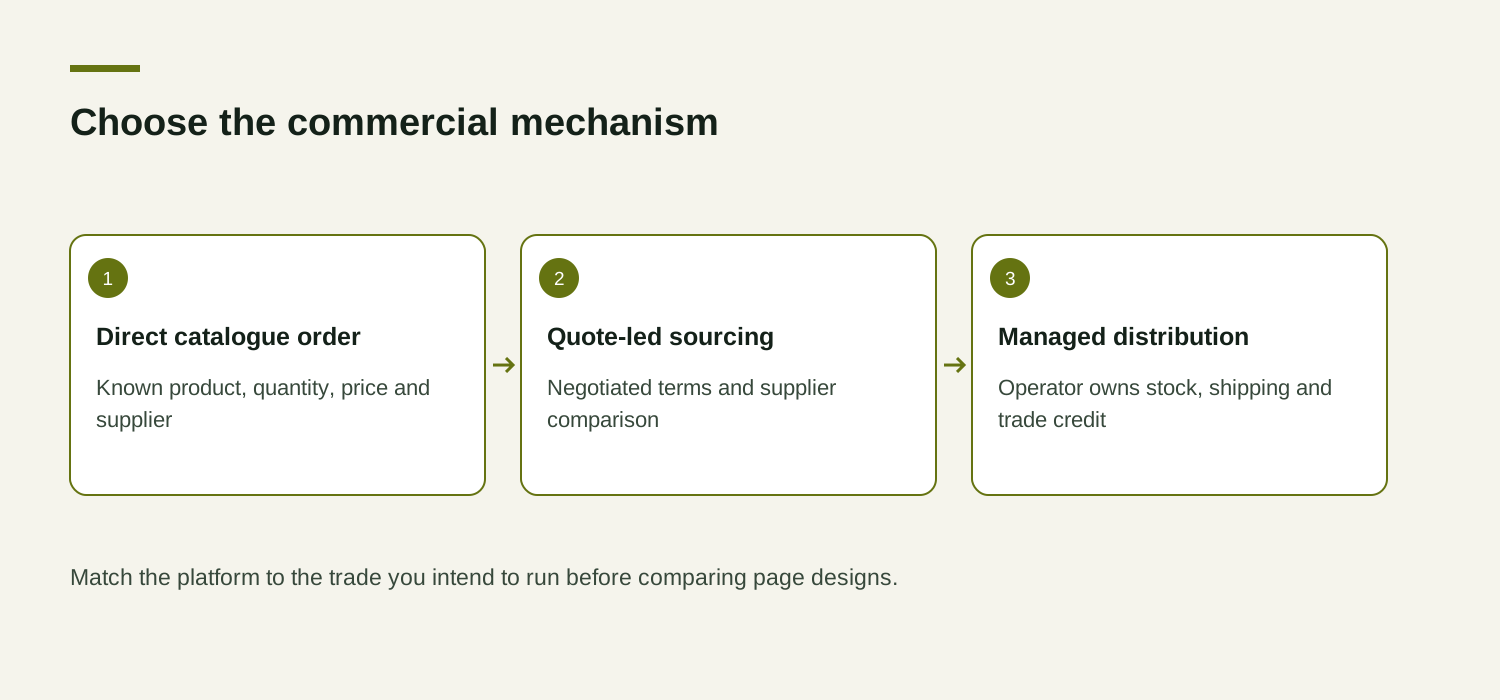
| Model | Buyer action | Seller responsibility | Owner's main question |
|---|---|---|---|
| Supplier marketplace | Choose listed products and place a supplier order | Catalogue accuracy and order fulfilment | How do onboarding fees, orders and supplier payouts connect? |
| Quote-led sourcing | Send requirements and compare responses | Prepare terms and negotiate supply | How are requests, quotes and conversations recorded? |
| Distributor store | Buy from the operator's own inventory | Operator sells and fulfils the order | How are stock, purchasing and fulfilment managed? |
Separate supplier onboarding income from ingredient sales
FlowerWax's documented owner revenue feature is a configurable one-time supplier setup fee. That is the charge for opening a supplier storefront. The ingredient order is a separate transaction, with payment routed to the connected supplier. A buyer should understand both paths before treating the application as an income-producing business.
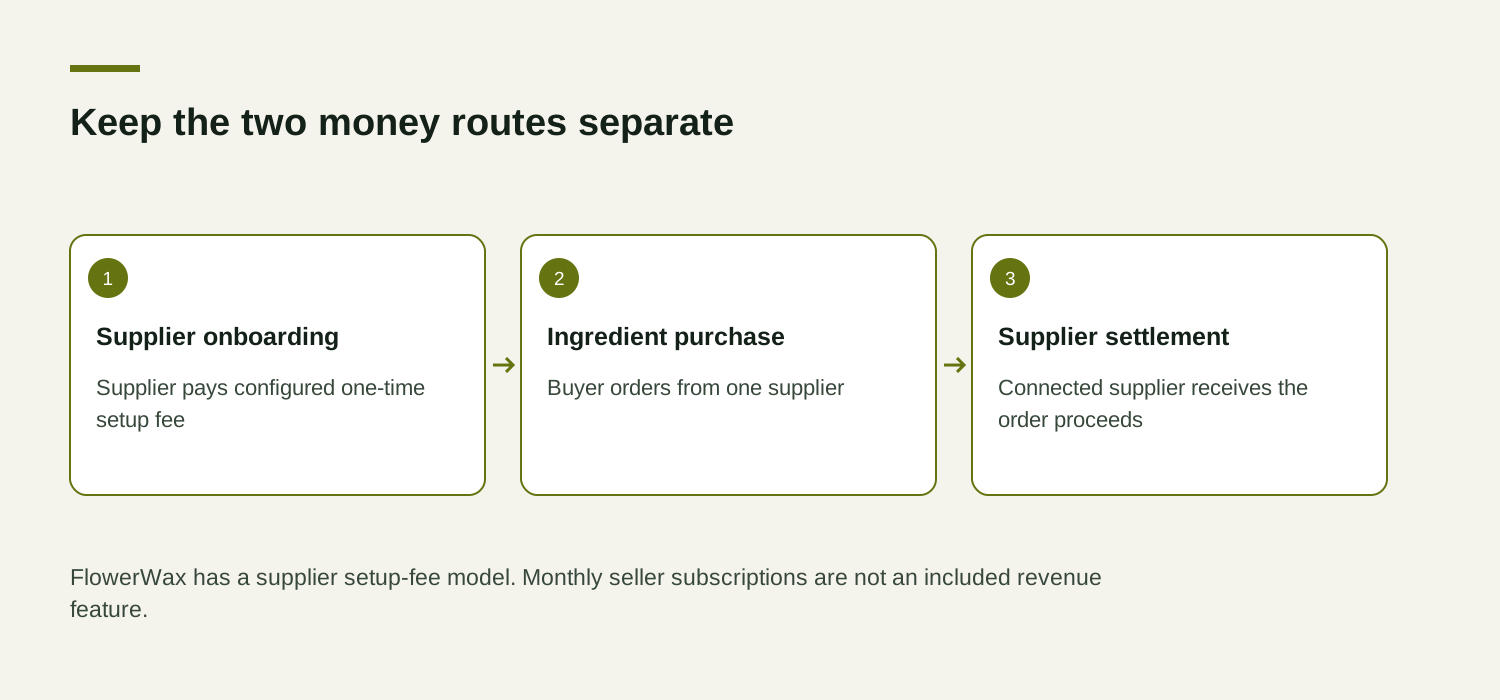
A setup fee produces a different operating pattern from a monthly subscription. You would need to recruit new suppliers to collect new setup fees, unless another charge is implemented and accepted. Recurring supplier plans could become a future product decision, but they should not appear in a buyer's financial model as an existing feature or customer commitment.
Likewise, total ingredient order value is not automatically the platform owner's revenue. Check the actual payment destination and any configured fee. If the platform retains no order commission, a large supplier sale does not create the same amount of platform income. Request a clear explanation rather than relying on a dashboard label such as sales or revenue.
Understand the single-supplier cart boundary
FlowerWax uses a same-supplier shopping cart. A buyer selects products from one supplier for the order. This boundary helps keep the product source, order responsibility and connected payment destination aligned. It is a meaningful part of the purchase scope, especially if your proposed business depends on baskets containing products from several suppliers.
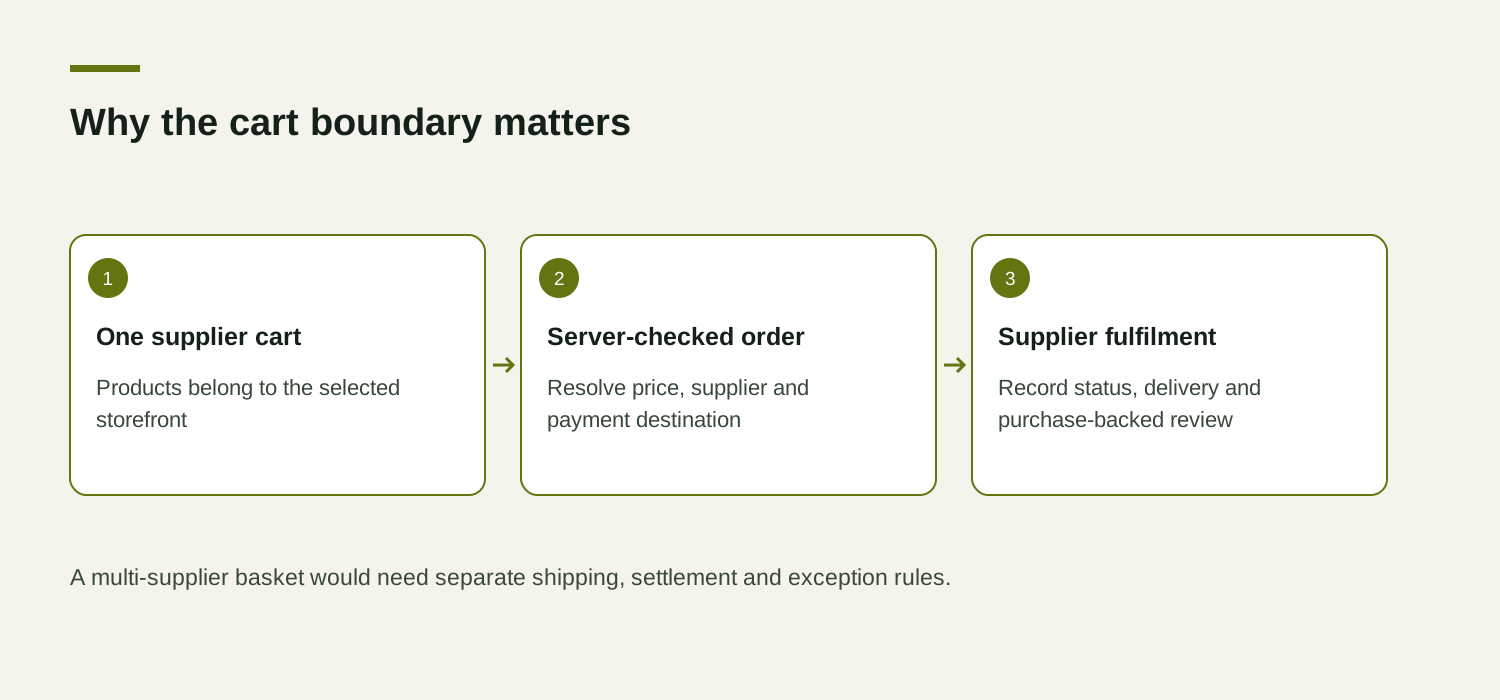
Test the boundary using two demonstration suppliers. Add an item from the first storefront and then choose one from the second. Ask how the application responds and whether the buyer can understand what is happening. The important result is a predictable order rule that matches the product description, rather than an assumed capability based on the number of suppliers in the directory.
If you need a combined basket, specify the change carefully. It may require separate shipping charges, order splits, payment destinations, refunds and supplier notifications. Treat those as connected workflows. Adding a second seller's product to a cart is only the visible surface of the change, so an implementation quote should include the operational behaviour as well.
Check the ingredient information your buyers will require
Botanical ingredients need useful product information. Ask whether the current fields can present the names, quantities, specifications and care or storage information relevant to your chosen catalogue. Build the purchase demonstration around a representative product instead of a generic item with a photograph and a short title.
Separate the ability to display information from the truth of that information. A marketplace can provide a place for a supplier's description; it does not independently establish purity, certification, origin or suitability for a formulation. Decide who reviews supplier claims, what evidence you will request and how a buyer can report a misleading listing.
Some buyers may need documents or information beyond the current product fields. Record each requirement precisely and check whether it is supported, handled manually or part of future development. Avoid representing a product page as a complete compliance workflow without evidence. Your purchase decision should reflect the catalogue and review process you can actually operate.
Inspect supplier control using two accounts
Supplier storefronts are a central reason to buy marketplace software rather than a simple store. Ask a demonstration supplier to change a product title, price, image and publishing state. Confirm how those changes appear publicly and which actions need owner approval. This reveals whether the current product supports the catalogue management process you intend to offer.
Repeat the exercise in a second supplier account. Each should manage its own products and orders. Ask the seller to explain what the platform owner can review and what remains private to a supplier or buyer. Use sample records for the review; private commercial customer data is unnecessary for this acceptance exercise.
Also inspect the supplier's first visit. It should be clear what information is required, how the setup charge works and what payment onboarding means. An empty storefront can be technically created while remaining unusable for trade. Your launch checklist should define the complete supplier state you require before publishing a real catalogue.
| Step | What to observe | What not to assume |
|---|---|---|
| Account creation | Correct role and own storefront access | That signing in completes supplier approval |
| Setup fee | Configured amount, payment result and account state | That a one-time fee creates monthly revenue |
| Catalogue | Product ownership, image handling and publication | That sample products are genuine supplier stock |
| Payment onboarding | Connected account readiness in the chosen environment | That an account identifier proves payout eligibility |
| First order | Correct supplier, amount, order record and status | That the public success page proves final settlement |
Trace a real-shaped order without claiming a real sale
Use a test order with a representative ingredient, pack size and quantity. Follow its price from the catalogue into checkout and the supplier order view. Ask which values the backend confirms and which are supplied by the browser. The documented product includes server-checked prices, signed payment notifications and replay protection; demonstrate the current behaviour rather than relying only on those labels.
Record the order identifier, supplier, amount and payment state. Refresh the buyer page and return through order history. Then inspect the same order from the supplier and owner views. The goal is a connected record that remains understandable after the checkout window has closed. This is more useful than several unrelated screenshots of a dashboard.
Describe the outcome accurately. A test payment shows the workflow under the chosen configuration. It does not prove commercial demand, supplier performance or a history of fulfilled orders. After the buyer's service accounts are ready, repeat the appropriate checks there and retain the evidence as part of the handover acceptance.
Decide how fulfilment and returns will work
Supplier payment routing does not remove fulfilment work. Someone must confirm stock, package the order, arrange dispatch and answer questions about delays or damaged goods. Write down whether those tasks belong to the supplier, platform owner or an external service. The public buying journey should make the relevant responsibility understandable.
Check which order states the application can store and who can change them. A simple status update may be enough for a small launch, while another operator needs tracking links, document attachments or separate dispatch events. Ask to see the current fields. Additional logistics features should be scoped as changes instead of assumed from the existence of an orders page.
Returns and payment reversals also need a process. Define how the buyer contacts the responsible party, how evidence is recorded and who has authority to act. Confirm the payment provider's available operations in the buyer's intended environment. A clear exception procedure is part of operating a marketplace, even if the normal order takes only a few clicks.
Application ownership and handover deliverables
The acquisition should identify the source repository, domain, brand materials and buyer documentation that change hands. Confirm the rights needed to operate and modify the delivered application. Request an inventory of included visual assets and any materials governed by separate terms, then retain that inventory with the purchase agreement.
Operating access matters alongside source ownership. List the hosting, authentication, backend and payment services required for the delivered product. The buyer should create or connect suitable owned accounts, rotate private credentials and verify its administrative access during handover. Keep confidential account material outside the public website and public documentation.
Make payment acceptance a written condition. Trace the supplier setup fee independently from an ingredient order, then verify the relevant supplier destination and application records. Any genuine supplier relationship, completed order history or recurring income represented in a transaction needs separate evidence. The starter software package alone does not establish those commercial assets.
| Included item to confirm | Acceptance record | Separate launch responsibility |
|---|---|---|
| Source and installation guides | Repository access and reproducible deployment | Operate and maintain buyer-owned services |
| Domain and brand material | Agreed transfer and content rights | Publish accurate supplier and ingredient information |
| Marketplace application | Supplier, buyer and owner workflow demonstration | Recruit and approve genuine suppliers |
| Payment foundations | Setup-fee and order tests in the intended environment | Complete account approval and operating policies |
Price the owner workload before setting supplier fees
A one-time setup fee should be evaluated against the work of onboarding and supporting a supplier. List the tasks: checking a profile, reviewing initial products, helping with payment setup, answering catalogue questions and handling corrections. You can then decide whether the fee and the planned operating service fit together.
Do not use an invented supplier-growth forecast to make the purchase look profitable. Prepare a budget with labelled assumptions instead. The number of suppliers you hope to recruit is an acquisition target. The number already paying needs independent evidence. A fee configured in software is a price option, not a customer agreement.
If you intend to add recurring plans, define why suppliers would keep paying. It might be catalogue tools, qualified buyer enquiries or a managed service. Match that promise to available features and operational capacity. Then scope the billing lifecycle, access rules and plan changes that the application would need before describing recurring subscriptions as part of the launched business.
Use a comparison with quote-led sourcing to avoid the wrong purchase
Some ingredient buyers know what they want and can order from a published catalogue. Others need a custom quantity, a specification review or negotiated terms before committing. A direct checkout platform and a sourcing platform serve different points in that purchasing journey. Choose based on your expected orders rather than the broad label wholesale.
FruitKiwi is a useful contrasting model: its documented product focuses on produce discovery, supplier requests, quote comparison and messaging, with produce invoices settled outside the platform. It illustrates a quote-led workflow. FlowerWax's supplier catalogue and checkout model addresses a different transaction. Neither should be presented as the other's implemented feature set.
A buyer could later connect these ideas, but that would be a product change. Explain how a quote becomes an order, who confirms the final price and which system holds the payment obligation. Without those rules, a combined feature list can obscure a broken commercial journey. Keep the initial purchase focused enough to demonstrate end to end.
Make account transfer part of the buying decision
Review the source code, domain, brand materials and the user and technical documentation included in the sale. Identify the hosting, sign-in, backend and payment services required to run the product. The buyer should create or connect suitable owned accounts and rotate private credentials during the agreed transfer process.
Ask for a deployment demonstration in the intended environment. Confirm public pages, supplier access, buyer order history and the private owner area. Record how application configuration reaches the live site and who can change administrative credentials. A repository transfer is useful, but a buyer should also be able to reproduce the running application from the delivered instructions.
FlowerWax's stored sales documentation describes up to thirty days of hands-on technical transfer support. Confirm the current written terms, the support start date and the accepted delivery checks. Keep any additional work separate and specific. A clear list of remaining integration or catalogue tasks is more useful than a general statement that the business is ready for every market.
Ask about catalogue rights and existing relationships
Determine what the buyer is receiving beyond code. Brand assets, demonstration images, product descriptions and sample supplier profiles may be included in the software package, but they do not necessarily represent contracted commercial suppliers. Ask for the rights and provenance of the materials you plan to retain on the public website.
If the sale includes genuine supplier relationships, request their specific scope and transfer arrangements through the agreed transaction process. Do not infer a supplier agreement from a sample storefront or a public logo. The same distinction applies to customer accounts, order history and testimonials. Sample data demonstrates the interface; commercial claims need separate evidence.
Prepare a launch catalogue that you have permission to publish and a process for correcting it. This may involve replacing demonstration records before taking real orders. The work is commercially important because buyer confidence depends on accurate supplier and ingredient information, not merely on a convincing design. Include that preparation in the launch budget.
Resolve pack units and price changes before a catalogue import
A wholesale catalogue may contain several pack sizes for the same ingredient. Write down exactly what a displayed price purchases: one bottle, one bag, a specified weight or a defined case quantity. Then compare that wording with the cart, checkout and supplier order record. Buyers and suppliers should be able to identify the same commercial item at each step.
Ask how the platform handles a price change after an item has been added to the cart. The current order should use an explained price rule and present any change clearly before commitment. A catalogue edit should not silently rewrite a completed order. Test this with sample products and ask the seller to show the stored order details.
If you plan to import a large supplier catalogue, inspect the available import tools and image process first. A storefront with a few demonstration records does not establish a bulk-import workflow. Scope the required fields, validation and correction method, then try a small representative file before committing to a large migration. Manual preparation may be acceptable for a small launch when its cost and owner are clear.
Finally, define who can publish a corrected product and how a buyer sees an important change. Ingredients can require more careful descriptions than a generic retail item. Accurate units, consistent order records and a responsive correction process support the commercial transaction far more directly than adding another promotional section to the homepage.
Documents to request with the wholesale website offer
- Digital asset schedule: source repository, domain, brand files, user guide and technical installation material.
- Supplier fee record: the configured one-time setup charge and its demonstrated account-state behaviour.
- Order acceptance record: one supplier, its cart boundary, checked price, test payment and fulfilment status.
- Content rights inventory: the descriptions and images included in the sale, with demonstration suppliers clearly identified.
- Transfer plan: buyer-owned service accounts, credential rotation, administrative access and agreed support dates.
Interactive platform purchase checklist
Use the checklist during a demonstration and sale-scope review.
Questions buyers commonly need answered
Does the purchase include ingredient stock?
Do not assume so. A marketplace software package and its demonstration catalogue are different from physical inventory. Any included stock, supply contracts, warehouse service or commercial supplier agreement should be itemised in the transaction. FlowerWax's product foundation helps suppliers publish and sell; the buyer still needs a genuine supply and operating plan.
Can I add subscriptions or take a commission?
Those can be future commercial decisions, subject to implementation and the chosen payment arrangement. The documented included owner revenue feature is the one-time supplier setup fee. Request a concrete scope for recurring billing or additional transaction fees, including account states, failed payments and supplier communications, before putting those charges into a public offer.
Is this a suitable purchase for an existing wholesale operator?
It may be relevant when the operator wants an owned supplier-marketplace product and can complete the remaining setup. Compare the current product against your catalogue, supplier structure and order process. If your core requirement is warehouse purchasing, trade credit or manufacturing traceability, demonstrate those requirements separately rather than assuming a marketplace covers them.
What should I review before sending an offer?
Review the current product entry, documentation, seller's transaction terms and the practical acceptance record. The decision should rest on the trade you can run, the software you have seen and the rights you will receive. Use the marketplace card below for the current listing status and continue the purchase through the stated transaction channel.
Compare other Codeblix marketplace businesses if your intended transaction is different. A supplier checkout platform, a produce RFQ tool and a direct grocery store can each serve a clear commercial need. Their business models should remain distinct when you decide what to buy.
Explore the products discussed
Explore related acquisition offers