
Buy a grower marketplace asset for your producer network
Request the distribution business that fits your harvest enquiries, nursery stock or prepared botanical catalogue.
Acquire an individual FruitKiwi, HerJungle or FlowerWax software asset for an existing producer network. Choose the first customer transaction and request its current purchase package.
Buy a digital distribution business around the producer relationships you already have. Request the individual acquisition package for FruitKiwi when your network needs produce sourcing and supplier quotes, HerJungle when growers can offer identified plant stock, or FlowerWax when suppliers have a prepared botanical ingredient catalogue. These are separate software purchases, each with its own current listing and agreed transfer.
A cooperative, grower association or existing supplier group can bring something valuable to an acquisition: people who understand the products and can answer a buyer. The software purchase supplies a platform foundation. Keep those two contributions visible in the offer. The sale does not supply farms, nursery stock, processing facilities or signed producer relationships simply because its preview contains supplier profiles.
Choose the application by the commercial commitment your members can make today. A harvest estimate belongs in a different conversation from an identified plant ready for checkout. A bottled botanical ingredient needs a different catalogue from either. Send Codeblix a purchase request describing that first transaction, then ask for the asset and walkthrough that match it.
Put the producer network into the acquisition mandate
Before requesting a price, describe the network that the proposed owner can actually reach. Separate members who have expressed interest from suppliers who have agreed to publish. Name the person who can approve a product description, answer a sourcing request and correct a stock statement. Those commitments belong to your proposed business, rather than to the software seller.
Your mandate can be short: “We want to acquire a platform for our existing produce supplier group. Buyers need to request current quantities and compare supplier responses. We will remain responsible for supplier participation and the physical trade.” That is a specific acquisition conversation. It gives the seller a customer journey to demonstrate and gives the buyer a clear reason for choosing the product.
If your members instead sell individually identified plants or a stable ingredient catalogue, change the mandate accordingly. The purchase should serve the network's real offer. Avoid selecting an application first and then asking producers to make promises their stock, staffing or supply arrangements cannot support.

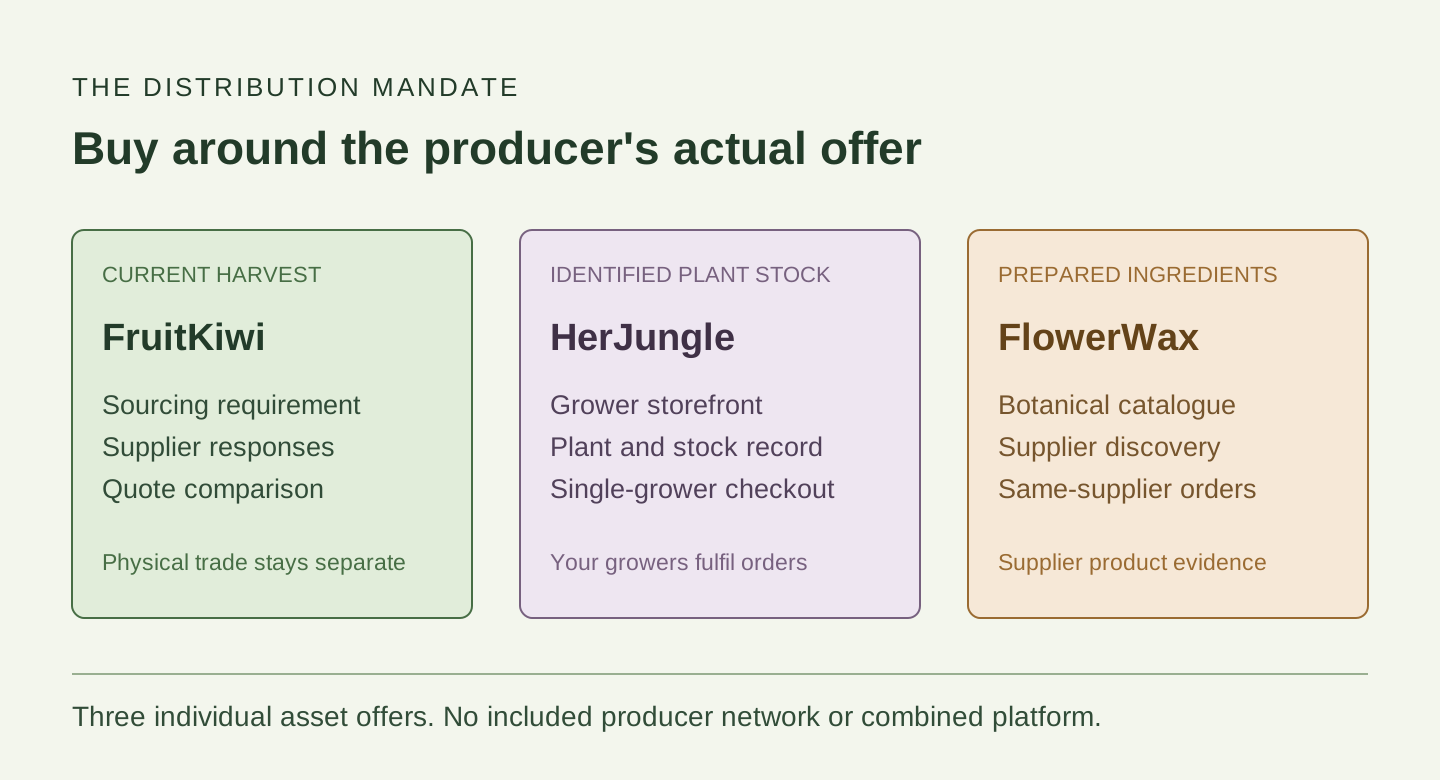
Three distinct distribution purchases for the same network owner
| Your starting position | Asset to request | Customer action being supported | Your separate contribution |
|---|---|---|---|
| Produce suppliers need to answer a buyer's current sourcing requirement | FruitKiwi | Browse suppliers, request quotes and compare responses | Participating suppliers, current commercial offers and the physical trade |
| Growers can publish specific plant listings with controlled stock | HerJungle | Select plants and complete a single-grower checkout | Actual plants, catalogue accuracy and fulfilment arrangements |
| Ingredient suppliers have products prepared for a botanical catalogue | FlowerWax | Discover ingredients and order from the selected supplier | Product information, substantiated specifications and supplier fulfilment |
The three offers share a broad connection to growers, but the customer is doing a different job in each. Request the relevant product rather than treating their source packages as interchangeable. Combining them into one catalogue, identity system or checkout would require a separately agreed project. No combined purchase package is represented here.
Purchase case: a harvest enquiry that needs a current answer
Suppose a buyer asks your supplier group for produce in a particular quantity and delivery period. Several members might be suitable, but their current availability and commercial terms need an answer. Your acquisition mandate is to organize that enquiry and make supplier responses understandable. It is not to promise that the platform owns the harvest.
Request the FruitKiwi software and domain offer. Its documented workflow includes supplier storefronts, multi-supplier requests for quotes, structured quote comparison and messaging. Ask the seller to demonstrate a buyer request and two fictional supplier responses using the fields currently available. Keep any additional specification field you need in a separate development request.
In your purchase scenario, one supplier may have enough stock but require a later delivery window. Another may offer a different quantity. Decide which details the buyer must see before continuing the commercial discussion. The point is to buy a useful sourcing channel for your network's actual negotiations. The software does not replace the suppliers' responsibility to confirm what they can deliver.
Specify the quote decision without buying an imaginary produce exchange
FruitKiwi's supplier software plans and promoted listings are distinct from the produce trade. Produce invoices and produce payments are handled outside the platform. A cooperative considering the acquisition should therefore write two separate promises: the access and visibility supplied by its software business, and the physical supply terms agreed by the trading parties.
Use one sourcing example to decide whether that boundary fits your business. Name the person who checks a supplier's response when availability changes. State when a buyer needs a fresh commercial confirmation. Ask the seller which request and response records are retained, then decide whether the delivered product supports the working arrangement you want to sell.
If your mandate requires the platform to collect payment for the produce, execute an auction, guarantee a commodity price or manage transport, identify that requirement before making an offer. Those capabilities are not established by the current FruitKiwi sourcing description. You can request a development proposal, but assess it separately from the existing asset purchase and its accepted sourcing journey.
Purchase case: a nursery can identify the stock being offered
Consider a nursery group whose members can photograph specific plants, publish their details and maintain the quantity available. The prospective operator wants buyers to purchase from a grower storefront, rather than begin every transaction with a multi-supplier sourcing request. That points toward a different acquisition mandate.
Request HerJungle's rare-plant marketplace package. The documented application includes grower storefronts, plant listings, inventory and single-grower checkout. Ask for a walkthrough using one grower, a clearly identified sample plant and a buyer order. The source and domain are the digital assets under discussion; the nursery group must supply its own real stock and participation agreements.
Write the plant promise precisely. A buyer may care about the listed specimen, size, care information or optional lineage recorded with the listing. Ask what the current catalogue supports and who will verify the information before publication. The operator needs a product record that its growers can keep accurate through the point of purchase, rather than a catalogue created solely for the sale demonstration.
Make the single-grower purchase fit the customer's basket
HerJungle's documented checkout boundary is one grower per order. Build that into the acquisition case. Suppose a collector wants plants from two members of your nursery group. Ask the seller to show what the customer sees when moving between grower storefronts and how the current application explains the order boundary.
Then decide whether separate orders fit your intended business. Your members may already fulfil independently, which could suit that arrangement. If you need one consolidated shipment, shared stock or a combined checkout across growers, describe it as additional scope. A network identity does not make independent nurseries one inventory owner.
The purchase decision should also assign responsibility for a plant sold elsewhere while its listing remains public. Ask for the current stock behaviour, then agree how your members will operate around it. Live inventory synchronization with another nursery system is not assumed. Accept the existing application against the stock routine you can actually maintain, and price any required integration separately.
Purchase case: botanical suppliers have a prepared ingredient catalogue
A group selling botanical ingredients to beauty brands has another starting point. Its suppliers may offer floral waxes, essential oils, botanical butters or carrier oils. The prospective platform owner wants customers to find a prepared product and order from a supplier. The purchase is about ingredient commerce rather than a plant collector's specimen or a fresh-produce sourcing negotiation.
Request the FlowerWax marketplace acquisition. The documented product includes supplier storefronts, ingredient discovery, catalogue management, a same-supplier cart and order foundations. Choose one representative ingredient from your intended supplier group and ask for a seller walkthrough around the information and purchase steps that are currently delivered.
Bring your actual catalogue requirements to that conversation. Determine which specifications can be stored, which documents need separate handling and who substantiates product claims. Software ownership does not establish laboratory results, certification or suitability for a cosmetic formulation. Those belong to the supplier and the real products the future operator allows to be offered.
Agree the owner offer behind the botanical storefront
FlowerWax's documented owner income feature is a configurable one-time supplier setup fee. That matters when deciding what business you are buying. The initial commercial offer can concern setting up supplier storefronts, while ingredient orders have their own supplier payment path. A recurring seller-plan business would require an additional agreed scope.
For your producer group, define what the setup service will include. You might intend to help participating suppliers prepare accurate catalogue material and understand their workspace. Those are proposed services you would provide after acquisition. Do not assume the software seller supplies a staffed onboarding team or a prepared commercial ingredient catalogue as part of the code transfer.
Ask for the current FlowerWax user guide and technical handover document. Use the walkthrough to confirm the delivered scope, then put your supplier service and any further product requirements into the purchase plan as separate responsibilities.
Separate a seasonal product from an enduring platform promise
The application purchase may last longer than a particular crop or catalogue season. Your buyer mandate needs to say which service remains useful when a product is unavailable. A sourcing platform may still connect buyers with alternative suppliers. A plant storefront may need its current stock accurately marked. An ingredient catalogue may need a changed product withdrawn until its supplier confirms the details.
Ask each prospective supplier what it can reliably maintain through those changes. Treat this as your own network planning, not as evidence that the acquired platform comes with committed suppliers. A member's willingness to discuss a launch is different from a signed participation arrangement with clear publishing responsibilities.
Use the seasonal case to narrow the acquisition, rather than adding every possible feature to it. Request the application whose normal customer action remains understandable when availability changes. Record which additional controls are essential for your launch and which can wait. A bounded purchase gives your group a concrete first service to operate.
Give the source of each stock statement a name
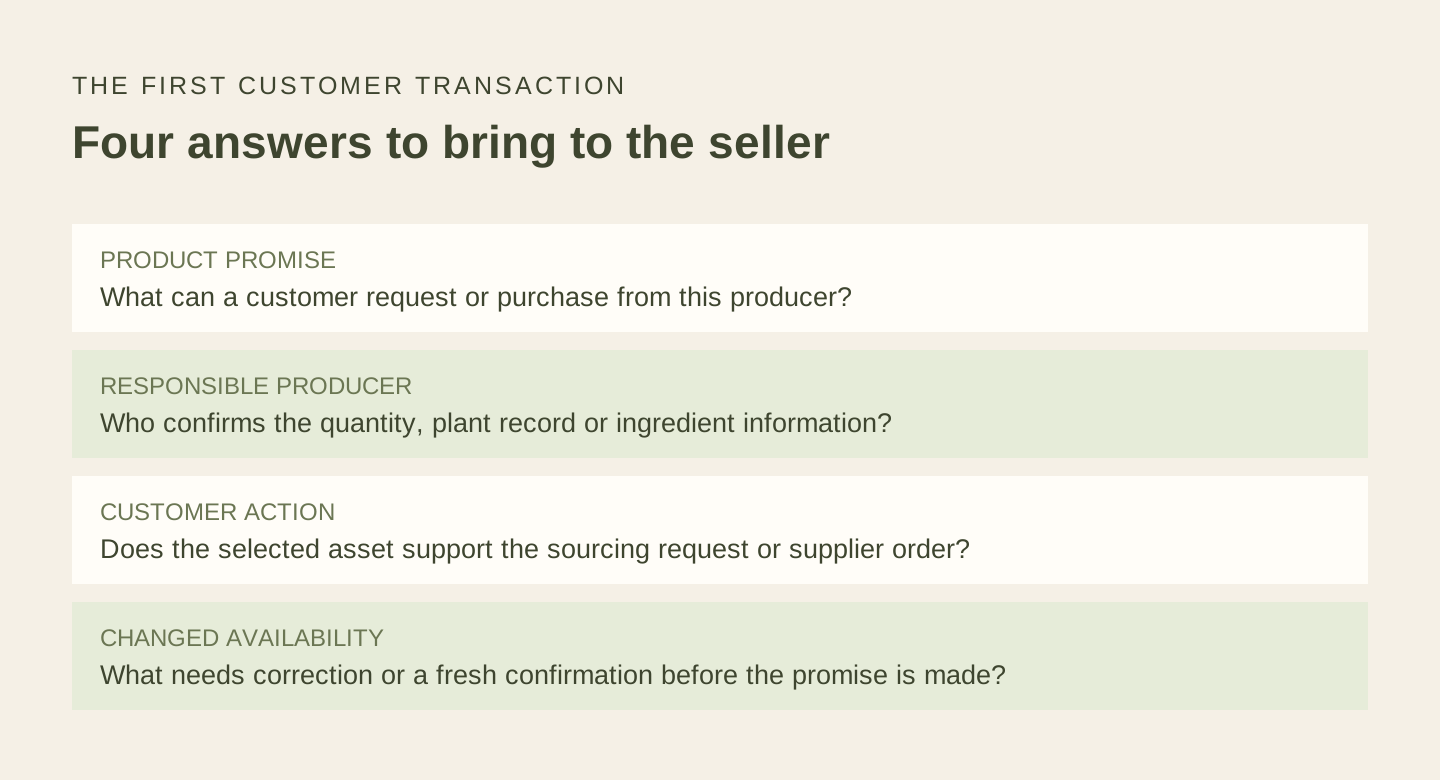
For every product in your worked purchase case, identify the person who can make its commercial statement. One member may publish a listing, while another confirms a harvest quantity. A supplier may have the product description but need a separate person to approve technical documentation. Your network mandate should make these responsibilities visible.
- Name who approves the first public catalogue entry.
- Identify who can confirm a quantity or answer a sourcing request.
- Record who corrects information after availability changes.
- State which party agrees the physical delivery terms with the buyer.
- Assign the operator who handles a question about platform access.
Use this list to assess whether the application fits the organization you intend to run. It does not require every producer to become a technical administrator. It requires the proposed owner to know where the commercial answer comes from. The seller's demonstration can then focus on the roles and records you need to see in the selected product.
Turn your real supplier list into a bounded purchase test
Choose a small fictional sample that resembles your intended network without exposing private member information. A sample produce buyer could request a quantity from two suppliers. A sample collector could select one grower's available plant. A sample beauty brand could examine an ingredient and place a same-supplier order in an agreed test environment.
Keep the test centered on the buying decision. Ask whether the delivered application can express the product promise your group wants to sell, which operator must act next, and what the customer sees when the expected stock or response changes. Record a result that the buyer and seller can both identify.
A new mandatory field, separate approval step or external system connection should become an explicit requirement. The repository purchase gives you a foundation for future work, but the existence of source code cannot stand in for a delivered feature. Decide whether to accept the existing scope or request a priced change before relying on it in the launch offer.
Choose your producer-network purchase brief
Select the closest starting position to reveal a specific acquisition request. The recommendations concern individual assets and their documented workflows. They do not create a combined offer, confirm current price or replace the seller's demonstration.
Send a fictional requirement and ask for supplier responses and quote comparison. State that your group will recruit and support its suppliers, while physical trade terms and produce payments remain outside the documented platform.
Open the FruitKiwi purchase conversationSend a sample plant record and ask for its grower storefront, stock and single-grower checkout. Identify your own growers and fulfilment routine separately from the software transfer.
Open the HerJungle purchase conversationSend a representative ingredient record and ask for supplier discovery and same-supplier ordering. Confirm the one-time supplier setup-fee model and list any additional catalogue requirements.
Open the FlowerWax purchase conversationBring a real route to the first customer conversation
Your network may know the producers well while having much less contact with the people who buy from them. Include both sides in the acquisition mandate. A list of growers supports the supplier side of a marketplace; it does not establish that purchasing teams, plant collectors or beauty brands will use a new channel.
Write down the customer relationship that the proposed operator can genuinely reach. For a sourcing application, that could be an existing produce buyer willing to discuss its normal enquiry. For plant commerce, it could be a nursery's current customer base, with the nursery's permission and an agreed introduction. For ingredients, it could be a supplier's existing business customers. These are possible buyer contributions to establish, rather than relationships included with the application.
Use that relationship to sharpen the purchase demonstration. Ask what information the customer needs before responding and which producer can supply it. Keep private customer lists outside the public sale conversation. A fictional example can show the application requirement without presenting someone else's contact data or implying that a transfer of those relationships has already been agreed.
Approve the offer you intend to make to participating producers
Set out the service your future platform would sell to a participating producer. FruitKiwi supports supplier software plans and promoted visibility; HerJungle supports grower subscriptions; FlowerWax includes a one-time supplier setup-fee model. Those mechanisms describe different offers. Choose one your group can explain and support before treating it as the reason to acquire a particular asset.
For example, your proposed service could include preparing a supplier storefront and helping its owner keep information current. Determine who would perform that work and what the producer would receive. If the intended service includes photography, product verification or a staffed sales desk, budget those separately. They do not arise automatically from buying a storefront application.
Record the proposed charge, the service behind it and the operator who will deliver that service. Then ask the seller to demonstrate the corresponding current account and commercial controls. This connects your producer participation offer with an observable software purchase, while keeping prospective fees separate from verified existing income.
Give the network launch its own spending decision
Separate the asset price from the work your group must fund after purchase. Catalogue preparation, member coordination, hosting, required service accounts, technical support and any accepted changes need their own estimates. Use quotes that match your selected application and the people who will perform the work.
Also decide who pays for the platform's initial operation if supplier participation starts slowly. A proposed subscription or setup price is a commercial offer you will need to sell. It is not money already available to pay the next invoice. Keep the spending approval independent of an unsupported expectation that every member will join immediately.
Your acquisition request can ask for the service requirements and included handover support, while your own purchase committee approves the total commitment. For available asset packages, continue through Codeblix's online businesses for sale. Confirm current terms on each individual listing before committing funds.
Keep the cooperative mandate separate from the seller's transfer
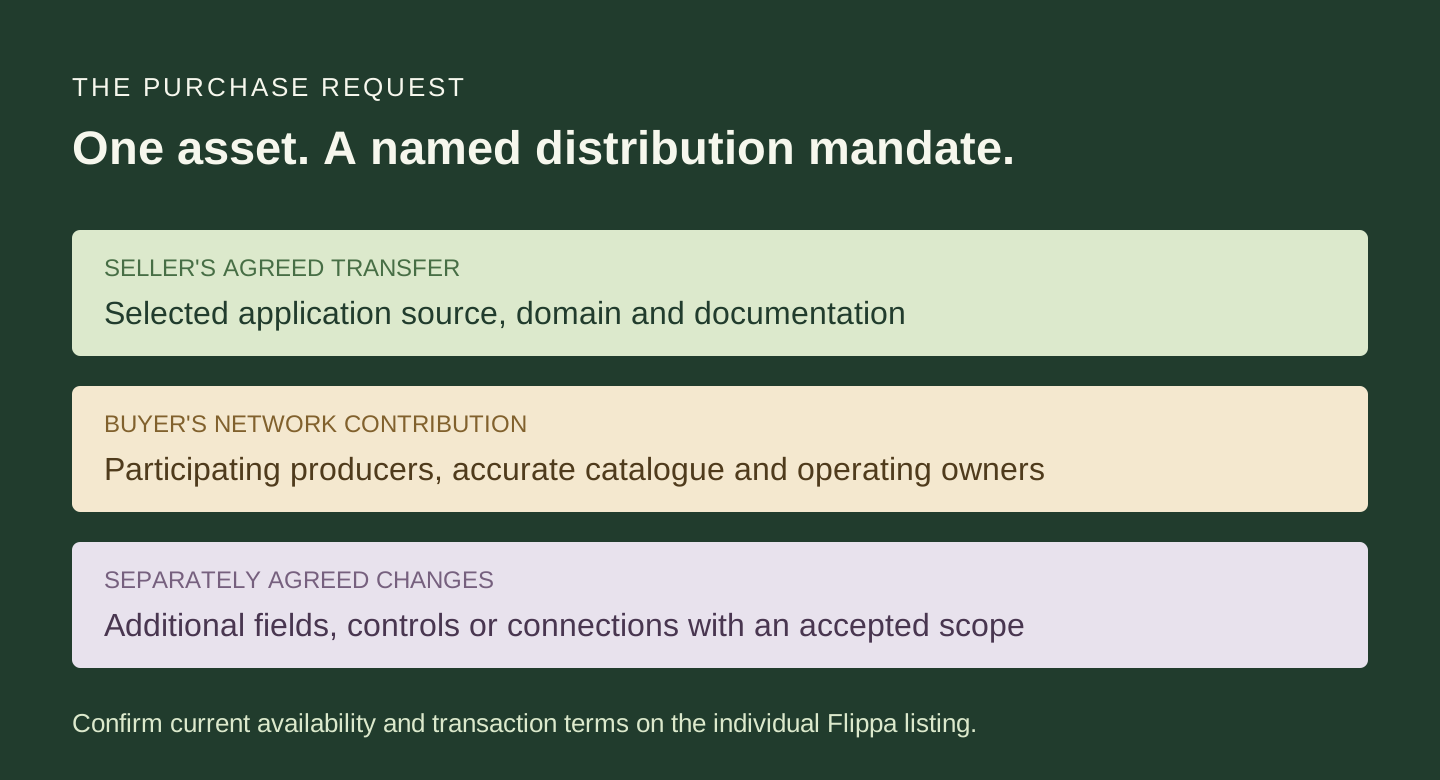
The seller can agree the source, domain, documentation and other specifically included assets. Your own organization needs to approve who will own those assets, which people administer the platform and how participating suppliers will be treated. Record those decisions before the transfer so the delivered package has a responsible recipient.
If different members expect different levels of visibility or access, resolve the commercial arrangement within your group. Do not turn an unfinished internal policy into an assumed application feature. Ask the seller to identify current roles and controls, then request any necessary change in a form that can be demonstrated and accepted.
This distinction helps keep the sale concrete. The agreed software package can transfer against an identifiable release and working acceptance journey. Supplier recruitment, catalogue approval and the group's operating policy can remain named launch tasks with their own owners and dates. Both sides know which work completes the acquisition and which belongs to the new business.
Send a producer-led offer with a clear first transaction
- Choose the sourcing request, plant purchase or ingredient order your network can support.
- Open the corresponding Flippa listing and request current availability, price and included assets.
- Send one fictional product or sourcing case for the seller walkthrough.
- Separate delivered application features from additional catalogue, integration or workflow requests.
- Approve the domain, source, documentation, buyer-owned services and handover terms.
- Assign your own supplier participation, catalogue and customer-support responsibilities.
A strong offer identifies the digital distribution business you are prepared to operate. It explains what your network contributes, what the seller must deliver and what the first customer can actually do. It gives Codeblix a specific purchase brief to answer and gives your group a realistic asset to assess.
Request FruitKiwi for produce sourcing, HerJungle for grower plant commerce or FlowerWax for botanical ingredient commerce. Review the selected asset's documentation and current listing, then agree the purchase around the transaction your own producer network can fulfil.
Explore the products discussed
Explore related acquisition offers